

Spottlight on Resolutions for the New Year
New Year’s is the perfect time of year to reflect on areas where you’d like to see a change in your organization and to take steps to achieve those improvements.

The Tradition of Resolutions
From losing weight to saving more money, from learning to knit to running a marathon, from spending more time with family to quitting smoking . . . the practice of making New Year’s resolutions is a worldwide tradition that’s steeped in history. Four thousand years ago in ancient Babylonia the people held celebrations in honor of the new year. They affirmed their loyalty to their king and made promises to the gods to pay their debts and returned borrowed objects. In return for keeping these promises, the gods would bestow favor on them for the coming year. In ancient Rome, the new year was a symbolic time to look at the previous year and ahead to the future. Friends settled differences and people exchanged gifts like pears or sweets as wishes for a sweet new year. We’d like to wish you a Sweet New Year and invite you to take advantage of our business relationships and enjoy an assortment of treats representing some of our clients.
Click here to request a free Taste of SSM.
Business Resolutions
New Year’s is the perfect time of year to reflect on areas where you’d like to see a change in your organization and to take steps to achieve those improvements. Let’s face it – a resolution looks a lot like a goal. You set an objective, outline a plan, and take action. So why not resolve to make some changes in your organization?
- Think about what you want to achieve.
- Say it out loud.
- Ask for help.
Resolution: Focus on the Core
It takes a lot to make and market a product. It also takes a lot to assure regulatory compliance as well as address needs such as increased capacity, routine maintenance and facility expansion. That's why manufacturers of everything from chocolate to steel turn to SSM when it comes time to secure prime locations, plan more efficient warehouses and distribution centers, conduct feasibility studies, upgrade utilities and building systems, improve traffic flow and expand operations. By taking the lead on the facilities engineering side, we enable manufacturers to focus more on their core business.
Resolution: Stop Wasting Energy
Are you faced with hot spots, cold spots, and a basic mismatch of providing more nominal cooling than necessary? Whether you use underfloor air distribution or “in the space” cooling, getting the air to the load has been a trial and error undertaking usually resulting in oversized cooling capacity and less floor space. The overlooked fundamental issue is air distribution.
We utilize CFD analysis to optimize the cooling system and layout. The data power load and the cooling system are matched and arranged to achieve maximum energy efficiency. This keeps the cost of cooling both in equipment and operation down while maximizing the data load capability. We create a model that replicates the physical data center layout including power densities and cooling equipment locations and capabilities and the analysis is run to determine the resulting temperatures and airflows in the space. Using programs specifically designed for use in analyzing air movement and heat transfer, we can create a virtual simulation of the conditions within the data center. The CFD analysis is a valuable tool for data center design that can save time and money by taking the guess work out of rack layout and cooling airflow design.
Spottlight on Historic Preservation - November 2016
Spottlight on Historic Preservation | Protecting our History for Future Generations
Protecting our History for Future Generations
Historical preservation frames a community's past and defines its heritage. Preservation initiatives have a positive impact on economic growth for a community in the form of higher property values, increased revenue, and job creation. Rehabilitated and renovated historic buildings are core components in revitalized downtowns and cultural venues. From an environmental perspective, renovations and rehabilitation of existing properties results in less construction, demolition, and hazardous material debris. Additionally, the cost of rehabilitation is often less than new construction with the energy savings being considerable since there is no energy used for demolition, new construction or the manufacture of new materials.
Preserving Historical Structures Exploring Technology Applications
High-Definition Laser Surveying(HDS) offers a non-intrusive, non-contact method to obtain three dimensional geometry measurements and models of existing structures and sites for both large and small-scale projects. SSM uses HDS for historic building preservationto acquires as-built information inside and outside of any structure quickly and efficiently.
Heating Historical Structures Exploring Alternative Technologies
From materials to system capabilities, it’s true, ‘they don’t build them like the used to.’ Retrofits, renovations, and adaptive reuse projects present some challenges in terms of the systems in the buildings.
Drone Technology: Capturing the Coordinates from the Air
We know data. Since 1932, information management has been a core component of SSM's services; improving efficiency in operations, decision-making, environmental management, and engineering design. The combination of our intimate knowledge of the industry, our extensive background in information management, and our continuous commitment to leveraging technology to improve operations allows SSM to bring engineering services to life.

SSM at forefront in use of drones
Drone Technology. Pilots Earn Certification: Two members of the SSM Survey team: Chris Snyder, PLSand Steve Smith have received their certification as Drone Pilots.

Lehigh Valley Business Journal
November 15, 2016
It took a while to get off the ground, but flight is might for SSM Group, Inc. of Wyomissing. The engineering firm last December acquired its long-awaited drone, a DJI Inspire 1 Pro model. And just last month, SSM began using the unmanned aircraft unit to benefit its clients. Read the full article
FOR MORE INFORMATION: Steve Smith, PLS

Spottlight on Fire Prevention - October 2016
Spottlight on . . . Fire Prevention
Managing the Risk of Fire: 5 commonplace workplace fire starters
- Flammable and Combustible Materials
- Accidents
- Cooking and Heating Equipment
- ArcFlash Hazards
- Inadequate Housekeeping
Mitigating the Risk Associated with Hazardous Materials
The storage, issue, use, and disposal of flammable and combustible materials falls under the rules and regulations promulgated under OSHA and the National Fire Protection Association.
The Hazard Communication Standard
(29 CFR 1910.1200(g)) was revised in 2012 to require that the chemical manufacturer, distributor, or importer provided Safety Data Sheets (SDSs), formerly MSDSs or Material Safety Data Sheets, for each hazardous chemical to downstream users to communicate information on these hazards. The information contained in the SDS is largely the same as the MSDS, except now the SDSs are required to be presented in a consistent user-friendly, 16-section format.
Fire Protection Critical to Business Continuity
Fire protection systems are essential to the safety of your employees and protection of your property. But more than that, these systems are essential in helping you to manage the risks associated with business continuity. Imagine the impact on your business or organization if a key production line were to go off-line for an extended period of time, if the runoff from a fire event were to cause an environmental impact, or if the assets in your building (from equipment to historical artefacts) were to be destroyed.
Regulatory Update: Preparing for MS4 Regulations
Under the new Municipal Separate Storm Sewer Systems (MS4) regulations that will take effect in 2018, new permittees will need to comply with additional obligations to meet the revised general stormwater permit requirements under PAG-13. Municipal employees, engineers, and contractors can prepare by reviewing the updated Minimum Control Measures (MCMs), and organizing current practices and training to determine possible gaps that fall short of their permit conditions.

2016 Maryland Groundwater Symposium
Tackling Hydrogeologic Complexity

Tackling Complexity through Stochastic Modeling
Yet Another Hydrogeologic Study of the Gettysburg Basin
Tackling Hydrogeologic Complexity
- Intermediate-scale geologic features exert a large influence on the groundwater flow patterns.
- Suspected seasonal reversals of groundwater flow direction complicate the groundwater flow regime mapping.
- Stochastic modeling techniques were employed to frame the unquantified variations inherent within this unique hydrogeologic system.
- Source water protection zones were generated by aggregating thousands of flow simulations that meet observed criterion ranges.
FOR MORE INFORMATION: Al Guiseppe, PG, Director Water Supply and Development

Spottlight - September 2016
Spottlight on Building Safety
Building Safety
Safety in building construction traces to the Code of Hammurabi around 1750 BC, offering rather straightforward dis-incentives of re-work or death. A mere six rules pertained to damages due a builder for his failure to properly construct a home. Building and natural catastrophes like the Great Fire of London (1666), the Great Fire of Chicago (1871), 1906 San Francisco Earthquake, and more recent Hurricane Sandy led to voluminous developments to identify risks, create consistent standards, and changes to reflect new materials and methods.
The International Code Council’s (ICC) 2015 International Building Code contains slightly less than 700 pages; 35 chapters and 13 appendices, with the singular focus of providing a model for minimum acceptable safety standards to protect public health and welfare for every type of building occupancy. Modern codes go one step further and also provided minimum standards for sustainability related to energy consumption. And the IBC is just one of many standards and guidelines we work with in industrial, commercial, municipal projects.
Inadequate Ventilation Design Impacts Air Quality
Since man began using indoor fires for heating, ventilation of indoor air has existed, and still today the primary source of indoor air quality issues result from inadequate ventilation. Contemporary building contaminants, including VOCs and synthetic fibers from building and furnishing materials; microbial, carbon dioxide, carbon monoxide, radon, asbestos, etc. can trigger discomfort, illness, allergic reactions, and temperature and humidity both impact concentrations of certain contaminants. In broad terms, ventilation design involves natural ventilation, mechanical ventilation, or local exhaust.
Electrical Engineering Issues Supporting Building Safety
Opportunities for electrical faults and associated health risks to workers exist throughout industrial, municipal, and institutional facilities, with electrical distribution equipment and large equipment associated with manufacturing, process systems, research, HVAC, and central utility plants. The IBC by reference to the NEC (National Electrical Code) and NFPA (National Fire Protection Association) dictates that an electrical system be evaluated for Arc Flash hazards and that equipment be appropriately labeled according to the protection required.
Hazards associated with electricity is a serious workplace hazard; The Electric Power Research Institute (EPRI) and National Institute for Occupational Safety and Health (NIOSH) have very good videos describing research into arc flash and stories by those affected by incidents.
Maintaining Building Safety While Modifying Footprint and Function
The average building life cycle of non-residential structures extends many, many years. In fact, according to the US Energy Information Administration’s (EIA) 2012 report, Commercial Buildings Energy Consumption Survey, “commercial buildings remain in use for many decades. Although about 12% of commercial buildings (comprising 14% of commercial floor space) were built since 2003, the commercial building stock is still fairly old, with about half of all buildings constructed before 1980; the median age of buildings in 2012 was 32 years.” It’s also true that within a short period of time, buildings become functionally unsuitable, or that facilities constructed for one product or purpose evolves to serve another.
Regulatory Updates:
Tax Code: Section 179-D - Energy-Efficient Commercial Building Deduction
National BIM Guide for Owners Now Available for Public Review

Spottlight - August 2016
Prevent disasters with a proactive approach to water quality. Protect your system with current and comprehensive emergency procedures.Maintain a current Emergency Response Plan to help reduce impacts to your system by unforeseen circumstances, or situations beyond your control.
Six Tips for a Healthy Water or Sewer System
1. Check the Pulse - Through your day-to-day operations of your water/wastewater system, are you keeping your finger on the pulse of your system? One way to do that is to liberate your Geographic Information System (GIS) data through the use of web-enabled mobile applications. Transform your water/wastewater infrastructure data into an easy-to-use operations Asset Management system.
2. Monitor the Pressure - Starting with the first day of pumping, the yield of a groundwater well will slowly begin to decline. The decline in performance is attributed to physical and biological clogging of the well. As water is pumped, fine sediment can be drawn towards the well, plugging the water flow pathways. Biological growth can also develop throughout the well, but especially in the primary water-bearing zones, where the bacteria can effectively reduce the well yield.
3. Protect your Immune System - In the event of an emergency that could impact treatment plant operations, immediate action is often critical in preventing or minimizing the incident. Boost your immunity from disaster by developing a comprehensive emergency response plan (ERP) as required by DEP. Possible emergency situations include a distribution system line break, power outages, drought conditions, disinfection system failure, contamination of supply, pump failure, and prolonged outage.
4. Prevention is the Best Protection - The first step towards prevention is to develop a Source Water Protection Plan. To maintain its usefulness, a Source Water Protection Plan should be updated every five years.
5. Check your Footing - In certain parts of Berks County, the ground can fall out from beneath your feet. What would you do if your utility lines were threatened by a sinkhole? SSM personnel have assisted municipalities, insurance companies, and legal defense teams in settlement instances involving sinkhole and non-sinkhole related damage claims. By observing, evaluating and documenting site specific details, we have often been successful at determining the causes leading to ground failures. Determining these details and causes have often been beneficial to our clientele whereby at times limiting their liability or determining their involvement with remediating sites and damaged infrastructures.
6. Have a Vision - Accurate knowledge of your system asset and infrastructural component locations in your water/wastewater system plays a vital role in healthy operations. Key operational decisions require precise geographic information. Relying on an outdated or incomplete system map will lead to wasted time and potentially costly mistakes. A comprehensive system map will provide the means to effective management. Just as our eyes are the window to the world, your system map is your view to the system as a whole. 20/20 vision of your system requires accurate locational data. Armed with up-to-date and comprehensive infrastructure data, the system can be run with greater efficiency and operational awareness.

Is Your Community Connected?
A greenway, open space and trail network connects people to nature, each other, village and town centers, parks, historic sites, and the other resources found in your community.

A greenway, open space and trail network connects people to nature, each other, village and town centers, parks, historic sites, and the other resources found in your community. It also helps connect us to ourselves by providing opportunities for quiet time and reflection.
Individual health is promoted by providing opportunities for walking, bicycling and jogging; but providing green infrastructure also promotes community health by increasing the quality of life, contributing to economic development, providing an alternative means of transportation, protecting landscapes, and protecting wildlife habitats.
Planning a greenway, open space and trail network provides opportunities for your residents and visitors to stretch their legs, but is also vital to protecting natural resources and can contribute to economic revitalization, and encourage tourism. Such planning can be done as a component of a comprehensive plan or as a stand-alone plan.
A greenway is a corridor of open space, and can take the form of a conservation greenway, recreational greenway, riparian buffer, landscape corridor, or greenbelt around a developed area. Ideally, there will be a continuous system of greenways planned throughout the community.
The network plan itself includes an inventory of existing resources, a vision, mapping of the network and destinations, and an action program to realize the vision. The action program is critical to implementing the plan, and typically includes recommendations for zoning and subdivision and land development ordinance amendments to protect open space and facilitate completion of the trail system, official mapping of target open areas, recreational facilities, and trails, and other greenway preservation and trail construction strategies.
SSM can help you keep your community connected.

For an Energetic and Strong Community: Let SSM be your Personal Trainer
Let SSM be your personal trainer. Take advantage of our experience to build a strong and healthy community park system.
Let us be your personal trainer. Take advantage of our experience to build a strong and healthy community park system.
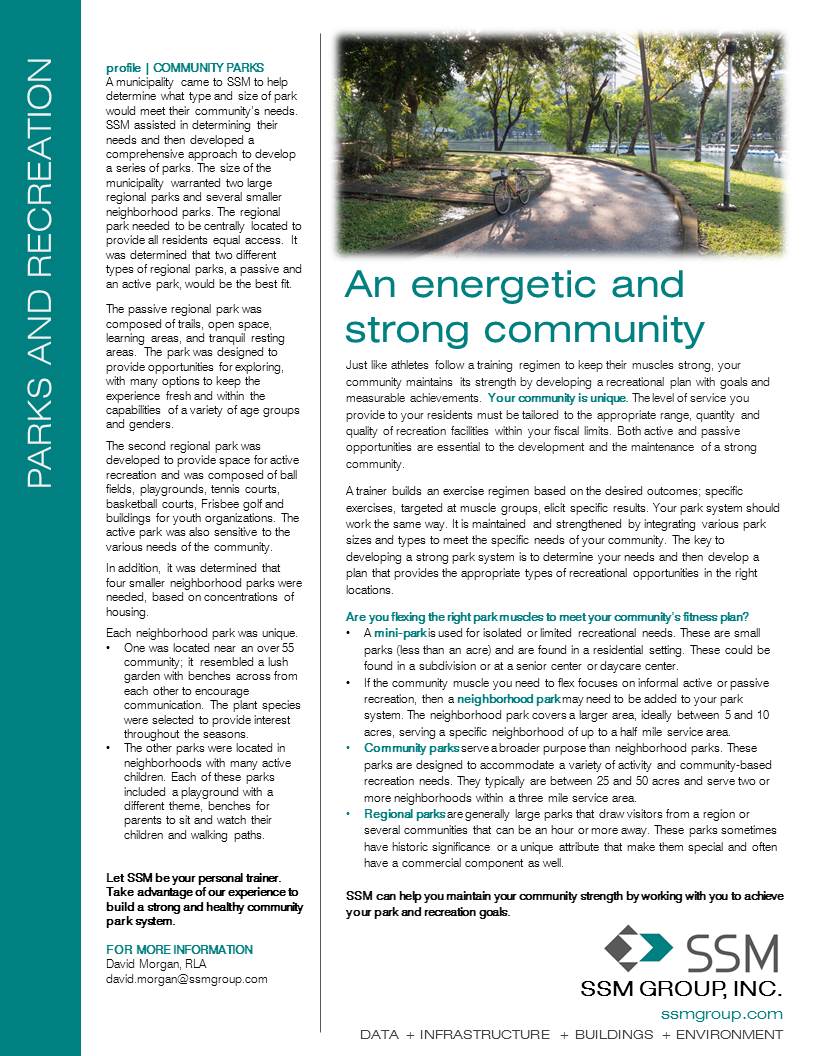
Just like athletes follow a training regimen to keep their muscles strong, your community maintains its strength by developing a recreational plan with goals and measurable achievements. Your community is unique. The level of service you provide to your residents must be tailored to the appropriate range, quantity and quality of recreation facilities within your fiscal limits. Both active and passive opportunities are essential to the development and the maintenance of a strong community.
A trainer builds an exercise regimen based on the desired outcomes; specific exercises, targeted at muscle groups, elicit specific results. Your park system should work the same way. It is maintained and strengthened by integrating various park sizes and types to meet the specific needs of your community. The key to developing a strong park system is to determine your needs and then develop a plan that provides the appropriate types of recreational opportunities in the right locations.
Are you flexing the right park muscles to meet your community’s fitness plan?
- A mini-park is used for isolated or limited recreational needs. These are small parks (less than an acre) and are found in a residential setting. These could be found in a subdivision or at a senior center or daycare center.
- If the community muscle you need to flex focuses on informal active or passive recreation, then a neighborhood park may need to be added to your park system. The neighborhood park covers a larger area, ideally between 5 and 10 acres, serving a specific neighborhood of up to a half mile service area.
- Community parks serve a broader purpose than neighborhood parks. These parks are designed to accommodate a variety of activity and community-based recreation needs. They typically are between 25 and 50 acres and serve two or more neighborhoods within a three mile service area.
- Regional parks are generally large parks that draw visitors from a region or several communities that can be an hour or more away. These parks sometimes have historic significance or a unique attribute that make them special and often have a commercial component as well.
SSM can help you maintain your community strength by working with you to achieve your park and recreation goals.

Source Water Plan Updates
If your source water protection plan was developed four or more years ago, new tools and technology can improve your plan and make a positive impact on source water protection.

Over the last 10 years, many community water systems participated in various source water protection programs offered by the PA Department of Environmental Protection.
These programs provided free technical assistance for a rigorous delineation of multiple water sources, identification of potential sources of contamination, and the development of a professional plan to address water quality issues. As these plans become older, many aspects of the plan become outdated or not applicable to current practices. If your plan was developed four or more years ago, new tools and technology can improve your plan and make a positive impact on source water protection.
SSM offers a menu of services that keeps your Source Water Protection Plan relevant to your system’s present needs. By using technology advances such as improved Geographic Information Systems (GIS) capability and new publicly-available information, your plan can be on the cutting edge of protection strategies.
- Enhanced groundwater and surface water computer modeling. Is there a particular concern in your area? SSM can use your plan delineation to model flow from a particular operation, or use a more rigorous computer model to track specific contaminants to your water sources.
- Review and update potential sources of contamination (PSOC) inventory. PSOCs can change quickly. Using updated databases, we will help you identify and analyze important changes in PSOCs that may affect your water sources.
- Resource extraction mapping for oil & gas wells and mining areas. SSM can research unconventional well development in your area for the best protection of your groundwater sources.
- Land-use analysis. Current sources of information can help map existing non-point source activities in your protection zones, such as residential, agriculture, and industrial areas.
- Review and add management options that update your system’s strategies for protecting your water sources. Management strategies should be evaluated regularly to ensure they are effective in protecting your water sources.
- Reinvigorate your steering committee. SSM can assist with organizing and conducting strategy meetings that brings new ideas and partners together to improve your plan.
- Contingency planning. After the January 2014 contamination incident in the Elk River and other events , Disaster Planning is the new hot topic. SSM staff can help develop partnerships with emergency responders and early warning networks through training and GIS assistance.
- Update your plan components. SSM can write an addendum to your existing plan, bringing all of your priorities and updates together in one, concise report.
The Source - Spring 2016
regulatory and legislative updates, best practices, and new technologies for source water protection
regulatory and legislative updates, best practices, and new technologies.
What's Inside this Issue
- Hydrogeologic Study Requires Robust Computer Modeling
- Stormwater Modeling Software
- Lower Allegheny Regional Partnership Stakeholders Meeting

Daniel R. Connolly, PE Joins SSM Group
Daniel R. Connolly, PE joins the firm as Senior Water and Wastewater Engineer.

SSM welcomes Daniel R. Connolly, PE as a Senior Water and Wastewater Engineer in the Water and Wastewater Engineering Department. Mr. Connolly will direct the firm’s water, wastewater and industrial process engineering and design efforts and will provide overall quality control/quality assurance oversight on all project initiatives. He has more than 25 years in the water and wastewater industry, serving a multitude of municipal clients on a wide variety of challenging and multi-faceted projects including both upgrades to existing systems and new facilities. His design experience includes process and engineering calculations, review of process equipment alternatives, selection of equipment and materials, preparation of sketches and schematics, process control concepts and instrumentation, development of specifications, coordination of work with other disciplines, preparation of construction cost estimates, and preparation of permitting applications to regulatory agencies. Bid and Construction phase experience includes response to bidder questions, review of bids, preparation of bid tabulation, review of submittals, response to contractor field questions, and construction progress meetings.
SSM Group, Inc. serves government, education, healthcare, industrial, and commercial clients in Pennsylvania, across the United States and in the Caribbean. SSM offers extraordinary experience in the planning, design, and construction management of wastewater and water systems, piping systems, pumping stations, and treatment plants. We offer solutions for tomorrow through far-sighted water and sewer infrastructure and environmental planning.

Carl D. Kline, Jr., LO Joins SSM Group
Carl D. Kline, Jr., LO joins the staff as a Senior Operations Specialist in the Water and Wastewater Engineering Services Department.

SSM welcomes Carl D. Kline, Jr., LO as Senior Operations Specialist in the Water and Wastewater Engineering Services group.
Mr. Kline will lead the firm’s water, wastewater and industrial treatment plant operations support efforts and will provide new equipment startup, process startup and training on all treatment plant related project initiatives. In addition, his responsibilities will include maintaining client contact and providing ongoing operational support services, advice, training, and troubleshooting, as may be required to assist client operations staff in maintaining treatment process efficiency, effectiveness and DEP compliance.
He has more than 40 years of experience in all aspects of water, wastewater, and public works. That experience includes responsible management of contracts, budgets, and personnel and associated operations, maintenance and safety programs. He has developed and maintains excellent relationships with clients, as well as federal, state, county, and local officials in Pennsylvania, Maryland, and Delaware.
SSM Group, Inc. serves government, education, healthcare, industrial, and commercial clients in Pennsylvania, across the United States and in the Caribbean. SSM offers extraordinary experience in the planning, design, and construction management of wastewater and water systems, piping systems, pumping stations, and treatment plants. We offer solutions for tomorrow through far-sighted water and sewer infrastructure and environmental planning.

Building Safety Month
A three-part series exploring engineering and environmental issues supporting Building Safety. Topics include Electrical Safety, Poor Ventilation: Impact and Solutions, and Crane Structural Safety.
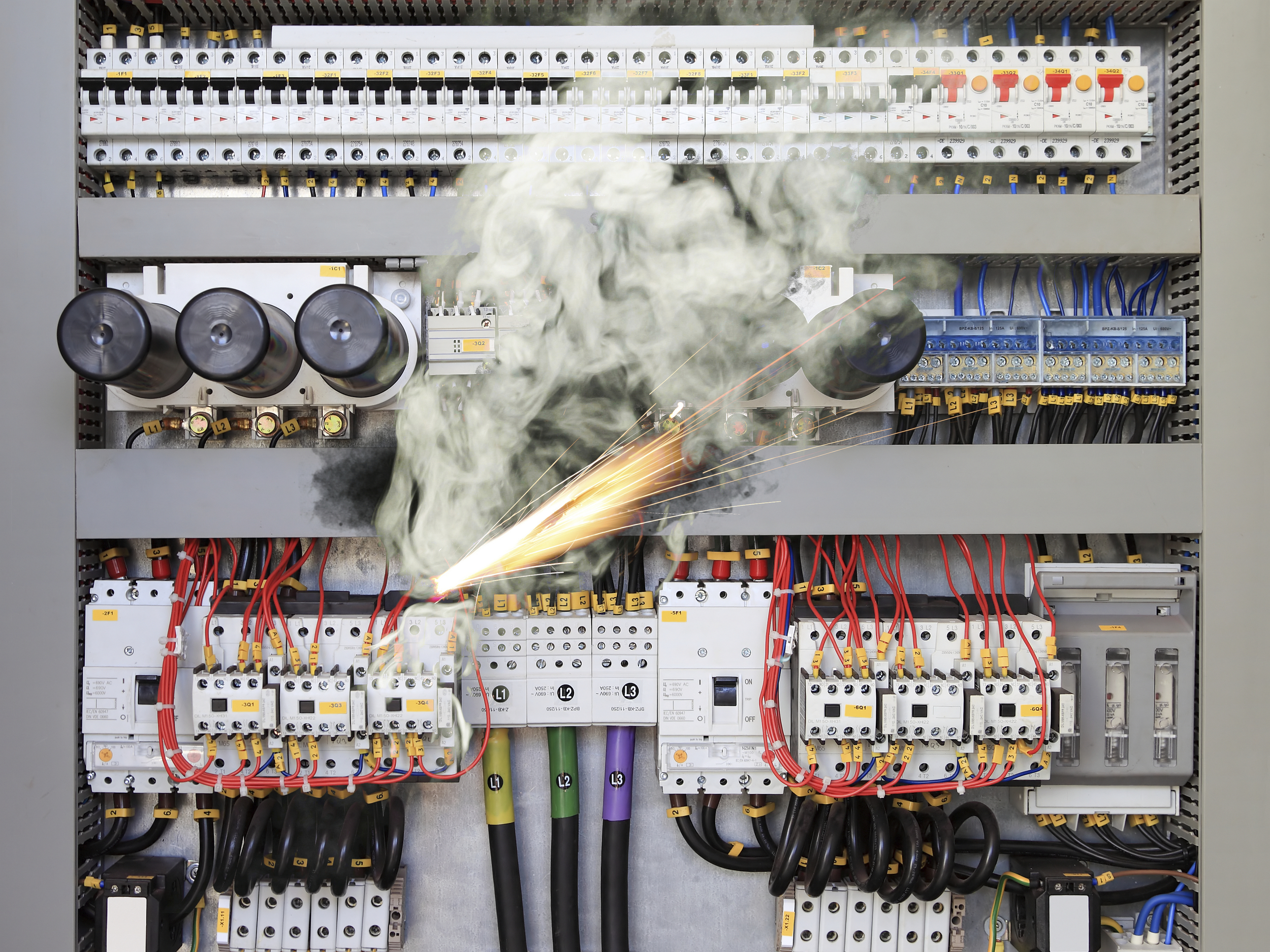
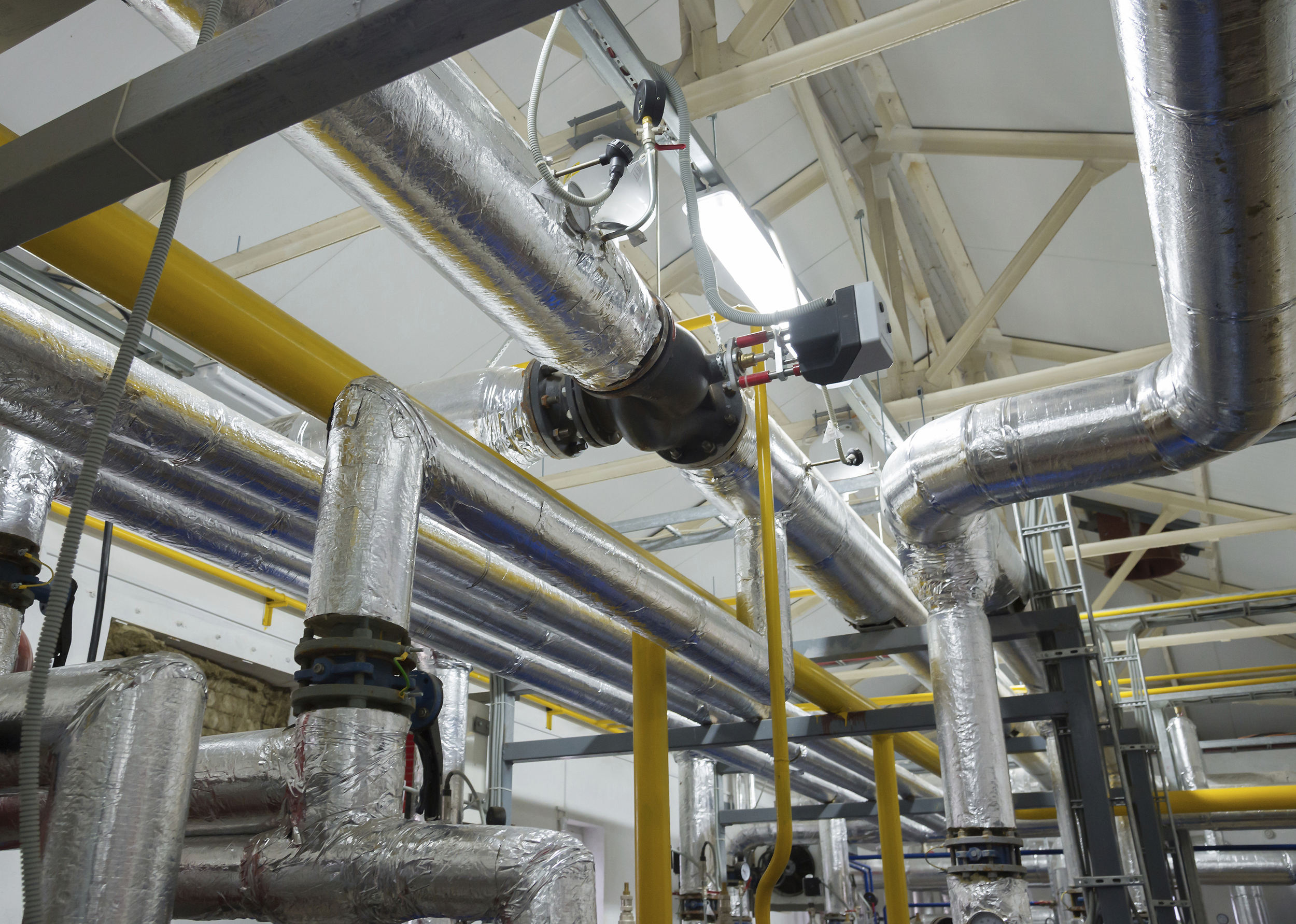
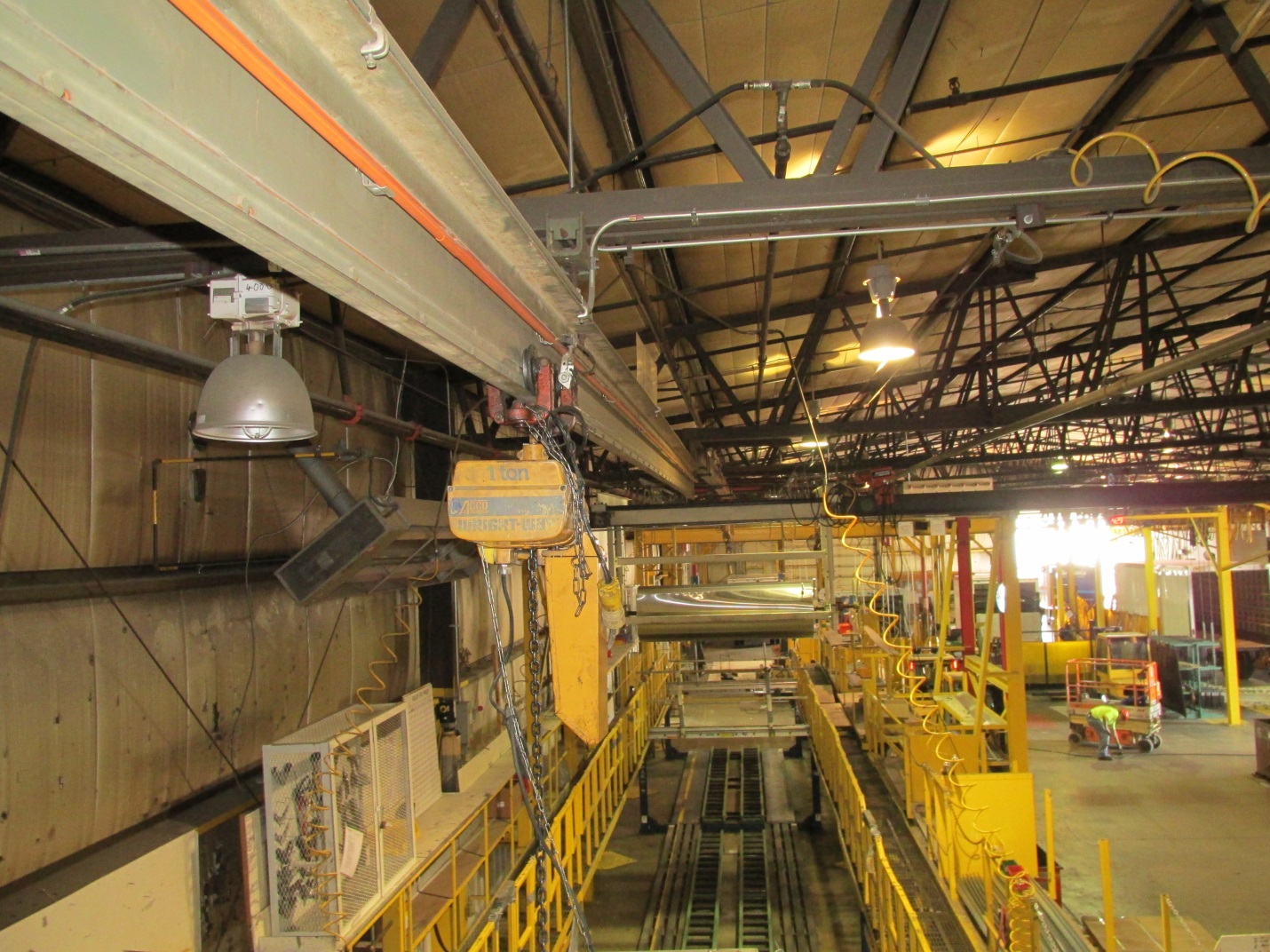
A three-part series exploring engineering and environmental issues supporting Building Safety. Topics include Electrical Safety, Poor Ventilation: Impact and Solutions, and Crane Structural Safety.
Building Safety
Safety in building construction traces to the Code of Hammurabi around 1750 BC, offering rather straightforward dis-incentives of re-work or death. A mere six rules pertained to damages due a builder for his failure to properly construct a home. Building and natural catastrophes like the Great Fire of London (1666), the Great Fire of Chicago (1871), 1906 San Francisco Earthquake, and more recent Hurricane Sandy led to voluminous developments to identify risks, create consistent standards, and changes to reflect new materials and methods.
The International Code Council’s (ICC) 2015 International Building Code contains slightly less than 700 pages; 35 chapters and 13 appendices, with the singular focus of providing a model for minimum acceptable safety standards to protect public health and welfare for every type of building occupancy. Modern codes go one step further and also provided minimum standards for sustainability related to energy consumption. And the IBC is just one of many standards and guidelines we work with in industrial, commercial, municipal projects.
Part 1: Electrical Safety
Opportunities for electrical faults and associated health risks to workers exist throughout industrial, municipal, and institutional facilities, with electrical distribution equipment and large equipment associated with manufacturing, process systems, research, HVAC, and central utility plants. The IBC by reference to the NEC (National Electrical Code) and NFPA (National Fire Protection Association) dictates that an electrical system be evaluated for Arc Flash hazards and that equipment be appropriately labeled according to the protection required. Hazards associated with electricity is a serious workplace hazard; The Electric Power Research Institute (EPRI http://www.epri.com/Pages/Default.aspx ) and National Institute for Occupational Safety and Health (NIOSH http://www.cdc.gov/niosh/) have very good videos (https://www.youtube.com/watch?v=fZP47mlELSc and https://www.youtube.com/watch?v=-RkbMdaeq0o ) describing research into arc flash and stories by those affected by incidents.
Consider your building. Have you completed an ArcFlash Hazard Analysis for the facility? Do you have a defined electrical safety program and proper training and PPE for your employees? Does your electrical equipment have warning labels that comply with NFPA 70E, OSHA, or ANSI Z 535?
We can help. SSM supports numerous clients by performing comprehensive electrical distribution and equipment assessments; conducting short circuit analysis, time current coordination studies and identifying Hazards.
FOR MORE INFORMATION: Emerick Martin, PE, Senior Electrical Engineer
Part 2: Ventilation Design
Since man began using indoor fires for heating, ventilation of indoor air has existed, and still today the primary source of indoor air quality issues result from inadequate ventilation. Contemporary building contaminants, including VOC’s and synthetic fibers from building and furnishing materials; microbials, carbon dioxide, carbon monoxide, radon, asbestos, etc. can trigger discomfort, illness, allergic reactions, and temperature and humidity both impact concentrations of certain contaminants. In broad terms, ventilation design involves natural ventilation, mechanical ventilation, or local exhaust.
Well designed and maintained HVAC systems provide thermal comfort while using outdoor air to ventilate, dilute, isolate, and exhaust odors and contaminants. The ICC, through The International Building Code (IBC), by reference to ASHRAE 55-2010, Thermal Environmental Conditions for Human Occupancy and; 62.1-2010, Ventilation for Acceptable Indoor Air Quality dictates comfort (temperature, humidity, air movement) and ventilation parameters. Comfort and ventilation standards have significantly evolved since the very early part of the 20th century when the first standards for thermal comfort and ventilation became requirements, to reflect changing patterns in building space use, outdoor pollutants, complex variety of chemicals and components in building and furnishing materials, energy conservation goals, to name a few.
Building Standards will continue to transform especially in regards to ventilation, to resolve the seemingly disparate design goals for more ventilation and lower energy consumption. Particularly interesting developments for design integration of energy simulation and CFD (computational fluid dynamics) in the design process, and occupant-specific, dynamic systems, are promising.
FOR MORE INFORMATION: Bruce Bell, PE, Senior Technical Director, Mechanical and Plumbing Engineering
Part 3: Structural Alterations and Additions
The average building life cycle of non-residential structures extends many, many years. In fact, according to the US Energy Information Administration’s (EIA) 2012 report, Commercial Buildings Energy Consumption Survey, “commercial buildings remain in use for many decades. Although about 12% of commercial buildings (comprising 14% of commercial floorspace) were built since 2003, the commercial building stock is still fairly old, with about half of all buildings constructed before 1980; the median age of buildings in 2012 was 32 years.” It’s also true that within a short period of time, buildings become functionally unsuitable, or that facilities constructed for one product or purpose evolves to serve another.
So, distinct from normal operations and maintenance activities, continuous investment in research and development, production and logistics requires that alterations, additions, reuse, reallocation of space be permitted to comply with building safety standards, including structural codes. Like the applicable zoning, electrical, mechanical, plumbing codes, the structural codes are also updated to reflect new or better understood threats to building safety. For instance, it is important that new equipment installation for research or manufacturing tools be evaluated for foundation or floor structural capacity. Similarly, a comprehensive building structural analysis may be necessary with the installation of new overhead cranes or conveying equipment installation where there exists multiple generations of similar equipment; it’s not atypical to discover that over time and staff turnover, historical knowledge of the building changes are lost.
FOR MORE INFORMATION: Patrick McCoy, PE

2016 PA Groundwater Symposium
Tackling Complexity through Stochastic Modeling

Tackling Complexity through Stochastic Modeling
A Hydrogeologic Study of the Gettysburg Basin
Tackling Hydrogeologic Complexity
Intermediate-scale geologic features exert a large influence on the groundwater flow patterns.
Suspected seasonal reversals of groundwater flow direction complicate the groundwater flow regime mapping.
Stochastic modeling techniques were employed to frame the unquantified variations inherent within this unique hydrogeologic system.
Source water protection zones were generated by aggregating thousands of flow simulations that meet observed criterion ranges.
FOR MORE INFORMATION:
Alfred Guiseppe, PG, Director Water Supply and Development
DOWNLOAD PRESENTATION HANDOUTS
2016 PA Groundwater Symposium: In celebration of National Drinking Water Week, Penn State Extension and the Pennsylvania Department of Environmental Protection along with numerous other sponsors presented the 2016 Pennsylvania Groundwater Symposium at the Ramada Inn Conference Center in State College, PA The Symposium theme, The Changing Climate of Groundwater, provided a forum for researchers, students, professionals and educators working in the groundwater field to exchange information and promote protection of groundwater resources throughout the state.
The Source
Source Water Protection: regulatory and legislative updates | best practices | new technologies
Source Water Protection
- Regulatory and Legislative Updates
- Best Practices
- New Technologies

ARC FLASH HAZARD ANALYSIS
The Arc Flash Hazard Analysis identifies the levels of incident energy throughout the system.The Arc Flash Hazard Analysis identifies the levels of incident energy throughout the system.

The Arc Flash Hazard Analysis identifies the levels of incident energy throughout the system.
An arc flash is the result of a rapid release of energy (light and heat) due to an arcing fault between electrical conductor(s) and another electrical conductor(s) or ground with enough electrical energy to cause damage or fire, and injury. During an arc fault air becomes the conductor. A massive amount of energy discharges during the arc flash or blast. This energy burns the conductors, vaporizing the copper and thus causing an explosive volumetric increase, the arc blast. This explosion propels deadly shrapnel and molten metal as it dissipates. This rapid release of energy can cause debilitating burns, other injuries and even death. Without an Arc-Flash Hazard Analysis, employers cannot properly protect their personnel from arc-flash.
Elements of the Hazard Analysis
- Short Circuit Study- The short circuit study calculates the maximum short circuit current the electrical power system may be subjected to at each equipment location through out the distribution network from the sources such as utilities, generators, and motors. The equipment includes substations, switchgear, motor control centers, and panels with their respective over current protective devices; generators; transforms; motors; and UPS equipment. The short circuit results determine the required ratings for electrical equipmen6t to adequately sustain the fault current capacity of the system. If a short circuit occurs, the electrical power system’s available energy is directed to the point of the fault in amounts that greatly exceed the normal operating currents, and the equipment must have the ability tow withstand and interrupt these large currents until the protective device opens to clear the faulted portion of the circuit.
- Protective Device Evaluation - The protective device evaluation study determines if the equipment ratings needed to sustain the fault currents calculated by the Short Circuit Study are adequate. Each circuit breaker, bus, etc., is reviewed in regards to the available short circuit to determine that the equipment can adequately withstand the fault current.
- The Protective Device Time Current Coordination - The protective device time current coordination study reviews the relay and circuit breaker trip settings, fuses, and their operating time and current characteristics in order to properly coordinate these settings with upstream and downstream devices so that any faults are isolated to the location of the fault; hence, limiting the impact to the remaining portions of the system. The coordination study is used in an Arc Flash study to determine the length of time an arc would occur which is directly related to the incident energy associated with an arc flash event.
What the Analysis Reveals
The Hazard Analysis will identify the locations which require PPE greater than Category 0. The review determines if there are possible arc flash mitigation recommendations that can be implemented to reduce the incident energy levels. Such recommendations might include device setting changes, replacement of molded case type circuit breakers with static trip type circuit breakers, changing fuse types, or installation of additional fused disconnects or circuit breakers. As a result of reducing the incident energy levels the corresponding Category of PPE required to work on the equipment while energized is reduced.
FOR MORE INFORMATION: Emerick Martin, PE, Senior Electrical Engineer

Sinkholes and Why They Matter
Sinkholes can be dangerous in many ways. They can cause damage to the foundation of a building, they serve as conduits for surficial contaminants to reach groundwater, and they can cause damage to buried services like water lines and electrical conduits according to Conserve Energy Future. Knowing the risk of sinkhole formation is key to minimizing possible damages.

Sinkholes can be dangerous in many ways.

MEASURING SINKHOLE POTENTIAL RISK
Karst is defined as “a terrain, generally underlain by limestone, in which the topography is chiefly formed by the dissolving of rock, and which is commonly characterized by Karren, closed depressions, subterranean drainage, and caves” by the Geological Survey Water-Supply Paper 1899. Each component listed above (Karren, closed depressions, subterranean drainage, and caves) are considered karst features, but most importantly, sinkholes are considered karst features.
Sinkholes can be dangerous in many ways. They can cause damage to the foundation of a building, they serve as conduits for surficial contaminants to reach groundwater, and they can cause damage to buried services like water lines and electrical conduits according to Conserve Energy Future. Knowing the risk of sinkhole formation is key to minimizing possible damages.
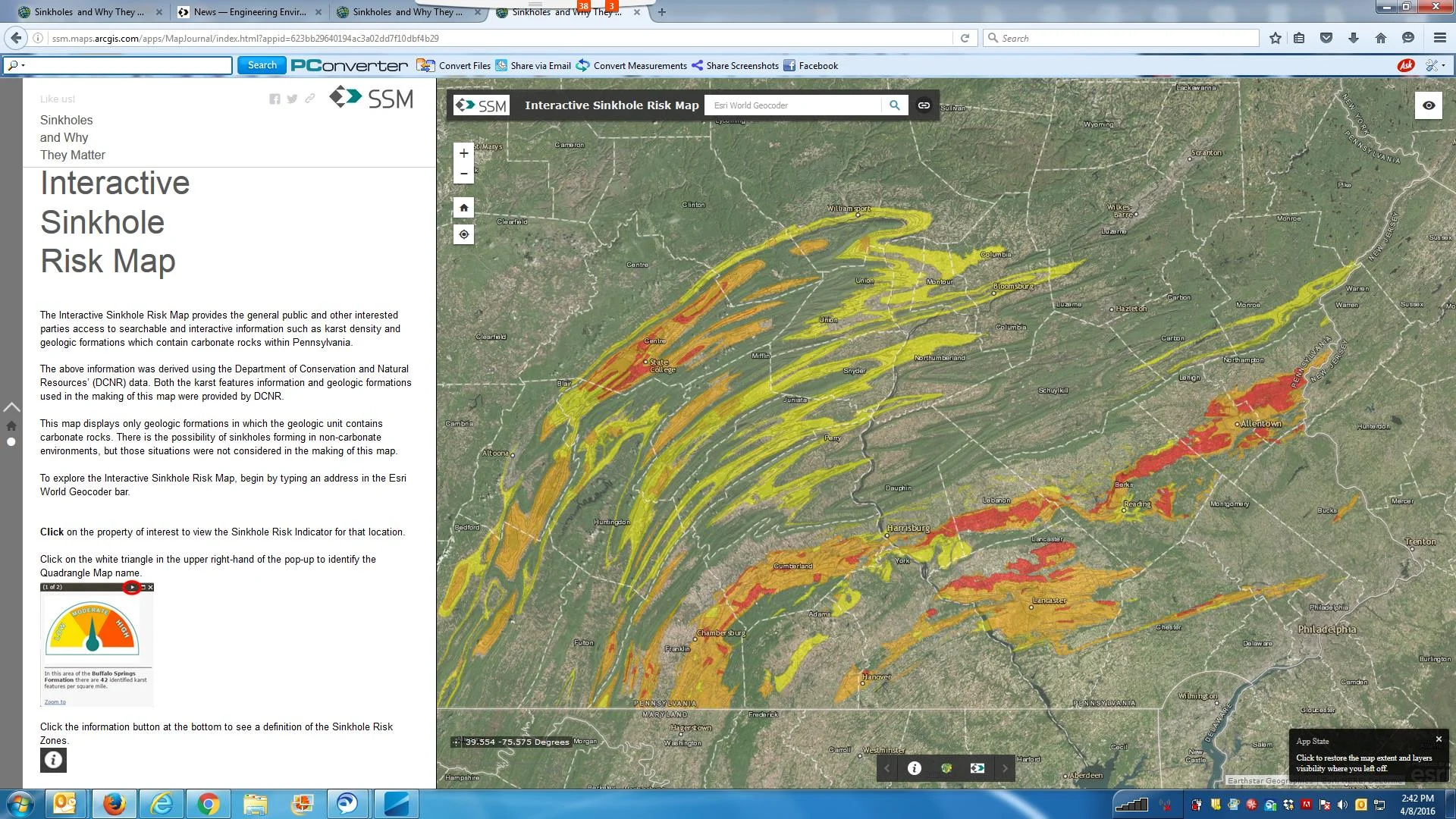
Since the amount of karst features in an area can be related to the occurrence of sinkholes, an interactive sinkhole risk map was created using the density of karst features within a geologic formation.
Interactive Sinkhole Risk Map
The Interactive Sinkhole Risk Map provides access to searchable and interactive information such as karst density and geologic formations which contain carbonate rocks within Pennsylvania. The map displays only geologic formations in which the geologic unit contains carbonate rocks. There is the possibility of sinkholes forming in non-carbonate environments, but those situations were not considered in the making of this map. Explore the Interactive Sinkhole Risk Map to view the Sinkhole Risk for any location.
If a sinkhole evaluation of a location is desired, SSM Group, Inc. has multiple professionals on staff with years of experience in sinkhole risk evaluations. Feel free to contact SSM Group, Inc. to learn more.

PEDA 2016 Spring Legislative Conference
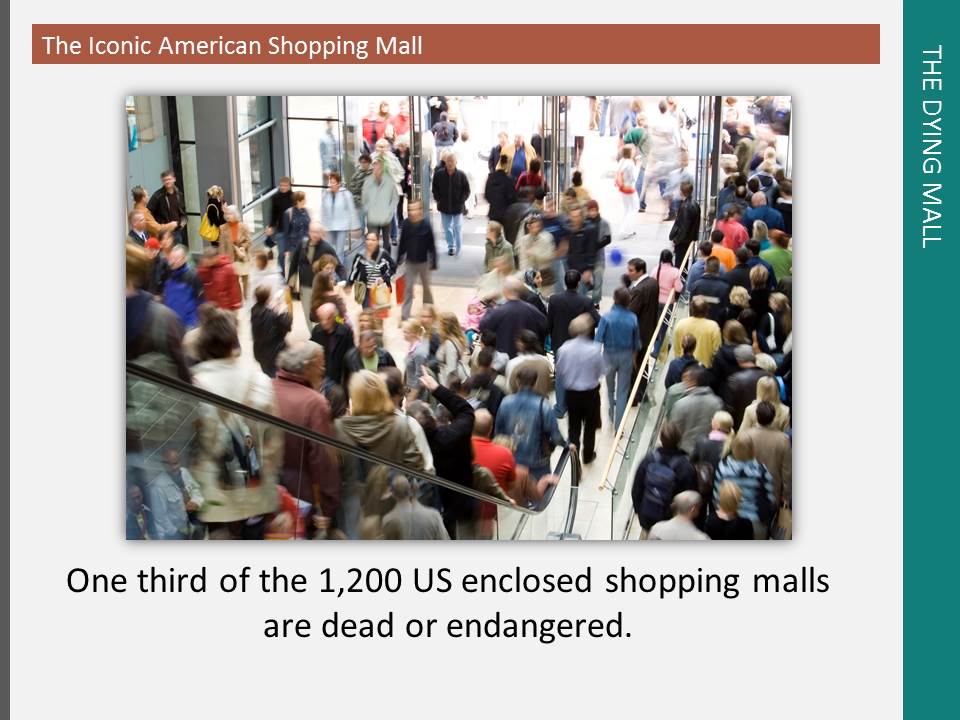
One third of the 1,200 US enclosed shopping malls are dead or endangered.

The Dying Mall: Reinventing Shopping Malls to Revitalize the Community
What’s to become of the shell of America’s shopping mall history?
Malls with high vacancy rates, low consumer traffic, no anchor store, or dated and deteriorating structures are considered ‘dead.’ Green Street Advisors report there are approximately 1,200 enclosed malls across the country and 15% of those malls will fail or be converted into non-retail space within the next 10 years. Online shopping, the recession, and demographic shifts are the key factors leading to this death toll. A change to the way we shop has led some mall owners to change the set-up of their mall, re-arranging like stores together, adding new anchors (like Apple stores) or new features (like daycare or children’s play areas) and changing the food court to a dining terrace with upgrades from fast food to sushi bars. While these approaches may save some shopping malls, the hard truth remains that many of these malls will not return to the glory of their past; but will instead close leaving behind a gigantic concrete shell on an island of macadam.
We'll be talking about the revitalization efforts at the PEDA 2016 Spring Conference!
For more information:
Terry Reed, Vice President Business Development
A great time to explore Solar opportunities in PA
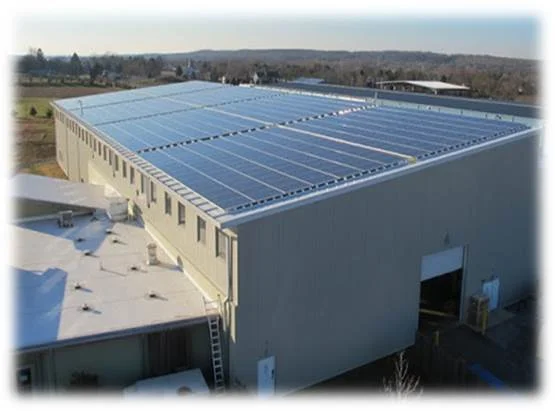
Why Solar Now in PA? Prices for solar systems have fallen by nearly 60% over the past five years. The lowered prices combined with incentives currently available make solar particularly attractive.
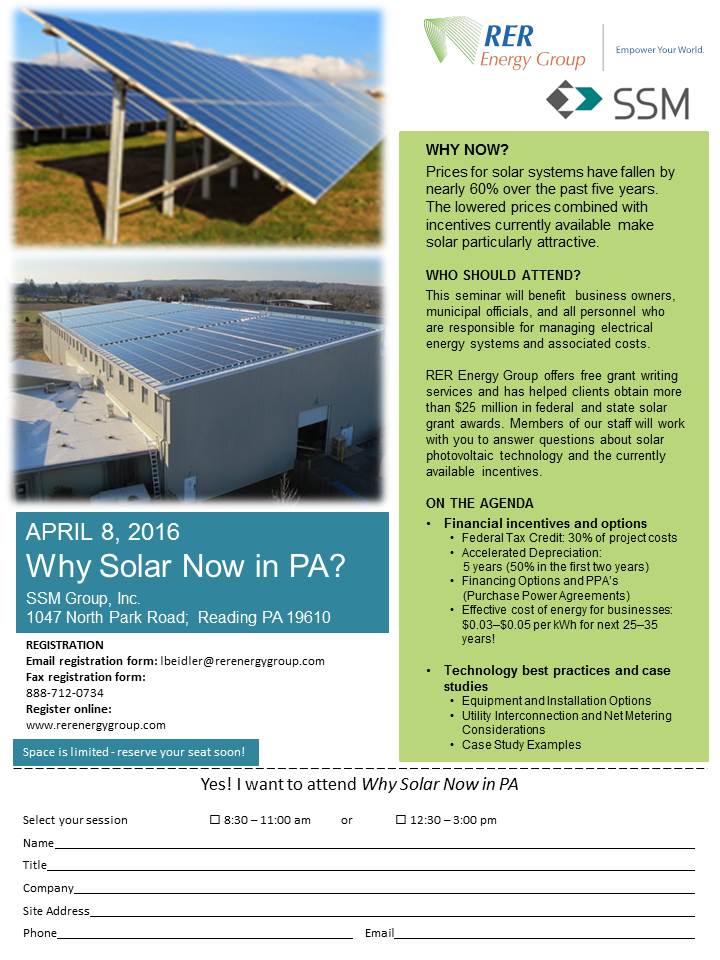
WHY NOW?
Prices for solar systems have fallen by nearly 60% over the past five years. The lowered prices combined with incentives currently available make solar particularly attractive
SSM Group, Inc and RER Energy Group, LLC are offering a seminar on solar photovoltaic energy for commercial, industrial, and municipal enterprises to explore the current opportunities in Pennsylvania.
WHO SHOULD ATTEND? The seminar will benefitbusiness owners, municipal officials, and all personnel who are responsible for managing electrical energy systems and associated costs.
ON THE AGENDA
Financial Incentives and Options
Federal Tax Credit: 30% of project costs
Accelerated Depreciation: 5 years (50% in the first two years)
Financing Options and PPA’s (Purchase Power Agreements)
Effective cost of energy for businesses: $0.03–$0.05 per kWh for next 25–35 years!
Technology Best Practices and Case Studies
Equipment and Installation Options
Utility Interconnection and Net Metering Considerations
Case Study Examples