

Agustin Conesa, PE, BCEE Joins SSM as Senior Water/Wastewater Engineer
We welcome Agustin Conesa, PE, BCEE as a Senior Water and Wastewater Engineer. Mr. Conesa will be a key component in the firm’s water, wastewater and industrial process engineering and design efforts and will provide quality control/quality assurance oversight on all project initiatives. He has more than 25 years of experience in the manufacturing industry and water/wastewater consulting engineering market.

Agustin Conesa, PE, BCEE
SSM celebrates another member of our Boomerang Club as we welcome Agustin Conesa, PE, BCEE as a Senior Water and Wastewater Engineer. Mr. Conesa will be a key component in the firm’s water, wastewater and industrial process engineering and design efforts and will provide quality control/quality assurance oversight on all project initiatives. He has more than 25 years of experience in the manufacturing industry and water/wastewater consulting engineering market.
His experience includes project management, process and project design of the following:
- Biological and enhanced nutrient removal (BNR/ENR) systems
- Pump stations
- Raw influent wastewater screening and de-gritting systems
- Aeration systems
- Disinfection and chemical feed systems
- Modeling of activated sludge processes
- Solid waste stabilization processes including biosolids dewatering and drying systems
- Energy cogeneration systems
- Process and instrumentation control systems
Based on the most recognizable type of boomerang, the Returning Boomerang; a special kind, that when thrown correctly, travels in a curved path and returns to its point of origin, the club was created as a means of celebrating those employees that had traveled their career path and returned to their point of origin, SSM.
Our company’s spirit, professional opportunities and working environment are certainly part of the power that draws our Boomerangers back.

2017 PennTec Conference
Real-world water/wastewater system examples that use online GIS applications to transform infrastructure data into an easy-to-use operations asset management system.

Online GIS Applications and Asset Management
This presentation provides real-world water/wastewater system examples that use online GIS applications to transform their infrastructure data into an easy-to-use operations asset management system. This low-cost approach captures vital data within a secure geo-spatial database. By creating customized mobile web applications, field-critical data (material description, installation date, inspection reports and service history) is available when needed most and accessible to operators in the office or in the field.

First Presbyterian Church set to acquire Wyomissing property
The headquarters of Spotts, Stevens and McCoy at 1047 North Park Road in Wyomissing, is expected to be the new home of the First Presbyterian Church in Reading. The church, founded in 1814, plans to lease space to SSM after purchasing the building from the consulting firm.
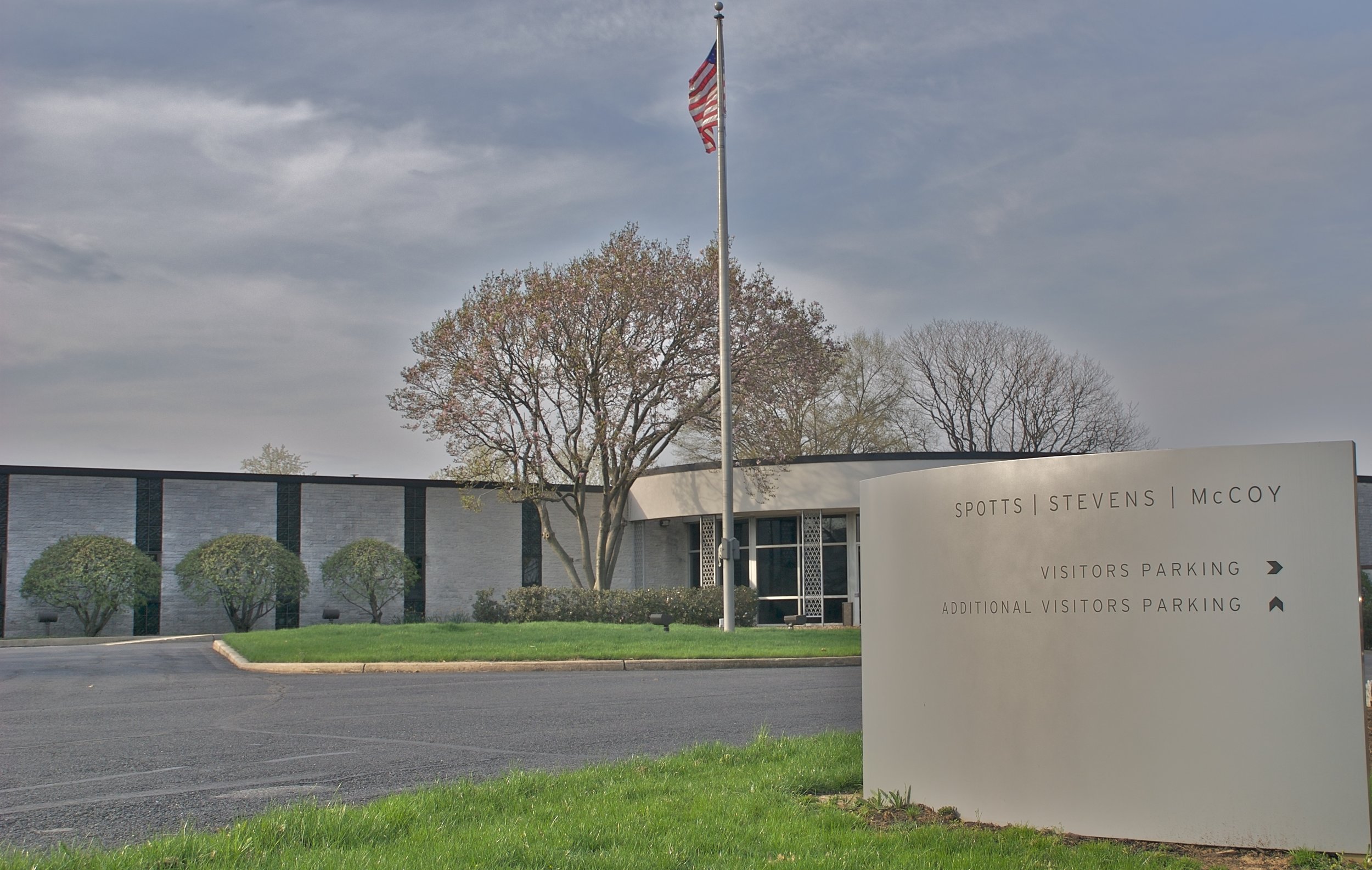
PRESS RELEASE: April 18, 2017
Wyomissing, PA – First Presbyterian Church set to acquire Wyomissing property owned by real estate Limited Partnership affiliated with Spotts, Stevens and McCoy (SSM).
In what is being described by both parties as a ‘union made in Heaven’ First Presbyterian Church, currently located at 37 South 5th Street in Reading and Spotts, Stevens and McCoy are jointly announcing plans for a real estate transaction whereby First Presbyterian Church is set to acquire the 1047 North Park Road, property currently occupied by Spotts, Stevens and McCoy (SSM) with plans to lease approximately half of it back to SSM. The purchase is contingent upon various approvals.
Attorney John Roland, long time member and elder at First Presbyterian Church who is a partner at Roland Stock, LLP, has provided leadership to First Presbyterian’s new site selection efforts. “Our Church is on a mission to expand our outreach efforts. This beautiful, new location will give us that opportunity,” said Roland. “Our congregation has embraced a number of changes in recent years and, following planned renovations, this facility will give us the space we need to support our membership growth goals.” First Presbyterian, founded in 1814, recently left the PC (USA) denomination to affiliate with the PC (ECU) and also just announced the calling of a new Senior Pastor, Christopher DiVietro. “We are very excited about these changes and in many ways, finding this location is an answer to prayers and the final piece of the puzzle,” said Nancy Alley, another church Session member who has been very active in the relocation process.
Brian Kelly, CEO at SSM and a partner in the real estate partnership, had the following to say: “We love our beautiful Wyomissing location and we had no desire to leave it; however, 43,000 square feet is simply more space than we need right now. So when the Church approached us about buying it and told us it was more space than they need at this time, we discussed a possible sale and lease-back situation. The result is that we’ve ended up with an Agreement that is truly a win-win for both parties. This sale unlocks resources that we can use to reinvest in the growth of the business, focusing on adding new technology and equipment and pursuing other strategic initiatives, including potential acquisitions.”
The 1047 North Park Road facility was constructed in 1963 as the world headquarters for Vanity Fair Corporation and it was subsequently renovated in 1998 and occupied by Carpenter Technology. The SSM principals purchased it in 2003. The building has just under 43,000 square feet on two levels and sits on approximately 5.5 acres of prime Wyomissing real estate.
“What makes the transaction so appealing to us is that Spotts, Stevens and McCoy will continue to occupy approximately half of the space as we embark upon our congregational growth plans,” said Roland. Current elder and former Treasurer Paul Eisenhuth notes that Presbyterians are known to be financial conservatives. “A key component of the transaction is that SSM and the Church are entering into a 5-year Lease Agreement which makes the space affordable for us. It also ensures our access to additional space as we grow.”
Spotts, Stevens and McCoy is a family owned and managed regional engineering and consulting firm with roots back to 1932. Two of the principals, Patrick McCoy and Lewis McCoy, Jr., are sons of founder, Lewis McCoy, Sr., and Kelly is a son-in-law. Both First Presbyterian Church and Spotts, Stevens and McCoy have deep roots in the Berks County community.
There are many factors that make this such a uniquely beneficial transaction for both parties:
- The SSM lease-back will provide the Church with an ongoing revenue stream as it embarks upon renovation plans and congregational growth goals. Financing is being provided by Customers Bank as the Church embarks upon a capital campaign to fund both the purchase and planned renovations. The Church will be seeking competitive bids for both design and construction work. No firm timeline for construction or occupancy has been established at this time.
- With a five-year Lease in place, SSM will be able to continue to operate from its existing headquarters location with little or no disruption to business as the Church embarks upon its renovation plans and prepares to move in
- Church offices will be open during the week; however its primary activity will occur on weekends and evenings when parking spaces are likely to be occupied by those attending scheduled worship services. SSM’s primary business activity will occur on week days during normal business hours and its employees will be off on weekends.
An answer to prayers? A partnership made in Heaven? The ‘joining’ of two old and well-established organizations? Laying all spiritual beliefs aside, it certainly appears to be a transaction that capitalizes on every possible benefit for both the Church and SSM. So at a minimum, it’s a win-win!
FOR ADDITIONAL INFORMATION:
- First Presbyterian Church - John Roland, Esq. | 610-372-5588
- Spotts, Stevens and McCoy – CEO, Brian Kelly | 610-621-2000
- Patricia Langiotti, Creative Management Concepts | 610-603-0306

Groundhog Day: Pipe Condition Assessment
Our water/wastewater engineers can help remedy even your largest sewer problems and nuisances!

For more than 50 years, SSM's water and wastewater engineers have been addressing capacity and blockage issues in stormwater pipes, sanitary sewer mains and assessing the conditions of underground pipes.
We can help remedy even your largest sewer problems and nuisances!
FOR MORE INFORMATION
Scott Carl, Sr. | Division Vice President | Water and Wastewater Engineering and Operations

Sam Zook, SIT Receives Certification as Drone Pilot
Sam Zook, SIT is the third surveyor at SSM to receive certification as a Drone Pilot.

Sam Zook, SIT, Surveyor has received his certification as a FAA Certified Remote Pilot. Zook is one of three certified pilots at SSM. He is a 2009 graduate of Pennsylvania College of Technology.
On June 21st, 2016 the FAA finalized a new regulatory framework for small, unmanned aerial systems. Titled Part 107, these new regulations created a new drone certification process that covers the majority of low-risk, commercial UAS flight operations for all commercially operated drones. Commercial refers to any kind of flight operation that can be tied to economic benefit. These new regulations were implemented on August 29, 2016.

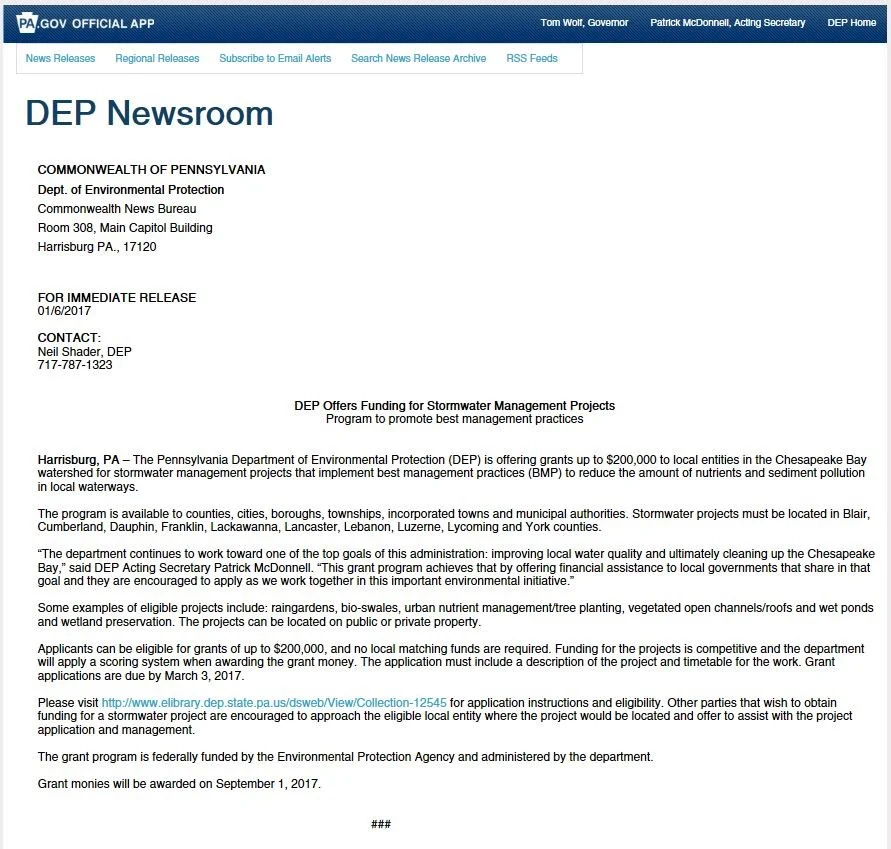
DEP Offers Funding for Stormwater Management Programs
The Pennsylvania Department of Environmental Protection (DEP) is offering grants up to $200,000 to local entities in the Chesapeake Bay watershed for stormwater management projects that implement best management practices (BMP) to reduce the amount of nutrients and sediment pollution in local waterways.

DOWNLOAD ARTICLE
Harrisburg, PA – The Pennsylvania Department of Environmental Protection (DEP) is offering grants up to $200,000 to local entities in the Chesapeake Bay watershed for stormwater management projects that implement best management practices (BMP) to reduce the amount of nutrients and sediment pollution in local waterways.
The program is available to counties, cities, boroughs, townships, incorporated towns and municipal authorities. Stormwater projects must be located in Blair, Cumberland, Dauphin, Franklin, Lackawanna, Lancaster, Lebanon, Luzerne, Lycoming and York counties.
“The department continues to work toward one of the top goals of this administration: improving local water quality and ultimately cleaning up the Chesapeake Bay,” said DEP Acting Secretary Patrick McDonnell. “This grant program achieves that by offering financial assistance to local governments that share in that goal and they are encouraged to apply as we work together in this important environmental initiative.”
Some examples of eligible projects include: raingardens, bio-swales, urban nutrient management/tree planting, vegetated open channels/roofs and wet ponds and wetland preservation. The projects can be located on public or private property.
Applicants can be eligible for grants of up to $200,000, and no local matching funds are required. Funding for the projects is competitive and the department will apply a scoring system when awarding the grant money. The application must include a description of the project and timetable for the work. Grant applications are due by March 3, 2017.
Please visit http://www.elibrary.dep.state.pa.us/dsweb/View/Collection-12545 for application instructions and eligibility. Other parties that wish to obtain funding for a stormwater project are encouraged to approach the eligible local entity where the project would be located and offer to assist with the project application and management.
The grant program is federally funded by the Environmental Protection Agency and administered by the department.
Grant monies will be awarded on September 1, 2017.
FOR MORE INFORMATION: Mark Stabolepszy, PE Director Municipal Engineering and Planning

Sinkholes and Why They Matter
Sinkholes can be dangerous in many ways. They can cause damage to the foundation of a building, they serve as conduits for surficial contaminants to reach groundwater, and they can cause damage to buried services like water lines and electrical conduits according to Conserve Energy Future. Knowing the risk of sinkhole formation is key to minimizing possible damages.

Sinkholes can be dangerous in many ways.

MEASURING SINKHOLE POTENTIAL RISK
Karst is defined as “a terrain, generally underlain by limestone, in which the topography is chiefly formed by the dissolving of rock, and which is commonly characterized by Karren, closed depressions, subterranean drainage, and caves” by the Geological Survey Water-Supply Paper 1899. Each component listed above (Karren, closed depressions, subterranean drainage, and caves) are considered karst features, but most importantly, sinkholes are considered karst features.
Sinkholes can be dangerous in many ways. They can cause damage to the foundation of a building, they serve as conduits for surficial contaminants to reach groundwater, and they can cause damage to buried services like water lines and electrical conduits according to Conserve Energy Future. Knowing the risk of sinkhole formation is key to minimizing possible damages.
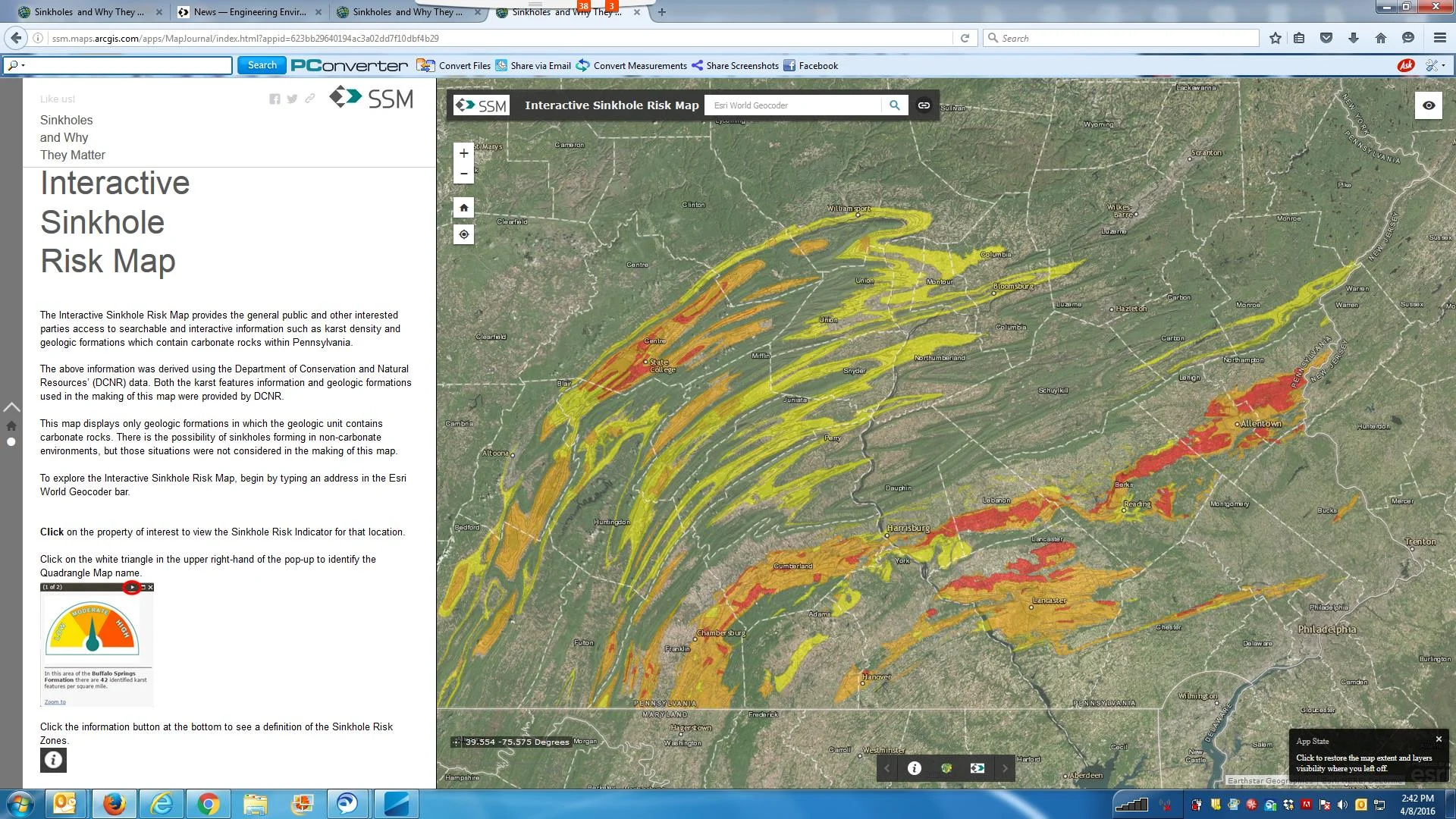
Since the amount of karst features in an area can be related to the occurrence of sinkholes, an interactive sinkhole risk map was created using the density of karst features within a geologic formation.
Interactive Sinkhole Risk Map
The Interactive Sinkhole Risk Map provides access to searchable and interactive information such as karst density and geologic formations which contain carbonate rocks within Pennsylvania. The map displays only geologic formations in which the geologic unit contains carbonate rocks. There is the possibility of sinkholes forming in non-carbonate environments, but those situations were not considered in the making of this map. Explore the Interactive Sinkhole Risk Map to view the Sinkhole Risk for any location.
If a sinkhole evaluation of a location is desired, SSM Group, Inc. has multiple professionals on staff with years of experience in sinkhole risk evaluations. Feel free to contact SSM Group, Inc. to learn more.
SSM Group, Inc. Announces Management Changes - Brian Kelly named President and CEO

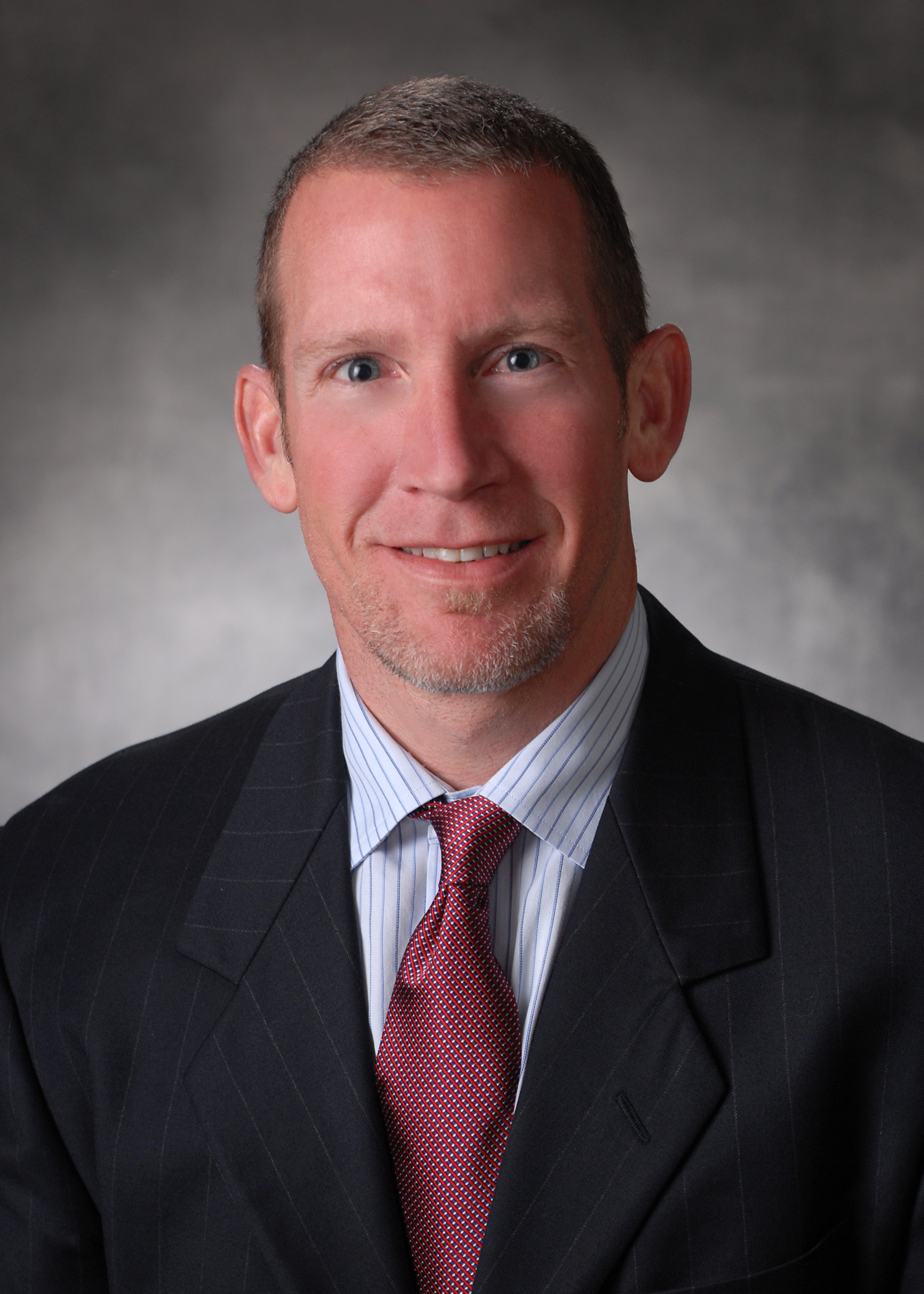

SSM Group, Inc. recently announced a corporate management restructure. Brian R. Kelly has been named President and Chief Executive Officer of the firm. Kelly, who formerly served as the company’s Executive Vice President with responsibility of running the firm’s operations, replaces J. Carlton Godlove, II, who has left the company to pursue other interests.
Kelly is one of four McCoy family members who assumed control and management of the firm in 1996. Kelly has an Associate Degree in Mechanical Engineering Technology from The Pennsylvania State University. Prior to joining the SSM management team, Kelly was employed at AT&T for more than 17 years in various roles. Kelly resides in Reading with his wife, Kay McCoy Kelly, who is a daughter of the company’s founder, Lewis J. McCoy, Sr. In a prepared statement, Kelly said, “I look forward to leading the company as we embark upon strategic growth and expansion. I am very proud of our exceptionally talented senior leadership team and all of our employees, and I am confident that, with their help and support, we will continue to grow the company and succeed at fulfilling our corporate mission – ‘Enhancing the quality of life for our clients, our employees, and all of the people touched by our work.’ Our work is so important because it touches this generation and future generations with a scope broader than we can imagine – and it leaves a legacy that will live far beyond us.”
“Approximately six months ago we appointed a team of independent professionals to work with us as members of an Advisory Board: Thomas A. Beaver, CPA, former managing partner at RKL; Patricia L. Langiotti, President of Creative Management Concepts; and Mike Shor, former executive with Carpenter. These Advisory Board members have played a key role in helping us plan for our future,” Kelly said.
Kelly also announced that shareholder, Patrick M. McCoy, PE, has been promoted to Executive Vice President. “Patrick will lead the company’s business development and sales and marketing efforts and he will be a strong right-hand man,” Kelly said. Patrick McCoy has been with the firm since 1996. He graduated from Drexel University, like his father, and holds Bachelor’s degrees in Civil Engineering and Architectural Engineering. McCoy formerly led the company’s Facilities and Site Engineering Division which provides services to worldwide companies such as IBM. Prior to joining SSM, he was with Ortega Consulting, Media, PA, and Gredell & Associates, Wilmington, DE.
Shareholder Lewis J. (Lou) McCoy, Jr. of Reading, who joined the firm in 1985, will continue in his role as Director of Human Resources.
Catherine (Kitty) Bell, who joined the firm in 2004, is being promoted to Divisional Vice President. Formerly the firm’s Vice President of Facility Engineering, she assumes an expanded role, with additional management responsibility for Site Engineering and Survey and Data Capture disciplines (formerly managed by Patrick McCoy). Bell resides in Reading, PA.
SSM Group, Inc. is an engineering and consulting firm founded by Lewis J. McCoy, Sr. in 1967. The company continues to be family owned and operated. Headquartered at 1047 North Park Road in Wyomissing with satellite offices in Harrisburg and the Lehigh Valley, SSM has just under 100 employees and provides services to various types of local, regional and national businesses that include commercial, industrial, manufacturing and telecommunications as well as healthcare and higher education institutions. The company also provides services to numerous local, regional, and county government entities. While the company’s primary market is a regional footprint including Berks County and the Lehigh Valley, SSM serves clients throughout PA and the Northeastern United States as well as to some international clients.
FOR MORE INFORMATION:
Brian Kelly, President and CEO
brian.kelly@ssmgroup.com | P: 610-621-2000
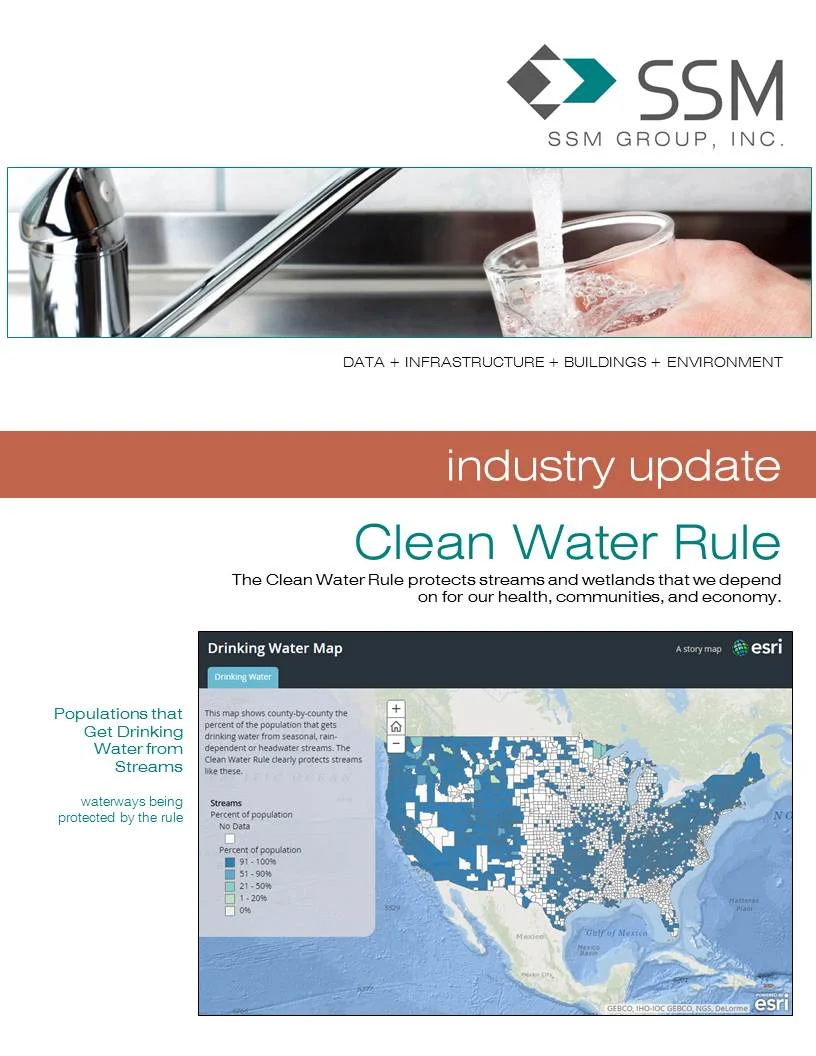
Clean Water Rule
The Clean Water Rule protects streams and wetlands that we depend on for our health, communities, and economy.

INDUSTRY UPDATE: Clean Water Rule

There’s been much buzz surrounding the Clean Water Rule, recently issued by the U.S. Environmental Protection Agency and U.S. Army Corps of Engineers. While the rule aims to clarify permitting regulations already in place with the Clean Water Act of 1972, many are worried it will create new stringent and burdensome regulations. Sixteen states have filed lawsuits against the U.S. Environmental Protection Agency over the rule. In an attempt to protect streams and wetlands, the Clean Water Rule simply enhances the Clean Water Act, responding to more than a decade’s worth of requests to more clearly define the water bodies and waterways referenced in the Clean Water Act.
According to the U.S. Environmental Protection Agency, clarification of the definitions of the waters protected by the Clean Water Act, will protect valuable water resources and help make permitting less costly, easier, and faster for business and industry. This is because it eliminates much confusion over which waterways are regulated, and how they are to be regulated. This reduces the time and resources required to submit and approve a permit. While environmental groups and some businesses support the rule, claiming the clean water is central their operations, other interests have mounted opposition to the rule, citing it as an example of burdensome federal overreach.
The Clean Water Rule is the result of more than 400 meetings with stakeholders from all over the country, over 1 million public comments, and the latest scientific research showing that the health of small tributaries and wetlands play an integral role in the health of larger, downstream bodies of water. By ensuring that our smaller tributaries and wetlands are covered by Clean Water Rule, the drinking water sources of more than 117 million Americans will now be protected that may not have had sufficient coverage under the Clean Water Act alone.
Only types of waters already addressed by the Clean Water Act are included in the Clean Water Rule, which does not create any new permitting requirements for agriculture. It also maintains all previous exemptions and exclusions, including activities like planting, harvesting, and moving livestock. The rule does not regulate most ditches, groundwater, shallow subsurface flows, or tile drains, and only requires a Clean Water Act permit if a protected water is going to be polluted or destroyed by an activity. Moreover, the rule does not place regulations on land use.
Not only is the rule important for the health of the surface water sources we utilize for drinking water, the water ways protected by this rule are beneficial to many aspects of our communities. Wetlands and streams trap floodwaters, recharge groundwater supplies, filter pollution, provide habitat for fish and wildlife, and are important for recreation and commercial value.
FOR MORE INFORMATION
Alfred Guiseppe, PG

Water Planning, Engineering and Design Services
Water Planning, Design and Engineering Services

Pure and simple.
Ah, a refreshing glass of water. On the surface, it's filled with nothing but H20. Thinking deeper, you'll see that a lot more has gone into it. Such as protecting the purity of reservoirs, aquifers, wellheads, and springs. Rehabilitating abandoned wells. Using hydrogeologic modeling to calculate the impact of proposed development on source water and surrounding terrain. Using GIS to manage complex and voluminous environmental databases. Tailoring solutions for municipalities and water suppliers, and getting clean water to communities, buildings and faucets. Into every refreshing glass of water goes a lot of deep thinking.
Protecting, developing, and managing water resources for future generations.