
DEP Offers Funding for Stormwater Management Programs
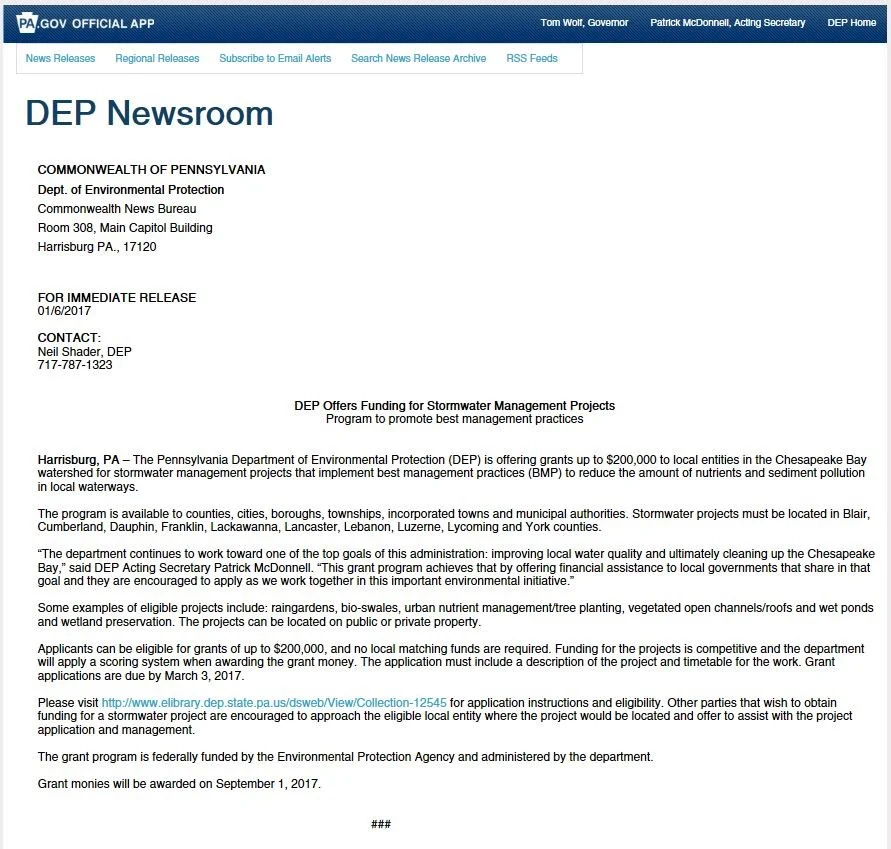
The Pennsylvania Department of Environmental Protection (DEP) is offering grants up to $200,000 to local entities in the Chesapeake Bay watershed for stormwater management projects that implement best management practices (BMP) to reduce the amount of nutrients and sediment pollution in local waterways.

DOWNLOAD ARTICLE
Harrisburg, PA – The Pennsylvania Department of Environmental Protection (DEP) is offering grants up to $200,000 to local entities in the Chesapeake Bay watershed for stormwater management projects that implement best management practices (BMP) to reduce the amount of nutrients and sediment pollution in local waterways.
The program is available to counties, cities, boroughs, townships, incorporated towns and municipal authorities. Stormwater projects must be located in Blair, Cumberland, Dauphin, Franklin, Lackawanna, Lancaster, Lebanon, Luzerne, Lycoming and York counties.
“The department continues to work toward one of the top goals of this administration: improving local water quality and ultimately cleaning up the Chesapeake Bay,” said DEP Acting Secretary Patrick McDonnell. “This grant program achieves that by offering financial assistance to local governments that share in that goal and they are encouraged to apply as we work together in this important environmental initiative.”
Some examples of eligible projects include: raingardens, bio-swales, urban nutrient management/tree planting, vegetated open channels/roofs and wet ponds and wetland preservation. The projects can be located on public or private property.
Applicants can be eligible for grants of up to $200,000, and no local matching funds are required. Funding for the projects is competitive and the department will apply a scoring system when awarding the grant money. The application must include a description of the project and timetable for the work. Grant applications are due by March 3, 2017.
Please visit http://www.elibrary.dep.state.pa.us/dsweb/View/Collection-12545 for application instructions and eligibility. Other parties that wish to obtain funding for a stormwater project are encouraged to approach the eligible local entity where the project would be located and offer to assist with the project application and management.
The grant program is federally funded by the Environmental Protection Agency and administered by the department.
Grant monies will be awarded on September 1, 2017.
FOR MORE INFORMATION: Mark Stabolepszy, PE Director Municipal Engineering and Planning

ARC FLASH HAZARD ANALYSIS
The Arc Flash Hazard Analysis identifies the levels of incident energy throughout the system.The Arc Flash Hazard Analysis identifies the levels of incident energy throughout the system.

The Arc Flash Hazard Analysis identifies the levels of incident energy throughout the system.
An arc flash is the result of a rapid release of energy (light and heat) due to an arcing fault between electrical conductor(s) and another electrical conductor(s) or ground with enough electrical energy to cause damage or fire, and injury. During an arc fault air becomes the conductor. A massive amount of energy discharges during the arc flash or blast. This energy burns the conductors, vaporizing the copper and thus causing an explosive volumetric increase, the arc blast. This explosion propels deadly shrapnel and molten metal as it dissipates. This rapid release of energy can cause debilitating burns, other injuries and even death. Without an Arc-Flash Hazard Analysis, employers cannot properly protect their personnel from arc-flash.
Elements of the Hazard Analysis
- Short Circuit Study- The short circuit study calculates the maximum short circuit current the electrical power system may be subjected to at each equipment location through out the distribution network from the sources such as utilities, generators, and motors. The equipment includes substations, switchgear, motor control centers, and panels with their respective over current protective devices; generators; transforms; motors; and UPS equipment. The short circuit results determine the required ratings for electrical equipmen6t to adequately sustain the fault current capacity of the system. If a short circuit occurs, the electrical power system’s available energy is directed to the point of the fault in amounts that greatly exceed the normal operating currents, and the equipment must have the ability tow withstand and interrupt these large currents until the protective device opens to clear the faulted portion of the circuit.
- Protective Device Evaluation - The protective device evaluation study determines if the equipment ratings needed to sustain the fault currents calculated by the Short Circuit Study are adequate. Each circuit breaker, bus, etc., is reviewed in regards to the available short circuit to determine that the equipment can adequately withstand the fault current.
- The Protective Device Time Current Coordination - The protective device time current coordination study reviews the relay and circuit breaker trip settings, fuses, and their operating time and current characteristics in order to properly coordinate these settings with upstream and downstream devices so that any faults are isolated to the location of the fault; hence, limiting the impact to the remaining portions of the system. The coordination study is used in an Arc Flash study to determine the length of time an arc would occur which is directly related to the incident energy associated with an arc flash event.
What the Analysis Reveals
The Hazard Analysis will identify the locations which require PPE greater than Category 0. The review determines if there are possible arc flash mitigation recommendations that can be implemented to reduce the incident energy levels. Such recommendations might include device setting changes, replacement of molded case type circuit breakers with static trip type circuit breakers, changing fuse types, or installation of additional fused disconnects or circuit breakers. As a result of reducing the incident energy levels the corresponding Category of PPE required to work on the equipment while energized is reduced.
FOR MORE INFORMATION: Emerick Martin, PE, Senior Electrical Engineer

Sinkholes and Why They Matter
Sinkholes can be dangerous in many ways. They can cause damage to the foundation of a building, they serve as conduits for surficial contaminants to reach groundwater, and they can cause damage to buried services like water lines and electrical conduits according to Conserve Energy Future. Knowing the risk of sinkhole formation is key to minimizing possible damages.

Sinkholes can be dangerous in many ways.

MEASURING SINKHOLE POTENTIAL RISK
Karst is defined as “a terrain, generally underlain by limestone, in which the topography is chiefly formed by the dissolving of rock, and which is commonly characterized by Karren, closed depressions, subterranean drainage, and caves” by the Geological Survey Water-Supply Paper 1899. Each component listed above (Karren, closed depressions, subterranean drainage, and caves) are considered karst features, but most importantly, sinkholes are considered karst features.
Sinkholes can be dangerous in many ways. They can cause damage to the foundation of a building, they serve as conduits for surficial contaminants to reach groundwater, and they can cause damage to buried services like water lines and electrical conduits according to Conserve Energy Future. Knowing the risk of sinkhole formation is key to minimizing possible damages.
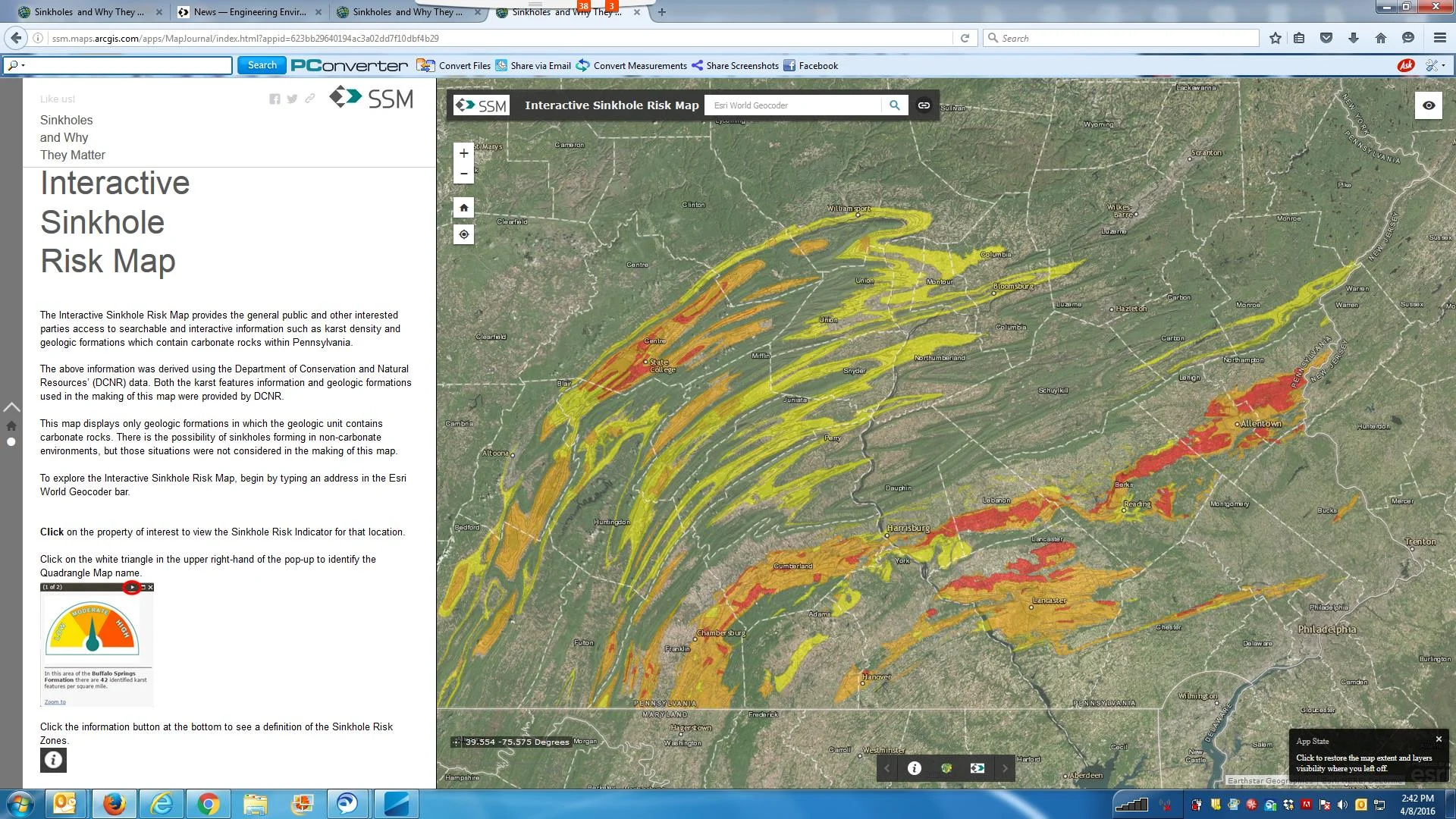
Since the amount of karst features in an area can be related to the occurrence of sinkholes, an interactive sinkhole risk map was created using the density of karst features within a geologic formation.
Interactive Sinkhole Risk Map
The Interactive Sinkhole Risk Map provides access to searchable and interactive information such as karst density and geologic formations which contain carbonate rocks within Pennsylvania. The map displays only geologic formations in which the geologic unit contains carbonate rocks. There is the possibility of sinkholes forming in non-carbonate environments, but those situations were not considered in the making of this map. Explore the Interactive Sinkhole Risk Map to view the Sinkhole Risk for any location.
If a sinkhole evaluation of a location is desired, SSM Group, Inc. has multiple professionals on staff with years of experience in sinkhole risk evaluations. Feel free to contact SSM Group, Inc. to learn more.
Snow and Your Roof
The snow is deep and as the weather begins to creep out of freezing, the addition of rain or snow melt into the mix can become a real threat. While all exposed roofs could be at risk, older flat roofs and roofs with poor drainage are the most susceptible to collapse due to snow.

With winter weather well under way, we can't help but raise our eyes to our roofs, and notice the snow piling up. The snow is getting deeper, and as the weather begins to creep out of freezing, the addition of rain or snow melt into the mix can become a real threat. While all exposed roofs could be at risk, older flat roofs and roofs with poor drainage are the most susceptible to collapse due to snow.
Newer roofs should have been designed for the minimum snow load as prescribed in the International Building Code, and the ASCE 7 – Minimum Design Loads for Buildings and Other Structures. Typically in the Berks County area, the design ground snow load is 30 pounds per square foot (PSF), which equates to just over 20 inches of dense snow. Additional snow load needs to be considered where snow from an adjacent sloped roof can slide onto a lower roof. Also, additional load from drifting snow must be considered when portions of the roof abut parapets, roof top equipment or higher roofs. Lastly, rain-on-snow surcharge can add 5 PSF for every inch of rain that is retained on the roof by the snow or poor drainage.
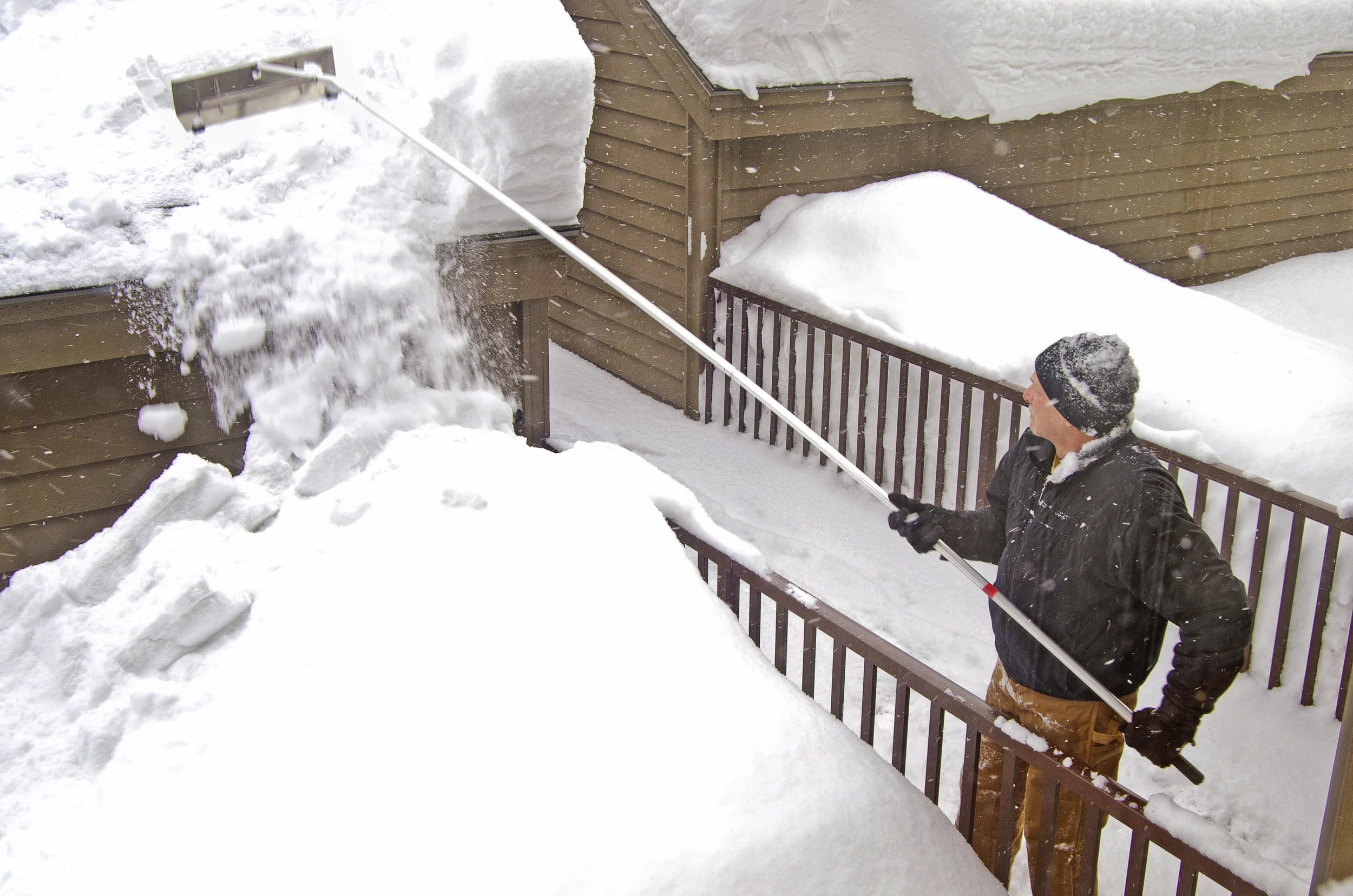
If you think your roof is at risk, you should contact a structural engineer to evaluate your roof condition. It may be necessary to remove some of the accumulated snow, clear roof drains, or provide temporary shoring to lessen the burden on the structural members. The removal of snow can be very dangerous, and is a job best left to a professional.
DEP Offers Funding for Projects to Improve Local Water Quality by Reducing Stormwater Runoff
Grant Opportunity: Municipalities, including cities, boroughs, or incorporated towns within the Chesapeake Bay Watershed are eligible to apply.

Grants will fund urban stormwater best management practices in Chesapeake Bay Watershed
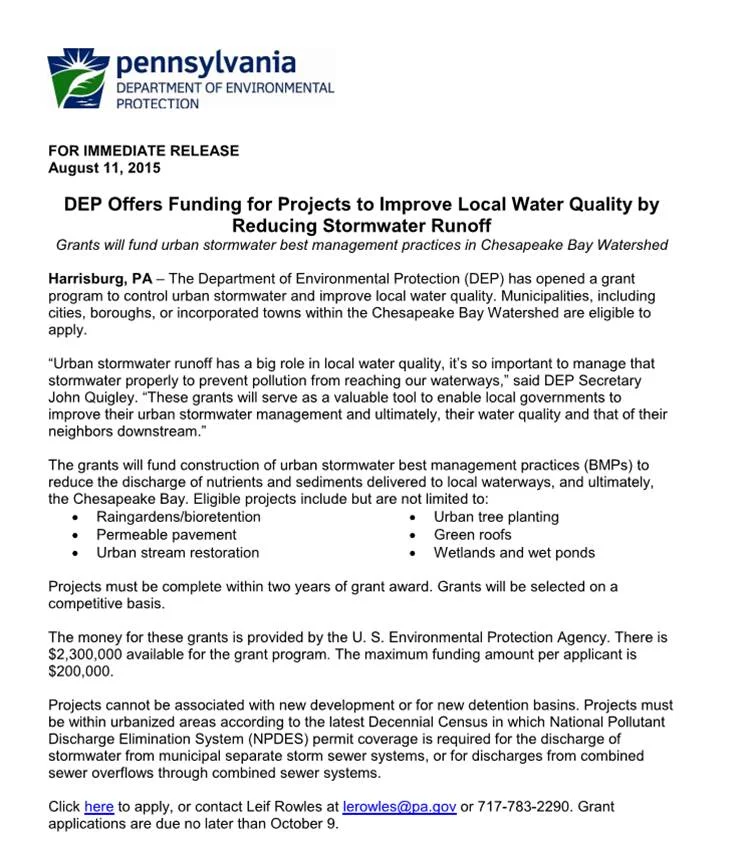
HARRISBURG, PA -- The Department of Environmental Protection (DEP) has opened a grant program to control urban stormwater and improve local water quality. Municipalities, including cities, boroughs, or incorporated towns within the Chesapeake Bay Watershed are eligible to apply.
“Urban stormwater runoff has a big role in local water quality, it’s so important to manage that stormwater properly to prevent pollution from reaching our waterways,” said DEP Secretary John Quigley. “These grants will serve as a valuable tool to enable local governments to improve their urban stormwater management and ultimately, their water quality and that of their neighbors downstream.”
The grants will fund construction of urban stormwater best management practices (BMPs) to reduce the discharge of nutrients and sediments delivered to local waterways, and ultimately, the Chesapeake Bay. Eligible projects include but are not limited to:
• Raingardens/bioretention
• Permeable pavement
• Urban stream restoration
• Urban tree planting
• Green roofs
• Wetlands and wet ponds
Projects must be complete within two years of grant award. Grants will be selected on a competitive basis.
The money for these grants is provided by the U. S. Environmental Protection Agency. There is $2,300,000 available for the grant program. The maximum funding amount per applicant is $200,000.
Projects cannot be associated with new development or for new detention basins. Projects must be within urbanized areas according to the latest Decennial Census in which National Pollutant Discharge Elimination System (NPDES) permit coverage is required for the discharge of stormwater from municipal separate storm sewer systems, or for discharges from combined sewer overflows through combined sewer systems.
Grant applications are due no later than October 9.
FOR MORE INFORMATION
COMMONWEALTH OF PENNSYLVANIA
Dept. of Environmental Protection
Commonwealth News Bureau
Room 308, Main Capitol Building
Harrisburg PA., 17120
CONTACT: Amanda Witman, DEP, 717-787-1323
CONTACT: Leif Rowles at lerowles@pa.gov or 717-783-2290.
SSM GROUP: Mark Stabolepszy, PE, Vice President Municipal Engineering and Planning
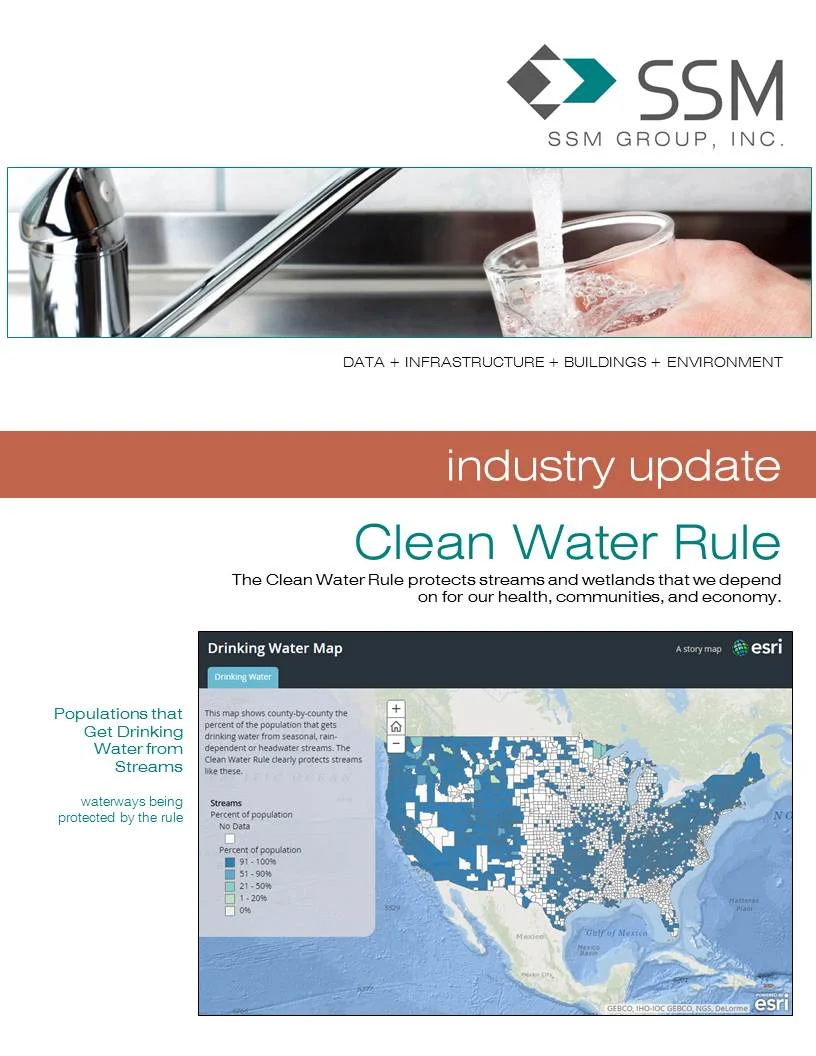
Clean Water Rule
The Clean Water Rule protects streams and wetlands that we depend on for our health, communities, and economy.

INDUSTRY UPDATE: Clean Water Rule

There’s been much buzz surrounding the Clean Water Rule, recently issued by the U.S. Environmental Protection Agency and U.S. Army Corps of Engineers. While the rule aims to clarify permitting regulations already in place with the Clean Water Act of 1972, many are worried it will create new stringent and burdensome regulations. Sixteen states have filed lawsuits against the U.S. Environmental Protection Agency over the rule. In an attempt to protect streams and wetlands, the Clean Water Rule simply enhances the Clean Water Act, responding to more than a decade’s worth of requests to more clearly define the water bodies and waterways referenced in the Clean Water Act.
According to the U.S. Environmental Protection Agency, clarification of the definitions of the waters protected by the Clean Water Act, will protect valuable water resources and help make permitting less costly, easier, and faster for business and industry. This is because it eliminates much confusion over which waterways are regulated, and how they are to be regulated. This reduces the time and resources required to submit and approve a permit. While environmental groups and some businesses support the rule, claiming the clean water is central their operations, other interests have mounted opposition to the rule, citing it as an example of burdensome federal overreach.
The Clean Water Rule is the result of more than 400 meetings with stakeholders from all over the country, over 1 million public comments, and the latest scientific research showing that the health of small tributaries and wetlands play an integral role in the health of larger, downstream bodies of water. By ensuring that our smaller tributaries and wetlands are covered by Clean Water Rule, the drinking water sources of more than 117 million Americans will now be protected that may not have had sufficient coverage under the Clean Water Act alone.
Only types of waters already addressed by the Clean Water Act are included in the Clean Water Rule, which does not create any new permitting requirements for agriculture. It also maintains all previous exemptions and exclusions, including activities like planting, harvesting, and moving livestock. The rule does not regulate most ditches, groundwater, shallow subsurface flows, or tile drains, and only requires a Clean Water Act permit if a protected water is going to be polluted or destroyed by an activity. Moreover, the rule does not place regulations on land use.
Not only is the rule important for the health of the surface water sources we utilize for drinking water, the water ways protected by this rule are beneficial to many aspects of our communities. Wetlands and streams trap floodwaters, recharge groundwater supplies, filter pollution, provide habitat for fish and wildlife, and are important for recreation and commercial value.
FOR MORE INFORMATION
Alfred Guiseppe, PG

Laser Scanning Terminology
Definitions associated with 3D Laser Scanning

These definitions have been gathered from various sources, some of which have been listed. The definitions associated with the ASTM are further obtained from various standard documents developed by various standards development organizations. The ASTM provides more in-depth discussion of several terms that have not been disclosed here; please refer to Designation: E 2544 — 08b, “Standard Terminology for Three-Dimensional (3D) Imaging Systems” for more details.
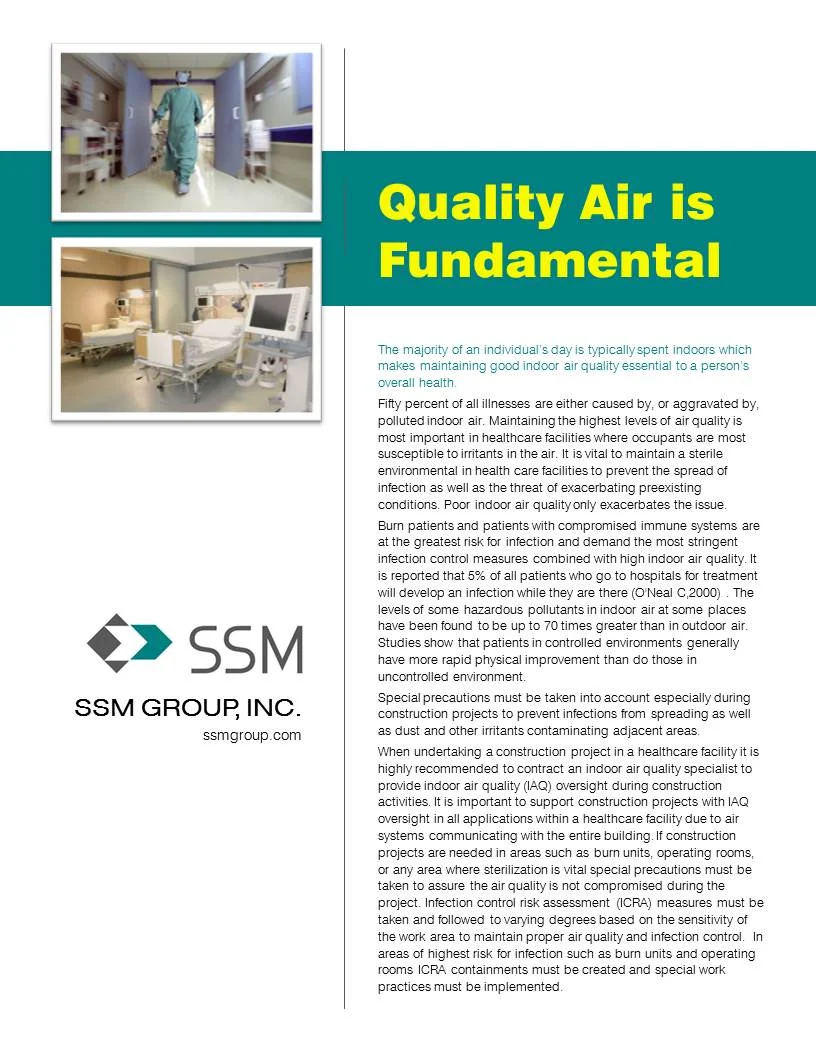
Quality Air Is Fundamental
It is vital to maintain a sterile environmental in health care facilities to prevent the spread of infection as well as the threat of exacerbating preexisting conditions. Poor indoor air quality only exacerbates the issue.

QUALITY AIR IS FUNDAMENTAL | ICRA
The majority of an individual’s day is typically spent indoors which makes maintaining good indoor air quality essential to a person’s overall health.
Fifty percent of all illnesses are either caused by, or aggravated by, polluted indoor air. Maintaining the highest levels of air quality is most important in healthcare facilities where occupants are most susceptible to irritants in the air. It is vital to maintain a sterile environmental in health care facilities to prevent the spread of infection as well as the threat of exacerbating preexisting conditions. Poor indoor air quality only exacerbates the issue.
Burn patients and patients with compromised immune systems are at the greatest risk for infection and demand the most stringent infection control measures combined with high indoor air quality. It is reported that 5% of all patients who go to hospitals for treatment will develop an infection while they are there (O'Neal C,2000) . The levels of some hazardous pollutants in indoor air at some places have been found to be up to 70 times greater than in outdoor air. Studies show that patients in controlled environments generally have more rapid physical improvement than do those in uncontrolled environment.
Special precautions must be taken into account especially during construction projects to prevent infections from spreading as well as dust and other irritants contaminating adjacent areas.
When undertaking a construction project in a healthcare facility it is highly recommended to contract an indoor air quality specialist to provide indoor air quality (IAQ) oversight during construction activities. It is important to support construction projects with IAQ oversight in all applications within a healthcare facility due to air systems communicating with the entire building. If construction projects are needed in areas such as burn units, operating rooms, or any area where sterilization is vital special precautions must be taken to assure the air quality is not compromised during the project. Infection control risk assessment (ICRA) measures must be taken and followed to varying degrees based on the sensitivity of the work area to maintain proper air quality and infection control. In areas of highest risk for infection such as burn units and operating rooms ICRA containments must be created and special work practices must be implemented.
ICRA Special Work Practices
- Isolate the HVAC system in the area where work is being done to prevent contamination of the duct system. Complete all critical barriers i.e. sheetrock, plywood, plastic, to seal area from non work areas or implement control a cube method (cart with plastic covering and sealed connection to work site with a HEPA vacuum for vacuuming prior to exit) before construction begins.
- Maintain negative air pressure within the work site utilizing HEPA equipped air filtration units. Seal holes, pipes, conduits, and punctures.
- Construct anteroom and require all personnel to pass through this room so they can be vacuumed using a HEPA vacuum cleaner before leaving work site or they can wear cloth or paper coveralls that are removed each time they leave work site.
- All personnel entering the work site are required to wear shoe covers. Shoe covers must be changed each time the worker exits the work area.
A thorough sampling protocol must be created by an indoor air quality specialist to provide data that the work areas were properly contained and all construction generated particulates were being contained. Upon completion of the work in a contained area an experienced industrial hygienists will perform a visual inspection and additional particulate sampling to confirm the area was suitable for re-occupancy. Through expert design of the sampling protocol and analysis of all data collected by the indoor air quality specialists it can be definitively shown that the air quality was not compromised during the construction project. As always, the goal is to establish the highest level of indoor air quality to promote a healthy working environment as well as maintaining a sterile environment for patients to heal.

Energy Efficiency is Good for the Bottom Line
SSM performs Energy Analysis in accordance with ASHRAE's Procedures For Commercial Building Energy Audits. The analysis is performed in steps and a value judgment made at the end of each step as to the benefit of proceeding to the next level.
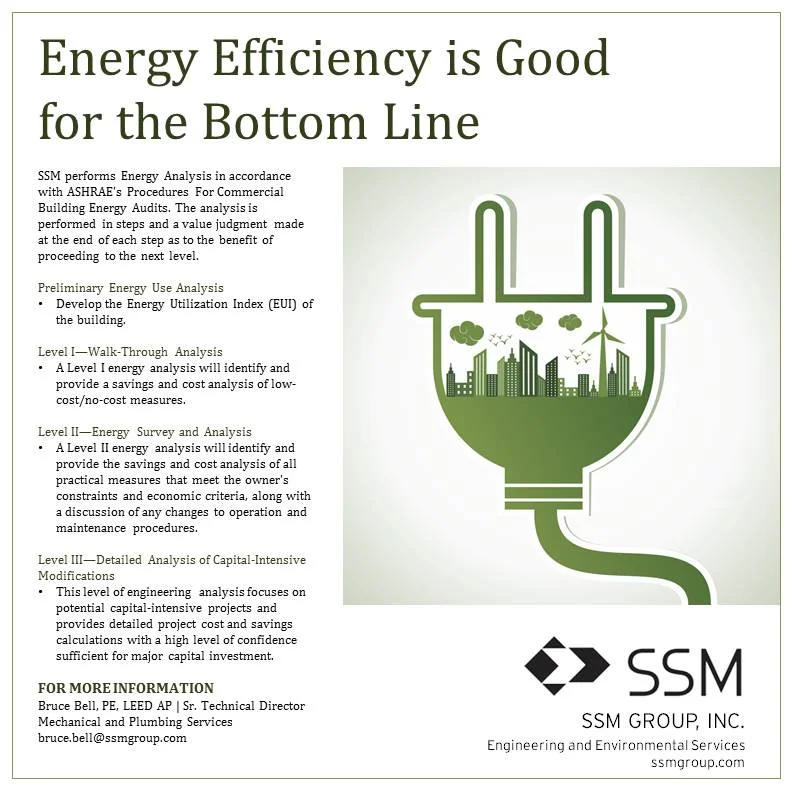
SSM performs Energy Analysis in accordance with ASHRAE's Procedures For Commercial Building Energy Audits. The analysis is performed in steps and a value judgment made at the end of each step as to the benefit of proceeding to the next level.
Preliminary Energy Use Analysis - Develop the Energy Utilization Index (EUI) of the building.
Level I Walk-Through Analysis - A Level I energy analysis will identify and provide a savings and cost analysis of low-cost/no-cost measures.
Level II Energy Survey and Analysis - A Level II energy analysis will identify and provide the savings and cost analysis of all practical measures that meet the owner's constraints and economic criteria, along with a discussion of any changes to operation and maintenance procedures.
Level III Detailed Analysis of Capital-Intensive Modifications - This level of engineering analysis focuses on potential capital-intensive projects and provides detailed project cost and savings calculations with a high level of confidence sufficient for major capital investment.
FOR MORE INFORMATION
Bruce Bell, PE, LEED AP, Sr. Technical Director, Mechanical and Plumbing Services