

Building Safety Month
A three-part series exploring engineering and environmental issues supporting Building Safety. Topics include Electrical Safety, Poor Ventilation: Impact and Solutions, and Crane Structural Safety.
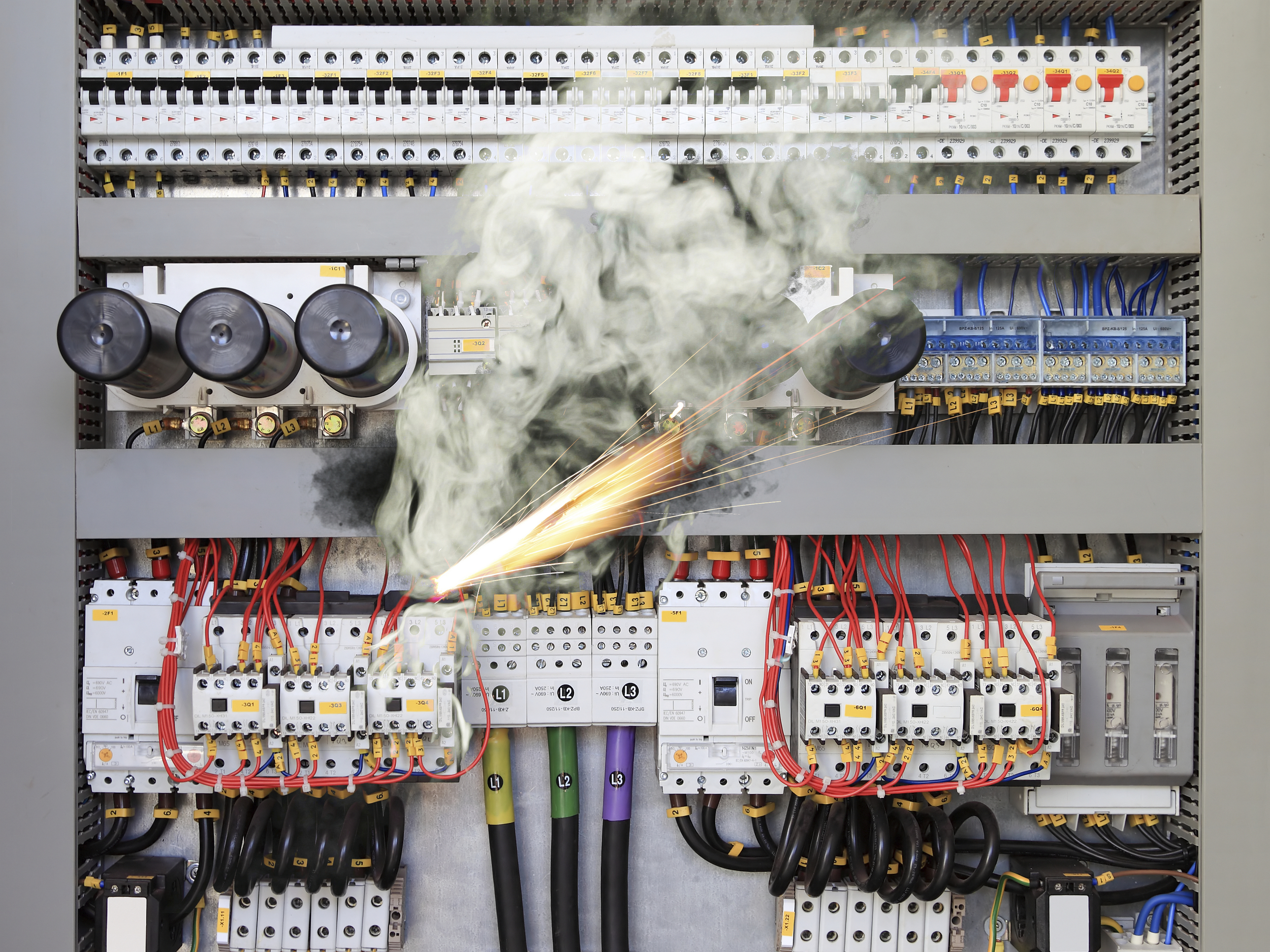
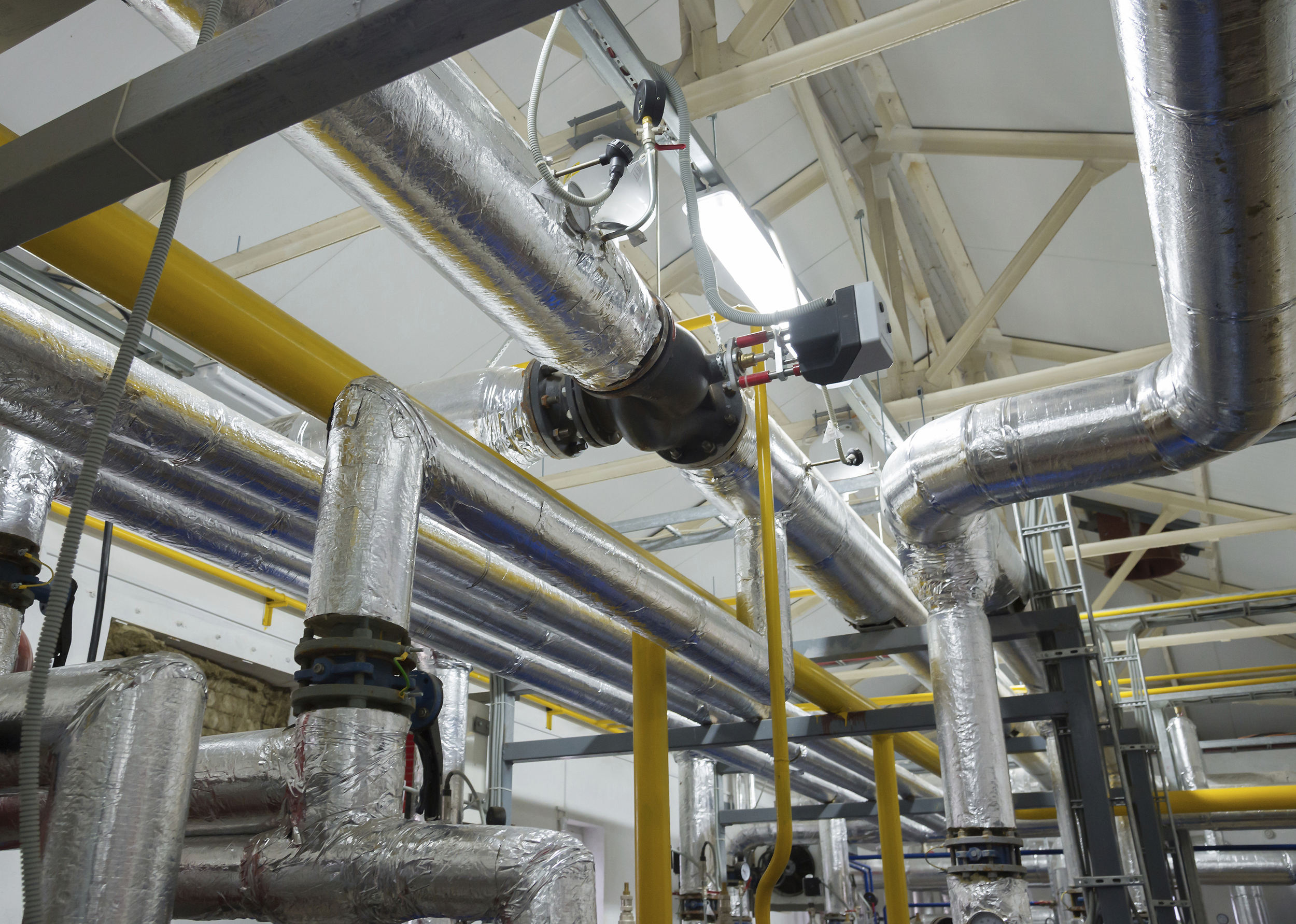
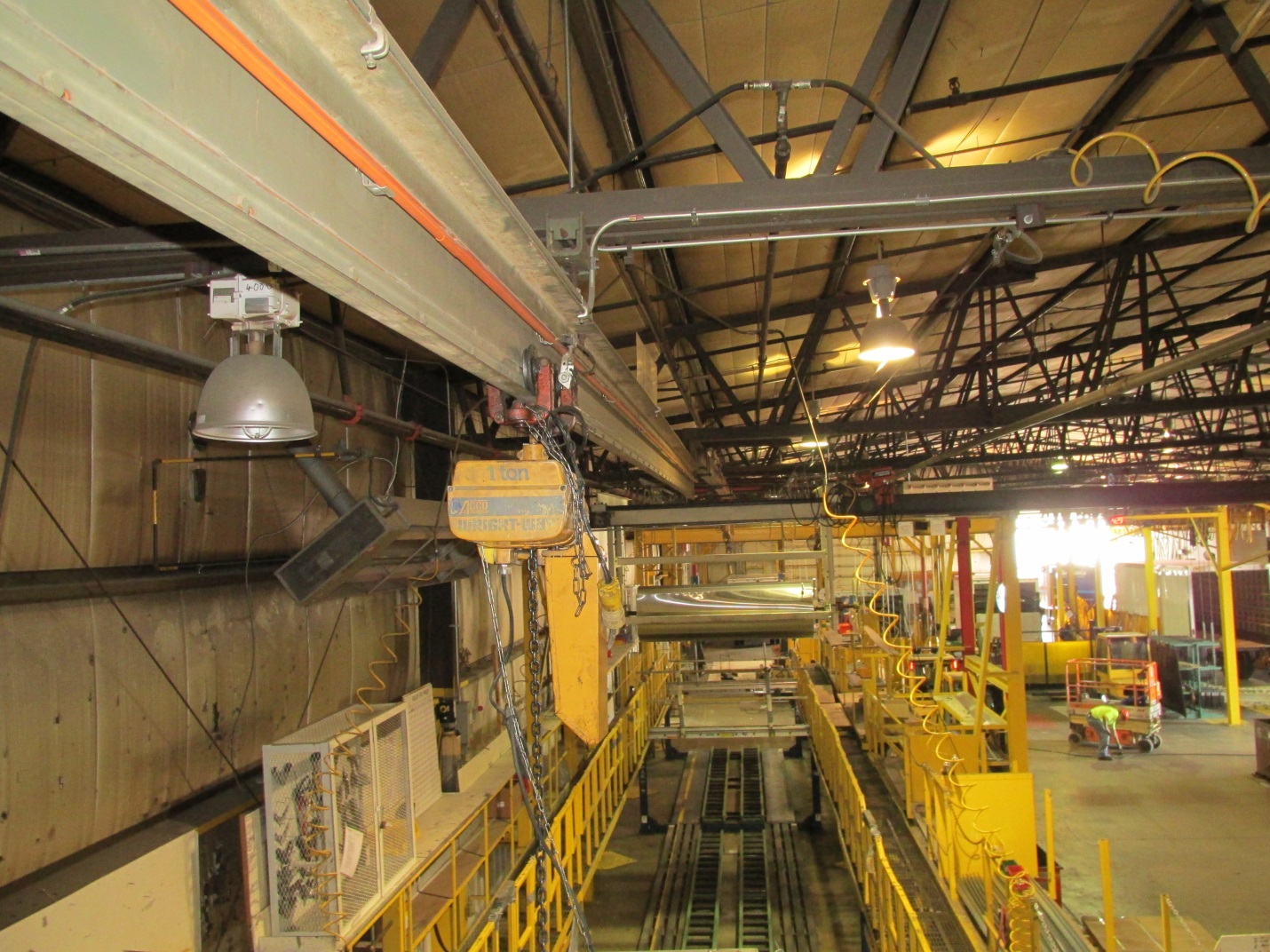
A three-part series exploring engineering and environmental issues supporting Building Safety. Topics include Electrical Safety, Poor Ventilation: Impact and Solutions, and Crane Structural Safety.
Building Safety
Safety in building construction traces to the Code of Hammurabi around 1750 BC, offering rather straightforward dis-incentives of re-work or death. A mere six rules pertained to damages due a builder for his failure to properly construct a home. Building and natural catastrophes like the Great Fire of London (1666), the Great Fire of Chicago (1871), 1906 San Francisco Earthquake, and more recent Hurricane Sandy led to voluminous developments to identify risks, create consistent standards, and changes to reflect new materials and methods.
The International Code Council’s (ICC) 2015 International Building Code contains slightly less than 700 pages; 35 chapters and 13 appendices, with the singular focus of providing a model for minimum acceptable safety standards to protect public health and welfare for every type of building occupancy. Modern codes go one step further and also provided minimum standards for sustainability related to energy consumption. And the IBC is just one of many standards and guidelines we work with in industrial, commercial, municipal projects.
Part 1: Electrical Safety
Opportunities for electrical faults and associated health risks to workers exist throughout industrial, municipal, and institutional facilities, with electrical distribution equipment and large equipment associated with manufacturing, process systems, research, HVAC, and central utility plants. The IBC by reference to the NEC (National Electrical Code) and NFPA (National Fire Protection Association) dictates that an electrical system be evaluated for Arc Flash hazards and that equipment be appropriately labeled according to the protection required. Hazards associated with electricity is a serious workplace hazard; The Electric Power Research Institute (EPRI http://www.epri.com/Pages/Default.aspx ) and National Institute for Occupational Safety and Health (NIOSH http://www.cdc.gov/niosh/) have very good videos (https://www.youtube.com/watch?v=fZP47mlELSc and https://www.youtube.com/watch?v=-RkbMdaeq0o ) describing research into arc flash and stories by those affected by incidents.
Consider your building. Have you completed an ArcFlash Hazard Analysis for the facility? Do you have a defined electrical safety program and proper training and PPE for your employees? Does your electrical equipment have warning labels that comply with NFPA 70E, OSHA, or ANSI Z 535?
We can help. SSM supports numerous clients by performing comprehensive electrical distribution and equipment assessments; conducting short circuit analysis, time current coordination studies and identifying Hazards.
FOR MORE INFORMATION: Emerick Martin, PE, Senior Electrical Engineer
Part 2: Ventilation Design
Since man began using indoor fires for heating, ventilation of indoor air has existed, and still today the primary source of indoor air quality issues result from inadequate ventilation. Contemporary building contaminants, including VOC’s and synthetic fibers from building and furnishing materials; microbials, carbon dioxide, carbon monoxide, radon, asbestos, etc. can trigger discomfort, illness, allergic reactions, and temperature and humidity both impact concentrations of certain contaminants. In broad terms, ventilation design involves natural ventilation, mechanical ventilation, or local exhaust.
Well designed and maintained HVAC systems provide thermal comfort while using outdoor air to ventilate, dilute, isolate, and exhaust odors and contaminants. The ICC, through The International Building Code (IBC), by reference to ASHRAE 55-2010, Thermal Environmental Conditions for Human Occupancy and; 62.1-2010, Ventilation for Acceptable Indoor Air Quality dictates comfort (temperature, humidity, air movement) and ventilation parameters. Comfort and ventilation standards have significantly evolved since the very early part of the 20th century when the first standards for thermal comfort and ventilation became requirements, to reflect changing patterns in building space use, outdoor pollutants, complex variety of chemicals and components in building and furnishing materials, energy conservation goals, to name a few.
Building Standards will continue to transform especially in regards to ventilation, to resolve the seemingly disparate design goals for more ventilation and lower energy consumption. Particularly interesting developments for design integration of energy simulation and CFD (computational fluid dynamics) in the design process, and occupant-specific, dynamic systems, are promising.
FOR MORE INFORMATION: Bruce Bell, PE, Senior Technical Director, Mechanical and Plumbing Engineering
Part 3: Structural Alterations and Additions
The average building life cycle of non-residential structures extends many, many years. In fact, according to the US Energy Information Administration’s (EIA) 2012 report, Commercial Buildings Energy Consumption Survey, “commercial buildings remain in use for many decades. Although about 12% of commercial buildings (comprising 14% of commercial floorspace) were built since 2003, the commercial building stock is still fairly old, with about half of all buildings constructed before 1980; the median age of buildings in 2012 was 32 years.” It’s also true that within a short period of time, buildings become functionally unsuitable, or that facilities constructed for one product or purpose evolves to serve another.
So, distinct from normal operations and maintenance activities, continuous investment in research and development, production and logistics requires that alterations, additions, reuse, reallocation of space be permitted to comply with building safety standards, including structural codes. Like the applicable zoning, electrical, mechanical, plumbing codes, the structural codes are also updated to reflect new or better understood threats to building safety. For instance, it is important that new equipment installation for research or manufacturing tools be evaluated for foundation or floor structural capacity. Similarly, a comprehensive building structural analysis may be necessary with the installation of new overhead cranes or conveying equipment installation where there exists multiple generations of similar equipment; it’s not atypical to discover that over time and staff turnover, historical knowledge of the building changes are lost.
FOR MORE INFORMATION: Patrick McCoy, PE

ARC FLASH HAZARD ANALYSIS
The Arc Flash Hazard Analysis identifies the levels of incident energy throughout the system.The Arc Flash Hazard Analysis identifies the levels of incident energy throughout the system.

The Arc Flash Hazard Analysis identifies the levels of incident energy throughout the system.
An arc flash is the result of a rapid release of energy (light and heat) due to an arcing fault between electrical conductor(s) and another electrical conductor(s) or ground with enough electrical energy to cause damage or fire, and injury. During an arc fault air becomes the conductor. A massive amount of energy discharges during the arc flash or blast. This energy burns the conductors, vaporizing the copper and thus causing an explosive volumetric increase, the arc blast. This explosion propels deadly shrapnel and molten metal as it dissipates. This rapid release of energy can cause debilitating burns, other injuries and even death. Without an Arc-Flash Hazard Analysis, employers cannot properly protect their personnel from arc-flash.
Elements of the Hazard Analysis
- Short Circuit Study- The short circuit study calculates the maximum short circuit current the electrical power system may be subjected to at each equipment location through out the distribution network from the sources such as utilities, generators, and motors. The equipment includes substations, switchgear, motor control centers, and panels with their respective over current protective devices; generators; transforms; motors; and UPS equipment. The short circuit results determine the required ratings for electrical equipmen6t to adequately sustain the fault current capacity of the system. If a short circuit occurs, the electrical power system’s available energy is directed to the point of the fault in amounts that greatly exceed the normal operating currents, and the equipment must have the ability tow withstand and interrupt these large currents until the protective device opens to clear the faulted portion of the circuit.
- Protective Device Evaluation - The protective device evaluation study determines if the equipment ratings needed to sustain the fault currents calculated by the Short Circuit Study are adequate. Each circuit breaker, bus, etc., is reviewed in regards to the available short circuit to determine that the equipment can adequately withstand the fault current.
- The Protective Device Time Current Coordination - The protective device time current coordination study reviews the relay and circuit breaker trip settings, fuses, and their operating time and current characteristics in order to properly coordinate these settings with upstream and downstream devices so that any faults are isolated to the location of the fault; hence, limiting the impact to the remaining portions of the system. The coordination study is used in an Arc Flash study to determine the length of time an arc would occur which is directly related to the incident energy associated with an arc flash event.
What the Analysis Reveals
The Hazard Analysis will identify the locations which require PPE greater than Category 0. The review determines if there are possible arc flash mitigation recommendations that can be implemented to reduce the incident energy levels. Such recommendations might include device setting changes, replacement of molded case type circuit breakers with static trip type circuit breakers, changing fuse types, or installation of additional fused disconnects or circuit breakers. As a result of reducing the incident energy levels the corresponding Category of PPE required to work on the equipment while energized is reduced.
FOR MORE INFORMATION: Emerick Martin, PE, Senior Electrical Engineer
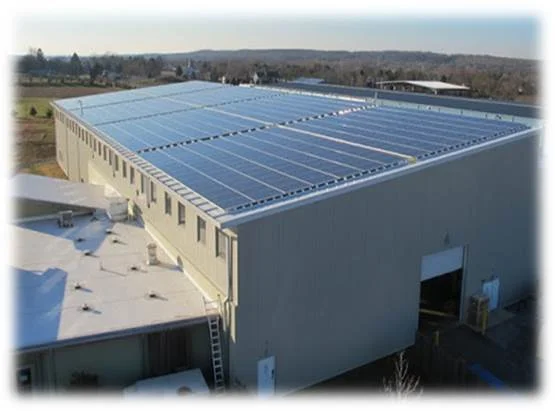
A great time to explore Solar opportunities in PA
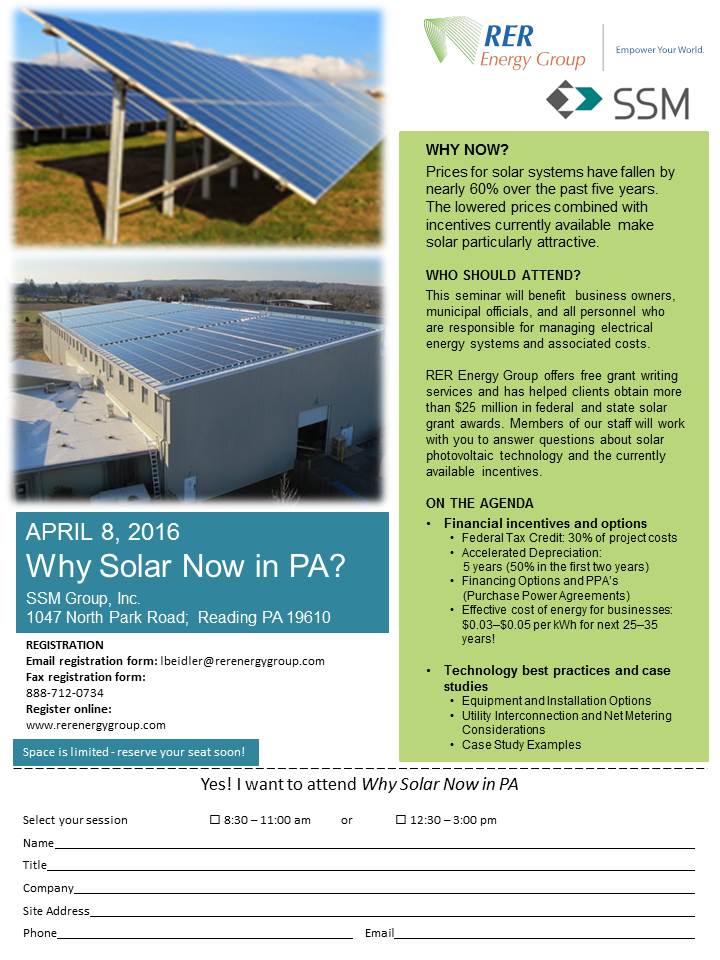
Why Solar Now in PA? Prices for solar systems have fallen by nearly 60% over the past five years. The lowered prices combined with incentives currently available make solar particularly attractive.
WHY NOW?
Prices for solar systems have fallen by nearly 60% over the past five years. The lowered prices combined with incentives currently available make solar particularly attractive
SSM Group, Inc and RER Energy Group, LLC are offering a seminar on solar photovoltaic energy for commercial, industrial, and municipal enterprises to explore the current opportunities in Pennsylvania.
WHO SHOULD ATTEND? The seminar will benefitbusiness owners, municipal officials, and all personnel who are responsible for managing electrical energy systems and associated costs.
ON THE AGENDA
Financial Incentives and Options
Federal Tax Credit: 30% of project costs
Accelerated Depreciation: 5 years (50% in the first two years)
Financing Options and PPA’s (Purchase Power Agreements)
Effective cost of energy for businesses: $0.03–$0.05 per kWh for next 25–35 years!
Technology Best Practices and Case Studies
Equipment and Installation Options
Utility Interconnection and Net Metering Considerations
Case Study Examples
SSM Group, Inc. Announces Management Changes - Brian Kelly named President and CEO



SSM Group, Inc. recently announced a corporate management restructure. Brian R. Kelly has been named President and Chief Executive Officer of the firm. Kelly, who formerly served as the company’s Executive Vice President with responsibility of running the firm’s operations, replaces J. Carlton Godlove, II, who has left the company to pursue other interests.
Kelly is one of four McCoy family members who assumed control and management of the firm in 1996. Kelly has an Associate Degree in Mechanical Engineering Technology from The Pennsylvania State University. Prior to joining the SSM management team, Kelly was employed at AT&T for more than 17 years in various roles. Kelly resides in Reading with his wife, Kay McCoy Kelly, who is a daughter of the company’s founder, Lewis J. McCoy, Sr. In a prepared statement, Kelly said, “I look forward to leading the company as we embark upon strategic growth and expansion. I am very proud of our exceptionally talented senior leadership team and all of our employees, and I am confident that, with their help and support, we will continue to grow the company and succeed at fulfilling our corporate mission – ‘Enhancing the quality of life for our clients, our employees, and all of the people touched by our work.’ Our work is so important because it touches this generation and future generations with a scope broader than we can imagine – and it leaves a legacy that will live far beyond us.”
“Approximately six months ago we appointed a team of independent professionals to work with us as members of an Advisory Board: Thomas A. Beaver, CPA, former managing partner at RKL; Patricia L. Langiotti, President of Creative Management Concepts; and Mike Shor, former executive with Carpenter. These Advisory Board members have played a key role in helping us plan for our future,” Kelly said.
Kelly also announced that shareholder, Patrick M. McCoy, PE, has been promoted to Executive Vice President. “Patrick will lead the company’s business development and sales and marketing efforts and he will be a strong right-hand man,” Kelly said. Patrick McCoy has been with the firm since 1996. He graduated from Drexel University, like his father, and holds Bachelor’s degrees in Civil Engineering and Architectural Engineering. McCoy formerly led the company’s Facilities and Site Engineering Division which provides services to worldwide companies such as IBM. Prior to joining SSM, he was with Ortega Consulting, Media, PA, and Gredell & Associates, Wilmington, DE.
Shareholder Lewis J. (Lou) McCoy, Jr. of Reading, who joined the firm in 1985, will continue in his role as Director of Human Resources.
Catherine (Kitty) Bell, who joined the firm in 2004, is being promoted to Divisional Vice President. Formerly the firm’s Vice President of Facility Engineering, she assumes an expanded role, with additional management responsibility for Site Engineering and Survey and Data Capture disciplines (formerly managed by Patrick McCoy). Bell resides in Reading, PA.
SSM Group, Inc. is an engineering and consulting firm founded by Lewis J. McCoy, Sr. in 1967. The company continues to be family owned and operated. Headquartered at 1047 North Park Road in Wyomissing with satellite offices in Harrisburg and the Lehigh Valley, SSM has just under 100 employees and provides services to various types of local, regional and national businesses that include commercial, industrial, manufacturing and telecommunications as well as healthcare and higher education institutions. The company also provides services to numerous local, regional, and county government entities. While the company’s primary market is a regional footprint including Berks County and the Lehigh Valley, SSM serves clients throughout PA and the Northeastern United States as well as to some international clients.
FOR MORE INFORMATION:
Brian Kelly, President and CEO
brian.kelly@ssmgroup.com | P: 610-621-2000
Partnership Conjures Up Real Energy Savings
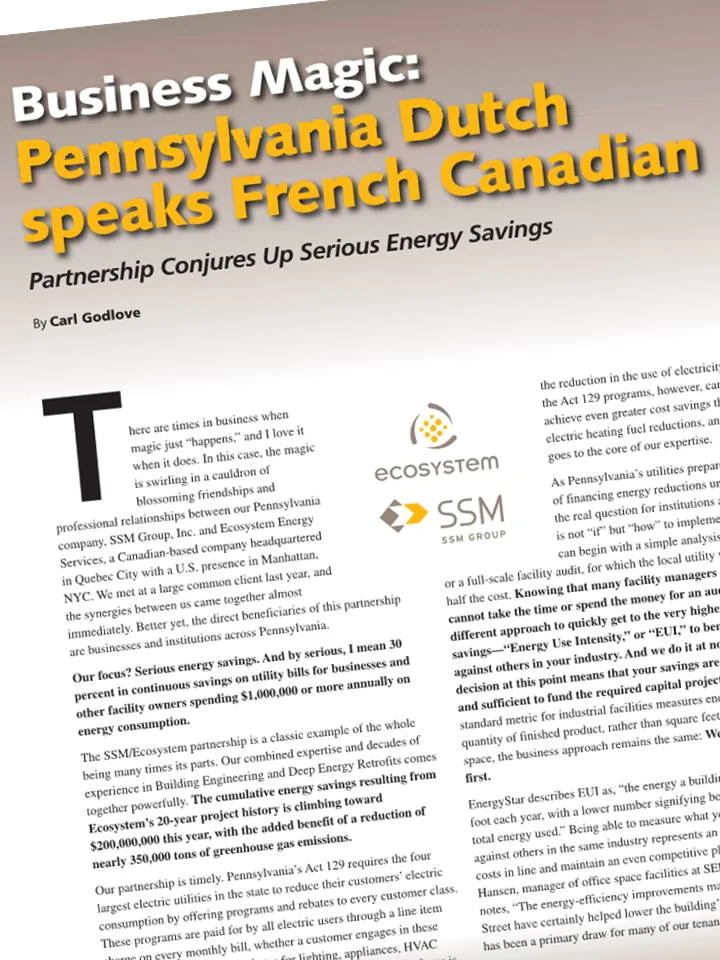
Our focus? Serious energy savings. And by serious, I mean 30% continuous savings on utility bills for businesses and other facility owners spending $1,000,000 or more annually on energy consumption.
PA CHAMBER BUSINESS AND INDUSTRY - Catalyst Magazine, Spring 2015
Business Magic – Pennsylvania Dutch speaks French Canadian
by: Carl Godlove
There are times in business when magic just “happens,” and I love it when it does. In this case, the magic is swirling in a cauldron of blossoming friendships and professional relationships between our Pennsylvania company, SSM Group, Inc. (ssmgroup.com), and Ecosystem Energy Services (ecosystem-energy.com), a Canadian-based company headquartered in Quebec City with a U.S. presence in Manhattan, NYC. We met at a large common client last year, and the synergies between us came together almost immediately. Better yet, the direct beneficiaries of this partnership are businesses and institutions across Pennsylvania.
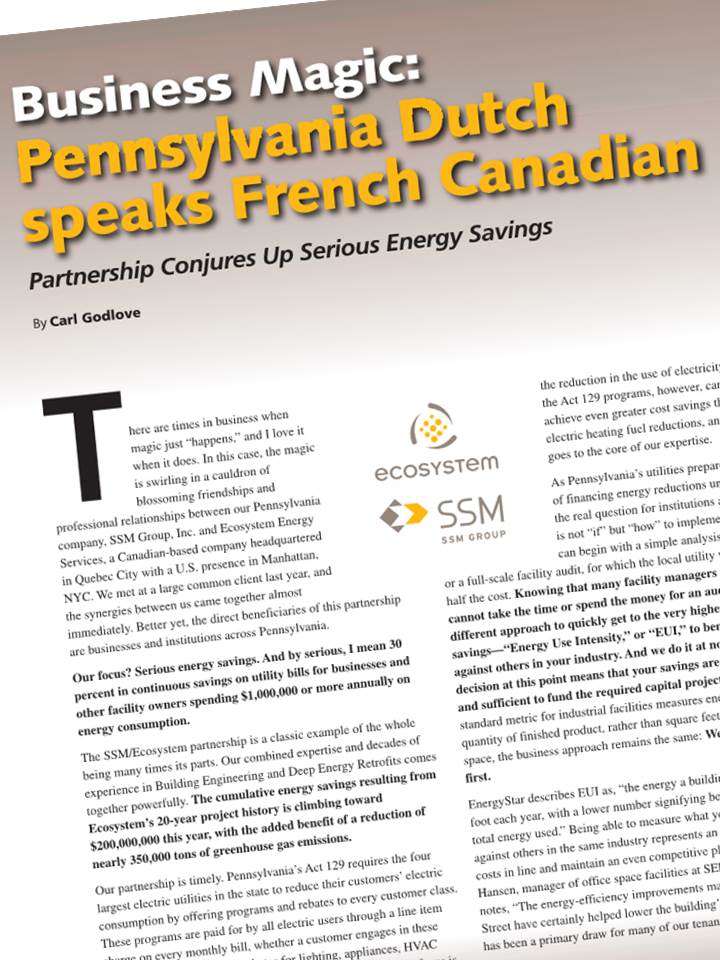
Our focus? Serious energy savings. And by serious, I mean 30% continuous savings on utility bills for businesses and other facility owners spending $1,000,000 or more annually on energy consumption.
The SSM/Ecosystem partnership is a classic example of the whole being many times its parts. Our combined expertise and decades of experience in Building Engineering and Deep Energy Retrofits comes together powerfully. The cumulative energy savings resulting from Ecosystem’s 20-year project history is climbing toward $200,000,000 this year, with the added benefit of a reduction of nearly 350,000 tons of greenhouse gas emissions.
Our partnership is timely. Pennsylvania’s Act 129 requires the four largest electric utilities in the state to reduce their customers’ electric consumption by offering programs and rebates to every customer class. These programs are paid for by all electric users through a line item charge on every monthly bill, whether a customer engages in these programs or not. There are rebates for lighting, appliances, HVAC systems, energy audits, and even self-generation. The primary focus is the reduction in the use of electricity. Several of the Act 129 programs, however, can be used to achieve even greater cost savings through non-electric heating fuel reductions, an approach that goes to the core of our expertise.
As Pennsylvania’s utilities prepare a third round of financing energy reductions under Act 129, the real question for institutions and businesses is not “if” but “how” to implement. The answer can begin with a simple analysis of energy bills or a full-scale facility audit, for which the local utility will likely pay half the cost. Knowing that many facility managers and owners cannot take the time or spend the money for an audit, we take a different approach to quickly get to the very highest value savings – “Energy Use Intensity,” or “EUI,” to benchmark your site against others in your industry. And we do it at no cost. A “Go” decision at this point means that your savings are both guaranteed and sufficient to fund the required capital projects. And while the standard metric for industrial facilities measures energy used per quantity of finished product, rather than square feet of manufacturing space, the business approach remains the same: We prove the savings first.
EnergyStar describes EUI as, “the energy a building uses per square foot each year, with a lower number signifying better efficiency and less total energy used.” Being able to measure what your facilities consume against others in the same industry represents an opportunity to keep costs in line and maintain an even competitive playing field. Peter Hansen, Manager of Office Space Facilities at SEPTA’s headquarters notes, “The energy-efficiency improvements made to 1234 Market Street have certainly helped lower the building’s operating costs. This has been a primary draw for many of our tenants.
To judge how much can be saved, we begin by calculating a site’s EUI to clarify the opportunity and solicit funding. When a hospital’s management team in New York discovered their building’s EUI was 138% the national average, they got motivated to make changes, securing $4,100,000 for an efficiency project. After implementation, their energy bills dropped by over $600,000, representing 39% in savings. Ecosystem CEO, André Rochette, notes the importance of aligning goals from the start: “Our ability to improve building performance stems from a corporate culture of collaboration and commitment to results and agile processes that let us design and build with the end result in mind. We believe we should always be held contractually responsible to our customers for those outcomes.”
SSM and Ecosystem are partners on a mission - “Enhance the Quality of Life” across Pennsylvania. Our self-funding projects not only lower operating costs and preserve capital for hospitals, schools and universities, residential and commercial complexes, manufacturers, and office and government buildings, they also create jobs and improve the environment. Our turnkey solution covers the full project lifecycle, from analysis and design through construction, commissioning, and continuous follow-up. Our partnership is not just a business... it’s a passion. Pennsylvania Dutch is officially speaking French Canadian. Let the magic begin.

Energy Efficiency is Good for the Bottom Line
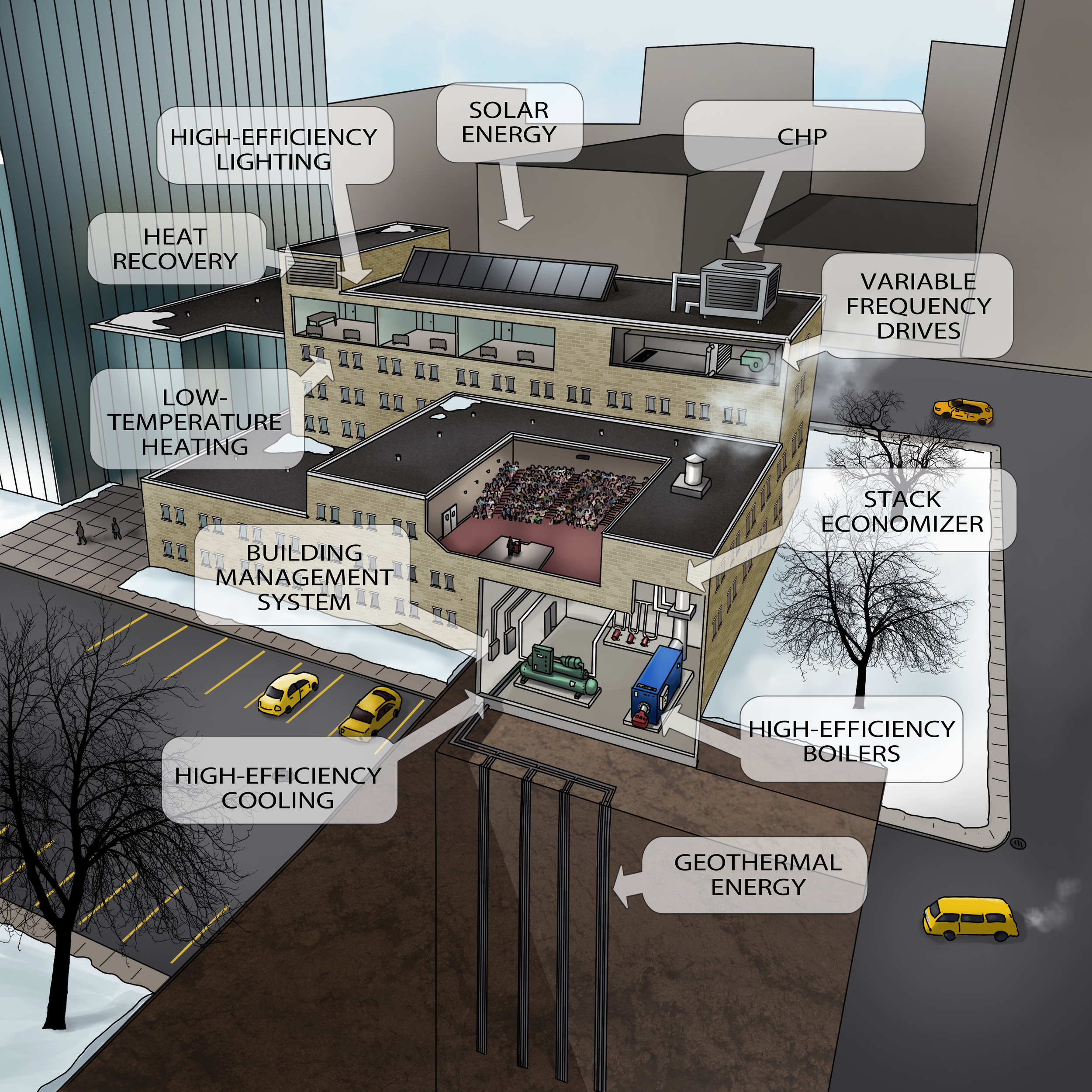
SSM performs Energy Analysis in accordance with ASHRAE's Procedures For Commercial Building Energy Audits. The analysis is performed in steps and a value judgment made at the end of each step as to the benefit of proceeding to the next level.
SSM performs Energy Analysis in accordance with ASHRAE's Procedures For Commercial Building Energy Audits. The analysis is performed in steps and a value judgment made at the end of each step as to the benefit of proceeding to the next level.
Preliminary Energy Use Analysis - Develop the Energy Utilization Index (EUI) of the building.
Level I Walk-Through Analysis - A Level I energy analysis will identify and provide a savings and cost analysis of low-cost/no-cost measures.
Level II Energy Survey and Analysis - A Level II energy analysis will identify and provide the savings and cost analysis of all practical measures that meet the owner's constraints and economic criteria, along with a discussion of any changes to operation and maintenance procedures.
Level III Detailed Analysis of Capital-Intensive Modifications - This level of engineering analysis focuses on potential capital-intensive projects and provides detailed project cost and savings calculations with a high level of confidence sufficient for major capital investment.
FOR MORE INFORMATION
Bruce Bell, PE, LEED AP, Sr. Technical Director, Mechanical and Plumbing Services