

First Presbyterian Church set to acquire Wyomissing property
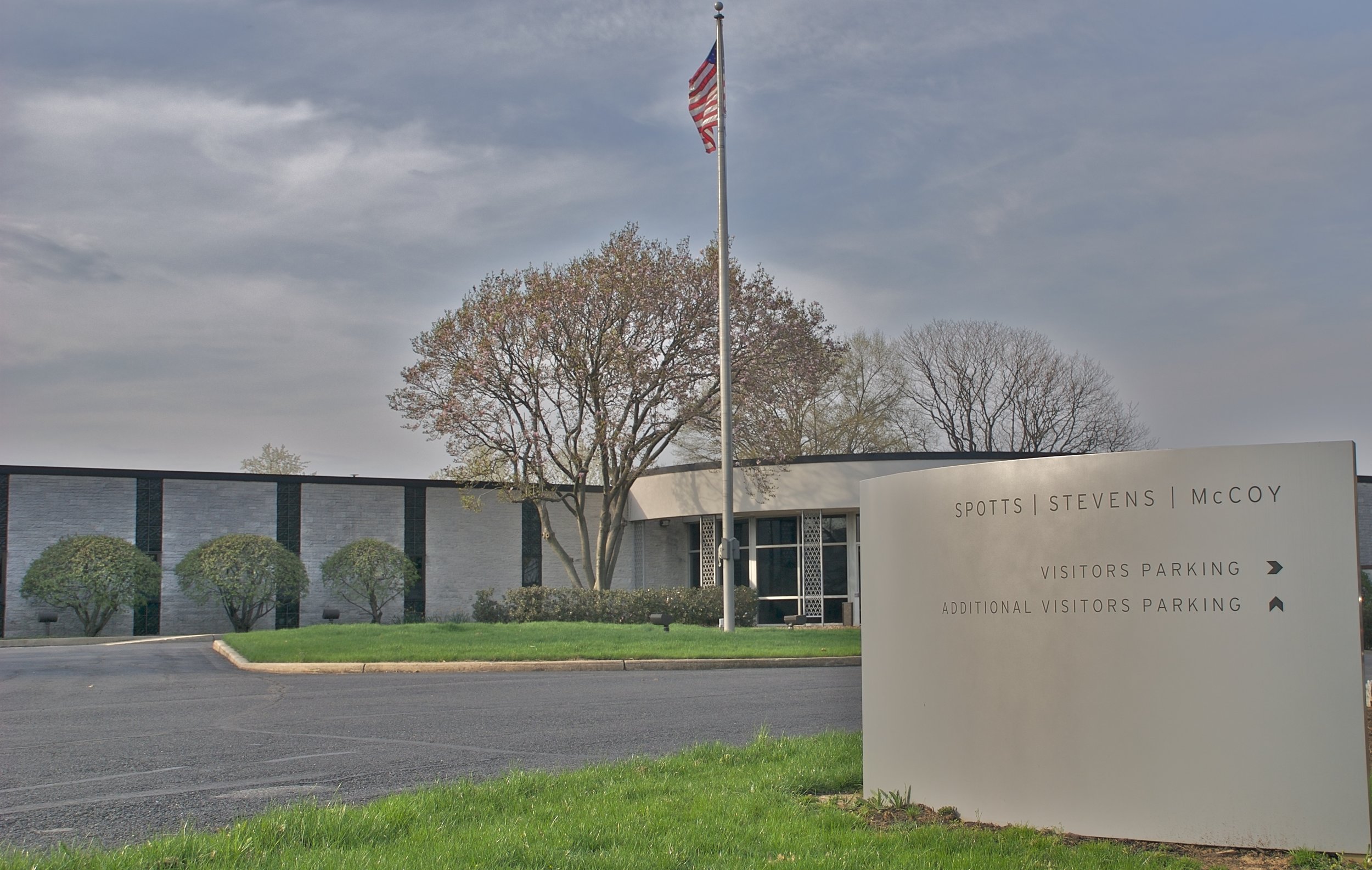
The headquarters of Spotts, Stevens and McCoy at 1047 North Park Road in Wyomissing, is expected to be the new home of the First Presbyterian Church in Reading. The church, founded in 1814, plans to lease space to SSM after purchasing the building from the consulting firm.
PRESS RELEASE: April 18, 2017
Wyomissing, PA – First Presbyterian Church set to acquire Wyomissing property owned by real estate Limited Partnership affiliated with Spotts, Stevens and McCoy (SSM).
In what is being described by both parties as a ‘union made in Heaven’ First Presbyterian Church, currently located at 37 South 5th Street in Reading and Spotts, Stevens and McCoy are jointly announcing plans for a real estate transaction whereby First Presbyterian Church is set to acquire the 1047 North Park Road, property currently occupied by Spotts, Stevens and McCoy (SSM) with plans to lease approximately half of it back to SSM. The purchase is contingent upon various approvals.
Attorney John Roland, long time member and elder at First Presbyterian Church who is a partner at Roland Stock, LLP, has provided leadership to First Presbyterian’s new site selection efforts. “Our Church is on a mission to expand our outreach efforts. This beautiful, new location will give us that opportunity,” said Roland. “Our congregation has embraced a number of changes in recent years and, following planned renovations, this facility will give us the space we need to support our membership growth goals.” First Presbyterian, founded in 1814, recently left the PC (USA) denomination to affiliate with the PC (ECU) and also just announced the calling of a new Senior Pastor, Christopher DiVietro. “We are very excited about these changes and in many ways, finding this location is an answer to prayers and the final piece of the puzzle,” said Nancy Alley, another church Session member who has been very active in the relocation process.
Brian Kelly, CEO at SSM and a partner in the real estate partnership, had the following to say: “We love our beautiful Wyomissing location and we had no desire to leave it; however, 43,000 square feet is simply more space than we need right now. So when the Church approached us about buying it and told us it was more space than they need at this time, we discussed a possible sale and lease-back situation. The result is that we’ve ended up with an Agreement that is truly a win-win for both parties. This sale unlocks resources that we can use to reinvest in the growth of the business, focusing on adding new technology and equipment and pursuing other strategic initiatives, including potential acquisitions.”
The 1047 North Park Road facility was constructed in 1963 as the world headquarters for Vanity Fair Corporation and it was subsequently renovated in 1998 and occupied by Carpenter Technology. The SSM principals purchased it in 2003. The building has just under 43,000 square feet on two levels and sits on approximately 5.5 acres of prime Wyomissing real estate.
“What makes the transaction so appealing to us is that Spotts, Stevens and McCoy will continue to occupy approximately half of the space as we embark upon our congregational growth plans,” said Roland. Current elder and former Treasurer Paul Eisenhuth notes that Presbyterians are known to be financial conservatives. “A key component of the transaction is that SSM and the Church are entering into a 5-year Lease Agreement which makes the space affordable for us. It also ensures our access to additional space as we grow.”
Spotts, Stevens and McCoy is a family owned and managed regional engineering and consulting firm with roots back to 1932. Two of the principals, Patrick McCoy and Lewis McCoy, Jr., are sons of founder, Lewis McCoy, Sr., and Kelly is a son-in-law. Both First Presbyterian Church and Spotts, Stevens and McCoy have deep roots in the Berks County community.
There are many factors that make this such a uniquely beneficial transaction for both parties:
- The SSM lease-back will provide the Church with an ongoing revenue stream as it embarks upon renovation plans and congregational growth goals. Financing is being provided by Customers Bank as the Church embarks upon a capital campaign to fund both the purchase and planned renovations. The Church will be seeking competitive bids for both design and construction work. No firm timeline for construction or occupancy has been established at this time.
- With a five-year Lease in place, SSM will be able to continue to operate from its existing headquarters location with little or no disruption to business as the Church embarks upon its renovation plans and prepares to move in
- Church offices will be open during the week; however its primary activity will occur on weekends and evenings when parking spaces are likely to be occupied by those attending scheduled worship services. SSM’s primary business activity will occur on week days during normal business hours and its employees will be off on weekends.
An answer to prayers? A partnership made in Heaven? The ‘joining’ of two old and well-established organizations? Laying all spiritual beliefs aside, it certainly appears to be a transaction that capitalizes on every possible benefit for both the Church and SSM. So at a minimum, it’s a win-win!
FOR ADDITIONAL INFORMATION:
- First Presbyterian Church - John Roland, Esq. | 610-372-5588
- Spotts, Stevens and McCoy – CEO, Brian Kelly | 610-621-2000
- Patricia Langiotti, Creative Management Concepts | 610-603-0306

Sam Zook, SIT Receives Certification as Drone Pilot
Sam Zook, SIT is the third surveyor at SSM to receive certification as a Drone Pilot.

Sam Zook, SIT, Surveyor has received his certification as a FAA Certified Remote Pilot. Zook is one of three certified pilots at SSM. He is a 2009 graduate of Pennsylvania College of Technology.
On June 21st, 2016 the FAA finalized a new regulatory framework for small, unmanned aerial systems. Titled Part 107, these new regulations created a new drone certification process that covers the majority of low-risk, commercial UAS flight operations for all commercially operated drones. Commercial refers to any kind of flight operation that can be tied to economic benefit. These new regulations were implemented on August 29, 2016.


Spottlight on Resolutions for the New Year
New Year’s is the perfect time of year to reflect on areas where you’d like to see a change in your organization and to take steps to achieve those improvements.

The Tradition of Resolutions
From losing weight to saving more money, from learning to knit to running a marathon, from spending more time with family to quitting smoking . . . the practice of making New Year’s resolutions is a worldwide tradition that’s steeped in history. Four thousand years ago in ancient Babylonia the people held celebrations in honor of the new year. They affirmed their loyalty to their king and made promises to the gods to pay their debts and returned borrowed objects. In return for keeping these promises, the gods would bestow favor on them for the coming year. In ancient Rome, the new year was a symbolic time to look at the previous year and ahead to the future. Friends settled differences and people exchanged gifts like pears or sweets as wishes for a sweet new year. We’d like to wish you a Sweet New Year and invite you to take advantage of our business relationships and enjoy an assortment of treats representing some of our clients.
Click here to request a free Taste of SSM.
Business Resolutions
New Year’s is the perfect time of year to reflect on areas where you’d like to see a change in your organization and to take steps to achieve those improvements. Let’s face it – a resolution looks a lot like a goal. You set an objective, outline a plan, and take action. So why not resolve to make some changes in your organization?
- Think about what you want to achieve.
- Say it out loud.
- Ask for help.
Resolution: Focus on the Core
It takes a lot to make and market a product. It also takes a lot to assure regulatory compliance as well as address needs such as increased capacity, routine maintenance and facility expansion. That's why manufacturers of everything from chocolate to steel turn to SSM when it comes time to secure prime locations, plan more efficient warehouses and distribution centers, conduct feasibility studies, upgrade utilities and building systems, improve traffic flow and expand operations. By taking the lead on the facilities engineering side, we enable manufacturers to focus more on their core business.
Resolution: Stop Wasting Energy
Are you faced with hot spots, cold spots, and a basic mismatch of providing more nominal cooling than necessary? Whether you use underfloor air distribution or “in the space” cooling, getting the air to the load has been a trial and error undertaking usually resulting in oversized cooling capacity and less floor space. The overlooked fundamental issue is air distribution.
We utilize CFD analysis to optimize the cooling system and layout. The data power load and the cooling system are matched and arranged to achieve maximum energy efficiency. This keeps the cost of cooling both in equipment and operation down while maximizing the data load capability. We create a model that replicates the physical data center layout including power densities and cooling equipment locations and capabilities and the analysis is run to determine the resulting temperatures and airflows in the space. Using programs specifically designed for use in analyzing air movement and heat transfer, we can create a virtual simulation of the conditions within the data center. The CFD analysis is a valuable tool for data center design that can save time and money by taking the guess work out of rack layout and cooling airflow design.

Spottlight on Fire Prevention - October 2016
Spottlight on . . . Fire Prevention
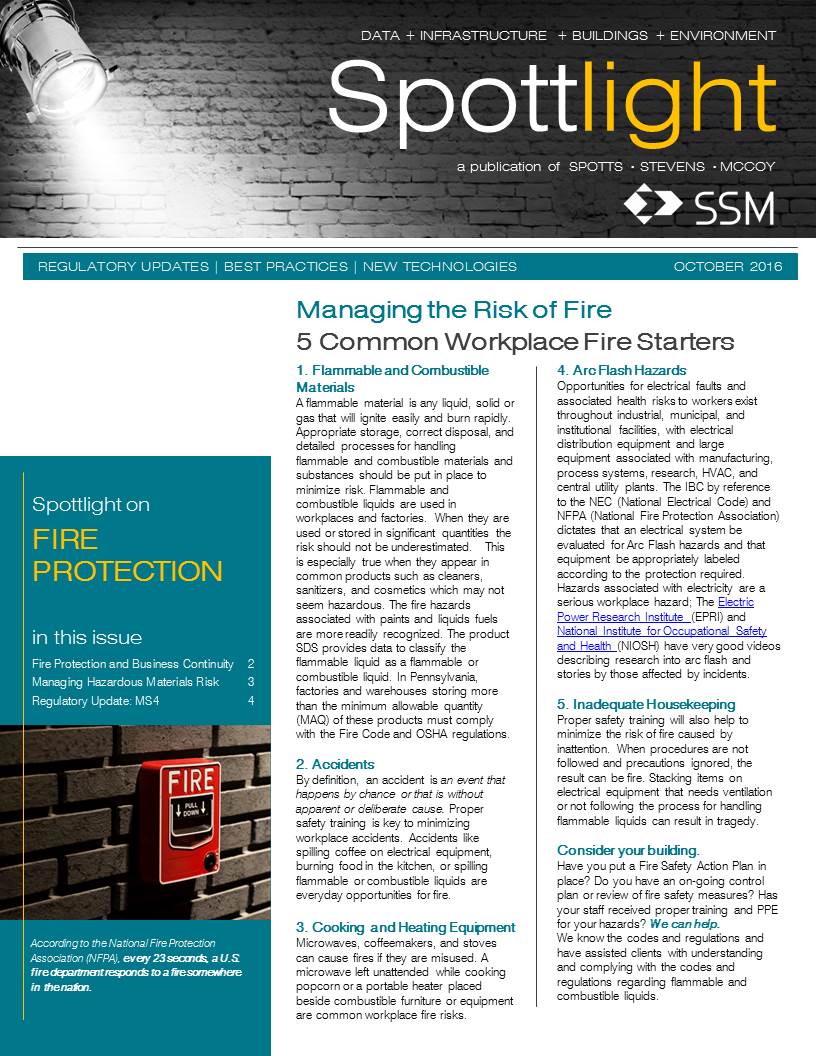
Managing the Risk of Fire: 5 commonplace workplace fire starters
- Flammable and Combustible Materials
- Accidents
- Cooking and Heating Equipment
- ArcFlash Hazards
- Inadequate Housekeeping
Mitigating the Risk Associated with Hazardous Materials
The storage, issue, use, and disposal of flammable and combustible materials falls under the rules and regulations promulgated under OSHA and the National Fire Protection Association.
The Hazard Communication Standard
(29 CFR 1910.1200(g)) was revised in 2012 to require that the chemical manufacturer, distributor, or importer provided Safety Data Sheets (SDSs), formerly MSDSs or Material Safety Data Sheets, for each hazardous chemical to downstream users to communicate information on these hazards. The information contained in the SDS is largely the same as the MSDS, except now the SDSs are required to be presented in a consistent user-friendly, 16-section format.
Fire Protection Critical to Business Continuity
Fire protection systems are essential to the safety of your employees and protection of your property. But more than that, these systems are essential in helping you to manage the risks associated with business continuity. Imagine the impact on your business or organization if a key production line were to go off-line for an extended period of time, if the runoff from a fire event were to cause an environmental impact, or if the assets in your building (from equipment to historical artefacts) were to be destroyed.
Regulatory Update: Preparing for MS4 Regulations
Under the new Municipal Separate Storm Sewer Systems (MS4) regulations that will take effect in 2018, new permittees will need to comply with additional obligations to meet the revised general stormwater permit requirements under PAG-13. Municipal employees, engineers, and contractors can prepare by reviewing the updated Minimum Control Measures (MCMs), and organizing current practices and training to determine possible gaps that fall short of their permit conditions.

Spottlight - September 2016
Spottlight on Building Safety
Building Safety
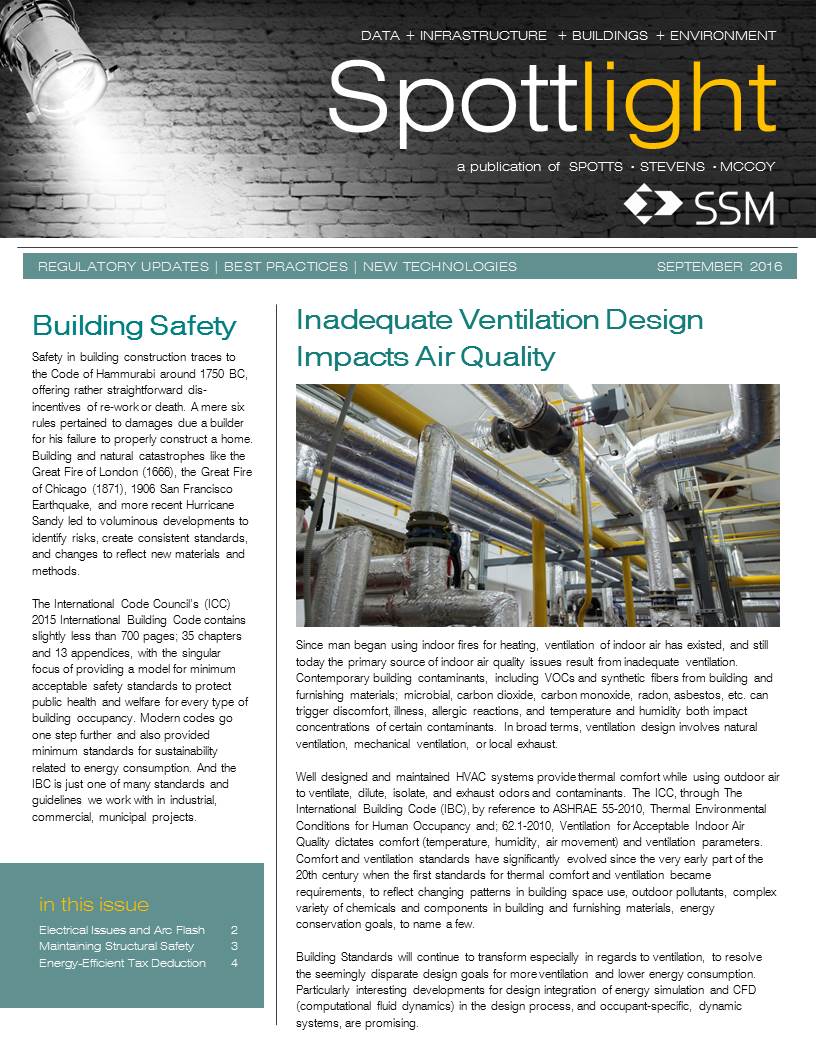
Safety in building construction traces to the Code of Hammurabi around 1750 BC, offering rather straightforward dis-incentives of re-work or death. A mere six rules pertained to damages due a builder for his failure to properly construct a home. Building and natural catastrophes like the Great Fire of London (1666), the Great Fire of Chicago (1871), 1906 San Francisco Earthquake, and more recent Hurricane Sandy led to voluminous developments to identify risks, create consistent standards, and changes to reflect new materials and methods.
The International Code Council’s (ICC) 2015 International Building Code contains slightly less than 700 pages; 35 chapters and 13 appendices, with the singular focus of providing a model for minimum acceptable safety standards to protect public health and welfare for every type of building occupancy. Modern codes go one step further and also provided minimum standards for sustainability related to energy consumption. And the IBC is just one of many standards and guidelines we work with in industrial, commercial, municipal projects.
Inadequate Ventilation Design Impacts Air Quality
Since man began using indoor fires for heating, ventilation of indoor air has existed, and still today the primary source of indoor air quality issues result from inadequate ventilation. Contemporary building contaminants, including VOCs and synthetic fibers from building and furnishing materials; microbial, carbon dioxide, carbon monoxide, radon, asbestos, etc. can trigger discomfort, illness, allergic reactions, and temperature and humidity both impact concentrations of certain contaminants. In broad terms, ventilation design involves natural ventilation, mechanical ventilation, or local exhaust.
Electrical Engineering Issues Supporting Building Safety
Opportunities for electrical faults and associated health risks to workers exist throughout industrial, municipal, and institutional facilities, with electrical distribution equipment and large equipment associated with manufacturing, process systems, research, HVAC, and central utility plants. The IBC by reference to the NEC (National Electrical Code) and NFPA (National Fire Protection Association) dictates that an electrical system be evaluated for Arc Flash hazards and that equipment be appropriately labeled according to the protection required.
Hazards associated with electricity is a serious workplace hazard; The Electric Power Research Institute (EPRI) and National Institute for Occupational Safety and Health (NIOSH) have very good videos describing research into arc flash and stories by those affected by incidents.
Maintaining Building Safety While Modifying Footprint and Function
The average building life cycle of non-residential structures extends many, many years. In fact, according to the US Energy Information Administration’s (EIA) 2012 report, Commercial Buildings Energy Consumption Survey, “commercial buildings remain in use for many decades. Although about 12% of commercial buildings (comprising 14% of commercial floor space) were built since 2003, the commercial building stock is still fairly old, with about half of all buildings constructed before 1980; the median age of buildings in 2012 was 32 years.” It’s also true that within a short period of time, buildings become functionally unsuitable, or that facilities constructed for one product or purpose evolves to serve another.
Regulatory Updates:
Tax Code: Section 179-D - Energy-Efficient Commercial Building Deduction
National BIM Guide for Owners Now Available for Public Review

Sinkholes and Why They Matter
Sinkholes can be dangerous in many ways. They can cause damage to the foundation of a building, they serve as conduits for surficial contaminants to reach groundwater, and they can cause damage to buried services like water lines and electrical conduits according to Conserve Energy Future. Knowing the risk of sinkhole formation is key to minimizing possible damages.

Sinkholes can be dangerous in many ways.

MEASURING SINKHOLE POTENTIAL RISK
Karst is defined as “a terrain, generally underlain by limestone, in which the topography is chiefly formed by the dissolving of rock, and which is commonly characterized by Karren, closed depressions, subterranean drainage, and caves” by the Geological Survey Water-Supply Paper 1899. Each component listed above (Karren, closed depressions, subterranean drainage, and caves) are considered karst features, but most importantly, sinkholes are considered karst features.
Sinkholes can be dangerous in many ways. They can cause damage to the foundation of a building, they serve as conduits for surficial contaminants to reach groundwater, and they can cause damage to buried services like water lines and electrical conduits according to Conserve Energy Future. Knowing the risk of sinkhole formation is key to minimizing possible damages.
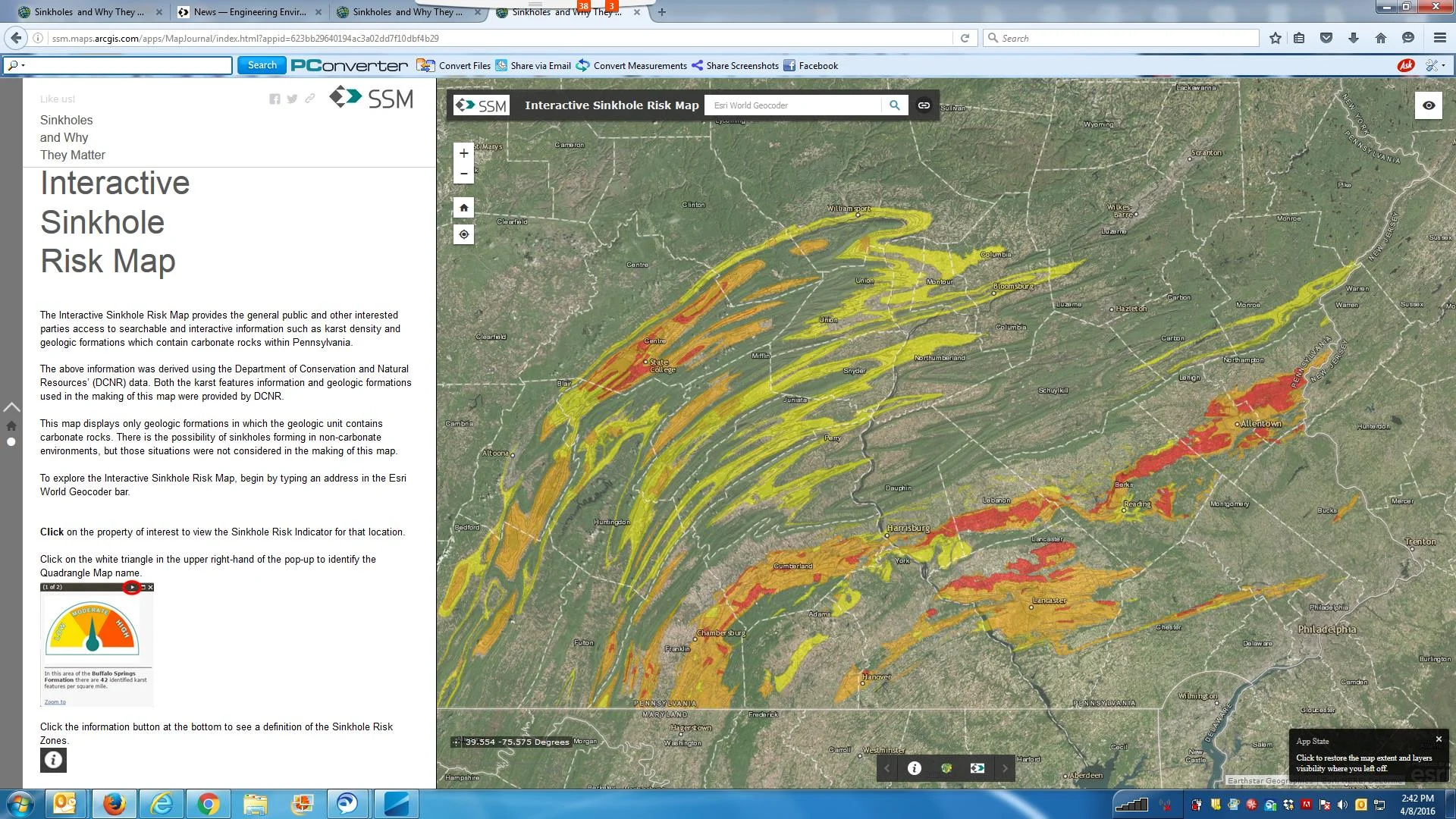
Since the amount of karst features in an area can be related to the occurrence of sinkholes, an interactive sinkhole risk map was created using the density of karst features within a geologic formation.
Interactive Sinkhole Risk Map
The Interactive Sinkhole Risk Map provides access to searchable and interactive information such as karst density and geologic formations which contain carbonate rocks within Pennsylvania. The map displays only geologic formations in which the geologic unit contains carbonate rocks. There is the possibility of sinkholes forming in non-carbonate environments, but those situations were not considered in the making of this map. Explore the Interactive Sinkhole Risk Map to view the Sinkhole Risk for any location.
If a sinkhole evaluation of a location is desired, SSM Group, Inc. has multiple professionals on staff with years of experience in sinkhole risk evaluations. Feel free to contact SSM Group, Inc. to learn more.

PEDA 2016 Spring Legislative Conference
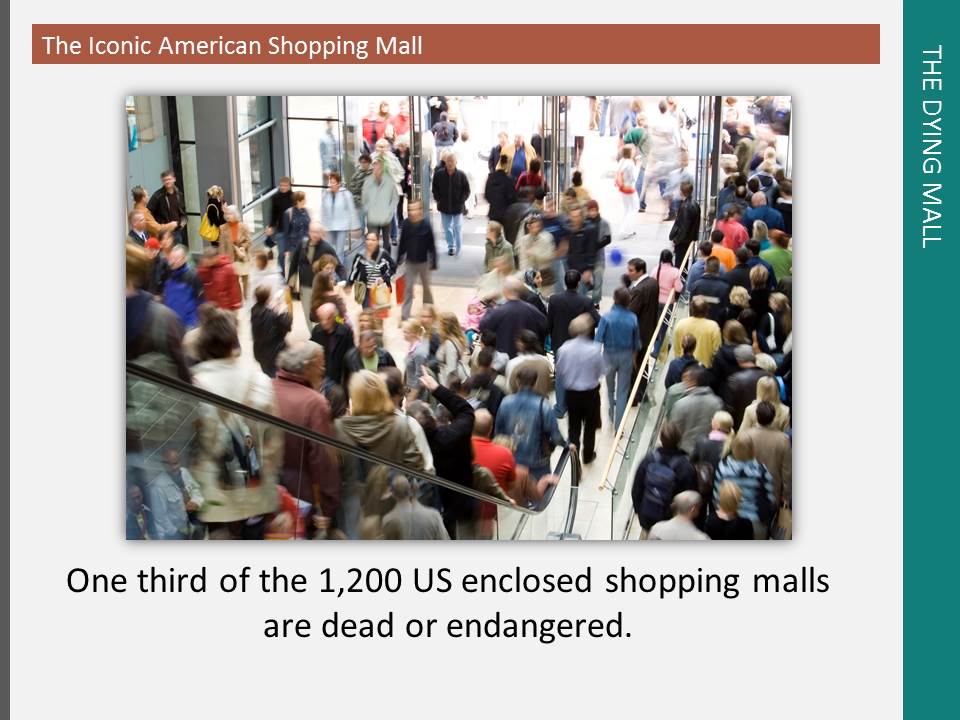
One third of the 1,200 US enclosed shopping malls are dead or endangered.

The Dying Mall: Reinventing Shopping Malls to Revitalize the Community
What’s to become of the shell of America’s shopping mall history?
Malls with high vacancy rates, low consumer traffic, no anchor store, or dated and deteriorating structures are considered ‘dead.’ Green Street Advisors report there are approximately 1,200 enclosed malls across the country and 15% of those malls will fail or be converted into non-retail space within the next 10 years. Online shopping, the recession, and demographic shifts are the key factors leading to this death toll. A change to the way we shop has led some mall owners to change the set-up of their mall, re-arranging like stores together, adding new anchors (like Apple stores) or new features (like daycare or children’s play areas) and changing the food court to a dining terrace with upgrades from fast food to sushi bars. While these approaches may save some shopping malls, the hard truth remains that many of these malls will not return to the glory of their past; but will instead close leaving behind a gigantic concrete shell on an island of macadam.
We'll be talking about the revitalization efforts at the PEDA 2016 Spring Conference!
For more information:
Terry Reed, Vice President Business Development
Snow and Your Roof
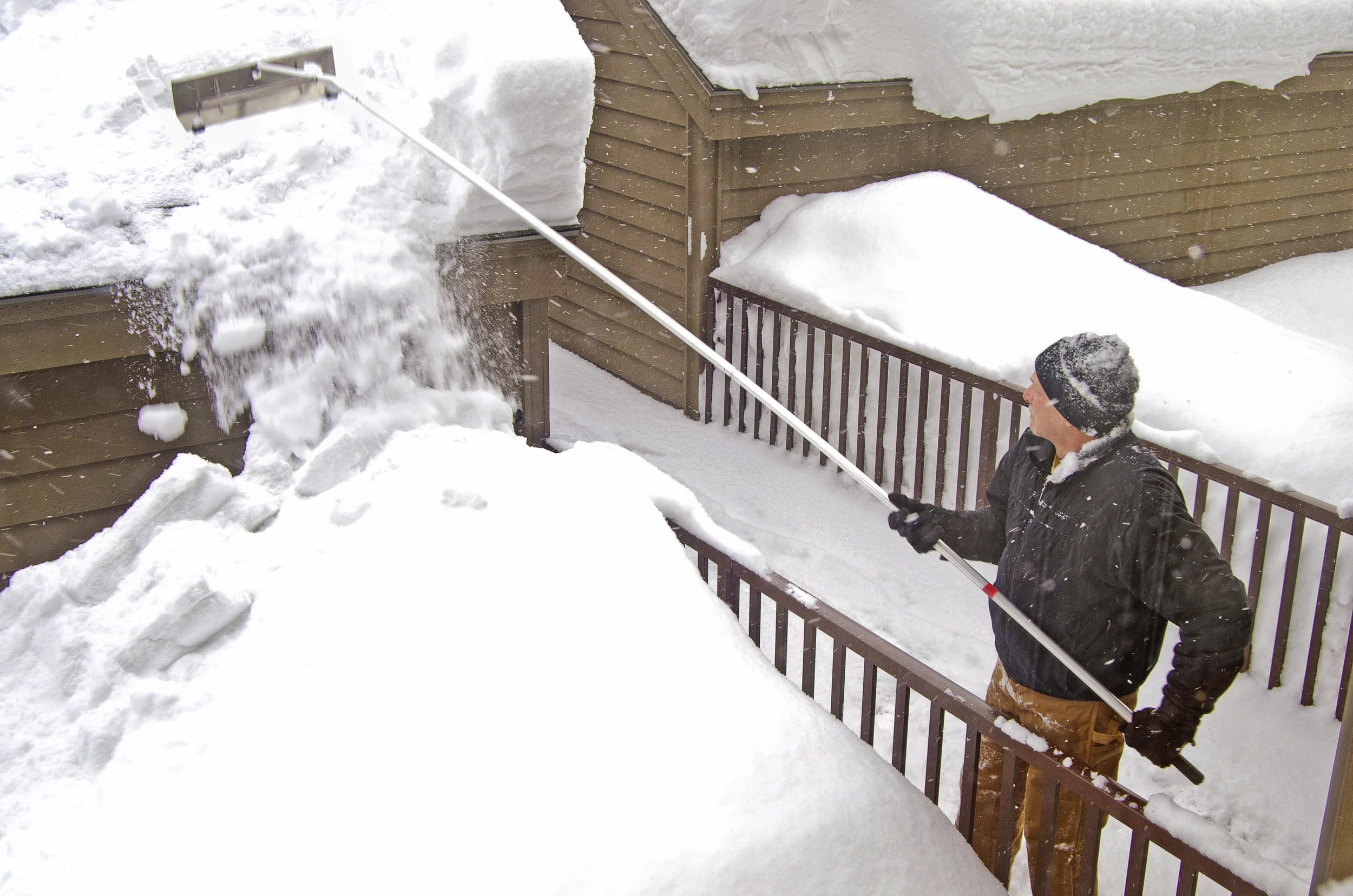
The snow is deep and as the weather begins to creep out of freezing, the addition of rain or snow melt into the mix can become a real threat. While all exposed roofs could be at risk, older flat roofs and roofs with poor drainage are the most susceptible to collapse due to snow.

With winter weather well under way, we can't help but raise our eyes to our roofs, and notice the snow piling up. The snow is getting deeper, and as the weather begins to creep out of freezing, the addition of rain or snow melt into the mix can become a real threat. While all exposed roofs could be at risk, older flat roofs and roofs with poor drainage are the most susceptible to collapse due to snow.
Newer roofs should have been designed for the minimum snow load as prescribed in the International Building Code, and the ASCE 7 – Minimum Design Loads for Buildings and Other Structures. Typically in the Berks County area, the design ground snow load is 30 pounds per square foot (PSF), which equates to just over 20 inches of dense snow. Additional snow load needs to be considered where snow from an adjacent sloped roof can slide onto a lower roof. Also, additional load from drifting snow must be considered when portions of the roof abut parapets, roof top equipment or higher roofs. Lastly, rain-on-snow surcharge can add 5 PSF for every inch of rain that is retained on the roof by the snow or poor drainage.
If you think your roof is at risk, you should contact a structural engineer to evaluate your roof condition. It may be necessary to remove some of the accumulated snow, clear roof drains, or provide temporary shoring to lessen the burden on the structural members. The removal of snow can be very dangerous, and is a job best left to a professional.
Tim East joins SSM Group

SSM welcomes Timothy East as Graduate Engineer in our Mechanical, Electrical and Plumbing Engineering Department. Tim is responsible for mechanical design and preparation of scope, plans, and specifications for industrial, commercial and institutional building projects. He received his BS in Mechanical Engineering from Wilkes University.
SSM Group Overview of Services
SSM Group Overview of Services
Solutions
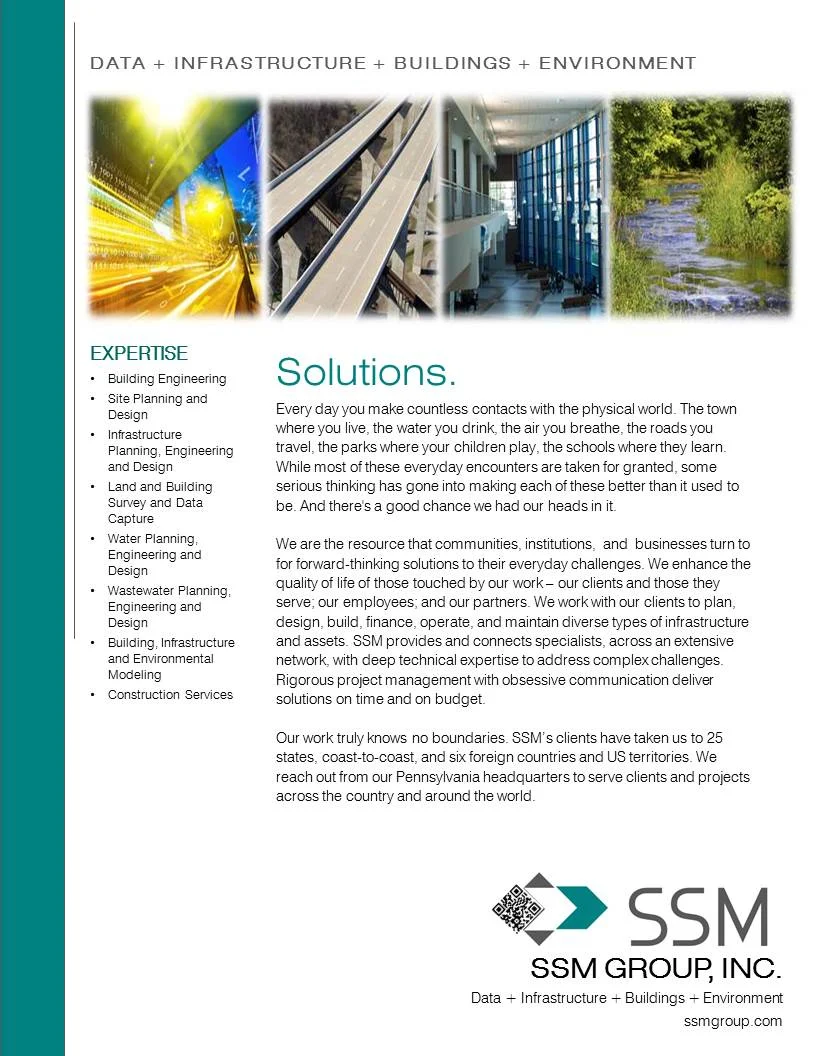
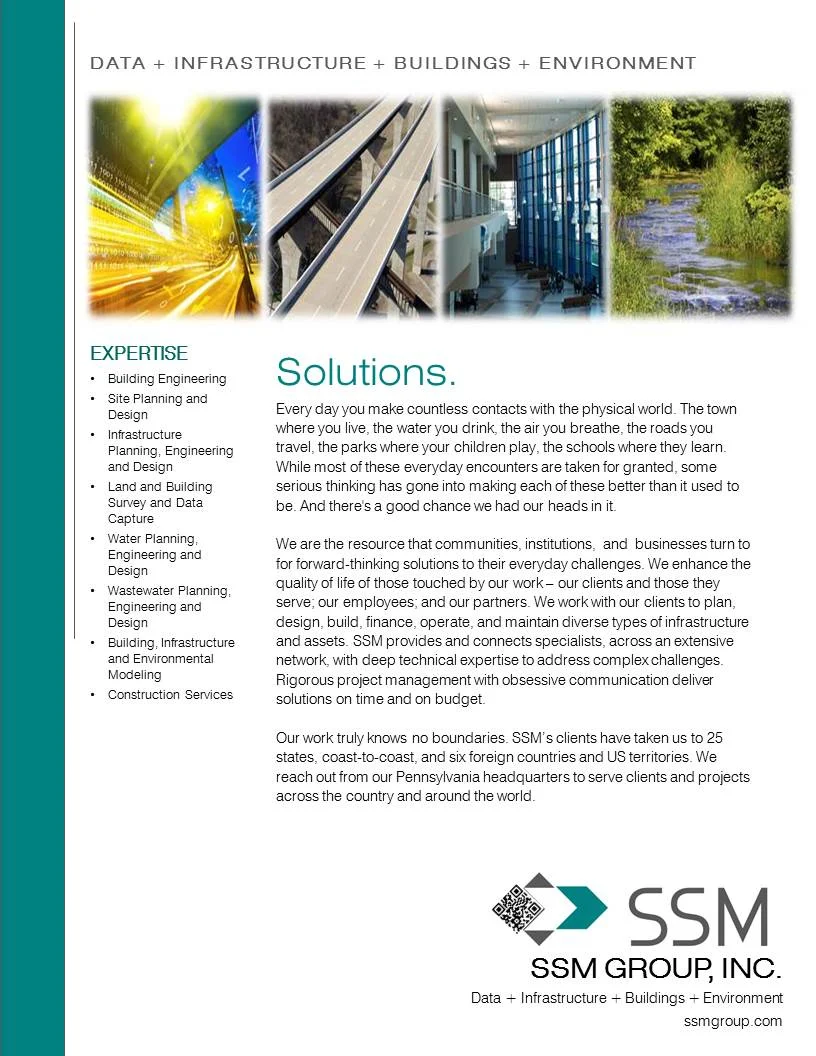
We are the resource that communities, institutions, and businesses turn to for forward-thinking solutions to their everyday challenges. We enhance the quality of life of those touched by our work – our clients and those they serve; our employees; and our partners. We work with our clients to plan, design, build, finance, operate, and maintain diverse types of infrastructure and assets. SSM provides and connects specialists, across an extensive network, with deep technical expertise to address complex challenges. Rigorous project management with obsessive communication deliver solutions on time and on budget.
Our work truly knows no boundaries. SSM’s clients have taken us to 25 states, coast-to-coast, and six foreign countries and US territories. We reach out from our Pennsylvania headquarters to serve clients and projects across the country and around the world.
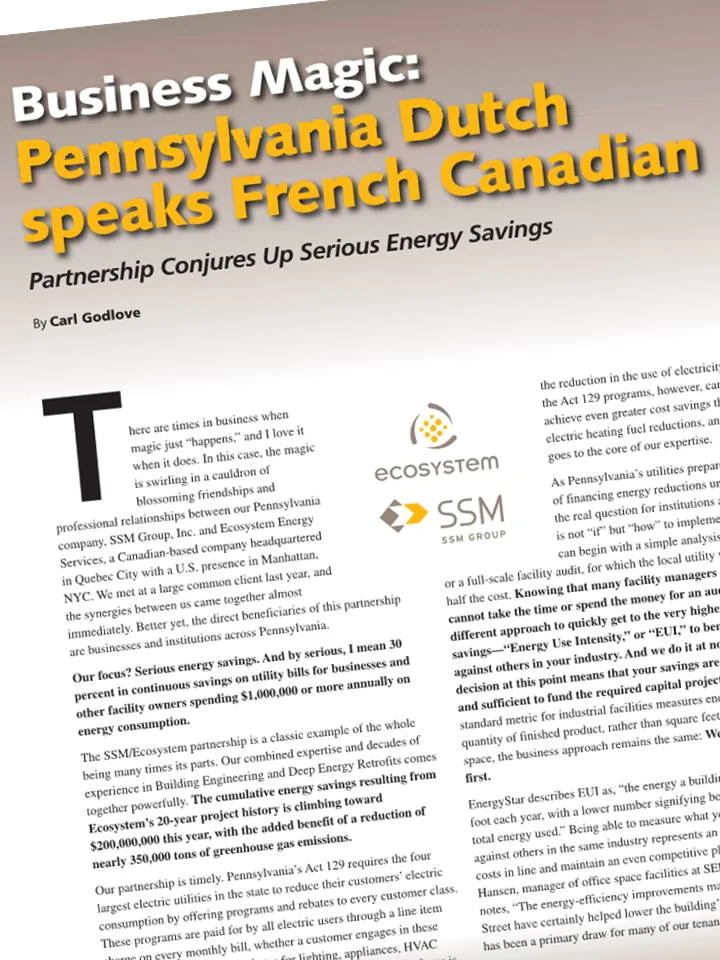
Partnership Conjures Up Real Energy Savings
Our focus? Serious energy savings. And by serious, I mean 30% continuous savings on utility bills for businesses and other facility owners spending $1,000,000 or more annually on energy consumption.
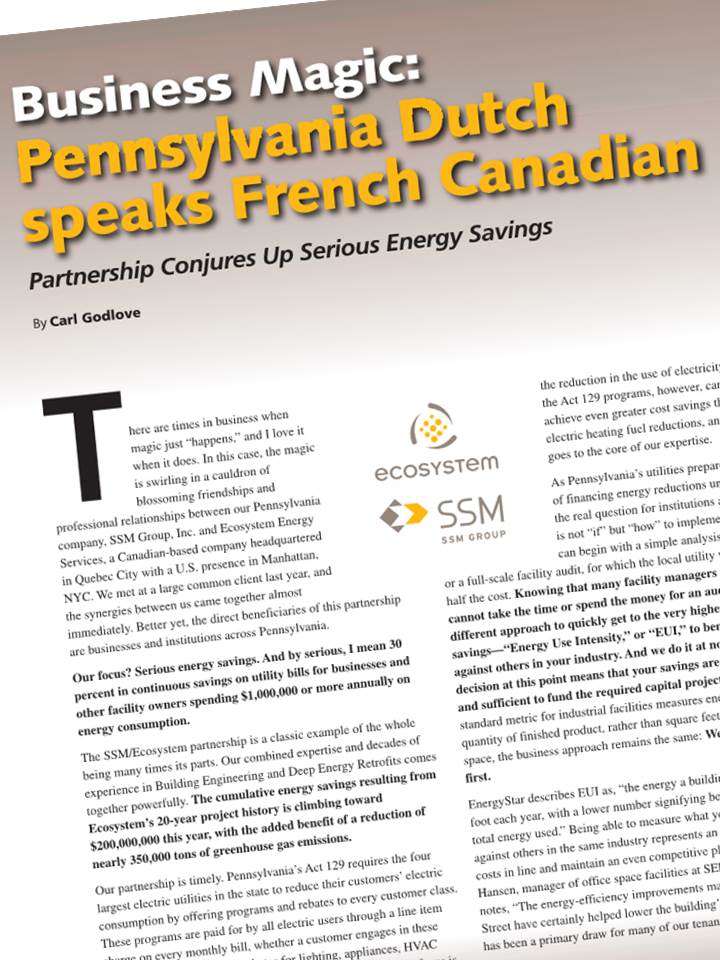
PA CHAMBER BUSINESS AND INDUSTRY - Catalyst Magazine, Spring 2015
Business Magic – Pennsylvania Dutch speaks French Canadian
by: Carl Godlove
There are times in business when magic just “happens,” and I love it when it does. In this case, the magic is swirling in a cauldron of blossoming friendships and professional relationships between our Pennsylvania company, SSM Group, Inc. (ssmgroup.com), and Ecosystem Energy Services (ecosystem-energy.com), a Canadian-based company headquartered in Quebec City with a U.S. presence in Manhattan, NYC. We met at a large common client last year, and the synergies between us came together almost immediately. Better yet, the direct beneficiaries of this partnership are businesses and institutions across Pennsylvania.
Our focus? Serious energy savings. And by serious, I mean 30% continuous savings on utility bills for businesses and other facility owners spending $1,000,000 or more annually on energy consumption.
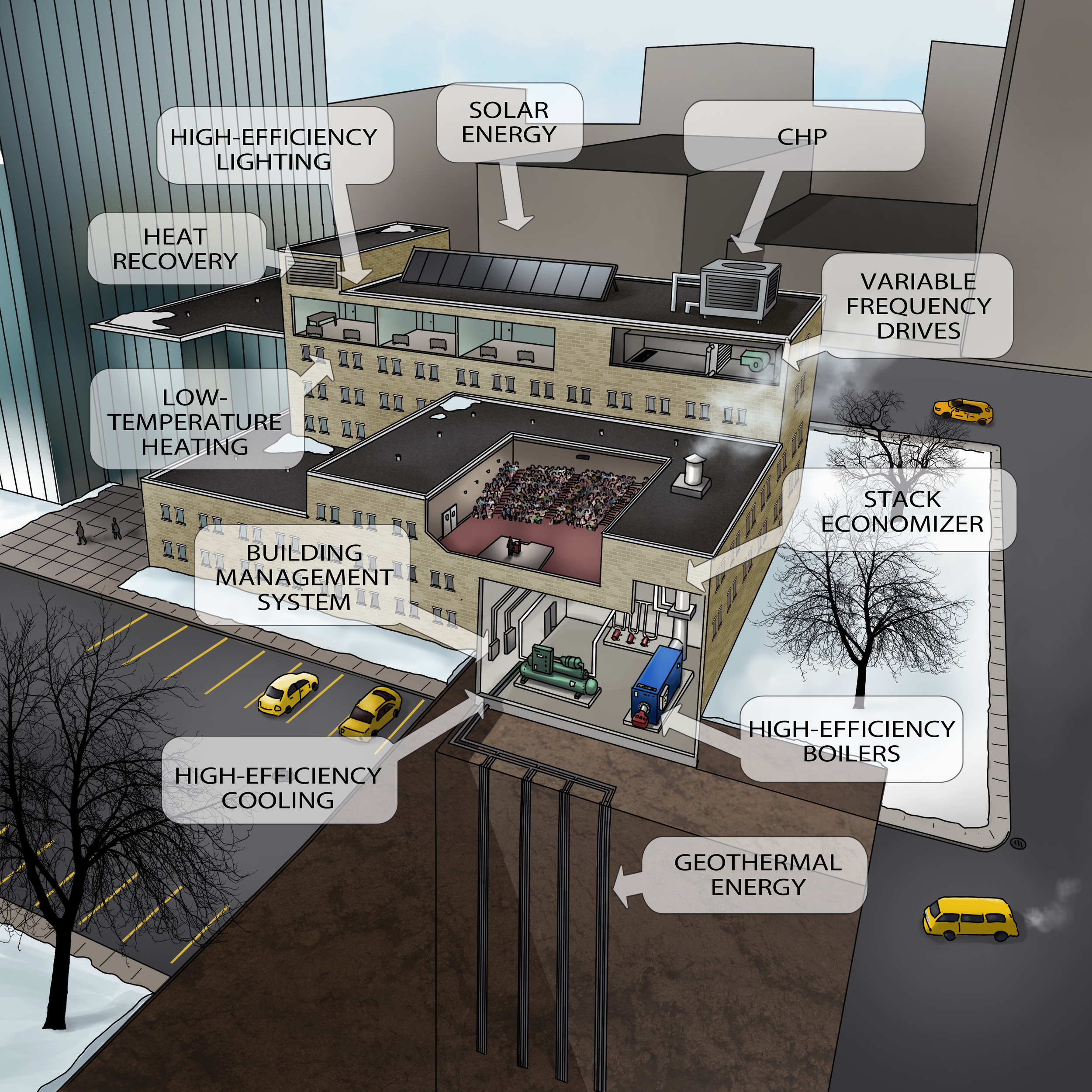
The SSM/Ecosystem partnership is a classic example of the whole being many times its parts. Our combined expertise and decades of experience in Building Engineering and Deep Energy Retrofits comes together powerfully. The cumulative energy savings resulting from Ecosystem’s 20-year project history is climbing toward $200,000,000 this year, with the added benefit of a reduction of nearly 350,000 tons of greenhouse gas emissions.
Our partnership is timely. Pennsylvania’s Act 129 requires the four largest electric utilities in the state to reduce their customers’ electric consumption by offering programs and rebates to every customer class. These programs are paid for by all electric users through a line item charge on every monthly bill, whether a customer engages in these programs or not. There are rebates for lighting, appliances, HVAC systems, energy audits, and even self-generation. The primary focus is the reduction in the use of electricity. Several of the Act 129 programs, however, can be used to achieve even greater cost savings through non-electric heating fuel reductions, an approach that goes to the core of our expertise.
As Pennsylvania’s utilities prepare a third round of financing energy reductions under Act 129, the real question for institutions and businesses is not “if” but “how” to implement. The answer can begin with a simple analysis of energy bills or a full-scale facility audit, for which the local utility will likely pay half the cost. Knowing that many facility managers and owners cannot take the time or spend the money for an audit, we take a different approach to quickly get to the very highest value savings – “Energy Use Intensity,” or “EUI,” to benchmark your site against others in your industry. And we do it at no cost. A “Go” decision at this point means that your savings are both guaranteed and sufficient to fund the required capital projects. And while the standard metric for industrial facilities measures energy used per quantity of finished product, rather than square feet of manufacturing space, the business approach remains the same: We prove the savings first.
EnergyStar describes EUI as, “the energy a building uses per square foot each year, with a lower number signifying better efficiency and less total energy used.” Being able to measure what your facilities consume against others in the same industry represents an opportunity to keep costs in line and maintain an even competitive playing field. Peter Hansen, Manager of Office Space Facilities at SEPTA’s headquarters notes, “The energy-efficiency improvements made to 1234 Market Street have certainly helped lower the building’s operating costs. This has been a primary draw for many of our tenants.
To judge how much can be saved, we begin by calculating a site’s EUI to clarify the opportunity and solicit funding. When a hospital’s management team in New York discovered their building’s EUI was 138% the national average, they got motivated to make changes, securing $4,100,000 for an efficiency project. After implementation, their energy bills dropped by over $600,000, representing 39% in savings. Ecosystem CEO, André Rochette, notes the importance of aligning goals from the start: “Our ability to improve building performance stems from a corporate culture of collaboration and commitment to results and agile processes that let us design and build with the end result in mind. We believe we should always be held contractually responsible to our customers for those outcomes.”
SSM and Ecosystem are partners on a mission - “Enhance the Quality of Life” across Pennsylvania. Our self-funding projects not only lower operating costs and preserve capital for hospitals, schools and universities, residential and commercial complexes, manufacturers, and office and government buildings, they also create jobs and improve the environment. Our turnkey solution covers the full project lifecycle, from analysis and design through construction, commissioning, and continuous follow-up. Our partnership is not just a business... it’s a passion. Pennsylvania Dutch is officially speaking French Canadian. Let the magic begin.

Energy Efficiency is Good for the Bottom Line
SSM performs Energy Analysis in accordance with ASHRAE's Procedures For Commercial Building Energy Audits. The analysis is performed in steps and a value judgment made at the end of each step as to the benefit of proceeding to the next level.
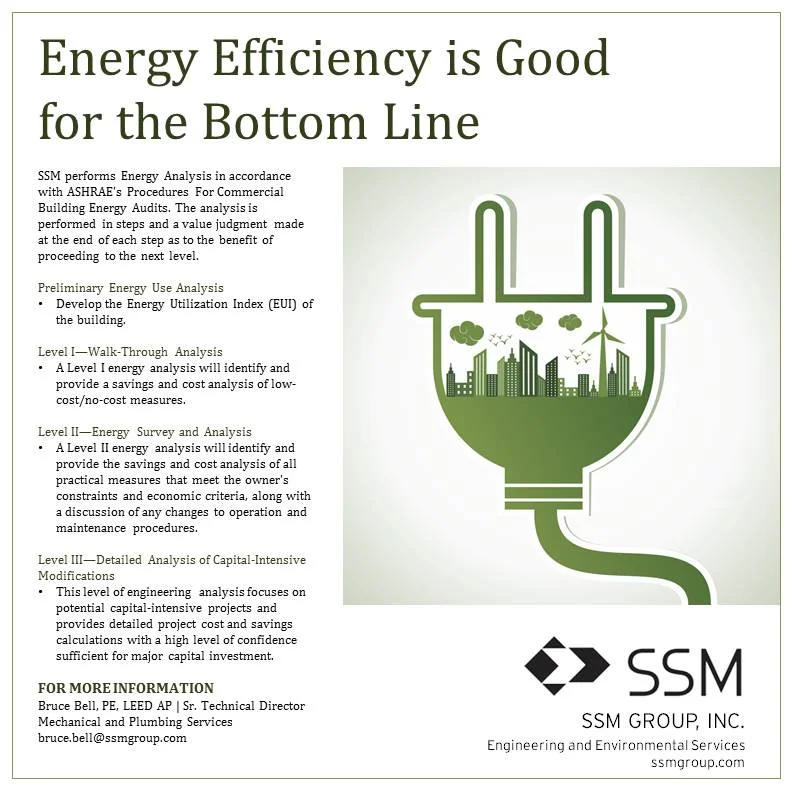
SSM performs Energy Analysis in accordance with ASHRAE's Procedures For Commercial Building Energy Audits. The analysis is performed in steps and a value judgment made at the end of each step as to the benefit of proceeding to the next level.
Preliminary Energy Use Analysis - Develop the Energy Utilization Index (EUI) of the building.
Level I Walk-Through Analysis - A Level I energy analysis will identify and provide a savings and cost analysis of low-cost/no-cost measures.
Level II Energy Survey and Analysis - A Level II energy analysis will identify and provide the savings and cost analysis of all practical measures that meet the owner's constraints and economic criteria, along with a discussion of any changes to operation and maintenance procedures.
Level III Detailed Analysis of Capital-Intensive Modifications - This level of engineering analysis focuses on potential capital-intensive projects and provides detailed project cost and savings calculations with a high level of confidence sufficient for major capital investment.
FOR MORE INFORMATION
Bruce Bell, PE, LEED AP, Sr. Technical Director, Mechanical and Plumbing Services