
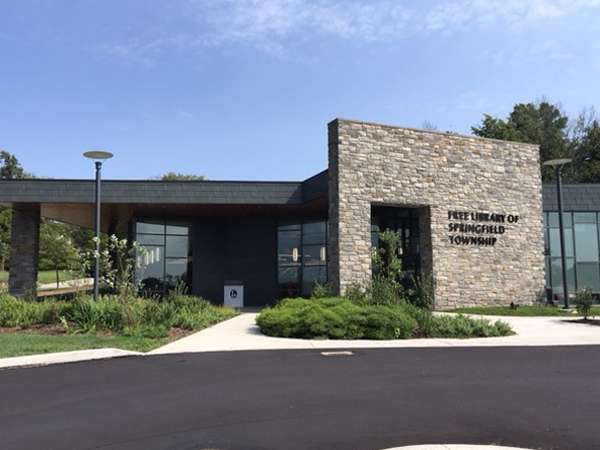
Case Study: Fine-Tuning HVAC Controls Reaps Big Savings
Our Energy and Sustainability Team completed an assessment of BAS settings and algorithms, and a subsequent fine-tuning by the controls contractor, providing a significant and progressive reduction in energy use, resulting in utility bill and environmental savings.

Overview
Practical Energy Solutions (our Energy and Sustainability team) provided both energy benchmarking services and an HVAC building automation system (BAS) controls analysis and modification plan to Springfield Township, in Montgomery County. The project was championed by the Township’s Environmental Advisory Council.
The initial energy benchmark of 3 township buildings identified that two of the buildings, the Free Library and Police/Administration building, were under-performing. This suggested substantial opportunities to improve energy efficiency, leading to full HVAC Controls Analyses of both buildings.
Initial Controls Assessment

The energy team conducted a full assessment of the HVAC operations of both facilities during heating season. The team focused on the BAS controls, since the lighting systems are highly efficient and the building envelope is in good condition due to the relatively young age of the buildings.
The team identified ample opportunities to refine the controls and reduce energy consumption in both buildings. One or two measures required minor programming by the controls contractor, but most of the changes were simple and cost-free to the Township.
Administration/Police Building: Identified seven measures that will conservatively reduce whole-building energy use by one-third, saving nearly $10,000 in annual utility costs and reducing the CO2 pollution by approximately 130,000 pounds every year.

Free Library Building: Similar opportunities that will conservatively produce a 28% energy reduction, annual utility bill savings of approximately $6,200 and CO2 pollution reductions of more than 76,000 pounds annually.
These changes are expected to be highly cost effective and have the same environmental impact as planting nearly 4,800 mature trees or removing 21 passenger cars from the road.
Follow-up Assessment
After two years, a second benchmark of whole-building energy performance of both facilities showed a clear and positive trend to reduced energy use. After partial implementation of recommendations, whole-building energy use in the Administration/Police and Library buildings has dropped 25% and 17% respectively, after normalizing for variations in weather climate. A second phase of BAS modifications is now underway, and we fully anticipate further, substantial energy and utility bill savings.
Here to Help | Paul Spiegel | Director, Energy and Sustainability Services | paul.spiegel@ssmgroup.com
Leaders in Municipal Energy Services
More than ever before, community leaders are under increasing pressure to institute green practices, and sustainable operations. SSM’s Energy and Sustainability Services team is a recognized leader in the Municipal Energy Services arena. Some of the largest municipal entities in the region have used our services, as have some of the smallest. Our team is unmatched by many similar firms in the area. Not only for their expertise, but for their experience.
Our firm has a 90-year history of being at the front of what our clients need.
In 1967, Lewis J. McCoy opened an individual engineering practice because he believed “everyone deserves clean water.” 5 years later, the Clean Water Act was amended into law. We were ready.
In 1968, Charles Stevens became a partner in the firm, bringing 24 years of environmental and air pollution experience. 2 years later, the Clean Air Act took effect. We were ready.
Our municipal roots date back to Walter Spotts, who served as the Owner and President of an engineering and consulting firm based solely on providing services to municipalities. Today, municipal leaders are embarking on their newest undertaking: to lessen their environmental impact and increase their energy efficiency. We are ready.

Practical Energy Solutions, the Energy Team at SSM
Our Energy and Sustainability Team, Practical Energy Solutions, is not only a leader in the field, but a well-known and trusted advisor for some of the largest municipal entities in the region as well as some of the smallest.
To date, we have completed energy audits on more than 200 municipal facilities. And, more than half of our division’s work each year is for municipalities. Our current and past clients include The City of Philadelphia, The State of Delaware, Chester County, PA, The City of Coatesville, Tredyffrin Township, and more than 80 other municipalities.

Our team recognizes that local governments are setting ambitious energy efficiency and renewable energy goals while also prioritizing the needs of their community and stakeholders. More than ever before, community leaders are under increasing pressure to institute green practices, and sustainable operations. Whether navigating a commitment to reach 100% clean energy or managing implementation of aggressive clean energy goals – we pride ourselves on understanding how to help communities get there.
Our team outshines many similar firms in the area. Not only in expertise, but in experience. We have worked on programs supported by Pennsylvania DEP’s Energy Programs Office, we’ve served on planning commissions, volunteered with energy groups, and even supported advocacy initiatives related to energy policy.
Our work is often used as the template or case study for future energy initiatives both locally and regionally. It’s safe to say we’re the team that “wrote the book” on municipal energy best practices and implementation.
Our team’s capacity to combine both financing expertise with engineering expertise is an invaluable skillset. In short, we tell you what you need, but we also help you get it. From assistance with navigating the financial commitment to system design and modeling, and even coordination as a start-to-finish advisor - we always get the job done.

You Need to Know
There’s one thing we want municipal leaders to know about our energy services: Yes, it is for you.

There’s little argument to the benefits of addressing your building and community’s environmental impact. However, community leaders are often concerned about the fiscal and logistical resources needed to commit to these goals. The truth is, we’ve helped many of our clients discover that they’re actually expending more of those resources by not addressing the energy use in their buildings. And yes, this includes fiscal resources.
Adopting sustainable measures and auditing the energy efficiency of your buildings doesn’t necessarily mean depleting your funds to invest in new systems. We’ve helped clients identify ways to save thousands of dollars annually with simple system adjustments. Some that are no cost to implement.
And for those that would benefit further from a more adept system upgrade, we’ve aided those clients in acquiring the funding and financial incentives they need to make those changes happen. Our team has found hundreds of thousands of dollars over fifteen years of providing energy consulting and design services.
As a firm, we believe our purpose is to help you stick to yours. We like to say that what we do best is find seamless, and timely solutions – so that you get to focus on what it is that you do best. We have 90 years of helping our clients’ visions come true. Ninety years of assisting our clients in the planning, growth, and well-being of their communities. Ninety years of being ready.
PA AWWA - WWOAP - Spring Joint Conference - Legislative and Regulatory Update
Legislative and Regulatory Updates
Legislative and Regulatory Update
Presented to: PA Section AWWA North and South Districts and WWOAP Central Section
Presented by: Serena DiMagno, Sr. Environmental Consultant
Legislative Update
House Bill 20 - PA Water Resources Act
House Bill 299 - Senate Bill 93 - Public Employee OSHA Protection
House Bill 390 - Plumber and Plumbing Contractors Licensure
House Bill 423 - Amends the Dam Safety and Encroachment Act
House Bill 487 - Amends Regulatory Review Act
Senate Bill 144 - Fire Fighting Foam Management Act
Senate Bill 428 - Amends Regulatory Review Act
Senate Bill 432 - Amends title 66 (Public Utilities)
Reintroduced Legislation - Legionnaires’ Disease

Regulatory Update
Proposed Rulemaking Consumer Confidence Report (CCR)
Proposed Rulemaking PFAS (Six), PFOA, and PFOS
PA DEP Maximum Contaminant Level for PFAS
Water Quality Standard for Manganese
Technical Guidance
Filter Plant Performance Evaluations
Public Water Supply Manual Part II, Community System Design Standards
Notification Requirements for Spills, Discharges and Other Incidents that Threaten to Cause Pollution of the Waters of the Commonwealth
Pennsylvania’s Public Water System Capability Enhancement Strategy
PA AWWA - WWOAP - Spring Joint Conference - Legislative and Regulatory Update
Legislative and Regulatory Updates
Legislative and Regulatory Update
Presented to: PA Section AWWA Southeast District and WWOAP Eastern Section
Presented by: Serena DiMagno, Sr. Environmental Consultant
Legislative Update
House Bill 20 - PA Water Resources Act
House Bill 299 - Senate Bill 93 - Public Employee OSHA Protection
House Bill 390 - Plumber and Plumbing Contractors Licensure
House Bill 423 - Amends the Dam Safety and Encroachment Act
House Bill 487 - Amends Regulatory Review Act
Senate Bill 144 - Fire Fighting Foam Management Act
Senate Bill 428 - Amends Regulatory Review Act
Senate Bill 432 - Amends title 66 (Public Utilities)

Regulatory Update
Proposed Rulemaking Consumer Confidence Report (CCR)
Proposed Rulemaking PFAS (Six), PFOA, and PFOS
PA DEP Maximum Contaminant Level for PFAS
Water Quality Standard for Manganese
Technical Guidance
Filter Plant Performance Evaluations
Public Water Supply Manual Part II, Community System Design Standards
Notification Requirements for Spills, Discharges and Other Incidents that Threaten to Cause Pollution of the Waters of the Commonwealth
Pennsylvania’s Public Water System Capability Enhancement Strategy

Refined Practices: Survey Technology through the Years
Since 1932 we’ve consistently refined our practices and pioneered into the newest technology, ensuring our survey data is always collected proficiently and accurately.


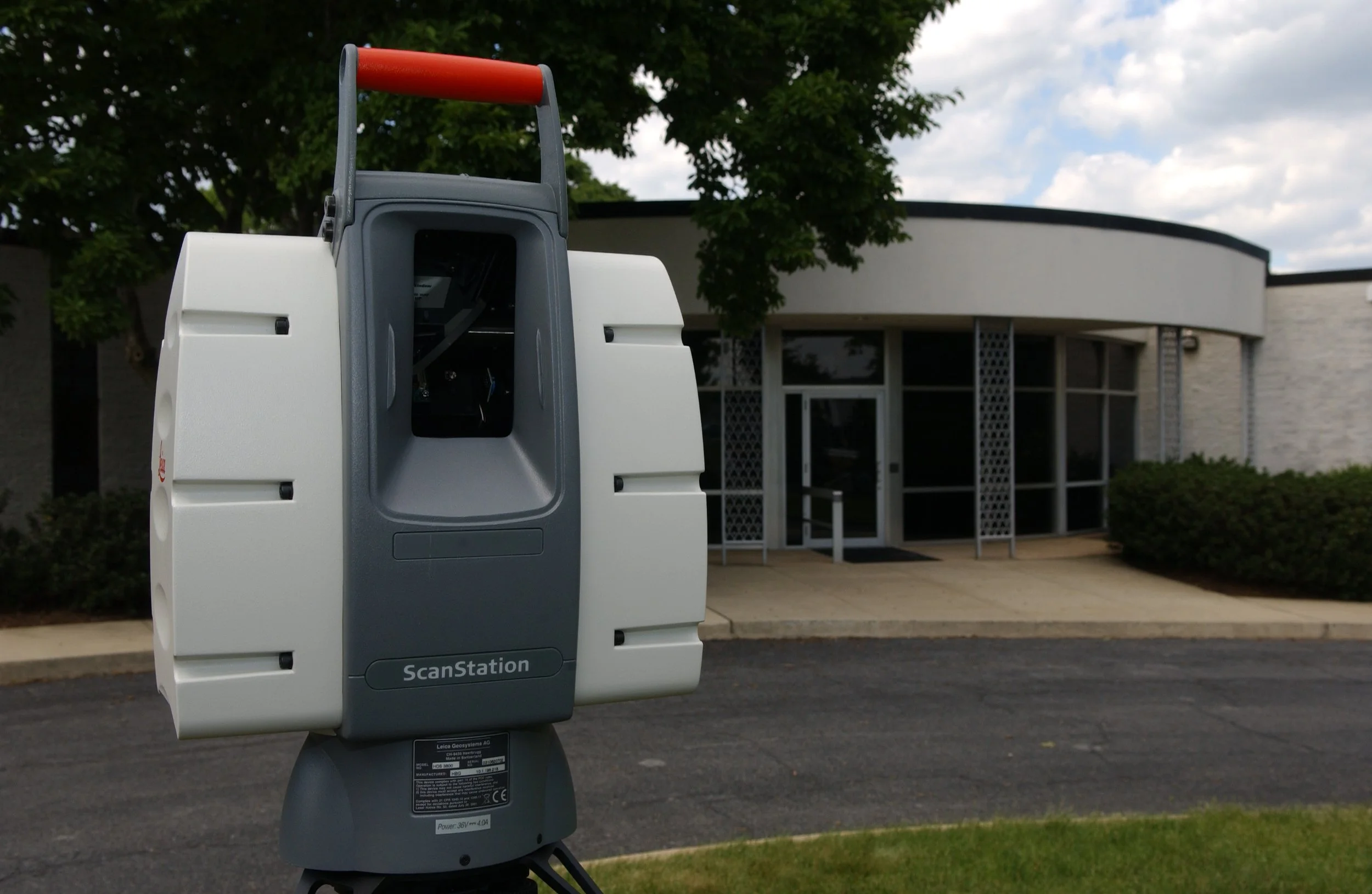


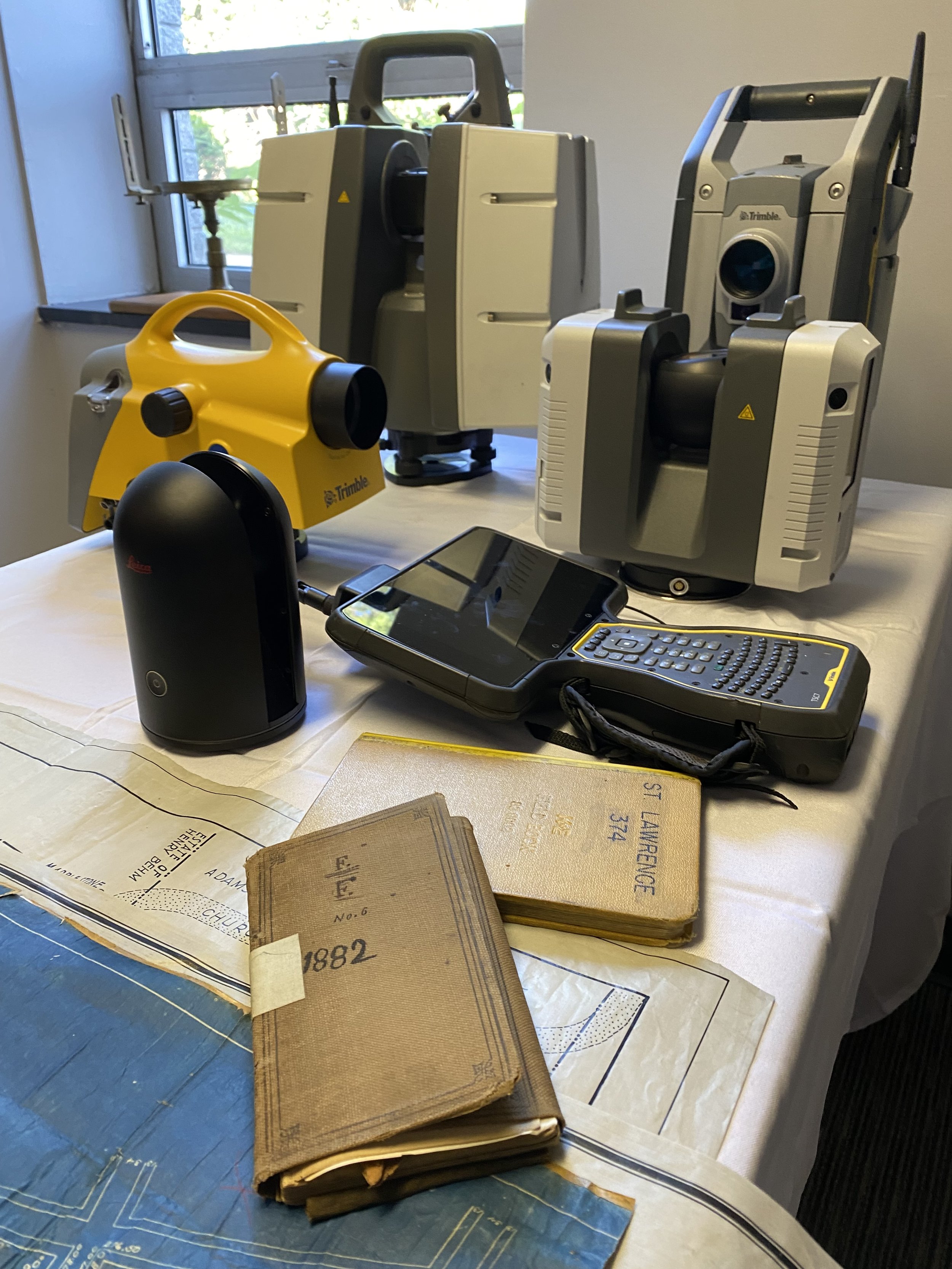


SSM has been at the forefront of surveying expertise since 1932. Since then, we’ve consistently refined our practices and pioneered into the newest technology, ensuring our survey data is always collected proficiently and accurately. With each new advancement in technology, we are able to decrease the potential for human error and increase precision. That’s why we find it so important.
Some of our notable survey and data capture technology upgrades throughout the years:
1932 | In 1932, engineering and surveying was a manual process. It started with paper and pencil, capturing data and measurements in the field and then drawing out plans and designs by hand.
1972 | Hewlett Packard's 3800A Distance Meter opened a new era in surveying for Spotts, Stevens and McCoy, Inc. This new equipment allowed measurements to be made up to 10,000 feet with an accuracy of +(0.01 feet +0.01 ft. per 1000 ft.). This instrument replaced the measuring tape when large tracts of land were to be surveyed.
1994 | CADD Department Upgrades Equipment: Our team added 5 new CADD stations and replaced its old Calcomp pen plotter with a new HP650C Design Jet color printer reducing printing time from 1 hour to six minutes.
1995 | SSM added state-of-the-art Trimble Global Positioning System (GPS) equipment. GPS uses satellite telemetry to obtain precise three-dimensional positions on the earth's surface. Since GPS does not rely on optical line of sight conditions, it can be used day or night, over long distances and under all weather conditions. This equipment now gave SSM the capability of providing land development control, groundwater monitoring well locations, and aerial photography orientation points as well as three-dimensional networks for municipal mapping and GIS applications.
2007 | SSM purchases its first high-definition scanner. Coined Lucille by the staff, the high-definition laser scanning technology provided a non-intrusive method to obtain three-dimensional geometry measurements and models of existing structures and sites for both large and small-scale projects. Today our scanners have evolved, some capturing 1,000,000 data points in just a second.
2012 | SSM purchases its first drone and invests in training/certifying staff as FAA Certified Remote Pilots. We use Drone Flight Services and High-Definition Laser Scanners to obtain models and measurements of existing structures and sites. This non-intrusive technology saves time while raising the bar for high-definition precision all size projects such as campus master planning, historic building preservation and industrial development or impact sensitive agricultural and preserved lands.
2022 | In addition to our Leica P40 scanner, our most recent scanner upgrade, the Leica RTC360, empowers our scanner team to document and capture project data in 3D, while improving efficiency and productivity in the field. Our implementation of Leica Cyclone and Register 360 post processing software allows our scanner team to export point cloud data in a variety of formats.
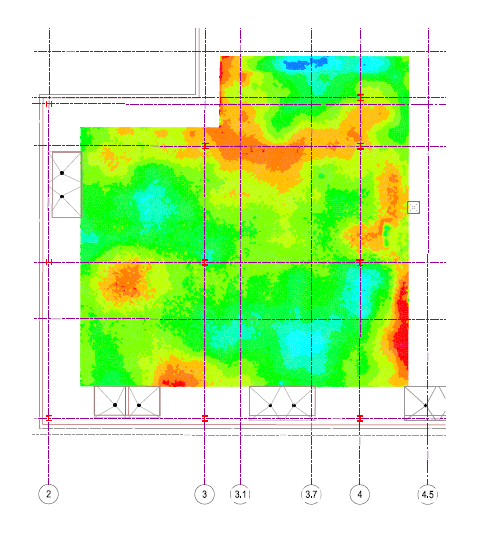
High-Definition Laser Scanning to Measure Floor Flatness
High definition laser scanning offers the best precision, efficiency, and accuracy to the process of measuring floor flatness. With speed unlike manual measurement, and collection of millions of points, digital scans identify and distinguish exactly where floors stand- competitively outshining historical practices.
Getting to the Bottom of It
Experienced building teams from construction supervisors to developers and managers - all know well the impact that floor flatness can have on timeline and long-term utility of a facility. Exact flatness in concrete floors is essential for efficient facility functioning, maximum floor tolerance, maintaining operations, and successful architectural design.
Down to minute measurements, just 1/16th of an inch, floors that are not exceptionally flat can cause major disruptions to existing facilities, or even halt construction of new ones. Although rarely noticeable to an untrained eye, the impacts of a floor that is not flat are impossible to ignore.
For industrial facilities- machinery and vertical storage all require precise floor flatness. Lack thereof can increase chance of injury, loss of product, and damage to large equipment.
For buildings being rehabilitated or revitalized - settled concrete can cause a severe disruption to the future utility.
High definition laser scanning offers the best precision, efficiency, and accuracy to the process of measuring floor flatness. With speed unlike manual measurement, and detailed collection including millions of points - digital scans identify and distinguish exactly where floors stand- competitively outshining other tactics.
Increasing Precision, Accuracy and Efficiency
It wasn’t long ago that technicians would lay a 10-foot straightedge on a finished floor, identifying gaps and using these to calculate flatness. More recently, crews are deployed to walk slabs of concrete, take a variety of measurements, and generate a resulting calculation. These methods not only leave great room for human error, but also require extensive manual labor and time requirements.
Utilizing high-definition laser scanning to measure floor flatness dramatically increases the three core areas of concern: precision, efficiency, and accuracy. Too often, building teams are forced to accept that accurate, precise results mean extended timelines. But with laser scanning, neither time nor accuracy must be sacrificed.
Here’s how it works:
Our survey and data collection technicians deploy cutting-edge scanners to the construction site.
In only a few minutes, the floor space is scanned, collecting millions of single data points that together form a digital rendition of the space at precise measurements.
This is repeated a number of times, each time utilizing the same control or benchmark within the space - increasing accuracy of each collection point.
The scans are transferred to digital format, creating a 3D point cloud- all of the multiple scans, millions and millions of individual data points, layered on top of one another, and anchored by the control.
Digital scans of the space offer elevation information- clearly highlighting the floor’s flatness. We are also able to take these precise measurements and calculate a F-Score just as manual labor did in the past.
21st century facilities shouldn’t be built with last century tactics. By collecting millions of points in minimal periods of time, laser scanning outshines manual labor and calculations. We’ve decreased the chance of human error and decreased the amount of time it takes to collect your information - getting you what you need in a better way, a faster way, and a more effective way.
Looking to talk more about using scanning to measure floor flatness? Our Survey team would be happy to help. Send us an email at information@ssmgroup.com
Read more about Survey and Data Capture.










Spring Highlight: Drone Data Collection
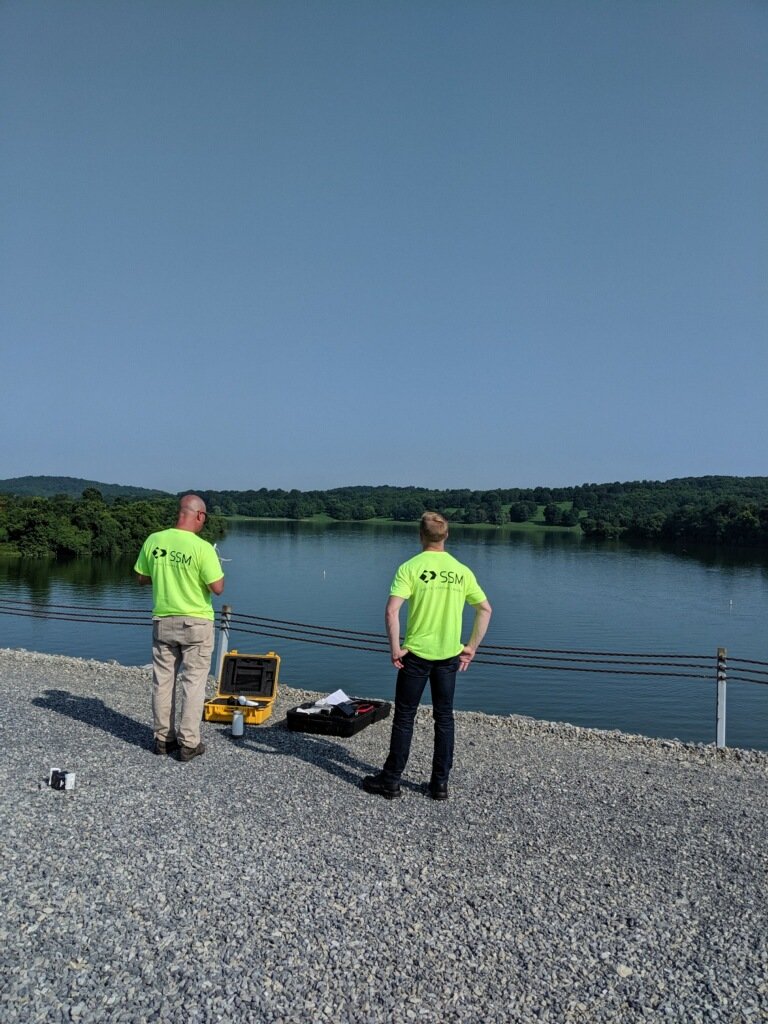
Spring is one of the best times to deploy drone technology for data and information collection. Snow-free, leaf-free and sunny conditions allow us to get the best picture and the most accurate information for our clients. At SSM, we have three certified FAA Remote Pilots on our team.




Above It All
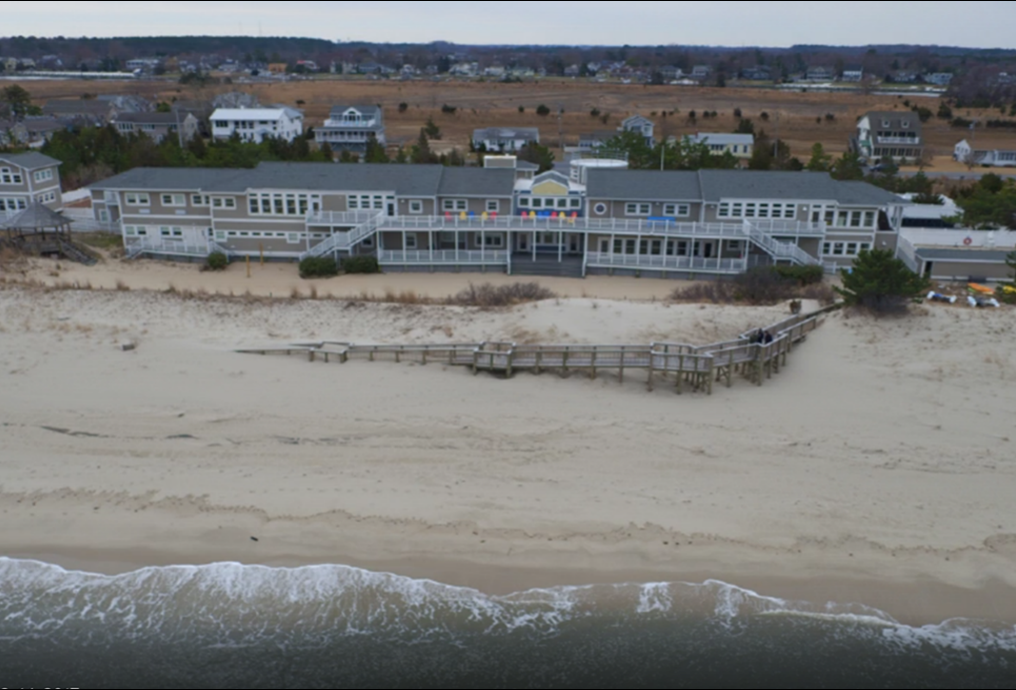
With drone flight technology, we are able to measure things that could never be measured before. By capturing information from the air, we help our clients establish images of existing conditions, create reference points for future site considerations, see areas of concern that are hard to reach, and make educated decisions that we previously could not make.
At SSM, we have three certified FAA Remote Pilots on our team. Drone photography offers a powerful solution for monitoring progress on construction sites, capturing hard-to-reach details on elevated structures, roof inspections and documenting infrastructure on expansive sites.
Spring Flying Season
Spring is one of the best times to deploy drone technology or conventional aerial photography from fixed wing aircraft for point data and image collection. Snow-free, leaf-free and sunny conditions allow us to get the best picture and the most accurate information to enhance our clients’ projects.
Now is the best time to get your aerial mapping projects scheduled.
Common Applications:
Construction Monitoring
Volumetric Computations
Site Design and System Layout
Promotional Imagery
Litigation Support
Aerial Site Evaluation and Progress Reports
Rooftop Condition Assessment
Erosion and Damage Assessments

Congratulations to our clients!
We helped our clients acquire nearly $3,000,000 in project funding!
We helped our clients acquire nearly $3,000,000 in project funding!
The Commonwealth Financing Authority (CFA) recently announced the approval of funding from the Local Share Account (Statewide). With the assistance of our team, several of our clients have received funding for projects that benefit the public interest of Pennsylvania.
Our grant services include preparation and submission on behalf of the entity. We also provide cost estimates and scope of work definition and description. Whether our client needs full range grant assistance, or just one piece of a bigger picture -we’re here to help.
Read about the great projects that received funding below:
Reading Area Water Authority | SCADA and IT Upgrade Project | $165,649
Through grant preparation and submission services, SSM helped Reading Area Water Authority (RAWA) obtain $165,649 for upgrades to network security. The funds will be used to offset costs associated with the procurement and implementation of hardware, software, licensing, programming, and SCADA upgrades. The completion of this project will allow RAWA to continue to protect its water supply, treatment, and distribution systems into the future.
Upper Montgomery Joint Authority | 2022 Wastewater Treatment Plant Improvements | $149,952
SSM helped secure $149,952 in funding for upgrades to the Upper Montgomery Joint Authority’s (UMJA) wastewater treatment plant. The funding will offset costs associated with the procurement and installation of process, treatment, pumping, and security equipment for the plant. Of these include two new primary sludge transfer pumps and sludge blanket level sensors, as well as rebuild of the existing final clarifier and installation of security equipment throughout the plant. All of these upgrades will significantly improve the wastewater treatment plant and reduce long-term costs to the authority.
Bern Township Municipal Authority | Leiscz’s Bridge Road Pumping Stations Project | $210,366
With the assistance of SSM’s grant services, Bern Township Municipal Authority secured $210,366 for the construction of two new pumping stations which will connect into the existing sanitary sewer system and is transported to the wastewater treatment plant for treatment. This project will allow the authority to provide service to the surrounding homes and businesses as well as allow for additional future development in this area of the system.
Perkiomen Township Municipal Authority | Lodal Creek Sanitary Sewer Repair Project | $211,494
SSM assisted with grant preparations and submission, securing $211,494 for Perkiomen Township Municipal Authority for permanent repair work to a section of sewer main that was damaged as a result of the flooding from Hurricane Ida. Some of the damages include a broken section of the concrete encasement that protects the sewer main in the creek, creek gravel around the encasement, and the gabion basket wall that protects a manhole, leaving the manhole partially exposed to the creek. Repairs planned with received funding include replacing the gabion basket wall, lining a section of the sanitary sewer main with CIPP lining, and repairing the concreate encasement that protects the sanitary sewer main at the creek crossing. The permanent repair work and CIPP lining will allow the authority to continue providing reliable service to its customers. It is also expected to reduce inflow and infiltration (I/I) within the collection system.
Perkiomen Township Municipal Authority | Television Inspection System Equipment | $101,530
Perkiomen Township Municipal Authority (PTMA) obtained $101,530 in funding with the assistance of SSM’s grant team. Funds will be used to purchase Television Inspection System Equipment for use with the Authority’s ongoing inflow and infiltration (I/I) work. This equipment is critical for PTMA to perform inspection work in its sewer collection system. It allows for identification of issues within the system that could lead to collapse. It also will allow PTMA to prioritize areas of the system for repair. By resolving issues in the system and reducing I/I, PTMA can increase system capacity, allowing for future development of the township and surrounding area.
Leesport Borough | Water System Emergency Generator Project | $119,983
Leesport Borough was granted $119,983 with the assistance of SSM’s grant services. These funds will be utilized for emergency generators to be located at the two largest producing wells in the public water system. The Borough Hall building will also receive an emergency generator due to its housing of the water system controls, alarms, and SCADA system. There are currently zero emergency generators installed in the water system, requiring the system to operate on storage capacity when there is no power to run the wells. This can present limitation in the case of drought or fire flow events. The emergency generator project will help to decrease service interruptions and secure the ability to provide full fire flow service to the system customers.
Manheim Area Water and Sewer Authority | 2022 Sanitary Sewer Interceptor CIPP Lining Project | $880,993
SSM aided Manheim Area Water and Sewer Authority (MAWSA) in securing $880,993 for continued sewer interceptor rehabilitation. The rehabilitation work includes closed-circuit televising of the main interceptor piping to determine pipe condition. Then, the interceptor will be repaired and restored through the installation of CIPP lining. The sewer rehabilitation and repair of the interceptor piping is expected to significantly reduce the amount of inflow and infiltration (I/I) that enters the sanitary sewer system and wastewater treatment plant. This will not only protect this valuable infrastructure, but will enable MAWSA to serve future commercial, residential, and industrial development.
Manheim Area Water and Sewer Authority | Systemwide Water Meter Replacement Project | $1,000,000
SSM also helped Manheim Area Water and Sewer Authority (MAWSA) secure $1M in funding to offset costs associated with the procurement and systemwide installation of water meters and associated equipment for use in MAWSA’s water distribution system. Installation of new water meters will allow the authority to provide reliable service to water customers, as well as accurately capture water consumption and withdraw - necesarry for both customers and regulatory agencies. Accurate water meter readings will also allow for future expansion and development.
Walnutport Municipal Authority | Sewer Pump Station Repair | $75,000
SSM aided in grant preparation and submission, securing $75,000 for Walnutport Municipal Authority’s proposed pump station improvements. The existing pump station, constructed in 1978 and updated in 1995, presents some limitations. The proposed improvements include new submersible pumps installed on a rail system inside the existing wet well as well as a new grinder inside a concrete manhole outside of the wet well. A new valve vault and meter pit with a pemanent bypass pumping connection will also be installed, allowing for bypass pumping capabilities in an emergency situations.
Welcome Aboard Six New Team Members
Spotts, Stevens and McCoy is proud to share the news of six new team members joining the firm. These team members joined us between January 2023 through March of 2023.
Spotts, Stevens and McCoy is proud to share the news of six new team members joining the firm. These team members joined us between January 2023 through March of 2023. Our firm continues to be recruiting for several open positions across our divisions. Be sure to visit our Join Us page for more information about working for SSM.
Meet our New Team Members:

Zane Britton | Survey Crew Chief
Zane joins the boomerang club at SSM, and we are thrilled to welcome him back to the team! Zane has assumed the role of Survey Crew Chief, performing all aspects of site and boundary reconnaissance, construction stakeout, and boundary, topographic, roadway and as-built surveys, as well as ultimately turning that field data into AutoCAD drawings.
Zane joins us with an A.S. in both Surveying Technology as well as Civil Engineering Technology from Pennsylvania College of Technology. He thrives in challenging environments, and loves to overcome an obstacle or make sense of a difficult project. His working strengths also include teamwork, adaptability, and challenge stamina.

Mitchell Peters, EIT | Senior Graduate Engineer | Mechanical Engineering
Mitchell is our newest Senior Graduate Engineer in the Mechanical Engineering Department! This role includes working with the Mechanical Engineering team as well as the overall Facilities team in the preparation of plans and designs as well as interpretation of engineering specifications.
Mitchell holds a Bachelor of Architectural Engineering with a Mechnical focus from The Pennsylvania State University. He comes to SSM with 12 years of HVAC system design experience including projects for a variety of markets: education/k12, government, federal, commercial, corporate, and healthcare.

Jason Coyle, LO | Senior Operations Specialist | Process Engineering and Design
We’re excited to welcome Jason Coyle to our team of professionals working the Water and Wastewater space. Jason brings over 20 years of industry experience to the firm. His experience includes operations and maintenance of municipal wastewater treatment facilities and sanitary sewer collection systems, including NPDES permitting renewals, infiltration/inflow identification and remediation, regulatory compliance, and process control and hazardous waste management and transportation of biosolids.
Jason is a licensed Wastewater System Operator, Class A, E (subclass 1,2,3,4). And he is an active member of several industry trade associations.

Lila Rockey | Energy Specialist
Lila joins our Energy and Sustainability team as an Energy Specialist, performing hand-on data gathering and analysis, and supporting project completion alongside our Energy Analyst(s) and Project Manager(s).
Lila holds a Bachelor of Science in Environmental Resource Management with a Minor in Environmental Engineering. She has a background in Environmental Science including experience with site assessments, project research, permit and regulatory compliance, as well as environmental impacts.

Margaret Cavalier | Senior Designer | Electrical Engineering
Margaret is an experienced Senior Electrical Designer, joining our Facilities team! Her role includes producing engineering drawings from design information provided by engineers and/or architects. Margaret utilizes computer-assisted drafting systems (AutoCAD and Civil 3D) to communicate engineering ideas. This can include preparing and reviewing drawings, performing design tasks, or preparing portions of project documents. It also includes working both independently and collaboratively on the planning, design, and/or research of engineering projects as well as project management of necessary projects.
Margaret has 20 years of experience in the drafting and design space, almost all of which is focused in electrical design. We’re so excited for the skill and expertise she will bring our clients.

Amber Keller | Project Coordinator
Amber is joining our West Chester office as Project Coordinator. The Project Coordinator position performs diversified duties for SSM’s technical staff and management including billing, project research, preparing and finalizing reports, tracking deadlines, and more. Amber will be responsible for performing administrative functions, coordinating projects, and developing relationships with key internal and external clients.
Amber comes to us with great experience managing administrative functions and handling business operations. She is an achiever, taking great pride in working hard and getting the job done! Her working strengths also include building relationships, maximizing productivity and a strong desire to learn and achieve!

Marika Selzler Wiliams named 2023 VISTA Millennial Superstar
Marika Selzler Williams was named a 2023 VISTA Millennial Superstar, an initiative presented by Penn State Great Valley through VISTA.Today.

Marika selzler williams, eit, env sp, cem
Marika Selzler Williams was named a 2023 VISTA Millennial Superstar, an initiative presented by Penn State Great Valley through VISTA.Today. The initiative identifies and honor 40 of Chester County’s most dynamic business and professional leaders, under the age of 40, who are shaping the county’s future.
What is a VISTA Millennial Superstar? It’s a young professional who is breaking down walls, shattering expectations, and doing a remarkable work in his or her profession or community. Superstars are selected through a nomination and evaluation process and then announced and highlighted through February and March. The initiative culminates in an annual awards reception and celebration in Chester County.
Marika is an Energy Analyst at Spotts, Stevens and McCoy with more than 6 years of experience in energy engineering. Of that experience includes energy benchmarking, load profiling, and long-term trend analysis of commercial facilities, industrial plants, and vehicle fleets; BAS-based continuous commissioning and Analytics-as-a-Service of commercial buildings; calculating and evaluating emissions of existing systems, buildings, campuses, and fleets, and improvements from conservation, efficiency, and fuel-switching projects; supervising preparation of energy audits and reports.
Marika’s professional affiliations include the Society of Women Engineers, Assocation of Energy Engineers, Institute for Sustainable Infrastructure, and Design-Build Institute of America. In addition to her engineering credentials, she is a certified Envision Sustainable Professional, Certified Energy Manager, and Qualified Tune-Up Specialist for the City of Philadelphia.
For more information about the 2023 Class of VISTA Millennial Superstars: Click Here

Josh James earns Professional Engineers License
Josh James, PE has earned his Professional Engineers license in Pennsylvania.

josh james, PE | Senior graduate engineer
Josh James, PE has earned his Professional Engineers license in Pennsylvania.
James is an Engineer in the Process Engineering and Design department at Spotts, Stevens and McCoy (SSM). He is a graduate of The Pennsylvania State University with a B.S. in Environmental Systems Engineering.
James has been an employee of SSM’s for more than five years. His responsibilities include water and wastewater design, design specifications, pump engineering cost opinions, Act 537 Planning, data analysis, preparation of DEP and DRBC permit applications and renewals, and report preparation. These reports include Annual Chapter 94 Reports, Annual Effluent Monitoring Reports, Risk and Resilience Assessments, Monthly Engineer’s Reports, and Discharge Monitoring Reports. He also has experience in pump selection and designing groundwater well treatment and distribution facilities.
James’ Professional Affiliations include the Eastern Pennsylvania Water Pollution Control Operators Association (EPWPCOA) where he is a member of multiple committees.
Municipal Experience | Assistance in the design and completion of permit applications for public water supply regarding the treatment and distribution of new groundwater wells; permitting assistance for addition of bulk water hauling station; design engineering services including writing specifications and aiding in construction observation as well as water quality management permitting; public water system capacity analyses; hydraulic calculations for water main extensions; capacity analyses for sewer systems
Risk and Resilience | Responsible for meeting with clients to collect and review information regarding assets and determining the consequences and risk value based on current AWIA/DEP guidelines. Perform Risk and Resilience Analyses including making recommendations to fix issues and lower risk.
Annual Chapter 94 Reporting | Data management services for comprehensive wastewater management reports including data collection, integration, analysis, graphic visualization and projections.
Other Key Experience | Design and bid phase assistance for the design of a new Wastewater Treatment Plant, including writing specifications and aiding with permitting.
Getting the Lead Out: Causes and Effects of Lead in Drinking Water
The US Environmental Protection Agency (EPA) estimates that 6-10 million lead service lines are currently in use in the United States. It is now recognized that lead does not belong in drinking water systems ro residential piping and fixtures.
Presented to the Penn State Health & College of Medicine - Grand Rounds Lecture
Presented by Serena DiMagno | SSM Senior Environmental Consultant
Background: Lead service lines are defined as the portion of the water distribution system that is connected from the water main in the street to the customer’s residence of business. Lead service pipes have been used since the time of the Roman Empire. Between 1900 and 1950, most cities installed lead water pipes due to the durability of lead pipes which can last 75 to 100 years or more. The US Environmental Protection Agency (EPA) estimates that 6-10 million lead service lines are currently in use in the United States. It is now recognized that lead does not belong in drinking water systems ro residential piping and fixtures.
Discussion Topics
Health Effects of Lead
Scope of the Lead Occurrence in the US
Safe Drinking Water Regulation
Paying for Lead Service Line Replacement
How to Reduce your Lead Exposure and Remove Lead from your Drinking Water


Jeff Thoms, PE Named Manager, Structural Engineering
Jeff Thoms, PE has been promoted to the role of Manager, Structural Engineering. In this role he will be responsible for daily operations of the department and execution of the department’s strategic assignments.

JEFF THOMS, PE | Manager
Jeff Thoms, PE has been promoted to the role of Manager, Structural Engineering. In this role he will be responsible for daily operations of the department and execution of the department’s strategic assignments.
Jeff has more than 25 years of experience in structural engineering and design. Projects include multi-tenant housing, industrial, educational and institutional structures. From elementary schools and middle schools to waste water treatment plants, he has experience in project management, detailed engineering design, and construction administration. Some of his earlier achievements include work on one of the mill buildings at the Bethlehem Steel Plant and two additions for what was then known as Lucent Technologies.
He also ahas experience with athletic and sports facilities, having worked on a design team for the Spillman Farmer-led sports complex project at Susquehanna University. He also has provided structural engineering on a number of YMCA projects and an ice skating rink.
He has been involved in several projects for the federal government including an addition to the William J. Hughes testing facility in Atlantic City, New Jersey and a structural analysis of the existing concrete roof of the Vanderbilt Mansion in Hyde Park, New York. He was also on the structural design team for the restoration of the Statue of Liberty on July 4, 2009.
Jeff is a graduate of The Pennsylvania State University, B.A.E. (Architectural Engineering), 1997; Minor, Engineering Mechanics. He is licensed Professional Engineer in Pennsylvania, New Jersey, Delaware, Maryland, Virginia, and New York.
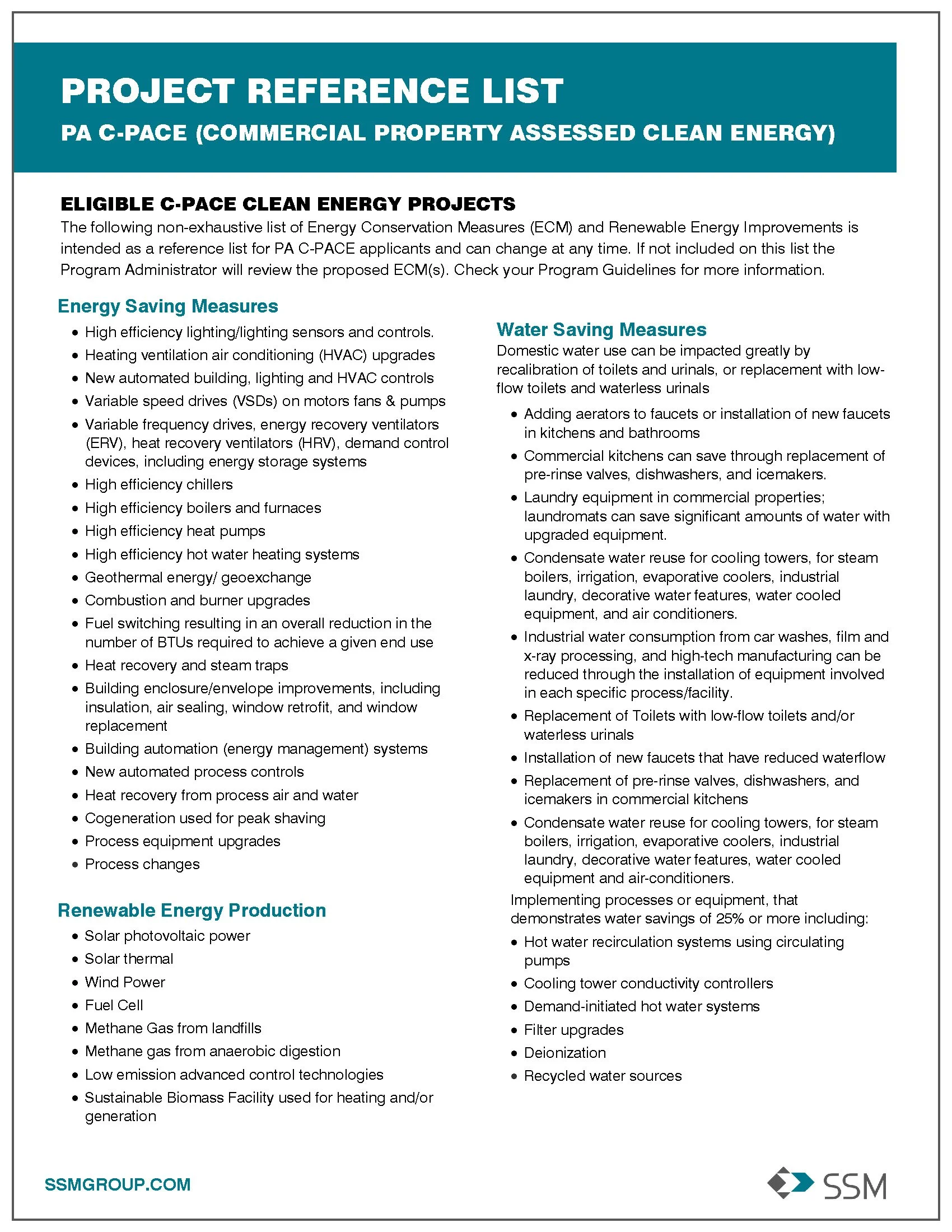
Financing Opportunity: Pennsylvania C-Pace (Commercial Property Assessed Clean Energy)
About the program: Commercial Property Assessed Clean Energy (C-PACE) is a financial tool for property owners to obtain low-cost, long-term financing for energy efficient equipment, renewable energy, and water conservation projects.
Commercial Property Assessed Clean Energy (C-Pace)
About the program:
Commercial Property Assessed Clean Energy (C-PACE) is a financial tool for property owners to obtain low-cost, long-term financing for energy efficient equipment, renewable energy, and water conservation projects.
About the program:
With C-PACE, building owners can enjoy the advantages of energy upgrades immediately and pay for them over time through a voluntary assessment lien that is repaid annually along with municipal property taxes. C-PACE can provide up to 100% funding of total project costs including equipment, labor, and soft costs. Because C-Pace is attached to a property assessment, it is a very secure form of financing.
Properties eligible for C-PACE in Pennsylvania:
Commercial, industrial and agricultural properties can access C-PACE if the county has adopted the C-PACE resolution.
The program guidelines adopted by a county will set forth the parameters for how a clean energy project can qualify for both new construction and a retrofit of qualified properties.
Finance:
Loans through the C-PACE program can be made to any property owner in good standing located in a participating county. Funding for the loan can come from “any public or private financing note, mortgage, loan, deed of trust, instrument, refunding note, or other evidence of indebtedness or obligation used to finance a qualified project.” While loans in other states are generally made from private equity capital providers, Pennsylvania is an open market so the property owner can borrow from a firm of their choice.
Administration:
Owners of commercial and agricultural properties that would like to improve their properties to save energy, conserve water, and/or generate renewable electricity should check the Sustainable Energy Fund (SEF) website or ask your Energy Consultant if C-PACE financing is available in your county or area. (Note: The Program Administrator for City of Philadelphia properties is Philadelphia Energy Authority, not SEF)
Here to Help:
The SSM Energy and Sustainability team provides technical support for C-Pace Philadelphia and is a partner of the Sustainable Energy Fund’s Service Provider Network.
Paul Spiegel, PE, LEED AP | paul.spiegel@ssmgroup.com

Funding Opportunity: Renewable Energy Systems & Energy Efficiency Improvements
What does this program do? The program provides guaranteed loan financing and grant funding to agricultural producers and rural small businesses for renewable energy systems or to make energy efficiency improvements. Agricultural producers may also apply for new energy efficient equipment and new system loans for agricultural production and processing.

FUNDING OPPORTUNITY
Rural Energy for America Program Renewable Energy Systems & Energy Efficiency Improvement Guaranteed Loans & Grants
Program Period | Open for Fiscal Year 2023
Applications due October 31, 2022 (set-aside) and March 31, 2023
What does this program do?
The program provides guaranteed loan financing and grant funding to agricultural producers and rural small businesses for renewable energy systems or to make energy efficiency improvements. Agricultural producers may also apply for new energy efficient equipment and new system loans for agricultural production and processing.
Who may apply for this program?
- Agricultural producers with at least 50 percent of their gross income coming from agricultural operations.
- Small businesses in eligible rural areas.
What are the borrowing restrictions for loan guarantees?
- Individual borrowers must be citizens of the United States or reside in the U.S. after being legally admitted for permanent residence.
- Private-entity borrowers must demonstrate that loan funds will remain in the U.S.
What is an eligible area?
- Businesses must be in located in rural areas with populations of 50,000 residents or less.
- Check eligible business addresses.
- Agricultural producers may be in rural or non-rural areas.
How may the funds be used?
Funds may be used for renewable energy systems, such as:
- Biomass (for example: biodiesel and ethanol, anaerobic digesters, and solid fuels).
- Geothermal for electric generation or direct use.
- Hydropower below 30 megawatts.
- Hydrogen.
- Small and large wind generation.
- Small and large solar generation.
- Ocean (tidal, current, thermal) generation.
Funds may also be used for the purchase, installation and construction of energy efficiency improvements, such as:
- High efficiency heating, ventilation and air conditioning systems (HVAC).
- Insulation.
- Lighting.
- Cooling or refrigeration units.
- Doors and windows.
- Electric, solar or gravity pumps for sprinkler pivots.
- Switching from a diesel to electric irrigation motor.
- Replacement of energy-inefficient equipment.
Agricultural producers may also use guaranteed loan funds to install energy efficient equipment and systems for agricultural production or processing.
What funding is available?
- Loan guarantees on loans up to 75 percent of total eligible project costs.
- Grants for up to 40 percent of total eligible project costs.
- Combined grant and loan guarantee funding up to 75% of total eligible project costs.
FOR MORE INFORMATION:
Rural Energy for America Program Energy Audit & Renewable Energy Development Assistance Grants in Pennsylvania | Rural Development (usda.gov)
The SSM Energy and Sustainability Team is well-versed in aiding clients with acquisition of funding for their energy projects.
For more information or assistance with acquiring REAP funds, contact our team.
Paul Spiegel, PE, LEED AP | paul.spiegel@ssmgroup.com

Building Energy Performance Program deadline is approaching
If you are a commercial building owner in the City of Philadelphia, you may be required to comply with a recent regulation called the Building Energy Performance Program (BEPP). This ordinance requires owners of buildings over 50,000 sf to do a "building tune-up" every 5 years. The tune-up is a review of maintenance and operations of primary energy using equipment like HVAC and lighting. The deadline for buildings over 100,000 sf is coming fast - September 30, 2022.
The Building Energy Performance Program, created through Building Energy Performance Policy aims to achieve efficient energy and water use in the largest non-residential buildings in Philadelphia.
Like cars, buildings need occasional tune-ups to keep them running smoothly and efficiently. A building tune-up requires a review of energy systems and controls and minor tweaks to bring them up to a good state of performance. On average, these tweaks result in 10–15% annual energy savings for a building. They also provide a more comfortable space for tenants. This policy is projected cut carbon pollution in Philadelphia by nearly 200,000 metric tons. This reduction is equivalent to taking 40,000 automobiles off our roads.
Who is impacted?
Owners of any non-residential building with indoor floor space of at least 50,000 square feet of indoor floor space must comply with the policy.
Who is not included?
- Residence halls, dormitories, and other non-transient large lodging places
- Parking lots and parking garages, or the portions of otherwise covered buildings used for parking
How do I comply?
Buildings must comply every 5 years from their compliance date.
Buildings have three options for compliance.
- Conduct a “tune-up” of existing building systems
- Certify high performance
- Receive an exemption
Qualified tune-up specialists:
If conducting tune-ups, building owners must hire approved tune-up specialists to lead their building system assessments and sign off on tune-up reports. In-house or contracted service providers may complete the corrective actions, however, the final tune-up report must be verified and signed by the qualified tune-up specialist.
Spotts, Stevens and McCoy has four certified tune-up specialists on our staff, ready and able to assist in compliance with this regulation.
What is a building tune-up?
The Building Tune-Up is an assessment of existing base building systems and corrective actions to bring the systems up to a state of good repair. The assessment includes all systems of the building that use energy or impact energy consumption.
- HVAC Operations and Controls
- Lighting System Assessment
- Building System Maintenance and Repairs
- Domestic Hot Water and Water Usage
- Building Envelope
The tune-up includes:
- Billing analysis.
- Assessment of Elements: HVAC Operations and Controls, Lighting System Assessment, Building System Maintenance and Repairs, Domestic Hot Water and Water Usage, and Building Envelope
- Determination and Implementation of Corrective Actions
- Post implementation assessment
- Final Tune-up Report
Here to Help:
Energy and Sustainability Services
Paul Spiegel, PE, LEED AP | paul.spiegel@ssmgroup.com

PA Adopts PFAS Limits for Drinking Water
Pennsylvania has adopted new regulations to protect Pennsylvanians' drinking water from PFAS chemicals by setting new limits on two forms of per- and poly-fluoroalkyl substances.
Pennsylvania has adopted new regulations to protect Pennsylvanians' drinking water from PFAS chemicals by setting new limits on two forms of per- and poly-fluoroalkyl substances. https://www.dep.pa.gov/Citizens/My-Water/drinking_water/PFAS/Pages/default..aspx(PFAS)
The new rule sets maximum contaminant levels (MCLs) in drinking water for two forms of PFAS - perfluorooctane sulfonic acid (PFOS) and perfluorooctanoic acid (PFOA) - in order to protect the public from potential adverse health effects linked to exposure to PFOA and PFOS. "Since Governor Tom Wolf signed an executive order https://www.governor.pa.gov/newsroom/executive-order-2018-08-perfluoroalkyl-and[1]polyfluoroalkyl-substances-pfas-action-team/ in 2018, DEP has been committed to protecting Pennsylvanians from the adverse impacts of PFAS. We are still learning more about these chemicals, and these new MCLs are a step in the right direction," said DEP Acting Secretary Ramez Ziadeh.
The rule sets an MCL of 14 parts per trillion (ppt) for PFOA and an MCL of 18 ppt for PFOS. The MCLs are intended to protect against adverse developmental effects (including neurobehavioral and skeletal effects), and adverse immune system effects (including immune suppression). The rule also specifies requirements to ensure compliance with the MCLs, including monitoring and reporting, analytical requirements and approved treatment technologies. PFAS are a class of synthetic chemicals used since the 1940s to make water-, heat-, and stain[1]resistant products such as cookware, carpets, clothing, furniture fabrics, paper packaging for food, and other resistant materials. These chemicals are persistent in the human body and throughout the environment. PFAS have been associated with adverse health effects but are classified by scientists as emerging contaminants because the risks they pose to human health and the environment are not completely understood.
The MCLs for PFOA and PFOS apply to all 3,117 community, nontransient noncommunity, bottled, vended, retail, and bulk public water systems. Of these, 1,905 are community water systems, serving a combined population of approximately 11.4 million residents; another 1,096 are nontransient noncommunity water systems (businesses, schools, and healthcare facilities) serving approximately 507,000 people. In September 2018, Governor Wolf signed an Executive Order establishing the PFAS Action Team, moving Pennsylvania to the forefront of states taking proactive steps to address PFAS and other contaminants.
Led by the Action Team, the administration has taken steps to identify and address contamination and establish a cleanup plan that will result in every Pennsylvanian having water free from PFAS contamination. Pennsylvania is at the forefront of states taking proactive steps to address PFAS. More information on Pennsylvania's efforts to address PFAS can be found at this webpage: http://www.dep.pa.gov/PFAS
The regulation was published in the Pennsylvania Bulletin on Saturday, January 14, 2023. Source: DEP Press Release, 1/14/2023
SSM Welcomes Jason Coyle, LO
Spotts, Stevens and McCoy, a family-owned and managed, regional engineering firm based in Reading PA welcomes Jason S. Coyle, L.O. to the team as a Sr. Operations Specialist in our Process and Design Engineering Department.

JASON COYLE, LO
Sr. Operations Specialist
Spotts, Stevens and McCoy, a family-owned and managed, regional engineering firm based in Reading PA welcomes Jason S. Coyle to the team as a Senior Operations Specialist in our Process and Design Engineering Department.
Mr. Coyle brings over 20 years of industry experience to the firm. His experience includes operations and maintenance of municipal wastewater treatment facilities and sanitary sewer collection systems, including NPDES permitting renewals, infiltration/inflow identification and remediation, regulatory compliance, and process control and hazardous waste management and transportation of biosolids. Jason has 20 years’ experience troubleshooting and assisting Reed Bed Biosolid Facilities with their daily process control to a complete rebuild specializing in utilizing recycled glass as the primary filtrate.
At SSM, Jason will assume the title of Sr. Operations Specialist, where his responsibilities include project management and operations assistance to municipal and private collection and treatment systems.
He is a licensed Wastewater System Operator, Class A, E (subclass 1,2,3,4). He is an active member of several industry trade associations including the PA Rural Water Association, PA Municipal Authorities Association, and the Eastern Pennsylvania Water Pollution Control Operators Association (recipient of the Daniel H. Treat Memorial Supervisory Award honoring Superintendent of Year 2019).
About the Firm
Spotts, Stevens and McCoy, Inc. is a family-owned regional engineering, environmental and surveying firm headquartered in Reading PA with offices in Lancaster, West Chester and Lehigh Valley. We serve local and global clients from large, regional and national companies in the manufacturing, processing and high tech sectors to public municipalities and authorities. We engineer solutions for a better world by helping our clients plan, design, build, operate, and protect their infrastructure, assets, and resources. We keep our schools and community buildings safe from environmental hazards. We support our growing and expanding businesses and hospitals. We help municipalities to prepare and protect their infrastructure and resources. We keep water fresh and we keep air clean. We bring old buildings back to life with cutting-edge technology and leading-edge designs. We evaluate; we collaborate; we innovate.

Lead and Copper Rule Revisions: GIS for Service Line Inventory
EPA recently revised the Lead and Copper Rule, establishing compliance deadlines of October 2024. To jumpstart the road to compliance, water systems should consider deploying a GIS team to establish their service line inventory. Likewise, water systems should ensure they have an engineering team on board that is well-versed in providing engineering design and consulting services.
Understanding the Lead and Copper Rule Revisions
In 2021, the U.S. Environmental Protection Agency (EPA) issued revisions to the Lead and Copper Rule that was first enacted in 1991. The new revisions intend to better protect children and communities from the risks of lead exposure in water. The revisions focus on taking more robust steps to get lead out of drinking water, as well as better informing communities and protecting children at schools and childcare facilities.
Required lead testing in schools and childcare facilities
Establishment of a “trigger level” to enable earlier mitigation
Use of science-based testing protocols to identify more sources of lead
Driving more full replacements of lead service lines
Development and maintenance of a public inventory of water service lines
The revisions to the Lead and Copper rule establish one of the largest updates to water regulation in 30 years. The rule is also accompanied by significant federal dollars available to assist community water systems (CWSs) with their plans for ridding the risk of lead in drinking water. The regulatory compliance deadline for water systems to meet the rule revisions is October of 2024.
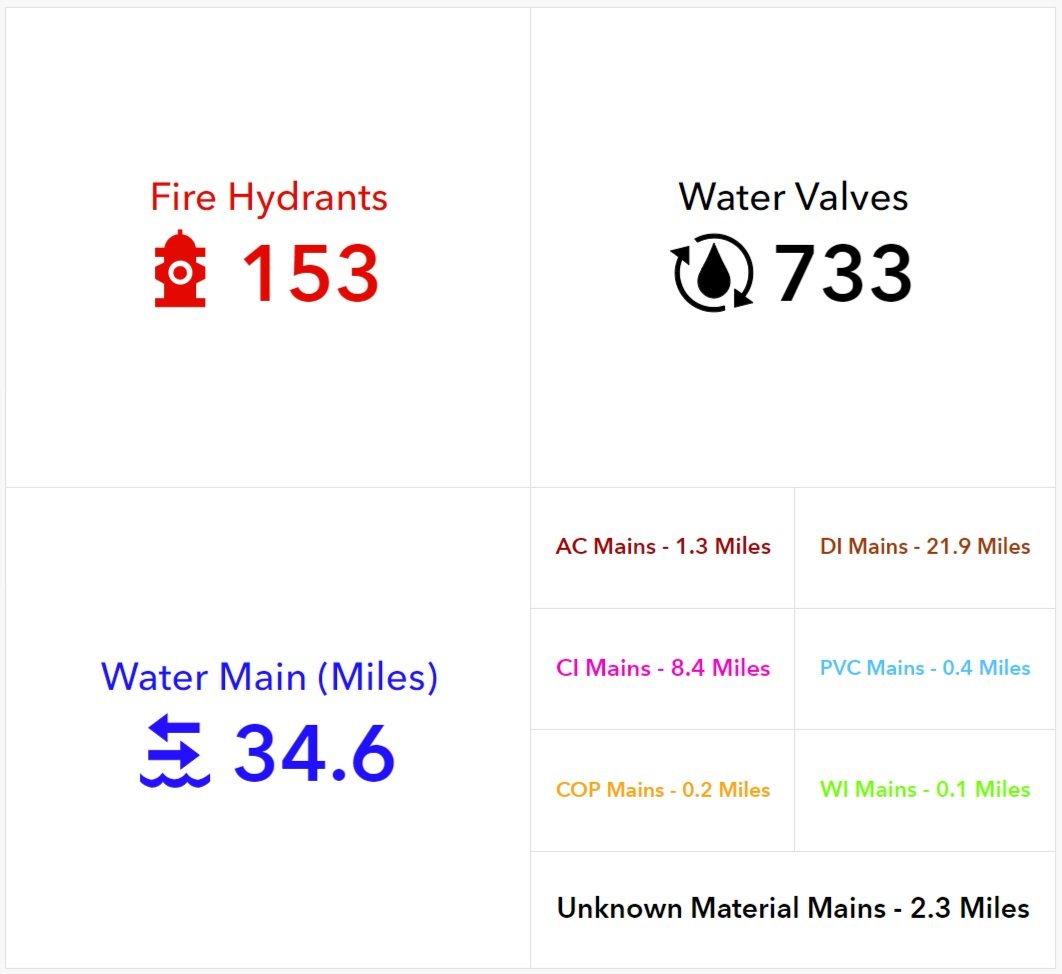
Sample of GIS data dashboard
Managing the Public Service Line Inventory with GIS
Among the revisions, EPA is requiring every water system provider to complete an inventory of their water service lines and report it. If done appropriately, this resource could aid in long-term planning and compliance including laying the groundwork for service line replacement plans as well as managing and tracking improvements and testing records.
A GIS dashboard, built around your water system means your data is always up to date and always accessible. In lieu of paper collection, management of assets can now be done through smart devices, in the field, with next to real-time updates. And accessing that information is easier than ever before. Your data can be built exactly the way that you need it - accompanying the location, analyzed alongside your capital planning, or summative looking at the whole picture.
Whether you're building your inventory from scratch or modifying your existing database - having a GIS team on board means that you data will start to work for you.
Our GIS team is well-versed in aiding our clients with the collection, documentation, and delivery of both private and public-facing dashboards as well as data analysis that ensures your data turns into an interactive, visual asset. This means all of that information becomes meaningful - saving you time and resources. The goal is not just to build a compliant service line industry. It’s to build one that is also valuable to you. To build an inventory that provides direction, meaning, and protection for you and your community.

The Right Time to Start your Service Line Inventory
The short answer to this common question is: now. While the deadline for compliance with the Lead and Copper Rule revisions isn’t until October 2024, it’s important to get your plan into action as soon as possible. A full inventory collection can be a time intensive process, particularly without deploying modern collection methods. It is recommended that the development of your inventory is as thorough as possible including the required historical records and assessment for replacement. Considering all of this, jumpstarting your inventory collection and database building now is crucial to compliance by 2024.
A great first step is to identify where you currently stand in the road to compliance. Then, assess the opportunities that a GIS team presents for preparing and managing your inventory moving forward.
SSM’s GIS Experience
For more than 20 years, we’ve provided professional GIS services to our clients; from mapping support for infrastructure projects, to focused GIS and data capture projects. We utilize GIS to analyze, visualize, and interpret data to understand patterns, relationships, and trends. Through SSM’s extensive geographic data our clients benefit from faster project startups and the economies of readily available data. SSM’s GIS Asset Management approach helps municipalities to transform water, sewer, storm water, or transportation infrastructure data into an easy-to-use operations asset management system capturing vital infrastructure data points with survey-grade accuracy. The data is verified and compiled into a geo-spatial database. Most of our water/wastewater clients have reaped the benefits of GIS in both their everyday use and long-term planning.
Compliance with Testing Protocols and Service Line Replacement
In addition to our GIS expertise, we have dedicated engineers with water system expertise. Our team of Process and Design Engineers have deep and long-standing experience providing water and wastewater engineering services. A significant number of our staff have more than 20 years of experience serving water and wastewater authorities. We combine professional engineers, professional land surveyors, environmental scientists, designers and drafters into teams to complete each assignment.
When it comes to managing and protecting water resources, SSM is the authority that everyone turns to. SSM offers extraordinary experience in the planning, design, and construction management of wastewater and water systems, piping systems, pumping stations, and treatment plants.
As you continue your planning for compliance with the Lead and Copper Rule Revisions, ensure your engineering team is ready and available to get you there not only with expertise, but with experience.


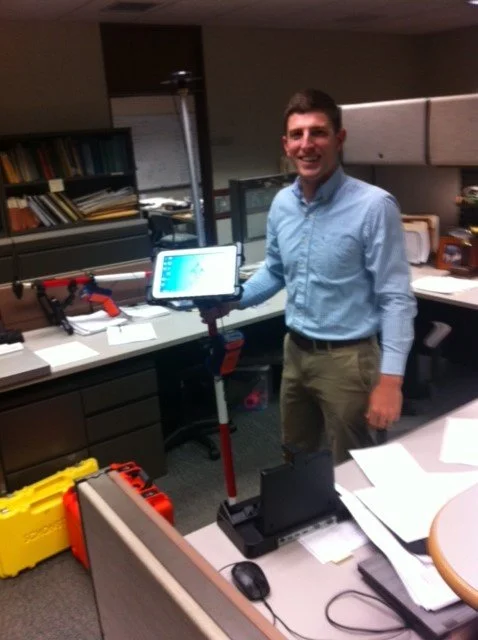


Legislative and Regulatory Update - November 15, 2022
Legislative Update: Clean Streams Law - Spill Reporting; Creek and Stream Maintenance; Workers Compensation and Worker Protection; Water and Wastewater Asset Management Plans; Legionnaires’ Disease
Regulatory Update: New or Revised Federal Drinking Water Regulations; Microbial and Disinfection Byproducts Rules; Maximum Contaminant Level for PFAS; Water Quality Standard for Manganese;

Solar system installation is more affordable than ever. Several financial opportunities including rebates, grants, and tax credits combined with expanding financing opportunities make the return on your investment faster and more attainable. Here’s a look at 3 key financial opportunities associated with solar system conversion.