

Expanding Footprint, Growth and Changing Workspace Requirements
Come Celebrate with us! Expanding Footprint, Growth and Changing Workspace Requirements.
The new SSM Lancaster Regional Office opened August 1, 2018 and is located in the Newport Commons community at 701 Creekside Lane in Lititz, PA.


Eighteen months ago a relationship blossomed between the First Presbyterian Church of Reading and Spotts, Stevens and McCoy (SSM). The result was a mutually advantageous sale of the firm’s Wyomissing facility allowing First Presbyterian to build a suburban presence, and SSM to reinvest resources into growing the business and addressing facility needs for a diverse and mobile staff. An expanded geographic footprint in the Southeastern and Central PA, Lehigh Valley communities where SSM serves a growing client base and implementation of workplace strategies that encourage flexible work arrangements, mobility, and integration of technology are just a few of the results from the sale of the building.
SSM recently completed the reconfiguration of our headquarters office at 1047 North Park Road and is hosting a Ribbon Cutting Ceremony on September 26, 2018 from 12:00 pm to 2:00 pm to commemorate the newly-renovated office space and entranceway. Brian R. Kelly, President and CEO, will be leading the ceremony at 12:30 pm. Lunch and refreshments will be served featuring locally-known Berks Hot Dogs as well as a build-your-own sundae bar for dessert by the Sweet Ride ice cream truck.
The new SSM Lancaster Regional Office opened August 1, 2018 and is located in the Newport Commons community at 701 Creekside Lane in Lititz, PA.
This office will also house dedicated and mobile staff to serve a growing base of Central PA clients. To celebrate the grand opening of the new office, SSM will be hosting a Ribbon Cutting Ceremony from 12:00 pm to 2:00 pm on October 10, 2018.
In addition, on October 1st a new, larger office at the Roma Corporate Center in Allentown will allow the firm to house a growing staff to serve Lehigh Valley.

Spottlight on Shopping
With less than one thousand shopping malls left in the United States, it’s fair to ask, who, or what, killed shopping malls?

Video Killed the Radio Star . . . but What Killed the Shopping Mall?
With less than one thousand shopping malls left in the United States, it’s fair to ask, who, or what, killed shopping malls? The 1950’s brought the population explosion to the suburbs, which welcomed the traditional shopping mall as a prosperous, indoor retail venue with rows of shops, including large “anchor” stores such as Sears and Macy’s, that would connect the smaller shops at each point. Shoppers would spend hours at the mall. But lately, the average time spent shopping is under an hour. In an effort to perpetuate prosperity, shopping malls have been morphing into what researchers call “lifestyle centers”.
So, what brought about this titanic shift in how and where we shop; and what brought on the demise of the traditional shopping mall? The answer is compound. Reasons such as a population shift away from the suburbs and back into the city is one major factor. The decrease of average income brought on by the recession is also to blame and led to discount chains occupying spaces where swanky shops once flourished. Another factor is a generation of “lazy” shoppers who want quick delivery without travel, easier returns, more greenspace. These shoppers also tend to spend more on leisure, experiences, upscale restaurants, and technology. The days of going to shopping centers to simply purchase clothes or shoes are dead and gone, because, frankly, there’s an Amazon for that.
In order to fulfill the needs of today’s buyers, developers and real estate gurus realized the importance of forward-thinking in their approach to revamping the “shopping mall”. With hundreds of large retailers downsizing or going out of business, suburbs across the nation are left with empty lots that need to be re-purposed and redeveloped to adhere to the needs of shoppers. One common theme is the recreation of the “Main Street” or “downtown”, which the modern-day shopping mall pushed to extinction. This retroactive shift will see the repurposing of old retail centers into experiential “lifestyle” centers, where the public can live, eat, work, and play, while still being drawn in with some upscale and chain retail stores.
In addition to living space, recent trends show the re-use of old shopping centers for bowling alleys, event venues, grocery stores, small businesses, movie theaters and fitness centers. Even DMVs, libraries, and walk-in health clinics are appearing for public convenience. For example, what was once the Granite Run Mall in Delaware County, PA., has now transformed into the Granite Run Promenades with the help of The Martin Architectural Group. This mall’s eye-catching multi-use makeover includes luxury apartments adjacent to the center, while other sections were repurposed into an outdoor oasis of finer dining, movie theaters and upgraded shopping. This successful upgrade focused on appeasing shoppers’ experiential and lifestyle needs while welcoming greenspace.
Instead of saying “R.I.P.” to the traditional shopping mall, today’s customers might choose to look at it as more of a reincarnation of the old and outdated, into the new and purposeful

Meeting the Needs of the Changing Retail Space
Dining - Gathering Spaces - Offices - Fitness Areas and Locker Rooms - Auditoriums and Performance Areas

Shark Finn Inn and Restaurant | C2 Architects
SSM engineers provided design of the mechanical, electrical, and plumbing systems for the conversion of a former furniture store into the 7,000 square foot restaurant and bar.
Fresh City Restaurant | C2 Architects
SSM engineers provided design of the mechanical, electrical, and plumbing systems for 4,200 square foot restaurant in the Livingston Town Center Mall.
John Harvard Brewhouse | CVM Engineers
SSM engineers provided MEP design for this restaurant brew house.
Student Union and Services Building | Lincoln University
SSM provided structural engineering for an approximately 15,000 square foot addition to the Student Union and Services Building at Lincoln University. The project also included significant upgrades to the existing building area. The existing two story concrete framed building was expanded on three sides by the addition of a two story, steel-framed structure. The upgrades included the addition or modification of a mailroom, bookstore, cinema viewing area, offices, game room, two story atrium, storage and maintenance areas, and a multi-purpose area. The existing structure was analyzed and reinforced as required for new loads, including new rooftop mechanical equipment. The structural design included design of foundations, ground floor slab, retaining walls, elevated floor slabs, steel framing, and roof deck. We also performed construction phase services including structural shop drawing reviews, responding to contractor’s “Request for Information (RFI)”, and occasional site visits to review construction.
West Hall Dormitory | University of the Virgin Islands
Provided HVAC, plumbing and electrical design for a 37,000 square foot residence hall. The project went from conception to occupancy in 13 months. Provided design for new three story, 100 room dormitory on the St Thomas Campus. Design included providing a new service for the dormitory from VIWAPA, the local utility, 13.2 kV – 480 volt distribution transformer, 480/277 volt power distribution to the buildings HVAC equipment and lighting and lighting control systems and 480 to 208/120 volt step-down transformers for each floor to provide general power distribution to the dorm rooms and common space on each floor. Design also included telecommunications wiring, data closets, wireless access points for wireless data communications within the building, fire alarm, and grounding.
Fitness Center | Olympus America Inc.
SSM assessed the existing HVAC systems capability to support the renovation of a portion of the first floor of Building D creating a fitness center. We reviewed the existing capacity of the HVAC system serving the area that may become a fitness center including expansion of the toilet room area into a toilet room and shower area and provided a letter summary of the evaluation including description of the work required to adapt the existing HVAC system to serve the fitness area and highlight potential areas of concern.
Gateway Motion and Fitness
SSM has been engaged with the Owners of Midway Fitness since 2012, performing a building energy audit and expansion feasibility projects for their existing facility located in Rehoboth DE. After the owners’ decision to relocate, SSM was engaged to provide due diligence and concept planning for alternate sites with existing structures and ultimately, the greenfield site selected for development of a new facility, Gateway Motion and Fitness. Due diligence and concept planning included site and civil engineering, and multi-disciplinary building systems.
Performing Arts Center | SMG
Provided structural engineering services to perform an investigation to determine the cause of the mezzanine ceiling failure at the Sovereign Performing Arts Center.
Our scope of work included analysis of a fly bridge over the stage and investigations of a mezzanine and masonry wall.
Structural Capacity | Tait Towers
SSM structural engineers provided services at Tait Towers, a musical performance practice facility for large productions. Services included determining maximum hoist loads, studies to determine floor capacities for carts, and structural review analysis for building cranes and roof top units.
Multi-Services Building for SEI | Blue Rock Construction
Project manager and lead mechanical engineer for the design of the mechanical, electrical, and plumbing services associated with new 30,000 sf building providing conference facilities, a fitness center, and kitchen and cafeteria.
Auditorium Structural Study | Alvernia University
Conducted an investigation and new design of the lighting rigging supports in the University’s main auditorium.


Join our Growing Team!
We are actively recruiting for qualified applicants to fill a variety of positions.
We are actively recruiting for qualified applicants to fill a variety of positions.
•A Project Representative - Construction Observer to inspect structures and infrastructure using engineering skills to determine structural soundness and compliance with specifications and other regulations.
•An entry-level CAD Drafter is a fast-paced, customer-facing position that collects thorough building information (mechanical, architectural, etc.) and assembles the data in a standard format.
•A highly motivated, performance driven, team-oriented Structural Engineer to assist our clients in the industrial, healthcare, higher education, research, and municipal markets.
•A Senior Water Engineer to work with our engineering staff to support our work in the water, water resources, and wastewater engineering markets on projects such as municipal treatment facilities, distribution systems, collection systems, sanitary and storm sewers and storm water.
•A Senior Civil Engineer to manage municipal projects and perform technical assignments involving storm water management, MS4, local road improvements, and related civil engineering projects.
•A Civil Engineer in our municipal engineering group to perform technical assignments involving Storm Water Management, Local Road Improvements and related projects.

Spottlight on Water Quality
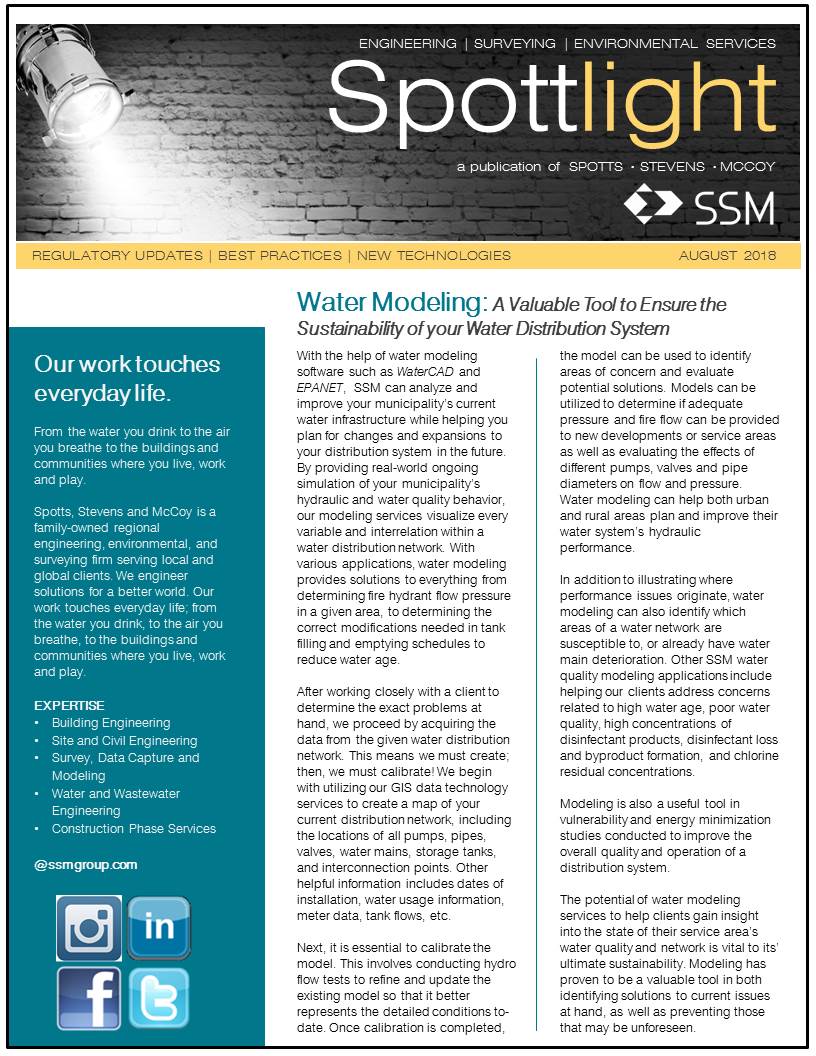
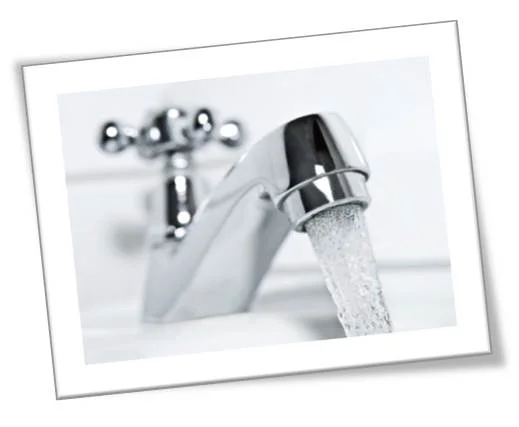
National Water Quality Month reminds us that it takes much more than just turning on the tap to guarantee clean, potable water. The average person uses approximately 80 gallons of water or more per day. The water we use includes bathing, cleaning, household waste, and drinking water. Depending on where we live, the amount of water, usage, population and treatment facilities available vary. Around the world, these variables change greatly. In some villages, available drinkable water is scarce and indoor plumbing does not exist. Protecting our water resources and educating ourselves about water quality is an important goal of National Water Quality Month.
IN THIS ISSUE


Welcome Aboard - Robert Conte

Robert Conte joined the firm as a Senior Designer in the Water and Wastewater Engineering Department. Bob has an AS in Mechanical Engineering Technology from Harrisburg Area Community College.
Welcome Aboard - Joe Cherinko, EIT

Joseph Cherinko, EIT joined the firm as a Graduate Engineer in our Water and Wastewater Engineering Department. Joe has a BS in Environmental Engineering from Wilkes University.
A thirst for clean water flowing from Berks County
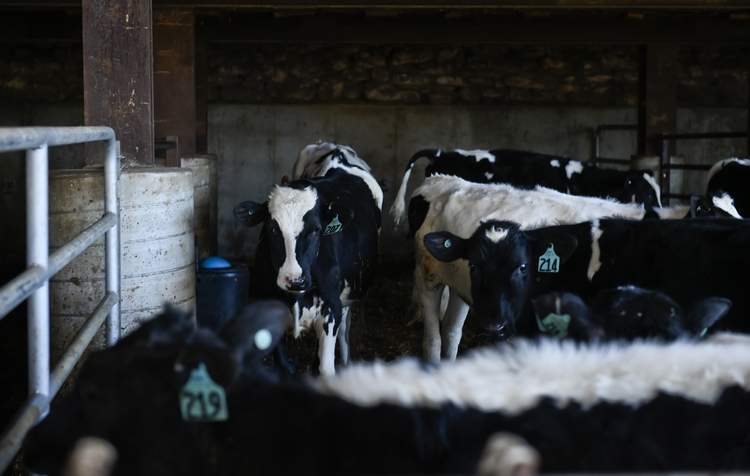
Manure from the cows at Furnace Stream Farm, Windsor Township, is prevented from leaching into the Furnace Creek under efforts that are part of the Delaware River Watershed Initiative.

Furnace Stream flows into Maiden Creek which flows into Ontelaunee Lake which is the drinking water supply for the City of Reading in Windsor Township. Streams are a key part for nitrogen wastes from land to be filtered and changed into harmless nitrogen gas.
Berks Nature and Stroud Water Research Center and other groups are working with farmers in the region to protect water resources and reducing pollutants on farms.

Manure from the cows at Furnace Stream Farm, Windsor Township, is prevented from leaching into the Furnace Creek under efforts that are part of the Delaware River Watershed Initiative.

The newly engineered cattle path at Furnace Stream Farm in Windsor Township protect their water resources. Berks Nature and Stroud Water Research Center and other groups are working with farmers in the region to protect water resources and reducing pollutants on farms.
Reprinted with permission of Reading Eagle Company
Written By:Monica von Dobeneck
Conservation groups join forces with farmers to protect waterways that are part of the vast Delaware River Basin.
Furnace Stream Farms sits at the foot of deeply forested Kittatinny Ridge. Furnace Creek runs through the farm's pastures, still clean and pure after its descent from its headwaters.
At least eight organizations, as well as the dairy farm's owners, are striving to keep it that way.
The farm is one of dozens in Berks County that is getting help from Berks Nature, Stroud Water Research Center, Partnership for the Delaware Estuary and their partners in protecting its waters. It is part of a wider effort throughout the Delaware River Basin called the Delaware River Watershed Initiative, a collaboration of 65 nongovernmental organizations working together to protect the Delaware River and its tributaries, which provide drinking water for 15 million people in four states.
"Small streams like this are 90 percent of all stream miles," said Lamonte Garber, watershed coordinator for Stroud Water Research Center, as he looked over Furnace Creek on a farm in Windsor Township belonging to siblings Doris Long and David Kaufman. "It's the best place to get water quality.“
Furnace Creek runs through wetlands on the farm, which act to purify water.
"If we can preserve streams like this, we have a natural water treatment system," Garber said.
Furnace Creek flows into the Maiden Creek and from there to Ontelaunee Lake, which provides drinking water to 125,000 people in Reading and nearby municipalities. From there it continues to the Schuylkill River and eventually the Delaware.
It is also close to the farm's 40 head of cattle, which were milling about in the faded red, 1885 barn on a recent spring day.
Kim Murphy, president of Berks Nature, said the organization has been doing this kind of work for 20 years, but just finished its fourth year as part of the Delaware River Watershed Initiative. Berks Nature and its partners have installed best management practices on 37 farms in Berks County covering 2,013 acres in the past year alone, focusing on the Middle Schuylkill area.
The work on each farm can cost $50,000 to $500,000, depending on its size and needs, she said.
Berks Nature has contributed $750,000 in grants directly, and uses that money to leverage hundreds of thousands more.
The money comes from federal, state and private sources. The William Penn Foundation recently announced $42 million in funding for the Delaware River initiative, a huge boost in the ability to continue the work.
The U.S. Department of Agriculture provides money through the Natural Resource Conservation Service. The Berks County Conservation District has offered staff expertise and volunteer muscle.
The National Fish and Wildlife Foundation is a funding source. The Reading Area Water Authority assists in planting trees. The state Conservation Reserve Enhancement Program pays rent to farmers for preserving stream buffers.
The farmers themselves contribute labor and maintenance. Kauffman and his son are excavators who lend their machinery.
Unlike the Chesapeake Bay Watershed, the Delaware initiative is thus far voluntary for the farmers who choose to participate.
"We prefer it that way," said senior ecologist Larry Lloyd with Berks Nature. "We can proactively work on getting farms environmentally compliant. These are the folks who are feeding us. We owe them help to stay in business.”
Murphy said it works well when professionals and volunteers come together and use data-driven science "to preserve such an identifying industry in Berks County.”
Harmful Algal Blooms (HABs) in Drinking Water
Freshwater harmful algal blooms (HABs), most notably Cyanobacteria blooms, were formerly known as blue-green algae blooms, and are found in lakes, rivers, ponds and other surface waters.
What are HABs?
Freshwater harmful algal blooms (HABs), most notably Cyanobacteria blooms, were formerly known as blue-green algae blooms, and are found in lakes, rivers, ponds and other surface waters. Cyanobacteria are common in freshwater and are an important part of aquatic life. Excessive growth of Cyanobacteria producing HABs have become a growing concern in the United States and worldwide. HABs can produce toxins referred to as cyanotoxins that pose health risks to humans, animals, fish and shellfish. HABs can also create taste and odor problems in drinking water sources, producing earthy and musty smells and off-putting taste. The impacts of HABs have increased significantly over the past several years with blooms affecting the drinking water supplies in numerous communities in multiple states.
Cyanobacteria have the capability to synthesize metabolites known as cyanotoxins during their exponential growth. Not all strains of Cyanobacteria possess the genes necessary to produce cyanotoxins. Simply possessing the necessary genes does not ensure expression of those genes. Cyanotoxins are classified into three categories by chemical structure: cyclic peptides, alkaloids and lipopolysaccharides. The most commonly occurring are cyclic peptides, of which microcystins are the most common in freshwater. Microcystin-LR is the most toxic of the known variants of microcystin.
What are the Health Impacts of HABs?
In 2015, The U.S. Environmental Protection Agency (EPA) issued 10-day Health Advisories for two cyanotoxins: Microcystin and Cylindrospermopsin. If these cyanotoxins occur in drinking water over the EPA national 10-day Health Advisory level (see Table below), people are at risk for various adverse health effects including headache, incoherent speech, drowsiness, loss of coordination, abdominal pain, upset stomach, vomiting and diarrhea, as well as liver and kidney damage. The Health Advisories (Do Not Drink) provide guidance for the cyanotoxin levels in drinking water at which adverse human health impacts are likely to occur when exposed to these levels over a 10-day time period. Health Advisories are not enforceable safe drinking water standards.
10-day Health Advisories Level

The risk of adverse health impacts from cyanotoxins are higher for infants, young children under the age of six, and other vulnerable populations including: pregnant women, nursing mothers, those with pre-existing liver conditions, those receiving dialysis treatment, the elderly, and sensitive populations.
What causes HABs?
Though all the factors that directly perpetuate HABs are not fully understood, increasing nutrient pollution and climate change are believed to be linked to the increase of occurrence and locations. Freshwater HABs occur most often where there are high levels of nutrients such as nitrogen and phosphorus present in warm, still waters such as reservoirs, lakes, and ponds. HABs can also occur in rivers, particularly in summer months. The sources of excess nutrients can be fertilizers from agricultural activities, sewage and industrial discharges, and stormwater. Climate change is also believed to be a contributor to the increased occurrence of HABs due to warming water temperatures, more frequent droughts, and increased flooding creating more polluted runoff into freshwater bodies. In recent years, Lake Erie algal blooms have lasted into December and January. Similarly, during California’s recent drought period higher incidences of HABs were experienced.
How do HABs Impact Drinking Water?
Cyanobacteria blooms are a significant concern to drinking water suppliers utilizing surface water sources. HABs can be difficult to identify. The shape, size, location, color and cyanotoxin production can vary from bloom to bloom. Seasonal and year-to-year fluctuations can make predicting the occurrence of HABs extremely difficult. While conventional water treatment facilities providing coagulation, sedimentation, filtration and disinfection can generally remove the cyanobacteria cells and very low levels of toxins, during a severe HAB event, when high levels of cyanobacteria and cyanotoxin occur, they can disrupt the treatment processes (floc formation, filtration and chlorination) and require considerable intervention to produce drinking water below the cyanotoxin health advisory levels. Some cyanobacteria may also produce color, unpleasant taste and odor, and may increase the production of potentially harmful disinfectant byproducts (DBPs) precursors. Each HAB event is unique and proper treatment measures need to be considered on a case by case basis. Control measures must be selected carefully, as applying the wrong treatment process could rupture the cyanobacteria cells and result in the release of cyanotoxins rather than the removal of cyanotoxins.
How to protect drinking water from HABs?
Be prepared! Drinking water suppliers need to evaluate and understand their surface water sources and the conditions that could produce HABs including high nutrient levels, water temperature, flow, and pH. HABs can be transported to drinking water intakes by wind or water currents. Water suppliers should evaluate the ability to vary raw water withdrawals from different levels within the raw water source to reduce or eliminate drawing a HAB into the water treatment plant. Depending on the HAB potential for any public water supply source, water suppliers should consider evaluating alternative sources of supply unaffected by HABs. Water suppliers should also effectively monitor for cyanobacteria and cyanotoxin in the raw water source, as well as evaluate methods to treat the raw water source. Additionally, suppliers should evaluate the ability of the treatment plant processes to effectively remove cyanobacteria and cyanotoxin and consider additional treatment technologies or processes to address HABs dependent on the HAB occurrence risk.
How are HABs regulated in Drinking Water?
There are currently no Clean Water Act regulations for cyanobacteria in surface waters or Safe Drinking Water Act enforceable standards or limits for cyanotoxins, although cyanotoxins are currently on EPA’s priority list of drinking water contaminants of potential concern. The EPA Health Advisories for the two cyanobacteria toxins which were issued in 2015 and discussed herein are not enforceable, but provide the technical guidelines needed to assist public water suppliers in protecting their consumers.
FOR MORE INFORMATION | Serena DiMagno, Sr. Environmental Consultant
Water Modeling: A Valuable Tool to Ensure the Sustainability of your Water Distribution System
By providing real-world ongoing simulation of your municipality’s hydraulic and water quality behavior, our modeling services visualize every variable and interrelation within a water distribution network.
With the help of water modeling software such as WaterCAD and EPANET, SSM can analyze and improve your municipality’s current water infrastructure while helping you plan for changes and expansions to your distribution system in the future.
By providing real-world ongoing simulation of your municipality’s hydraulic and water quality behavior, our modeling services visualize every variable and interrelation within a water distribution network. With various applications, water modeling provides solutions to everything from determining fire hydrant flow pressure in a given area, to determining the correct modifications needed in tank filling and emptying schedules to reduce water age.
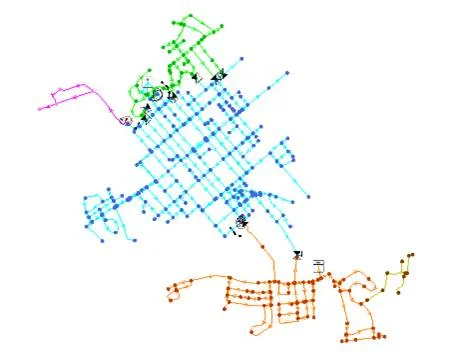
After working closely with a client to determine the exact problems at hand, we proceed by acquiring the data from the given water distribution network. This means we must create; then, we must calibrate! We begin with utilizing our GIS data technology services to create a map of your current distribution network, including the locations of all pumps, pipes, valves, water mains, storage tanks, and interconnection points. Other helpful information includes dates of installation, water usage information, meter data, tank flows, etc.
Next, it is essential to calibrate the model. This involves conducting hydro flow tests to refine and update the existing model so that it better represents the detailed conditions to-date. Once calibration is completed, the model can be used to identify areas of concern and evaluate potential solutions. Models can be utilized to determine if adequate pressure and fire flow can be provided to new developments or service areas as well as evaluating the effects of different pumps, valves and pipe diameters on flow and pressure. Water modeling can help both urban and rural areas plan and improve their water system’s hydraulic performance.
In addition to illustrating where performance issues originate, water modeling can also identify which areas of a water network are susceptible to, or already have water main deterioration. Other SSM water quality modeling applications include helping our clients address concerns related to high water age, poor water quality, high concentrations of disinfectant products, disinfectant loss and byproduct formation, and chlorine residual concentrations. Modeling is also a useful tool in vulnerability and energy minimization studies conducted to improve the overall quality and operation of a distribution system.
The potential of water modeling services to help clients gain insight into the state of their service area’s water quality and network is vital to its’ ultimate sustainability. Modeling has proven to be a valuable tool in both identifying solutions to current issues at hand, as well as preventing those that may be unforeseen.

Spottlight on Berks County
A great place to live, work and play!

#BerksCountyRocks!
We’re joining the Berks County Rocks! Facebook initiative. We’ve hidden rocks at some of our client and project sites and we’re tracking their journey. If you find one, bring it to our office and receive a free Taste of SSM. This issue provides some clues to the first locations! We’ll be posting updates on our website GIS Map as the rocks are found.

A great place to live, work and play.
Founded March 11, 1752, Berks County is home to rich farm land, industry, beautiful parks, entertainment, and 5 higher educational institutions. In addition to deep historic roots and a place on the Monopoly board, Berks County boasts many notable connections including Pulitzer Prize winner John Hoyer Updike, NASCAR Driver Kenny Brightbill, Philadelphia Phillies pitcher Chad Billingsley, American Pioneer Daniel Boone, actor Michael Constantine (My Big Fat Greek Wedding), Grammy Award-winner Dave Cullen, Professional Football Player John Henry Gilmore, Reality TV stars of Jon & Kate Plus 8, and artist Keith Haring. From the plentiful Ontelaunee Orchards and chocolate manufacturers like R. M. Palmer, to prominent manufacturers like East Penn Manufacturing Co., Inc. and Carpenter Technology, to Jazz Festivals and renowned bike races, Berks County has many hidden treasures waiting to be discovered.
We’re connected to the Berks County community. For more than 85 years, Spotts, Stevens and McCoy has proudly called Berks County home. We work with local communities, industries, educational, health care, and government clients to enhance the quality of life for the people touched by our work.
IN THIS ISSUE

L.F. Driscoll Company - Tower Health | Berks County
SSM provided a full range of construction stakeout and surveying services to L.F. Driscoll for the $354 million construction of a 476,000 SF surgical tower expansion on the Tower Health System campus.

Surgical Tower
SSM provided a full range of construction stakeout and surveying services to L.F. Driscoll for the $354 million construction of a 476,000 SF surgical tower expansion on the Reading Health System campus. The eight-story building is home to 24 operating rooms, 8 procedure rooms, a 15-room emergency department expansion, 4-bay trauma expansion and 150 single-bed patient rooms.
In coordination with the prime contractor and in conjunction with various trades, SSM provided a variety of surveying services throughout the duration of the project. The SSM surveying team provided on-site survey control for the entire site including stake out reference points that provided guidance and control to the project from groundbreaking through to final construction. Close interaction between trades, our surveying team, and the construction team results in cost-efficient construction, and more importantly accurate construction of the tower on this complex site.
Our survey team utilized high-definition surveying technology for each slab on grade and on deck. The team provided laser scan results and analysis of high and low spots from baseline elevation in 1/8” increments.
The team collected data and provided as-built documentation for all phases of the project including existing steel tie-in points. In addition, the survey team verified all anchor bolt locations prior to concrete placement.
Specific services included:
- Establishing horizontal and vertical surveying control throughout the job site. Establishing control points associated to the project layout and interacting with trades as the project progresses.
- Provide layout of job fence, tower crane areas, and set perimeter pins and benchmarks for building footprint column locations.
- Verification of all site utilities, existing and new, and layout of critical utilities, all water, sewer and storm drainage improvements. As-built all newly installed utilities.
- Providing elevation control points for each floor as well as exterior points to ensure the alignment of the upper story walls.
- Provide layout of shoring walls and weekly movement monitoring of installed walls.

Penn State University Berks Campus | Berks County
PV Solar System and Car Charging Station

PV Solar System, Gaige Building - Performed design review for the 2.8 kW ground mounted solar array and connecting the system into the campus distribution system in the Gaige Building. Project was done for the University as a demonstration project for the University’s science and engineering schools. Project was a gift in kind to the University.
Electric Car Charging Station, Luerssen Building - Performed design review for the electrical car charging station circuited from in the Luerssen Building. Project was done for the University as a demonstration project for the University’s science and engineering schools. Project was a gift in kind to the University.

Boscov's Berkshire Mall | Berks County
Site Engineering

Site Engineering
Evaluation of site conditions and re-design of loading dock and associated stormwater management provisions in preparation for establishing a new store in an existing space at Berkshire Mall.

Daniel Boone Homestead | Berks County
Wastewater Treatment Plant Emergency Assessment
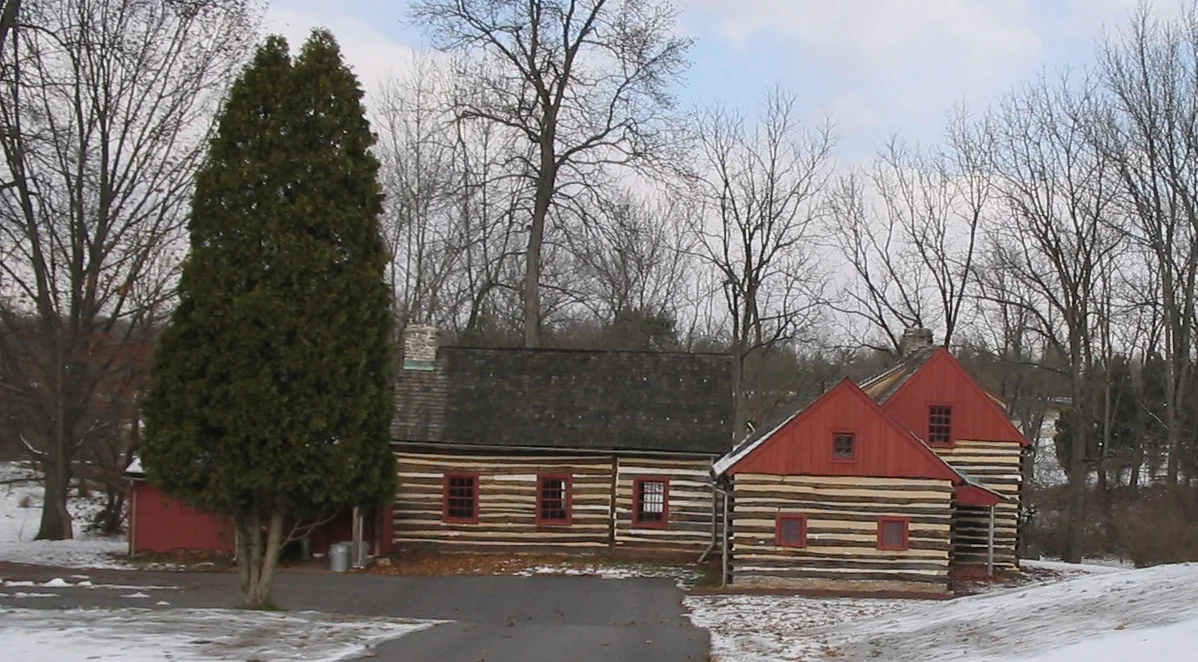
Wastewater Treatment Plant Emergency Assessment
SSM conducted site investigations and evaluated appropriate technology and the feasibility of planned improvements to method of proceeding to develop an environmentally sound and technically feasible solution for wastewater collection and treatment. Developed preliminary sizing, design requirements, costs, permitting, and regulatory requirements.

City of Reading Pagoda | Berks County
SSM provided a Topographical and Building survey using conventional and HDS (High-Density Scanning) technology.
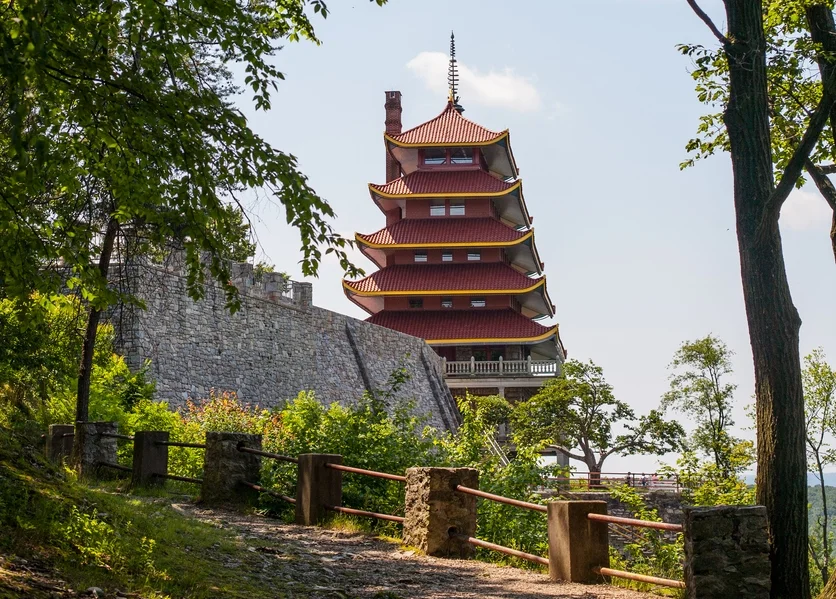
Standing on the mountaintop at 620 feet above the city of Reading, PA is a Berks County historical claim to fame - the Pagoda. Commissioned in 1906 for $50,000 by William A. Witman, Sr. to cover his stone quarry, the Pagoda was completed in 1908. The Pagoda is 7 stories high, 28 feet wide, and 50 feet long. There are a total of 87 steps to the top. The walls are 5 feet thick at the base tapering to 2 feet thick at the top of the second floor, from there to the top, they are frame-covered with terra-cotta shingles - there are 60 tons of tiles on the Pagoda.
SSM provided a Topographical and Building survey using conventional and HDS (High-Density Scanning) technology. The job included surveying the areas around the building in order to design and construct a Japanese garden and improve the parking area below the large stone walls that surround the Pagoda.
SSM also performed geotechnical investigations in the areas of the existing and future retaining walls at the lower entrance. Designs for the new walls, parking lot expansion and landscaping in the terrace garden were also provided. This included the design of a driveway with parking and handicap accessibility along Duryea Drive and creation of the new garden on the existing terrace. To complete this phase, structural repairs and stabilization designs for the building, walls and landscape would be provided, as well as minor plumbing modifications.
Following these designs, SSM prepared plans to upgrade and expand the Pagoda’s outdated and inefficient HVAC systems, as well as replaced the unique exterior lighting with energy-efficient LED lighting.

Year 11: Source Water Protection
Clean and sustainable drinking water is an essential element of the quality of life for any community.
Since 2007 . . .
- Over 250 community water systems signed up for the program.
- Over 120 small water systems have developed a plan.
- 4,000,000 people in Pennsylvania are covered by a Source Water Protection Plan.
June 30, 2018 marked the end of the 11th year of the Source Water Protection Technical Assistance Program (SWPTAP), a voluntary program administered by the PA Department of Environmental Protection, through financing from the Environmental Protection Agency. Participation in SWPTAP provides Community Water Systems with information to help protect drinking water by developing a source water protection plan, create partnerships in their community, and implement a local program. The technical assistance delivered by the program includes delineation of all their raw water sources, an inventory of possible contamination sources, and selecting management strategies that help the water system with ways to manage their watershed.
During the 2017-2018 program year, SWPTAP had an increasing number of partnerships, where several Community Water Systems formed a joint steering committee to manage shared water resources or a common watershed.
The River Alert Information Network (RAIN), based in the Pittsburgh Region, is working on a protection plan for several water systems withdrawing from intakes in the Upper Monongahela River. This plan encompasses watershed management areas alongside the river, and will also discuss protection measures for systems operating near the headwaters of the river in West Virginia. Once completed, this plan can be shared with the systems already approved under the Lower Monongahela Regional Partnership.
The Berks County plan, completed in 2017, has provided momentum for other Community Water Systems to join the county-wide source water protection program. The Berks County project established a joint committee that meets quarterly to discuss grants, best management practices and projects, and stormwater management.
If your community does not currently have a Source Water Protection Plan, contact your DEP Regional Office or Spotts, Stevens and McCoy to learn more about SWPTAP!

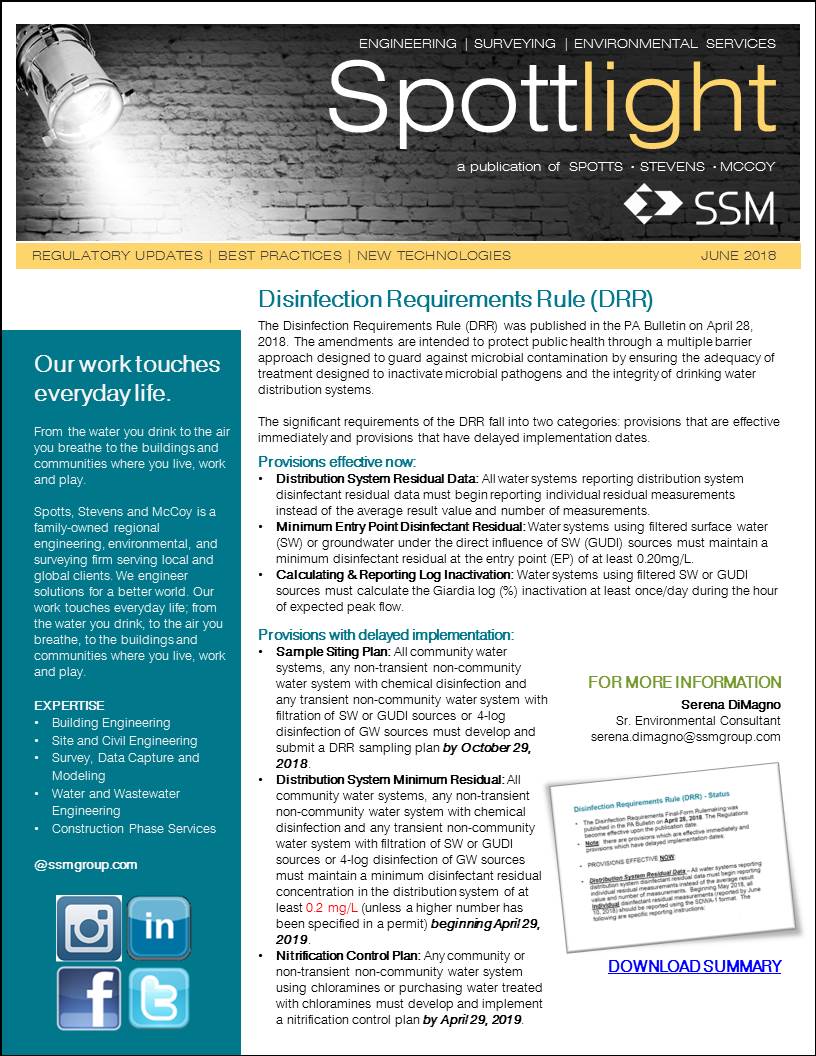
Spottlight on Regulatory Updates

Other Water/Wastewater Industry Regulatory and Legislative Updates: BCWSA Presentation


REGULATORY UPDATE | PA One Call
Amendment highlights to the Underground Utility Line Protection Law which went into effect April 28, 2018.

#PASafetyDays18
2018 PA Safety Day Conferences
Tuesday, June 26
Blair County Convention Center | 1 Convention Center Dr.; Altoona PA 16602
Thursday, June 28
York Expo Center | Mid Atlantic Industrial Memorial East and West | 334 Carlisle Ave.; York PA 17404
Thursday, September 20
Pittsburgh International Airport | Allegheny County Field Mtnce. Bldg. | Hangar Road; Moon PA 15108
FOR MORE INFORMATION

Amendment highlights to the Underground Utility Line Protection Law which went into effect April 28, 2018.
Administratively, the duties of the PA One Call are being transferred from the Department of Labor and Industry to the Public Utility Commission (PUC). There will also be changes to the way violations are handled.
Enforcement by the PUC will entail investigating alleged violations by a Damage Prevention Investigator and the formation of a Damage Prevention Committee. The Damage Prevention Investigator will present findings and recommendations to the Damage Prevention Committee if it is determined that a violation occurred. The Committee can issue a warning, require the person to attend training, or issue an “informal determination” to modify or dismiss a recommendation/ impose a penalty.
Tiered Maximum Penalties:
- Repair - up to $5,000/violation if repair is less than $3,000; up to $10,000/violation if repair is greater than $3,000; up to $50,000 with injury, death or property damage greater than $25,000;
- Administrative - penalties for repeat offenders, and tiered maximum limits ($1,000, $5,000 or $10,000) based on personal injury or property damage assessment.
Appeals will be referred to the PUC’s Bureau of Investigation and Enforcement as a “formal complaint”.
The Bill includes several new definitions many of which are aimed a the natrual resources extraction industries (natural gas, pipeline, and oil and gas well issues), excepting surface mining and coal mining.
Duties and requirements of Facility Owners:
- Participate in the One Call System’s Members Mapping Solutions, requirements to be determined.
- Communicate directly with excavator within two hours after re-notification when Facility Owner failed to respond to a location request.
- Submit reports of alleged violations to PUC within 30 business days if cost to repair is greater than $2,500.
- Maintain existing records of abandoned “main” lines and locate, if possible.
Duties of Designers:
- Report violations to PUC within 30 business days.
- Paying a “request fee” (annual) to the One Call System.
Duties of Excavators:
- Report if facilities lines are struck or damaged.
- Requesting facility location before excavation and paying a locate request fee (annual).
- Re-notifying if a facility is unmarked or incorrectly marked.
Duty of Project Owner:
- Provide report within 10 business days if owner believes a violation (line damage) occurred.

REGULATORY UPDATE | Chapter 109 Safe Drinking Water
Updates existing regulations pertaining to treatment technique requirements for pathogens, permit fees, and monitoring and reporting requirements.

DOWNLOAD SUMMARY
Proposed Chapter 109 (Safe Drinking Water) General Update and Fees
Updates existing regulations pertaining to treatment technique requirements for pathogens, permit fees, and monitoring and reporting requirements.
The proposed amendments are intended to:
- Incorporate the remaining general update provisions that were separated from the proposed Revised Total Coliform Rule (RTCR) as ordered by the Environmental Quality Board as follows:
- Clarify source water assessment and protection program requirements.
- Revise treatment technique and turbidity performance requirements.
- Revise permit requirements and design standards, and add new requirements for alarm and shutdown capabilities.
- Require auxiliary power or an alternate provision, such as adequate finished water storage or interconnections.
- Establish new annual fees and amend existing permit fees.
- Incorporate additional general updates that will:
- Establish the regulatory basis for issuing general permits.
- Clarify that non-community water systems require a permit or approval from DEP prior to construction or operation.
- Address concerns related to gaps in monitoring and tracking of back-up water sources and entry points.
Status Update
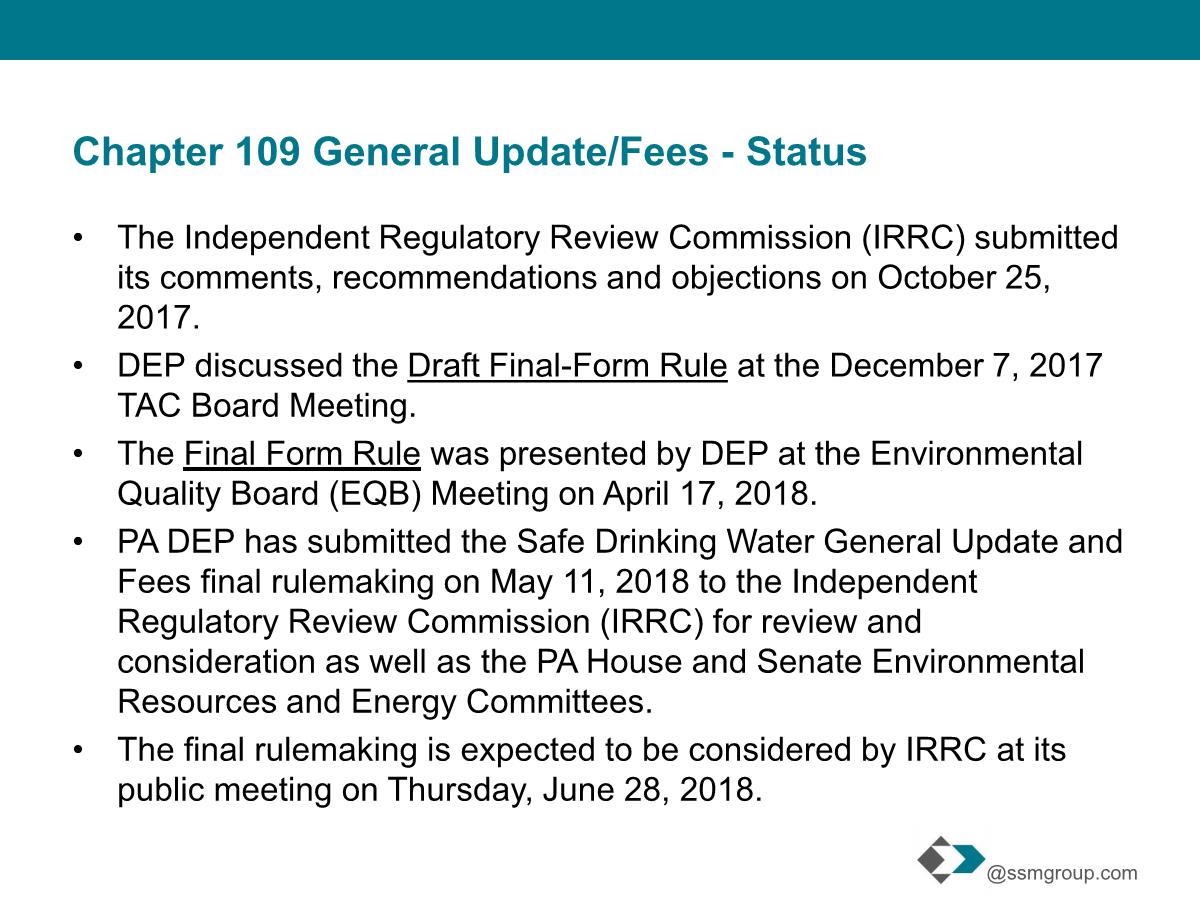
The Independent Regulatory Review Commission (IRRC) submitted its comments, recommendations and objections on October 25, 2017.
- DEP discussed the draft Final-Form Rule at the December 7, 2017 Technical Assistance Center (TAC) Board Meeting.
- The Final-Form Rule was presented by PA DEP at the Environmental Quality Board (EQB) Meeting on April 17, 2018.
- PA DEP submitted the Safe Drinking Water General Update and Fees final rulemaking on May 11, 2018 to the IRRC for review and consideration as well as the PA House and Senate Environmental Resources and Energy Committees.
- The final rulemaking is expected to be considered by IRRC at its public meeting on Thursday, June 28, 2018.
- The Final Form: Safe Drinking Water General Updates and Fees (25 PA Code Chapter 109) is available on IRCC’s webpage: (www.irrc.state.pa.us).
Provisions
- Amends existing permit fees and adds new annual fees to supplement DEP’s costs and fill the funding gap of $7.5 million.
- Annual Fee Ranges
- Community Water Systems - $250 - $40,000
- Non-Community Water Systems - $50 - $1,000
- Bottled, Vended, Retail and Bulk Water Haulers - $1,000 - $2,500
- The new annual fees will be required beginning January 2, 2018 to allow systems to include the new fees in their 2019 budgets.
Provides for new requirements for treatment plant alarm and shut-down capabilities and auxiliary power requirements.
FOR MORE INFORMATION: Serena DiMagno, Sr. Environmental Consultant