

REGULATORY UPDATE | PA One Call
Amendment highlights to the Underground Utility Line Protection Law which went into effect April 28, 2018.

#PASafetyDays18
2018 PA Safety Day Conferences
Tuesday, June 26
Blair County Convention Center | 1 Convention Center Dr.; Altoona PA 16602
Thursday, June 28
York Expo Center | Mid Atlantic Industrial Memorial East and West | 334 Carlisle Ave.; York PA 17404
Thursday, September 20
Pittsburgh International Airport | Allegheny County Field Mtnce. Bldg. | Hangar Road; Moon PA 15108
FOR MORE INFORMATION

Amendment highlights to the Underground Utility Line Protection Law which went into effect April 28, 2018.
Administratively, the duties of the PA One Call are being transferred from the Department of Labor and Industry to the Public Utility Commission (PUC). There will also be changes to the way violations are handled.
Enforcement by the PUC will entail investigating alleged violations by a Damage Prevention Investigator and the formation of a Damage Prevention Committee. The Damage Prevention Investigator will present findings and recommendations to the Damage Prevention Committee if it is determined that a violation occurred. The Committee can issue a warning, require the person to attend training, or issue an “informal determination” to modify or dismiss a recommendation/ impose a penalty.
Tiered Maximum Penalties:
- Repair - up to $5,000/violation if repair is less than $3,000; up to $10,000/violation if repair is greater than $3,000; up to $50,000 with injury, death or property damage greater than $25,000;
- Administrative - penalties for repeat offenders, and tiered maximum limits ($1,000, $5,000 or $10,000) based on personal injury or property damage assessment.
Appeals will be referred to the PUC’s Bureau of Investigation and Enforcement as a “formal complaint”.
The Bill includes several new definitions many of which are aimed a the natrual resources extraction industries (natural gas, pipeline, and oil and gas well issues), excepting surface mining and coal mining.
Duties and requirements of Facility Owners:
- Participate in the One Call System’s Members Mapping Solutions, requirements to be determined.
- Communicate directly with excavator within two hours after re-notification when Facility Owner failed to respond to a location request.
- Submit reports of alleged violations to PUC within 30 business days if cost to repair is greater than $2,500.
- Maintain existing records of abandoned “main” lines and locate, if possible.
Duties of Designers:
- Report violations to PUC within 30 business days.
- Paying a “request fee” (annual) to the One Call System.
Duties of Excavators:
- Report if facilities lines are struck or damaged.
- Requesting facility location before excavation and paying a locate request fee (annual).
- Re-notifying if a facility is unmarked or incorrectly marked.
Duty of Project Owner:
- Provide report within 10 business days if owner believes a violation (line damage) occurred.

REGULATORY UPDATE | Chapter 109 Safe Drinking Water
Updates existing regulations pertaining to treatment technique requirements for pathogens, permit fees, and monitoring and reporting requirements.

DOWNLOAD SUMMARY
Proposed Chapter 109 (Safe Drinking Water) General Update and Fees
Updates existing regulations pertaining to treatment technique requirements for pathogens, permit fees, and monitoring and reporting requirements.
The proposed amendments are intended to:
- Incorporate the remaining general update provisions that were separated from the proposed Revised Total Coliform Rule (RTCR) as ordered by the Environmental Quality Board as follows:
- Clarify source water assessment and protection program requirements.
- Revise treatment technique and turbidity performance requirements.
- Revise permit requirements and design standards, and add new requirements for alarm and shutdown capabilities.
- Require auxiliary power or an alternate provision, such as adequate finished water storage or interconnections.
- Establish new annual fees and amend existing permit fees.
- Incorporate additional general updates that will:
- Establish the regulatory basis for issuing general permits.
- Clarify that non-community water systems require a permit or approval from DEP prior to construction or operation.
- Address concerns related to gaps in monitoring and tracking of back-up water sources and entry points.
Status Update
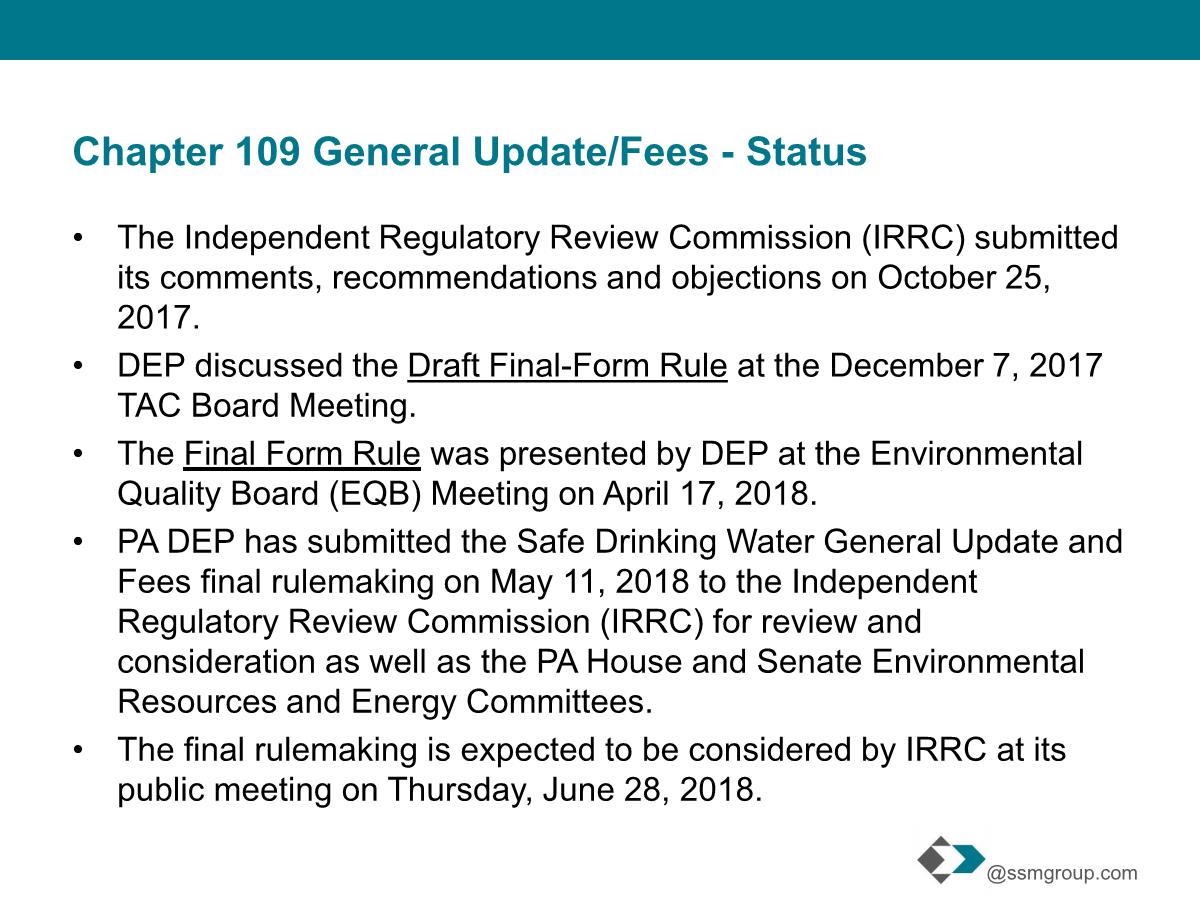
The Independent Regulatory Review Commission (IRRC) submitted its comments, recommendations and objections on October 25, 2017.
- DEP discussed the draft Final-Form Rule at the December 7, 2017 Technical Assistance Center (TAC) Board Meeting.
- The Final-Form Rule was presented by PA DEP at the Environmental Quality Board (EQB) Meeting on April 17, 2018.
- PA DEP submitted the Safe Drinking Water General Update and Fees final rulemaking on May 11, 2018 to the IRRC for review and consideration as well as the PA House and Senate Environmental Resources and Energy Committees.
- The final rulemaking is expected to be considered by IRRC at its public meeting on Thursday, June 28, 2018.
- The Final Form: Safe Drinking Water General Updates and Fees (25 PA Code Chapter 109) is available on IRCC’s webpage: (www.irrc.state.pa.us).
Provisions
- Amends existing permit fees and adds new annual fees to supplement DEP’s costs and fill the funding gap of $7.5 million.
- Annual Fee Ranges
- Community Water Systems - $250 - $40,000
- Non-Community Water Systems - $50 - $1,000
- Bottled, Vended, Retail and Bulk Water Haulers - $1,000 - $2,500
- The new annual fees will be required beginning January 2, 2018 to allow systems to include the new fees in their 2019 budgets.
Provides for new requirements for treatment plant alarm and shut-down capabilities and auxiliary power requirements.
FOR MORE INFORMATION: Serena DiMagno, Sr. Environmental Consultant

REGULATORY UPDATE | Disinfection Requirements Rule
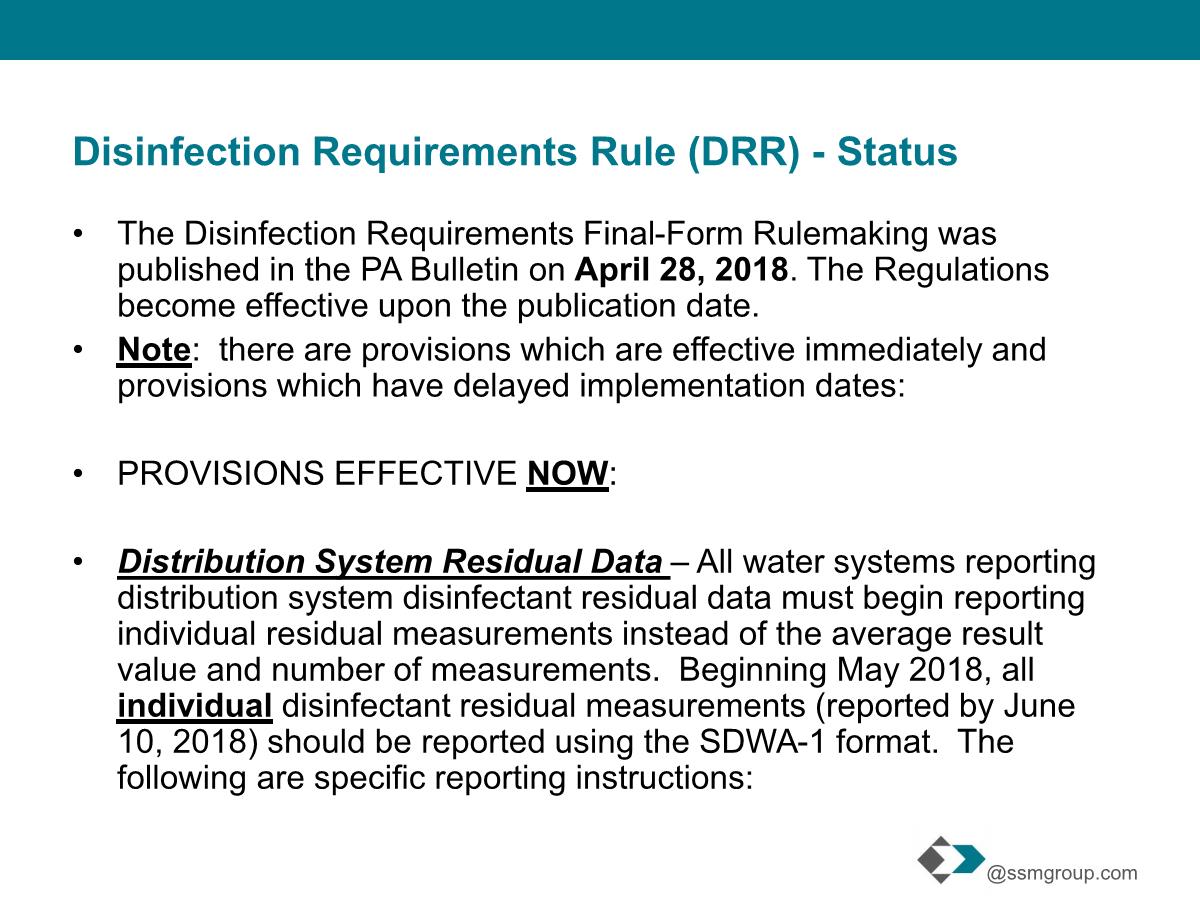
The Disinfection Requirements Rule (DRR) was published in the PA Bulletin on April 28, 2018. The amendments are intended to protect public health through a multiple barrier approach designed to guard against microbial contamination by ensuring the adequacy of treatment designed to inactivate microbial pathogens and the integrity of drinking water distribution systems.
The Disinfection Requirements Rule (DRR) was published in the PA Bulletin on April 28, 2018. The amendments are intended to protect public health through a multiple barrier approach designed to guard against microbial contamination by ensuring the adequacy of treatment designed to inactivate microbial pathogens and the integrity of drinking water distribution systems.
The significant requirements of the DRR fall into two categories: provisions that are effective immediately and provisions that have delayed implementation dates.
Provisions effective now:
- Distribution System Residual Data: All water systems reporting distribution system disinfectant residual data must begin reporting individual residual measurements instead of the average result value and number of measurements.
- Minimum Entry Point Disinfectant Residual: Water systems using filtered surface water (SW) or groundwater under the direct influence of SW (GUDI) sources must maintain a minimum disinfectant residual at the entry point (EP) of at least 0.20mg/L.
- Calculating & Reporting Log Inactivation: Water systems using filtered SW or GUDI sources must calculate the Giardia log (%) inactivation at least once/day during the hour of expected peak flow.
Provisions with delayed implementation:
- Sample Siting Plan: All community water systems, any non-transient non-community water system with chemical disinfection and any transient non-community water system with filtration of SW or GUDI sources or 4-log disinfection of GW sources must develop and submit a DRR sampling plan by October 29, 2018.
- Distribution System Minimum Residual: All community water systems, any non-transient non-community water system with chemical disinfection and any transient non-community water system with filtration of SW or GUDI sources or 4-log disinfection of GW sources must maintain a minimum disinfectant residual concentration in the distribution system of at least 0.2 mg/L (unless a higher number has been specified in a permit) beginning April 29, 2019.
- Nitrification Control Plan: Any community or non-transient non-community water system using chloramines or purchasing water treated with chloramines must develop and implement a nitrification control plan by April 29, 2019.
FOR MORE INFORMATION: Serena DiMagno, Sr. Environmental Consultant