

David Morgan, RLA Confirmed ASLA Board
The PA Senate confirmed the nomination to continue serving on the State Board of Landscape Architects.

DAVID MORGAN, RLA
Spotts, Stevens and McCoy is pleased to announce that David B. Morgan, RLA has been confirmed by the PA Senate as a member of the State Board of Landscape Architects.
Mr. Morgan was appointed by Governor Corbett as a member of the State Board of Landscape Architects in 2012.
David has over 24 years of land planning and landscape architecture experience. In his current role, he is responsible for managing all phases of landscape architecture and site design from conceptual design and master planning through production of construction documents and presentations to governmental agencies. His experience includes subdivision planning, storm water management, and land development planning; recreation facility planning; site design; grading; landscaping; soil erosion and sediment control; site construction inspections; NPDES/NOI permit preparation; review and commentary of engineering plans for local government agencies and municipalities; PENNDOT Highway Occupancy Permits; feasibility studies, cost estimates, and securing project approvals.
He has an A.S. Commercial Arts & Design, Antonelli Institute of Art & Design and is a Registered Landscape Architect in Pennsylvania (LA001388L) since 1996.
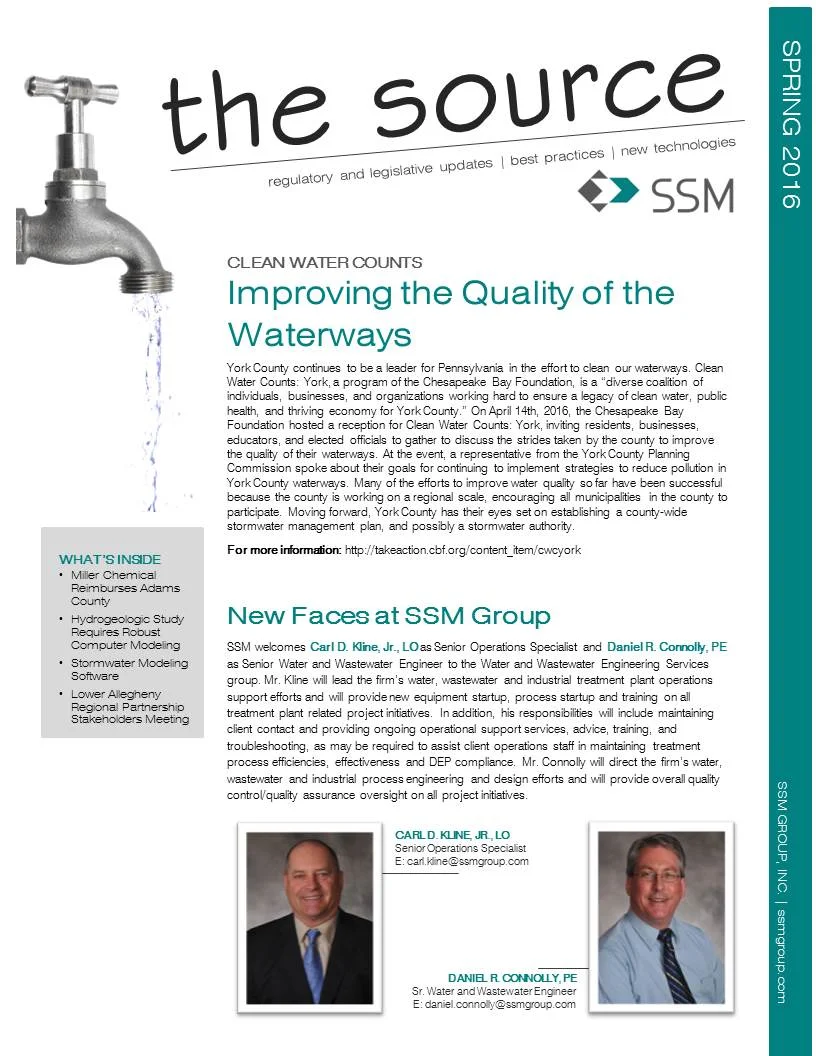
The Source - Spring 2016
regulatory and legislative updates, best practices, and new technologies for source water protection
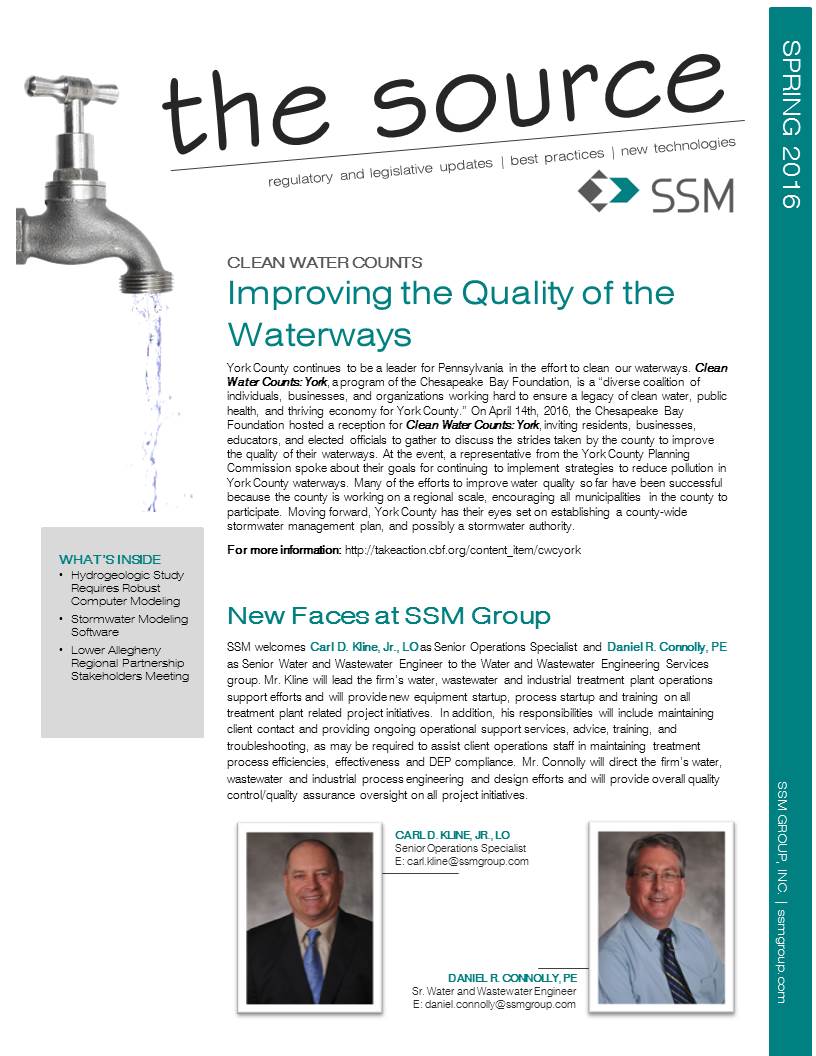
regulatory and legislative updates, best practices, and new technologies.
What's Inside this Issue
- Hydrogeologic Study Requires Robust Computer Modeling
- Stormwater Modeling Software
- Lower Allegheny Regional Partnership Stakeholders Meeting

PEDA 2016 Spring Legislative Conference
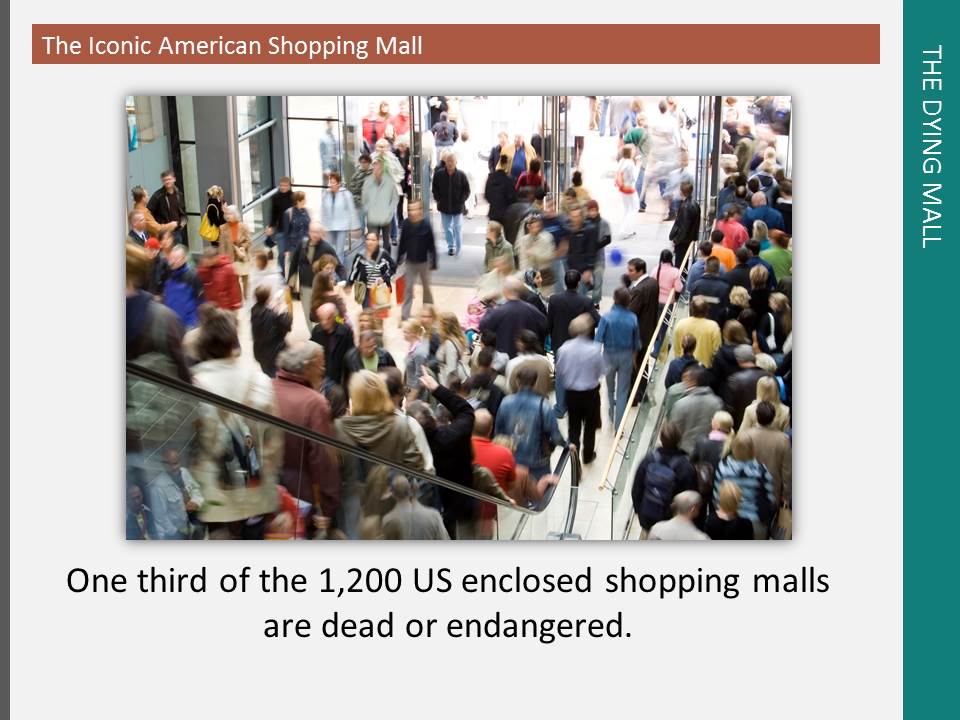
One third of the 1,200 US enclosed shopping malls are dead or endangered.

The Dying Mall: Reinventing Shopping Malls to Revitalize the Community
What’s to become of the shell of America’s shopping mall history?
Malls with high vacancy rates, low consumer traffic, no anchor store, or dated and deteriorating structures are considered ‘dead.’ Green Street Advisors report there are approximately 1,200 enclosed malls across the country and 15% of those malls will fail or be converted into non-retail space within the next 10 years. Online shopping, the recession, and demographic shifts are the key factors leading to this death toll. A change to the way we shop has led some mall owners to change the set-up of their mall, re-arranging like stores together, adding new anchors (like Apple stores) or new features (like daycare or children’s play areas) and changing the food court to a dining terrace with upgrades from fast food to sushi bars. While these approaches may save some shopping malls, the hard truth remains that many of these malls will not return to the glory of their past; but will instead close leaving behind a gigantic concrete shell on an island of macadam.
We'll be talking about the revitalization efforts at the PEDA 2016 Spring Conference!
For more information:
Terry Reed, Vice President Business Development
The Source - November 2015

Regulatory and legislative updates, best practices, and new technologies.
WHAT’S INSIDE
- Unassessed Waters Project Successful in Berks County
- Strategies for Successful Implementation
- Consider the Source Campaign
- New Faces in Sourcewater Protection
- Good Water = Good Life
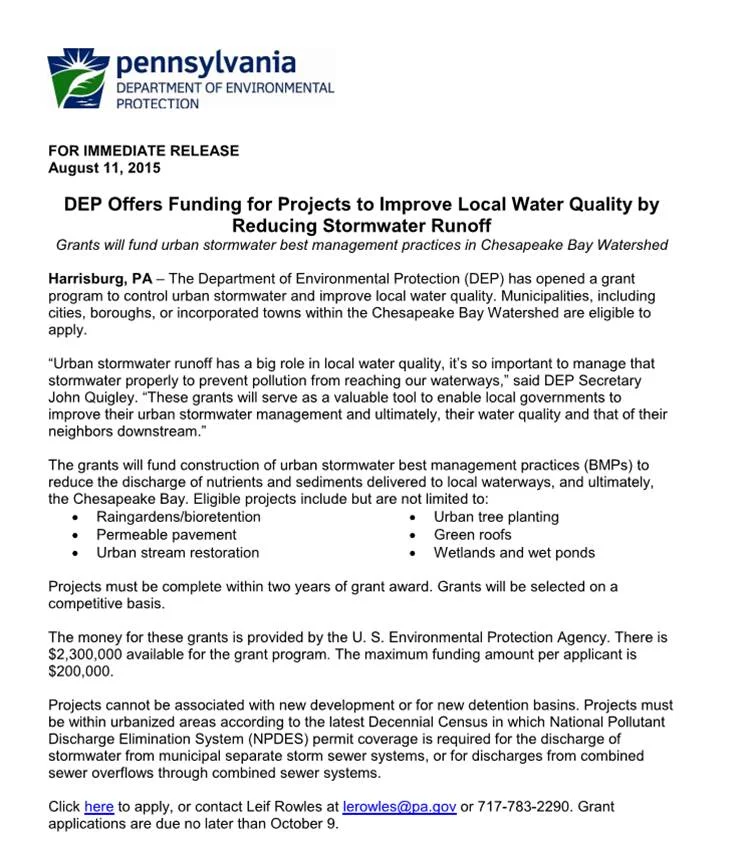
DEP Offers Funding for Projects to Improve Local Water Quality by Reducing Stormwater Runoff
Grant Opportunity: Municipalities, including cities, boroughs, or incorporated towns within the Chesapeake Bay Watershed are eligible to apply.

Grants will fund urban stormwater best management practices in Chesapeake Bay Watershed
HARRISBURG, PA -- The Department of Environmental Protection (DEP) has opened a grant program to control urban stormwater and improve local water quality. Municipalities, including cities, boroughs, or incorporated towns within the Chesapeake Bay Watershed are eligible to apply.
“Urban stormwater runoff has a big role in local water quality, it’s so important to manage that stormwater properly to prevent pollution from reaching our waterways,” said DEP Secretary John Quigley. “These grants will serve as a valuable tool to enable local governments to improve their urban stormwater management and ultimately, their water quality and that of their neighbors downstream.”
The grants will fund construction of urban stormwater best management practices (BMPs) to reduce the discharge of nutrients and sediments delivered to local waterways, and ultimately, the Chesapeake Bay. Eligible projects include but are not limited to:
• Raingardens/bioretention
• Permeable pavement
• Urban stream restoration
• Urban tree planting
• Green roofs
• Wetlands and wet ponds
Projects must be complete within two years of grant award. Grants will be selected on a competitive basis.
The money for these grants is provided by the U. S. Environmental Protection Agency. There is $2,300,000 available for the grant program. The maximum funding amount per applicant is $200,000.
Projects cannot be associated with new development or for new detention basins. Projects must be within urbanized areas according to the latest Decennial Census in which National Pollutant Discharge Elimination System (NPDES) permit coverage is required for the discharge of stormwater from municipal separate storm sewer systems, or for discharges from combined sewer overflows through combined sewer systems.
Grant applications are due no later than October 9.
FOR MORE INFORMATION
COMMONWEALTH OF PENNSYLVANIA
Dept. of Environmental Protection
Commonwealth News Bureau
Room 308, Main Capitol Building
Harrisburg PA., 17120
CONTACT: Amanda Witman, DEP, 717-787-1323
CONTACT: Leif Rowles at lerowles@pa.gov or 717-783-2290.
SSM GROUP: Mark Stabolepszy, PE, Vice President Municipal Engineering and Planning
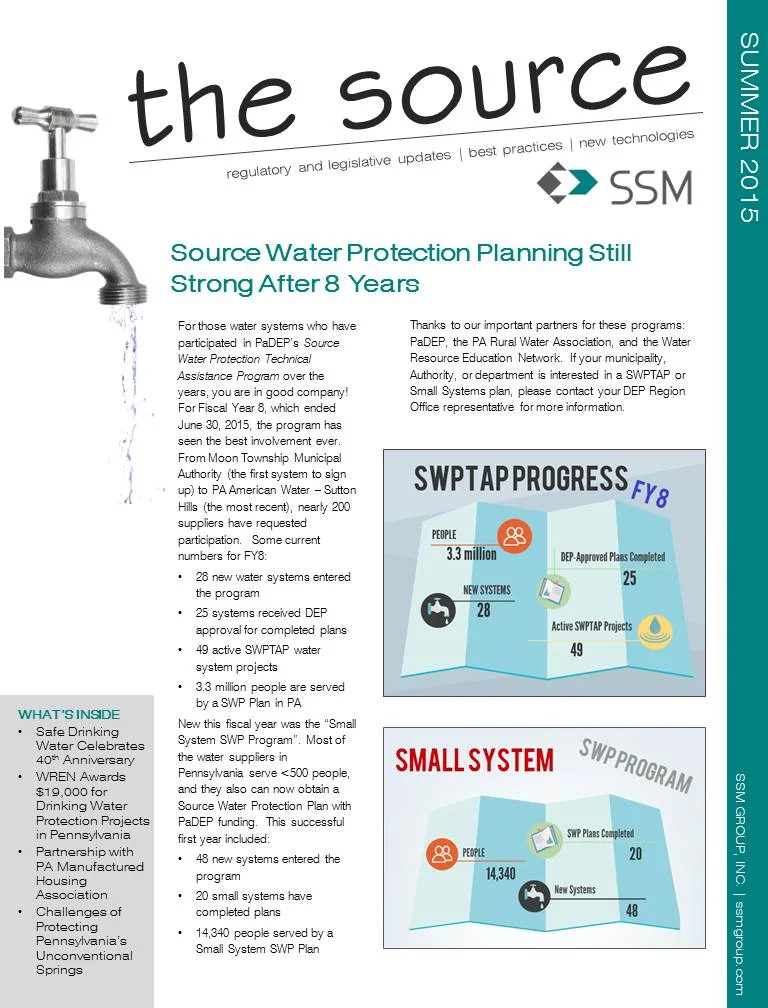
The Source - July 2015
July 2015 Inside this Issue:
- Safe Drinking Water Celebrates 40th Anniversary
- WREN Awards $19,000 for Drinking Water Protection Projects in Pennsylvania
- Partnership with PA Manufactured Housing Association
- Challenges of Protecting Pennsylvania’s Unconventional Springs
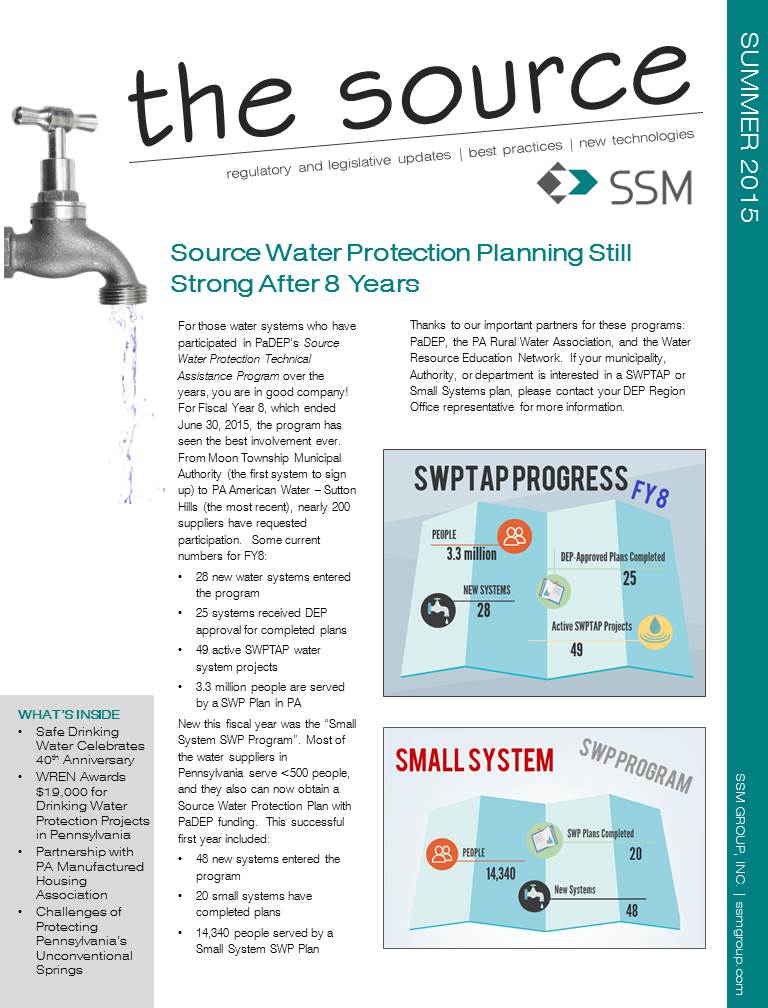
JULY 2015 | The Source
Regulatory and legislative updates, best practices, and new technologies.
Celebrating National Parks Week
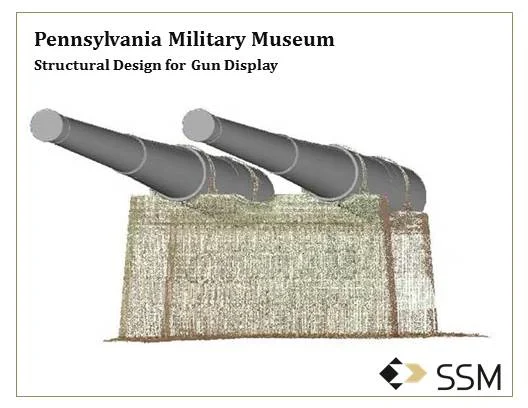
Structural Design for Gun Display

Pennsylvania Military Museum
Pennsylvania Military Museum
Structural Design for Gun Display
- Provided engineering services to support the installation of two, 14-inch diameter, 53-foot-long gun barrels from the Battleship USS Pennsylvania (BB-38) on a concrete pedestal.
- Oversaw a geotechnical investigation and prepared structural designs to design pedestal that would approximate the manner in which the guns appeared on the ship, including a 28’diameter disc that replaces the ship’s turret.
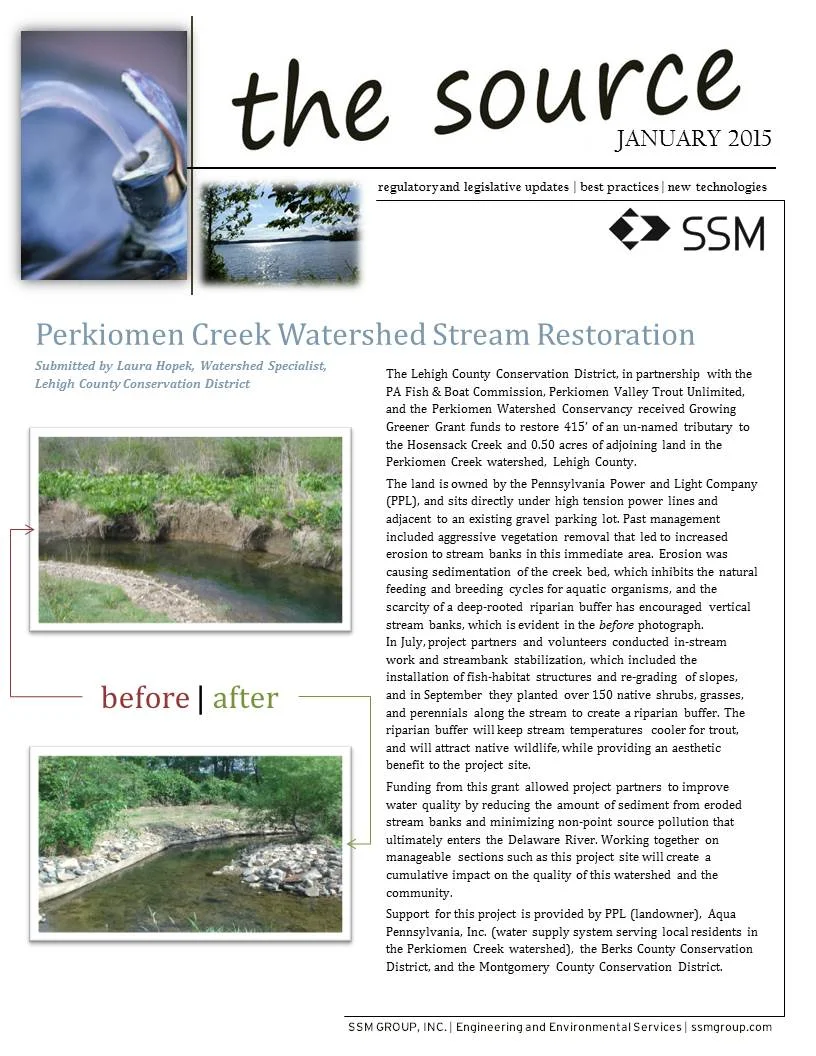
the Source - January 2015
Source Water Protection News: regulatory and legislative updates, best practices, new technologies
Source Water Protection News
Regulatory and legislative updates, best practices, and new technologies.
Protecting your water begins with your land
The Eastern Lancaster County (ELANCO) Source Water Collaborative hosted a workshop entitled, Protecting Your Water Begins with Your Land. The workshop invited government, the local farming community, and environmental organizations to comingle and learn about new findings in farming best management practices.

Elanco Source water collaborative
ELANCO Source Water Collaborative
The Eastern Lancaster County (ELANCO) Source Water Collaborative hosted a workshop entitled, Protecting Your Water Begins with Your Land. The workshop invited government, the local farming community, and environmental organizations to co-mingle and learn about new findings in farming best management practices.
Although the theme of the workshop was farming best management practices, the underlying theme in each presentation was communication. Whether it was a member of a federal agency, a conservation organization or a representative of the Mennonite community, each person that spoke promoted respecting differences, seeing from all points of view and coming together to work towards a better balance of environmental conservation and profit maximization.
The event’s keynote speaker, Ray Archuleta promoted soil health in an informative way that simply made sense. Using fantastic demonstrations, he showed how conventional farming techniques strip the soil of nutrients and the ability to form aggregates and hold water. By improving the health of the soil, not only do we increase farmers’ yields, but we also prevent soil runoff and erosion, improving our water quality. Ray’s speech was so engaging that during the exhibition session, farmers crowded around him to discuss the topics further.
The workshop was an eye opener, not only for the community, who was there to learn about, or possibly criticize, the suggestions the workshop was providing, but to the educators, environmental activists, vendors and agency workers. No one in the room expected such a successful workshop and for so many different people to get along so wonderfully. It really inspired hope that we can work together on these critical issues.
If you’d like more information on soil health, you can check out some of Ray’s demonstrations on his Vimeo page at http://www.vimeo.com/channels/raythesoilguy.
The videos are short (about a minute for most) but really do say a lot.