
SSM Group, Inc. Announces Management Changes - Brian Kelly named President and CEO



SSM Group, Inc. recently announced a corporate management restructure. Brian R. Kelly has been named President and Chief Executive Officer of the firm. Kelly, who formerly served as the company’s Executive Vice President with responsibility of running the firm’s operations, replaces J. Carlton Godlove, II, who has left the company to pursue other interests.
Kelly is one of four McCoy family members who assumed control and management of the firm in 1996. Kelly has an Associate Degree in Mechanical Engineering Technology from The Pennsylvania State University. Prior to joining the SSM management team, Kelly was employed at AT&T for more than 17 years in various roles. Kelly resides in Reading with his wife, Kay McCoy Kelly, who is a daughter of the company’s founder, Lewis J. McCoy, Sr. In a prepared statement, Kelly said, “I look forward to leading the company as we embark upon strategic growth and expansion. I am very proud of our exceptionally talented senior leadership team and all of our employees, and I am confident that, with their help and support, we will continue to grow the company and succeed at fulfilling our corporate mission – ‘Enhancing the quality of life for our clients, our employees, and all of the people touched by our work.’ Our work is so important because it touches this generation and future generations with a scope broader than we can imagine – and it leaves a legacy that will live far beyond us.”
“Approximately six months ago we appointed a team of independent professionals to work with us as members of an Advisory Board: Thomas A. Beaver, CPA, former managing partner at RKL; Patricia L. Langiotti, President of Creative Management Concepts; and Mike Shor, former executive with Carpenter. These Advisory Board members have played a key role in helping us plan for our future,” Kelly said.
Kelly also announced that shareholder, Patrick M. McCoy, PE, has been promoted to Executive Vice President. “Patrick will lead the company’s business development and sales and marketing efforts and he will be a strong right-hand man,” Kelly said. Patrick McCoy has been with the firm since 1996. He graduated from Drexel University, like his father, and holds Bachelor’s degrees in Civil Engineering and Architectural Engineering. McCoy formerly led the company’s Facilities and Site Engineering Division which provides services to worldwide companies such as IBM. Prior to joining SSM, he was with Ortega Consulting, Media, PA, and Gredell & Associates, Wilmington, DE.
Shareholder Lewis J. (Lou) McCoy, Jr. of Reading, who joined the firm in 1985, will continue in his role as Director of Human Resources.
Catherine (Kitty) Bell, who joined the firm in 2004, is being promoted to Divisional Vice President. Formerly the firm’s Vice President of Facility Engineering, she assumes an expanded role, with additional management responsibility for Site Engineering and Survey and Data Capture disciplines (formerly managed by Patrick McCoy). Bell resides in Reading, PA.
SSM Group, Inc. is an engineering and consulting firm founded by Lewis J. McCoy, Sr. in 1967. The company continues to be family owned and operated. Headquartered at 1047 North Park Road in Wyomissing with satellite offices in Harrisburg and the Lehigh Valley, SSM has just under 100 employees and provides services to various types of local, regional and national businesses that include commercial, industrial, manufacturing and telecommunications as well as healthcare and higher education institutions. The company also provides services to numerous local, regional, and county government entities. While the company’s primary market is a regional footprint including Berks County and the Lehigh Valley, SSM serves clients throughout PA and the Northeastern United States as well as to some international clients.
FOR MORE INFORMATION:
Brian Kelly, President and CEO
brian.kelly@ssmgroup.com | P: 610-621-2000
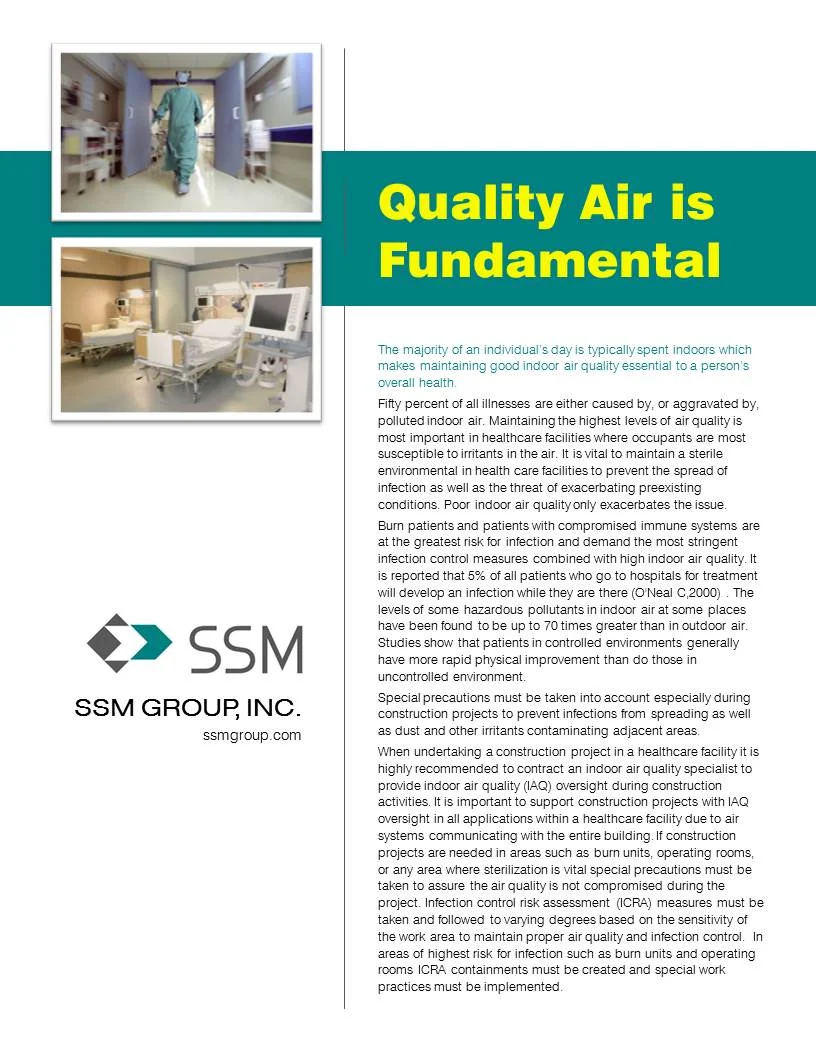
Quality Air Is Fundamental
It is vital to maintain a sterile environmental in health care facilities to prevent the spread of infection as well as the threat of exacerbating preexisting conditions. Poor indoor air quality only exacerbates the issue.

QUALITY AIR IS FUNDAMENTAL | ICRA
The majority of an individual’s day is typically spent indoors which makes maintaining good indoor air quality essential to a person’s overall health.
Fifty percent of all illnesses are either caused by, or aggravated by, polluted indoor air. Maintaining the highest levels of air quality is most important in healthcare facilities where occupants are most susceptible to irritants in the air. It is vital to maintain a sterile environmental in health care facilities to prevent the spread of infection as well as the threat of exacerbating preexisting conditions. Poor indoor air quality only exacerbates the issue.
Burn patients and patients with compromised immune systems are at the greatest risk for infection and demand the most stringent infection control measures combined with high indoor air quality. It is reported that 5% of all patients who go to hospitals for treatment will develop an infection while they are there (O'Neal C,2000) . The levels of some hazardous pollutants in indoor air at some places have been found to be up to 70 times greater than in outdoor air. Studies show that patients in controlled environments generally have more rapid physical improvement than do those in uncontrolled environment.
Special precautions must be taken into account especially during construction projects to prevent infections from spreading as well as dust and other irritants contaminating adjacent areas.
When undertaking a construction project in a healthcare facility it is highly recommended to contract an indoor air quality specialist to provide indoor air quality (IAQ) oversight during construction activities. It is important to support construction projects with IAQ oversight in all applications within a healthcare facility due to air systems communicating with the entire building. If construction projects are needed in areas such as burn units, operating rooms, or any area where sterilization is vital special precautions must be taken to assure the air quality is not compromised during the project. Infection control risk assessment (ICRA) measures must be taken and followed to varying degrees based on the sensitivity of the work area to maintain proper air quality and infection control. In areas of highest risk for infection such as burn units and operating rooms ICRA containments must be created and special work practices must be implemented.
ICRA Special Work Practices
- Isolate the HVAC system in the area where work is being done to prevent contamination of the duct system. Complete all critical barriers i.e. sheetrock, plywood, plastic, to seal area from non work areas or implement control a cube method (cart with plastic covering and sealed connection to work site with a HEPA vacuum for vacuuming prior to exit) before construction begins.
- Maintain negative air pressure within the work site utilizing HEPA equipped air filtration units. Seal holes, pipes, conduits, and punctures.
- Construct anteroom and require all personnel to pass through this room so they can be vacuumed using a HEPA vacuum cleaner before leaving work site or they can wear cloth or paper coveralls that are removed each time they leave work site.
- All personnel entering the work site are required to wear shoe covers. Shoe covers must be changed each time the worker exits the work area.
A thorough sampling protocol must be created by an indoor air quality specialist to provide data that the work areas were properly contained and all construction generated particulates were being contained. Upon completion of the work in a contained area an experienced industrial hygienists will perform a visual inspection and additional particulate sampling to confirm the area was suitable for re-occupancy. Through expert design of the sampling protocol and analysis of all data collected by the indoor air quality specialists it can be definitively shown that the air quality was not compromised during the construction project. As always, the goal is to establish the highest level of indoor air quality to promote a healthy working environment as well as maintaining a sterile environment for patients to heal.
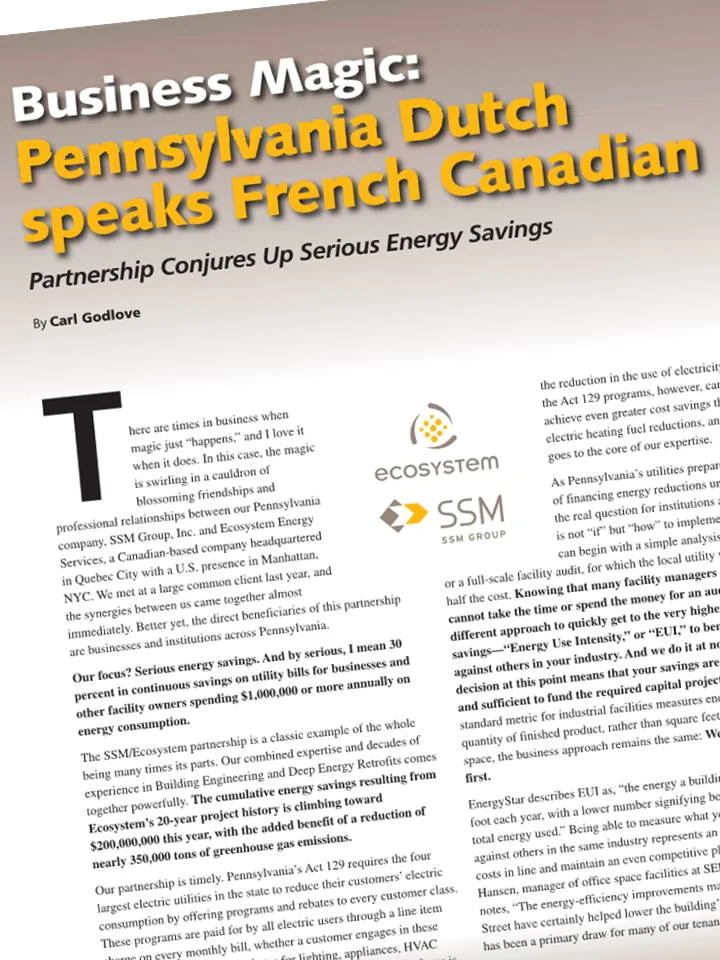
Partnership Conjures Up Real Energy Savings
Our focus? Serious energy savings. And by serious, I mean 30% continuous savings on utility bills for businesses and other facility owners spending $1,000,000 or more annually on energy consumption.
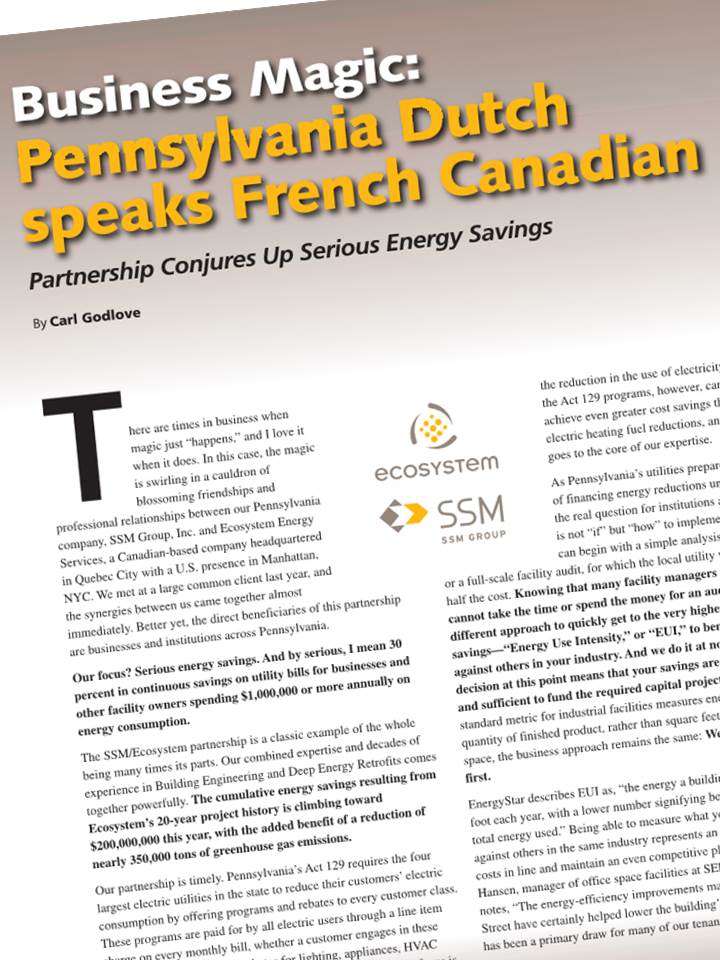
PA CHAMBER BUSINESS AND INDUSTRY - Catalyst Magazine, Spring 2015
Business Magic – Pennsylvania Dutch speaks French Canadian
by: Carl Godlove
There are times in business when magic just “happens,” and I love it when it does. In this case, the magic is swirling in a cauldron of blossoming friendships and professional relationships between our Pennsylvania company, SSM Group, Inc. (ssmgroup.com), and Ecosystem Energy Services (ecosystem-energy.com), a Canadian-based company headquartered in Quebec City with a U.S. presence in Manhattan, NYC. We met at a large common client last year, and the synergies between us came together almost immediately. Better yet, the direct beneficiaries of this partnership are businesses and institutions across Pennsylvania.
Our focus? Serious energy savings. And by serious, I mean 30% continuous savings on utility bills for businesses and other facility owners spending $1,000,000 or more annually on energy consumption.
The SSM/Ecosystem partnership is a classic example of the whole being many times its parts. Our combined expertise and decades of experience in Building Engineering and Deep Energy Retrofits comes together powerfully. The cumulative energy savings resulting from Ecosystem’s 20-year project history is climbing toward $200,000,000 this year, with the added benefit of a reduction of nearly 350,000 tons of greenhouse gas emissions.
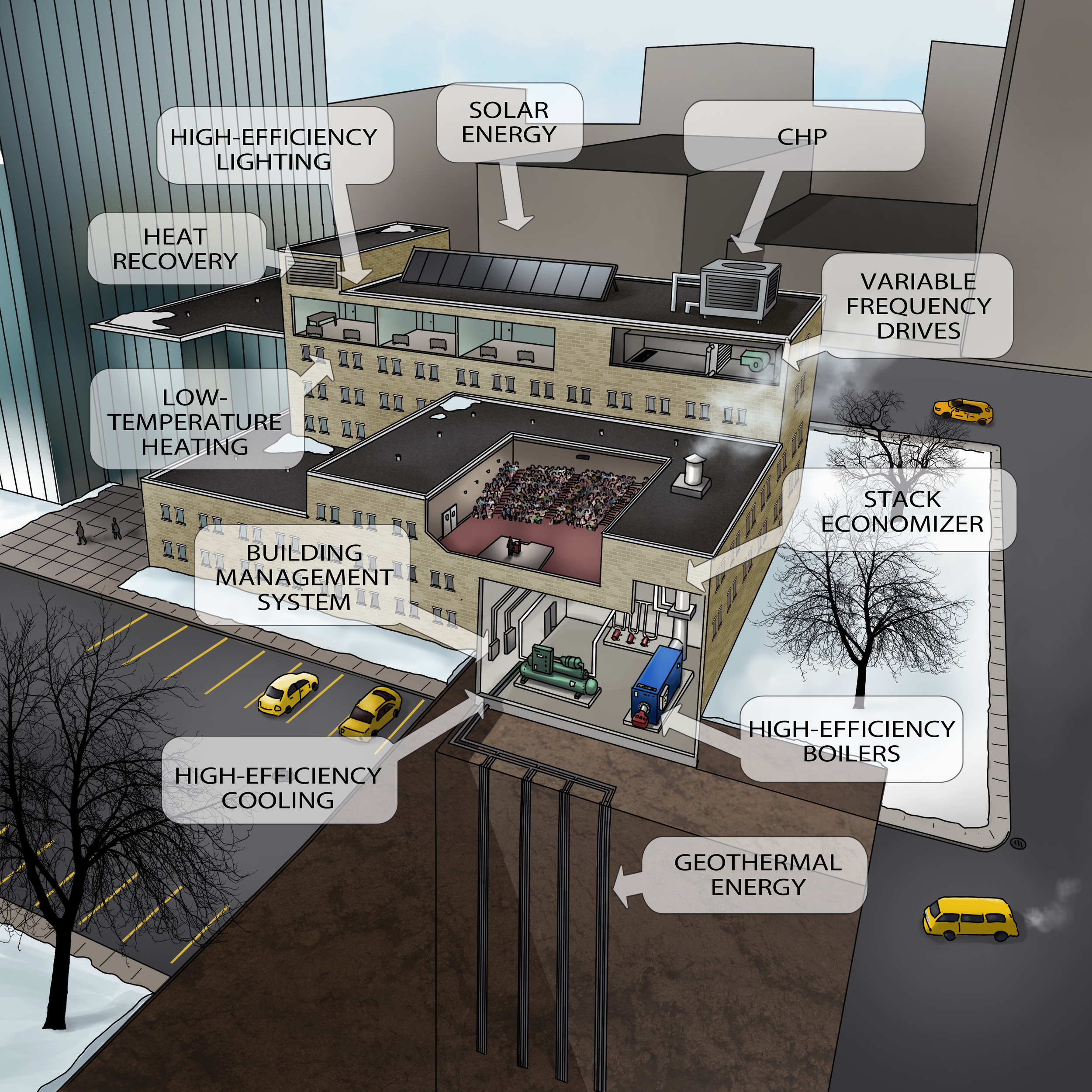
Our partnership is timely. Pennsylvania’s Act 129 requires the four largest electric utilities in the state to reduce their customers’ electric consumption by offering programs and rebates to every customer class. These programs are paid for by all electric users through a line item charge on every monthly bill, whether a customer engages in these programs or not. There are rebates for lighting, appliances, HVAC systems, energy audits, and even self-generation. The primary focus is the reduction in the use of electricity. Several of the Act 129 programs, however, can be used to achieve even greater cost savings through non-electric heating fuel reductions, an approach that goes to the core of our expertise.
As Pennsylvania’s utilities prepare a third round of financing energy reductions under Act 129, the real question for institutions and businesses is not “if” but “how” to implement. The answer can begin with a simple analysis of energy bills or a full-scale facility audit, for which the local utility will likely pay half the cost. Knowing that many facility managers and owners cannot take the time or spend the money for an audit, we take a different approach to quickly get to the very highest value savings – “Energy Use Intensity,” or “EUI,” to benchmark your site against others in your industry. And we do it at no cost. A “Go” decision at this point means that your savings are both guaranteed and sufficient to fund the required capital projects. And while the standard metric for industrial facilities measures energy used per quantity of finished product, rather than square feet of manufacturing space, the business approach remains the same: We prove the savings first.
EnergyStar describes EUI as, “the energy a building uses per square foot each year, with a lower number signifying better efficiency and less total energy used.” Being able to measure what your facilities consume against others in the same industry represents an opportunity to keep costs in line and maintain an even competitive playing field. Peter Hansen, Manager of Office Space Facilities at SEPTA’s headquarters notes, “The energy-efficiency improvements made to 1234 Market Street have certainly helped lower the building’s operating costs. This has been a primary draw for many of our tenants.
To judge how much can be saved, we begin by calculating a site’s EUI to clarify the opportunity and solicit funding. When a hospital’s management team in New York discovered their building’s EUI was 138% the national average, they got motivated to make changes, securing $4,100,000 for an efficiency project. After implementation, their energy bills dropped by over $600,000, representing 39% in savings. Ecosystem CEO, André Rochette, notes the importance of aligning goals from the start: “Our ability to improve building performance stems from a corporate culture of collaboration and commitment to results and agile processes that let us design and build with the end result in mind. We believe we should always be held contractually responsible to our customers for those outcomes.”
SSM and Ecosystem are partners on a mission - “Enhance the Quality of Life” across Pennsylvania. Our self-funding projects not only lower operating costs and preserve capital for hospitals, schools and universities, residential and commercial complexes, manufacturers, and office and government buildings, they also create jobs and improve the environment. Our turnkey solution covers the full project lifecycle, from analysis and design through construction, commissioning, and continuous follow-up. Our partnership is not just a business... it’s a passion. Pennsylvania Dutch is officially speaking French Canadian. Let the magic begin.