

First Presbyterian Church set to acquire Wyomissing property
The headquarters of Spotts, Stevens and McCoy at 1047 North Park Road in Wyomissing, is expected to be the new home of the First Presbyterian Church in Reading. The church, founded in 1814, plans to lease space to SSM after purchasing the building from the consulting firm.
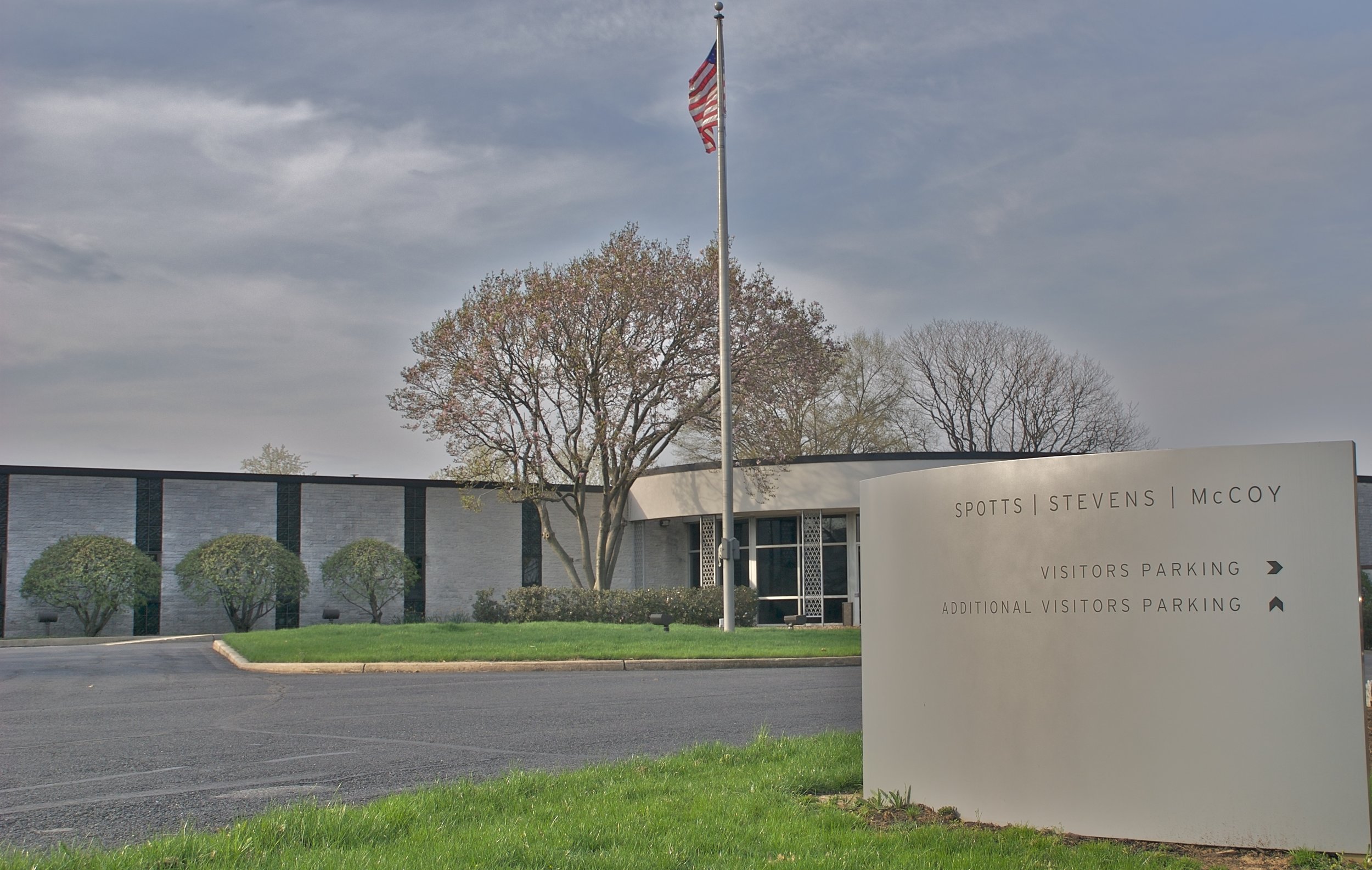
PRESS RELEASE: April 18, 2017
Wyomissing, PA – First Presbyterian Church set to acquire Wyomissing property owned by real estate Limited Partnership affiliated with Spotts, Stevens and McCoy (SSM).
In what is being described by both parties as a ‘union made in Heaven’ First Presbyterian Church, currently located at 37 South 5th Street in Reading and Spotts, Stevens and McCoy are jointly announcing plans for a real estate transaction whereby First Presbyterian Church is set to acquire the 1047 North Park Road, property currently occupied by Spotts, Stevens and McCoy (SSM) with plans to lease approximately half of it back to SSM. The purchase is contingent upon various approvals.
Attorney John Roland, long time member and elder at First Presbyterian Church who is a partner at Roland Stock, LLP, has provided leadership to First Presbyterian’s new site selection efforts. “Our Church is on a mission to expand our outreach efforts. This beautiful, new location will give us that opportunity,” said Roland. “Our congregation has embraced a number of changes in recent years and, following planned renovations, this facility will give us the space we need to support our membership growth goals.” First Presbyterian, founded in 1814, recently left the PC (USA) denomination to affiliate with the PC (ECU) and also just announced the calling of a new Senior Pastor, Christopher DiVietro. “We are very excited about these changes and in many ways, finding this location is an answer to prayers and the final piece of the puzzle,” said Nancy Alley, another church Session member who has been very active in the relocation process.
Brian Kelly, CEO at SSM and a partner in the real estate partnership, had the following to say: “We love our beautiful Wyomissing location and we had no desire to leave it; however, 43,000 square feet is simply more space than we need right now. So when the Church approached us about buying it and told us it was more space than they need at this time, we discussed a possible sale and lease-back situation. The result is that we’ve ended up with an Agreement that is truly a win-win for both parties. This sale unlocks resources that we can use to reinvest in the growth of the business, focusing on adding new technology and equipment and pursuing other strategic initiatives, including potential acquisitions.”
The 1047 North Park Road facility was constructed in 1963 as the world headquarters for Vanity Fair Corporation and it was subsequently renovated in 1998 and occupied by Carpenter Technology. The SSM principals purchased it in 2003. The building has just under 43,000 square feet on two levels and sits on approximately 5.5 acres of prime Wyomissing real estate.
“What makes the transaction so appealing to us is that Spotts, Stevens and McCoy will continue to occupy approximately half of the space as we embark upon our congregational growth plans,” said Roland. Current elder and former Treasurer Paul Eisenhuth notes that Presbyterians are known to be financial conservatives. “A key component of the transaction is that SSM and the Church are entering into a 5-year Lease Agreement which makes the space affordable for us. It also ensures our access to additional space as we grow.”
Spotts, Stevens and McCoy is a family owned and managed regional engineering and consulting firm with roots back to 1932. Two of the principals, Patrick McCoy and Lewis McCoy, Jr., are sons of founder, Lewis McCoy, Sr., and Kelly is a son-in-law. Both First Presbyterian Church and Spotts, Stevens and McCoy have deep roots in the Berks County community.
There are many factors that make this such a uniquely beneficial transaction for both parties:
- The SSM lease-back will provide the Church with an ongoing revenue stream as it embarks upon renovation plans and congregational growth goals. Financing is being provided by Customers Bank as the Church embarks upon a capital campaign to fund both the purchase and planned renovations. The Church will be seeking competitive bids for both design and construction work. No firm timeline for construction or occupancy has been established at this time.
- With a five-year Lease in place, SSM will be able to continue to operate from its existing headquarters location with little or no disruption to business as the Church embarks upon its renovation plans and prepares to move in
- Church offices will be open during the week; however its primary activity will occur on weekends and evenings when parking spaces are likely to be occupied by those attending scheduled worship services. SSM’s primary business activity will occur on week days during normal business hours and its employees will be off on weekends.
An answer to prayers? A partnership made in Heaven? The ‘joining’ of two old and well-established organizations? Laying all spiritual beliefs aside, it certainly appears to be a transaction that capitalizes on every possible benefit for both the Church and SSM. So at a minimum, it’s a win-win!
FOR ADDITIONAL INFORMATION:
- First Presbyterian Church - John Roland, Esq. | 610-372-5588
- Spotts, Stevens and McCoy – CEO, Brian Kelly | 610-621-2000
- Patricia Langiotti, Creative Management Concepts | 610-603-0306

Sam Zook, SIT Receives Certification as Drone Pilot
Sam Zook, SIT is the third surveyor at SSM to receive certification as a Drone Pilot.

Sam Zook, SIT, Surveyor has received his certification as a FAA Certified Remote Pilot. Zook is one of three certified pilots at SSM. He is a 2009 graduate of Pennsylvania College of Technology.
On June 21st, 2016 the FAA finalized a new regulatory framework for small, unmanned aerial systems. Titled Part 107, these new regulations created a new drone certification process that covers the majority of low-risk, commercial UAS flight operations for all commercially operated drones. Commercial refers to any kind of flight operation that can be tied to economic benefit. These new regulations were implemented on August 29, 2016.


Spottlight on Resolutions for the New Year
New Year’s is the perfect time of year to reflect on areas where you’d like to see a change in your organization and to take steps to achieve those improvements.

The Tradition of Resolutions
From losing weight to saving more money, from learning to knit to running a marathon, from spending more time with family to quitting smoking . . . the practice of making New Year’s resolutions is a worldwide tradition that’s steeped in history. Four thousand years ago in ancient Babylonia the people held celebrations in honor of the new year. They affirmed their loyalty to their king and made promises to the gods to pay their debts and returned borrowed objects. In return for keeping these promises, the gods would bestow favor on them for the coming year. In ancient Rome, the new year was a symbolic time to look at the previous year and ahead to the future. Friends settled differences and people exchanged gifts like pears or sweets as wishes for a sweet new year. We’d like to wish you a Sweet New Year and invite you to take advantage of our business relationships and enjoy an assortment of treats representing some of our clients.
Click here to request a free Taste of SSM.
Business Resolutions
New Year’s is the perfect time of year to reflect on areas where you’d like to see a change in your organization and to take steps to achieve those improvements. Let’s face it – a resolution looks a lot like a goal. You set an objective, outline a plan, and take action. So why not resolve to make some changes in your organization?
- Think about what you want to achieve.
- Say it out loud.
- Ask for help.
Resolution: Focus on the Core
It takes a lot to make and market a product. It also takes a lot to assure regulatory compliance as well as address needs such as increased capacity, routine maintenance and facility expansion. That's why manufacturers of everything from chocolate to steel turn to SSM when it comes time to secure prime locations, plan more efficient warehouses and distribution centers, conduct feasibility studies, upgrade utilities and building systems, improve traffic flow and expand operations. By taking the lead on the facilities engineering side, we enable manufacturers to focus more on their core business.
Resolution: Stop Wasting Energy
Are you faced with hot spots, cold spots, and a basic mismatch of providing more nominal cooling than necessary? Whether you use underfloor air distribution or “in the space” cooling, getting the air to the load has been a trial and error undertaking usually resulting in oversized cooling capacity and less floor space. The overlooked fundamental issue is air distribution.
We utilize CFD analysis to optimize the cooling system and layout. The data power load and the cooling system are matched and arranged to achieve maximum energy efficiency. This keeps the cost of cooling both in equipment and operation down while maximizing the data load capability. We create a model that replicates the physical data center layout including power densities and cooling equipment locations and capabilities and the analysis is run to determine the resulting temperatures and airflows in the space. Using programs specifically designed for use in analyzing air movement and heat transfer, we can create a virtual simulation of the conditions within the data center. The CFD analysis is a valuable tool for data center design that can save time and money by taking the guess work out of rack layout and cooling airflow design.

Sinkholes and Why They Matter
Sinkholes can be dangerous in many ways. They can cause damage to the foundation of a building, they serve as conduits for surficial contaminants to reach groundwater, and they can cause damage to buried services like water lines and electrical conduits according to Conserve Energy Future. Knowing the risk of sinkhole formation is key to minimizing possible damages.

Sinkholes can be dangerous in many ways.

MEASURING SINKHOLE POTENTIAL RISK
Karst is defined as “a terrain, generally underlain by limestone, in which the topography is chiefly formed by the dissolving of rock, and which is commonly characterized by Karren, closed depressions, subterranean drainage, and caves” by the Geological Survey Water-Supply Paper 1899. Each component listed above (Karren, closed depressions, subterranean drainage, and caves) are considered karst features, but most importantly, sinkholes are considered karst features.
Sinkholes can be dangerous in many ways. They can cause damage to the foundation of a building, they serve as conduits for surficial contaminants to reach groundwater, and they can cause damage to buried services like water lines and electrical conduits according to Conserve Energy Future. Knowing the risk of sinkhole formation is key to minimizing possible damages.
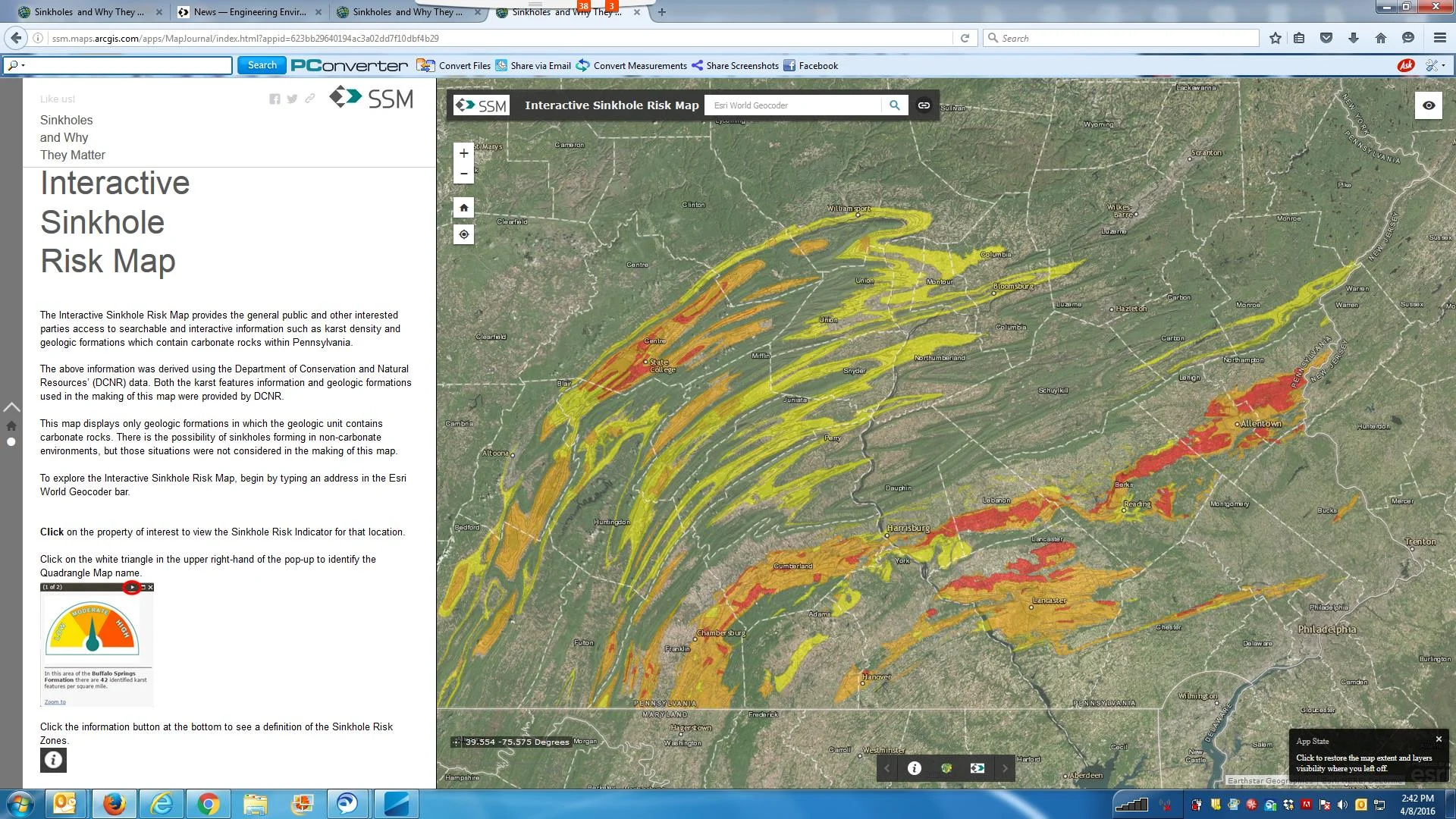
Since the amount of karst features in an area can be related to the occurrence of sinkholes, an interactive sinkhole risk map was created using the density of karst features within a geologic formation.
Interactive Sinkhole Risk Map
The Interactive Sinkhole Risk Map provides access to searchable and interactive information such as karst density and geologic formations which contain carbonate rocks within Pennsylvania. The map displays only geologic formations in which the geologic unit contains carbonate rocks. There is the possibility of sinkholes forming in non-carbonate environments, but those situations were not considered in the making of this map. Explore the Interactive Sinkhole Risk Map to view the Sinkhole Risk for any location.
If a sinkhole evaluation of a location is desired, SSM Group, Inc. has multiple professionals on staff with years of experience in sinkhole risk evaluations. Feel free to contact SSM Group, Inc. to learn more.
SSM Group, Inc. Announces Management Changes - Brian Kelly named President and CEO

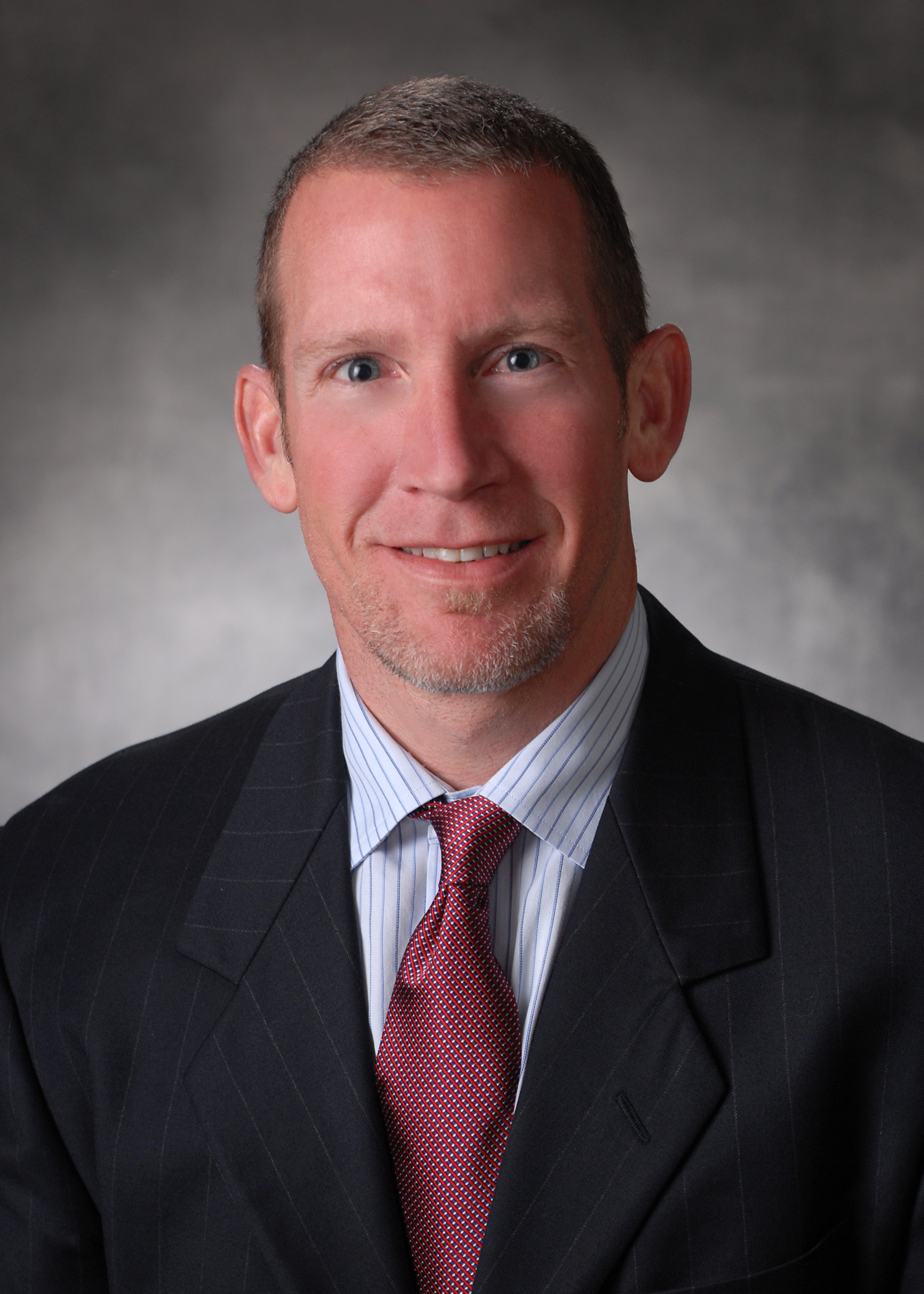

SSM Group, Inc. recently announced a corporate management restructure. Brian R. Kelly has been named President and Chief Executive Officer of the firm. Kelly, who formerly served as the company’s Executive Vice President with responsibility of running the firm’s operations, replaces J. Carlton Godlove, II, who has left the company to pursue other interests.
Kelly is one of four McCoy family members who assumed control and management of the firm in 1996. Kelly has an Associate Degree in Mechanical Engineering Technology from The Pennsylvania State University. Prior to joining the SSM management team, Kelly was employed at AT&T for more than 17 years in various roles. Kelly resides in Reading with his wife, Kay McCoy Kelly, who is a daughter of the company’s founder, Lewis J. McCoy, Sr. In a prepared statement, Kelly said, “I look forward to leading the company as we embark upon strategic growth and expansion. I am very proud of our exceptionally talented senior leadership team and all of our employees, and I am confident that, with their help and support, we will continue to grow the company and succeed at fulfilling our corporate mission – ‘Enhancing the quality of life for our clients, our employees, and all of the people touched by our work.’ Our work is so important because it touches this generation and future generations with a scope broader than we can imagine – and it leaves a legacy that will live far beyond us.”
“Approximately six months ago we appointed a team of independent professionals to work with us as members of an Advisory Board: Thomas A. Beaver, CPA, former managing partner at RKL; Patricia L. Langiotti, President of Creative Management Concepts; and Mike Shor, former executive with Carpenter. These Advisory Board members have played a key role in helping us plan for our future,” Kelly said.
Kelly also announced that shareholder, Patrick M. McCoy, PE, has been promoted to Executive Vice President. “Patrick will lead the company’s business development and sales and marketing efforts and he will be a strong right-hand man,” Kelly said. Patrick McCoy has been with the firm since 1996. He graduated from Drexel University, like his father, and holds Bachelor’s degrees in Civil Engineering and Architectural Engineering. McCoy formerly led the company’s Facilities and Site Engineering Division which provides services to worldwide companies such as IBM. Prior to joining SSM, he was with Ortega Consulting, Media, PA, and Gredell & Associates, Wilmington, DE.
Shareholder Lewis J. (Lou) McCoy, Jr. of Reading, who joined the firm in 1985, will continue in his role as Director of Human Resources.
Catherine (Kitty) Bell, who joined the firm in 2004, is being promoted to Divisional Vice President. Formerly the firm’s Vice President of Facility Engineering, she assumes an expanded role, with additional management responsibility for Site Engineering and Survey and Data Capture disciplines (formerly managed by Patrick McCoy). Bell resides in Reading, PA.
SSM Group, Inc. is an engineering and consulting firm founded by Lewis J. McCoy, Sr. in 1967. The company continues to be family owned and operated. Headquartered at 1047 North Park Road in Wyomissing with satellite offices in Harrisburg and the Lehigh Valley, SSM has just under 100 employees and provides services to various types of local, regional and national businesses that include commercial, industrial, manufacturing and telecommunications as well as healthcare and higher education institutions. The company also provides services to numerous local, regional, and county government entities. While the company’s primary market is a regional footprint including Berks County and the Lehigh Valley, SSM serves clients throughout PA and the Northeastern United States as well as to some international clients.
FOR MORE INFORMATION:
Brian Kelly, President and CEO
brian.kelly@ssmgroup.com | P: 610-621-2000
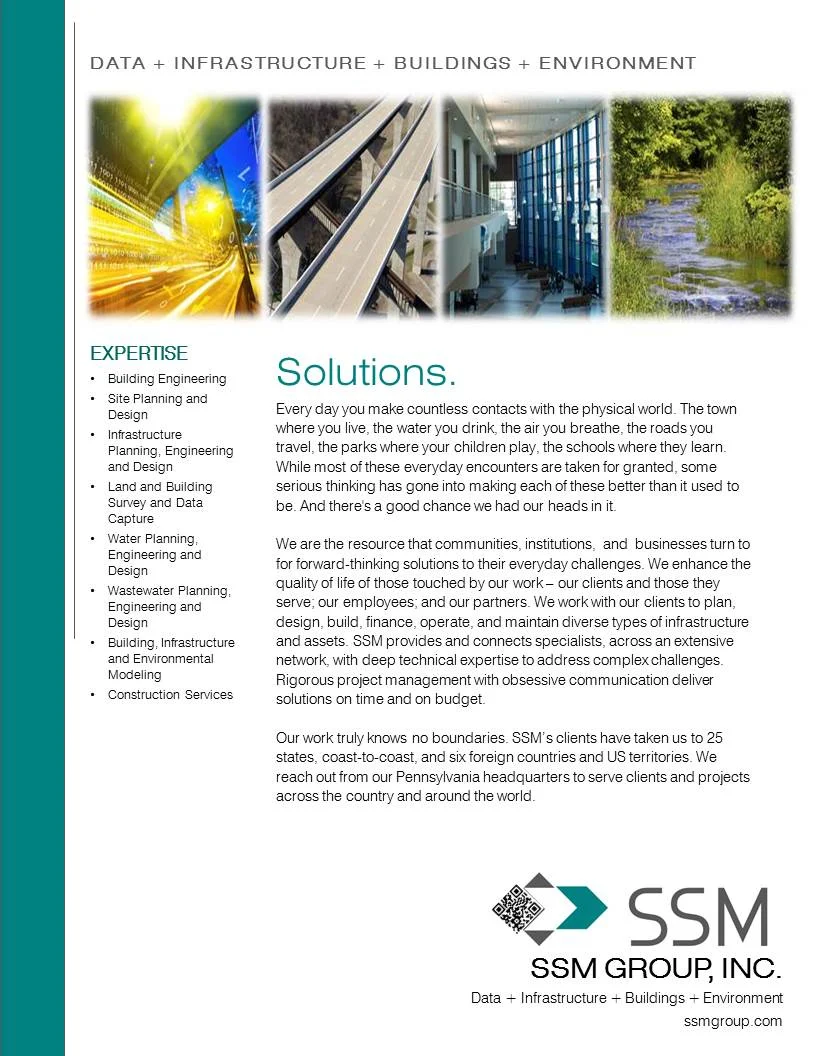
SSM Group Overview of Services
SSM Group Overview of Services
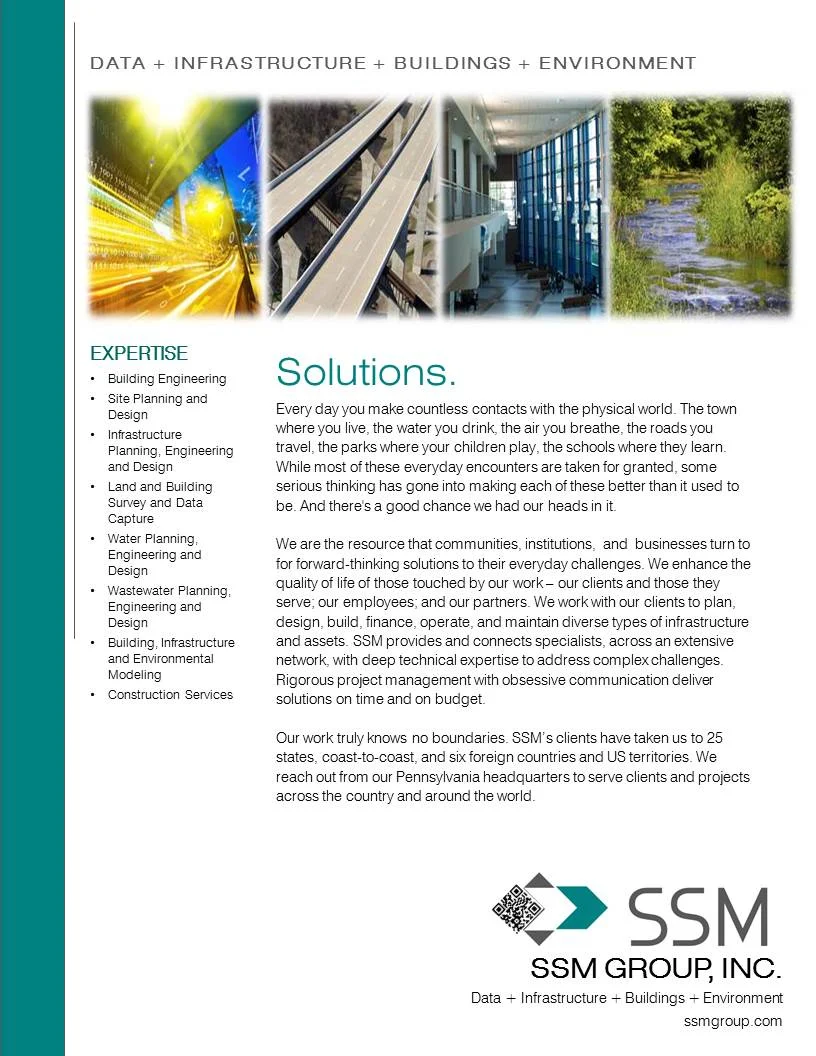
Solutions
We are the resource that communities, institutions, and businesses turn to for forward-thinking solutions to their everyday challenges. We enhance the quality of life of those touched by our work – our clients and those they serve; our employees; and our partners. We work with our clients to plan, design, build, finance, operate, and maintain diverse types of infrastructure and assets. SSM provides and connects specialists, across an extensive network, with deep technical expertise to address complex challenges. Rigorous project management with obsessive communication deliver solutions on time and on budget.
Our work truly knows no boundaries. SSM’s clients have taken us to 25 states, coast-to-coast, and six foreign countries and US territories. We reach out from our Pennsylvania headquarters to serve clients and projects across the country and around the world.
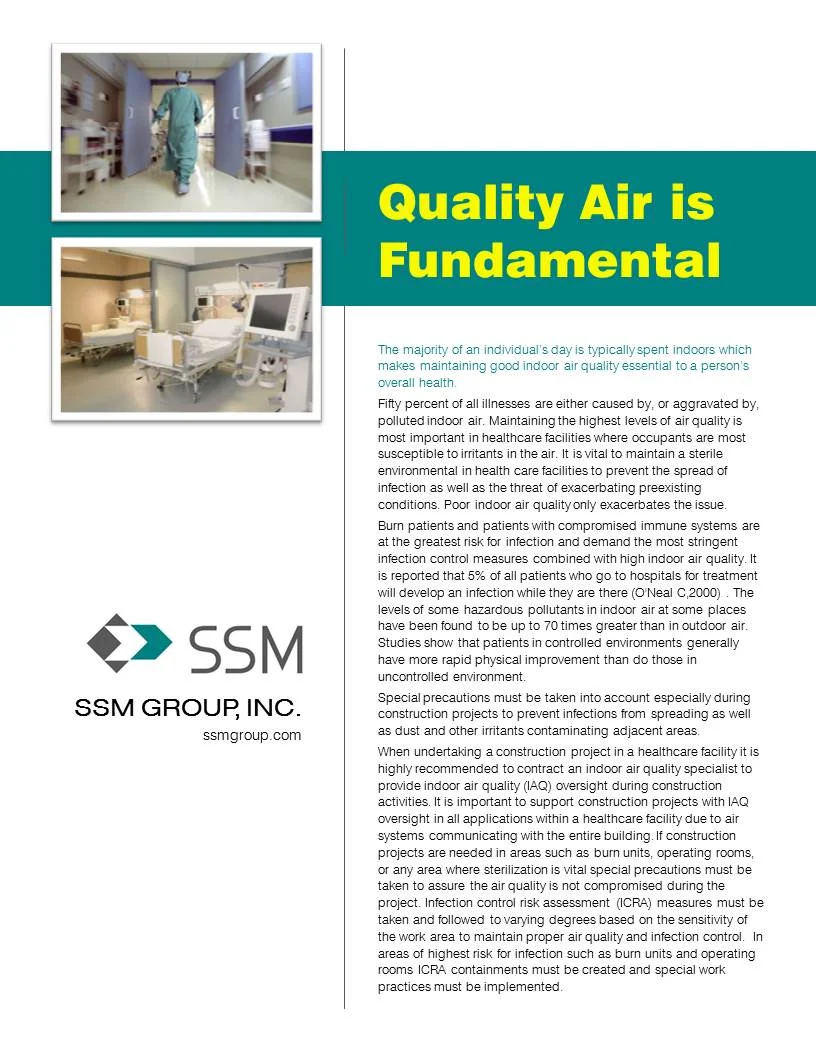
Quality Air Is Fundamental
It is vital to maintain a sterile environmental in health care facilities to prevent the spread of infection as well as the threat of exacerbating preexisting conditions. Poor indoor air quality only exacerbates the issue.

QUALITY AIR IS FUNDAMENTAL | ICRA
The majority of an individual’s day is typically spent indoors which makes maintaining good indoor air quality essential to a person’s overall health.
Fifty percent of all illnesses are either caused by, or aggravated by, polluted indoor air. Maintaining the highest levels of air quality is most important in healthcare facilities where occupants are most susceptible to irritants in the air. It is vital to maintain a sterile environmental in health care facilities to prevent the spread of infection as well as the threat of exacerbating preexisting conditions. Poor indoor air quality only exacerbates the issue.
Burn patients and patients with compromised immune systems are at the greatest risk for infection and demand the most stringent infection control measures combined with high indoor air quality. It is reported that 5% of all patients who go to hospitals for treatment will develop an infection while they are there (O'Neal C,2000) . The levels of some hazardous pollutants in indoor air at some places have been found to be up to 70 times greater than in outdoor air. Studies show that patients in controlled environments generally have more rapid physical improvement than do those in uncontrolled environment.
Special precautions must be taken into account especially during construction projects to prevent infections from spreading as well as dust and other irritants contaminating adjacent areas.
When undertaking a construction project in a healthcare facility it is highly recommended to contract an indoor air quality specialist to provide indoor air quality (IAQ) oversight during construction activities. It is important to support construction projects with IAQ oversight in all applications within a healthcare facility due to air systems communicating with the entire building. If construction projects are needed in areas such as burn units, operating rooms, or any area where sterilization is vital special precautions must be taken to assure the air quality is not compromised during the project. Infection control risk assessment (ICRA) measures must be taken and followed to varying degrees based on the sensitivity of the work area to maintain proper air quality and infection control. In areas of highest risk for infection such as burn units and operating rooms ICRA containments must be created and special work practices must be implemented.
ICRA Special Work Practices
- Isolate the HVAC system in the area where work is being done to prevent contamination of the duct system. Complete all critical barriers i.e. sheetrock, plywood, plastic, to seal area from non work areas or implement control a cube method (cart with plastic covering and sealed connection to work site with a HEPA vacuum for vacuuming prior to exit) before construction begins.
- Maintain negative air pressure within the work site utilizing HEPA equipped air filtration units. Seal holes, pipes, conduits, and punctures.
- Construct anteroom and require all personnel to pass through this room so they can be vacuumed using a HEPA vacuum cleaner before leaving work site or they can wear cloth or paper coveralls that are removed each time they leave work site.
- All personnel entering the work site are required to wear shoe covers. Shoe covers must be changed each time the worker exits the work area.
A thorough sampling protocol must be created by an indoor air quality specialist to provide data that the work areas were properly contained and all construction generated particulates were being contained. Upon completion of the work in a contained area an experienced industrial hygienists will perform a visual inspection and additional particulate sampling to confirm the area was suitable for re-occupancy. Through expert design of the sampling protocol and analysis of all data collected by the indoor air quality specialists it can be definitively shown that the air quality was not compromised during the construction project. As always, the goal is to establish the highest level of indoor air quality to promote a healthy working environment as well as maintaining a sterile environment for patients to heal.