

Reducing Plastic Waste: Joining the Movement with Plastic Free July
Take the challenge and join in on Plastic Free July!
Plastic Free July was founded in 2011 by Rebecca Prince-Ruiz to help reduce the amount of plastic waste we consume. The month is dedicated to encouraging people to discover alternatives to single-use plastics and to reexamine the major role plastic takes in their everyday lives.

Humans create 400 million tons of plastic waste every year. It has been found in nearly everywhere on Earth.
There’s no denying that plastic plays a major role in our everyday lives. But surprisingly, it has only been around for a little more than a century as the first fully synthetic plastic was created in 1907 by Leo Baekeland. While it may be a convenient resource, it has serious consequences for the environment, animals and even humans.
Plastic Free July was founded in 2011 by Rebecca Prince-Ruiz to help reduce the amount of plastic waste we consume. The month is dedicated to encouraging people to discover alternatives to single-use plastics and to reexamine the major role plastic takes in their everyday lives.
It is so necessary for us to reduce our plastic waste because it accounts for 35% of waste. About 86% of plastic waste ends up in landfills, even if it’s deemed recyclable. Aquatic ecosystems are the most at-risk with over 1 million marine animal casualties each year due to plastic. Single-use plastic water bottles, straws and bags are among the most common waste found in the ocean.
Microplastics, which can be found in clothing fibers, plastic packaging and cosmetic exfoliating agents, are small pieces of plastic invisible to the naked eye that can get into the lungs, bloodstream and even cells. Scientists fear that microplastics are possible links to cancer, heart disease and chronic illnesses.
Even smaller than microplastics are nanoplastics, formed when the suns UV Rays break down microplastics. Nanoplastics are so miniscule that they are can be found in things we eat, drink and even the air we breathe, making them dangerous to human health.
With all the risks associated with plastics, it’s becoming more crucial to steer clear of them. While the task may seem daunting, the hard work is paying off. In 2021, only 10 years after Plastic Free July was founded, participants reduced 2.1 million tons of plastic waste.
Going completely plastic free can be intimidating for some, but by making a few small changes in your daily life, you can make a significant impact.
Some small changes you could make are as follows:
Use a reusable water bottle: plastic water bottles are among the most common plastic waste.
Switch to reusable bags: instead of using multiple plastic bags from the grocery store every time you go shopping, bring reusable bags from home.
Buy in bulk: Instead of buying items individually wrapped in plastic, buy in bulk to cut down on wasteful packaging.
Buy soap bars: instead of buying plastic bottles of soap, buy a soap bar to reduce plastic packaging.
Make a to-go bag: some people take a reusable water bottle, coffee cup, silverware and reusable container with them when they go out to reduce single use items from places such as fast food establishments and restaurants.
While you may not be able to change all of these habits, even changing one can make a difference. Take the challenge and join in on Plastic Free July!
PA Department of Environmental Protection Launches Energy Efficiency Grant and Loan Program
The PA Department. of Environmental Protection (PA DEP) launched a new program to help local governments develop and implement energy efficiency upgrades for their buildings. The Municipal Opportunities for Retrofits and Energy Efficiency (MORE) program offers grants to $50,000 each and loans to PA municipalities and municipal authorities that are ineligible for direct EECBG allocations. Applications are open now, and awards are first come, first served.

The PA Department of Environmental Protection (PA DEP) recently launched a new program to help local governments develop and implement energy efficiency upgrades for their buildings. The Municipal Opportunities for Retrofits and Energy Efficiency (MORE) program offers grants to $50,000 each and loans to PA municipalities and municipal authorities that are ineligible for direct EECBG allocations. Applications are open now, and awards are first come, first served.
Approximately $1.8 million in grant funds will be offered through October 25, 2024, $1 million of which is on reserve through August 30 for “priority” communities based on need.
The intent of the MORE program is to help local PA governments pay for energy efficiency upgrades, building retrofits, and onsite renewable energy generation (when paired with energy efficiency), while lowering utility bills and fighting climate change pollution. Grant funds may be used to conduct an ASHRAE Level 2 Energy Audit, design Energy Conservation Measures (ECMs), develop the MORE loan application, and buy down the loan interest rate to as low as 0% with any remaining funds. ASHRAE Level 2 Energy Audits performed within the last 5 years can be used.
The MORE loan application period opened June 3, 2024, and will remain open as long as funds are available. The minimum loan available is $5,000, and the program offers repayment terms up to 15 years. The loan application requires submission of the Level 2 audit and ECM design.
MORE program participants are strongly encouraged to apply for the grant first, as it is intended to reduce the hurdles of securing financing for energy efficiency projects.
Who is eligible for MORE? Eligible applicants for the MORE Program are PA local governments that are ineligible for an Energy Efficiency & Conservation Block Grant (EECBG) from the U.S. Department of Energy (DOE). A full list of local governments allocated EECBG awards that are not eligible for a MORE grant can be found here.
Eligible local government entities include:
Counties
Cities
Boroughs
Towns
Townships
Municipal Authorities
Program Timeline - The MORE Grant application will only be open from June 3, 2024 to October 25, 2024, but the MORE loan will continue accepting applications as long as funds are available. As a revolving loan fund, the MORE Loan does not have a closing date.
June 3, 2024: MORE grant and MORE loan opened
August 30, 2024: Priority applicant window for the MORE grant closes
October 25, 2024: MORE grant application closes
FOR MORE INFORMATION
Energy & Sustainability Services
Paul Spiegel, P.E., LEED AP | paul.spiegel@ssmgroup.com

Sydney Jernigan, EIT Named Senior Graduate Engineer
Sydney Jernigan, EIT has been named Senior Graduate Engineer, Process Engineering and Design.

SYDNEY JERNIGAN, EIT
Sr. Graduate Engineer
Sydney Jernigan, EIT has been named Senior Graduate Engineer, Process Engineering and Design. In this role her responsibilities include data analysis, preparation of DEP and DRBC permit applications and renewals, preparation of legal specifications and bidding documents and coordinating various reports for water and wastewater systems.
Sydney has five years of experience in environmental engineering including experience with hydraulic modeling of water systems and 3D pipe design, preparation of CFA Grant Applications and preparation of Act 537 Sewage Facilities Planning. She holds a Bachelor of Science in Civil Engineering from Temple University. She is also professionally affiliated with the Eastern Pennsylvania Water Pollution Control Operators Association (EPWPCOA).
About the Firm: Spotts, Stevens and McCoy, Inc. is a family-owned regional engineering, environmental and surveying firm headquartered in Wyomissing PA with satellite offices in Lancaster, West Chester and Lehigh Valley. SSM provides services to various types of local, regional and national businesses that include commercial, industrial, manufacturing and telecommunications as well as healthcare and higher education institutions.

Embracing Plastic Free July and Protecting Our Environment
Becoming plastic free or lessening your consumption of plastic can positively impact the environment greatly. Plastic Free July gives participants the tools they need to change their habits and the resources to stop and think about how individuals can make an impact for the better and reduce their reliance on plastic.

With the irreparable damage that pollution and climate change are doing to our environment, it’s become increasingly important to implement practices that benefit the environment the most.
Plastic Free July, a key initiative of the Plastic Free Foundation, is a perfect catalyst to make people aware of their everyday actions that negatively impact the environment. Since the start of the Plastic Free July Campaign in 2011, millions of people have changed their plastic usage habits, resulting in over 200 million behavior changes with about 90% of those changes becoming permanent habits.
Though the Plastic Free Foundation is based in Australia, its impact is felt all over the world, all thanks to this campaign.
Becoming plastic free or lessening your consumption of plastic can positively impact the environment greatly. Plastic Free July gives participants the tools they need to change their habits and the resources to stop and think about how individuals can make an impact for the better and reduce their reliance on plastic.
Plastic Free July is not just about reducing your plastic consumption, it’s meant to make you think about how much healthier our world and ecosystems would be without plastic pollution.
Here are some facts about plastic pollution and its effects on our world:
10 million tons of plastic are dumped in our oceans annually. This equates to more than one garbage truck load every minute.
Less than 9% of all plastic gets recycled.
One million marine animals are killed by plastic pollution each year.
100% of mussels tested have contained microplastics.
Humans eat over 40 pounds of plastic in their lifetimes.
There will be more plastic in our oceans than fish by 2050.
The biggest collection of plastic in the ocean is the Great Pacific Garbage Patch, which spans an area twice the size of Texas. It contains nearly 2 trillion pieces of plastic.
50% of the plastic produced (380 million tons per year) is single use, meaning it’s used for just minutes and then immediately thrown away.
Isn’t it strange that we use it for such a short period of time, yet it lasts for hundreds of years?
Even when plastic does break down, it never disappears completely. As it decomposes, it breaks down into tiny fragments known as microplastics. Because these pieces are so small, they infect everything, including our waterways.
Water affects everyone’s life in a plethora of ways and as climate change, pollution and plastic production increase, it’s vital to protect our water sources.
Especially as summer progresses, we depend on natural water sources such as oceans, lakes, rivers and streams for recreational purposes. It’s vital to protect these waterways. Someday in the not-so-distant future, it’s very possible that these once beautiful locations could be clogged with garbage and infected by pollutants. It’s important to leave no trace—so be sure to clean up any waste you see or any waste you produce.
Lewis McCoy Sr., PE started his individual engineering practice on the idea that everyone deserves clean water. Since then, the firm has continued to lead the charge in making the world a better place today and for future generations by helping clients plan, design, build, operate and protect their infrastructure, assets and resources. From ensuring everyone has clean water, to preparing for a future with clean energy.
SSM engineers solutions for a better world. Our work touches everyday life; from the water you drink, to the air you breathe, to the buildings and communities where you live, work and play.
Learn more about getting involved with Plastic Free July at www.plasticfreejuly.org.

The Impact and Benefits of Solar Power
As we celebrate the first days of summer, it's the perfect time to explore how solar power can benefit our world.

In honor of the first day of summer, it’s a great opportunity to discuss the impact and benefits of solar power.
Benefits of Solar Energy
Financial Savings: Property owners can claim at least 30% of the cost of their solar system on their federal income taxes—including non-taxable entities. This benefit is thanks to the Investment Tax Credit (ITC), and can make solar installations significantly more affordable. Pennsylvania utilities such as PECO offer additional rebates.
Environmental Benefits: Using more solar power is good for the planet! It reduces air pollution, reduces our carbon footprint, generates renewable energy and offers energy independence, thanks to the abundant free energy from the sun. As solar power replaces fossil fuels released from conventional grid electricity generation, our impact on climate change lessens.
Benefits Grid Capacities: Utility companies encourage home and business owners to take advantage of the sun’s power. Solar installations typically generate additional electricity into the grid during high demand periods. This allows utility companies to reduce reliance on gas and coal generation. In addition, home and business owners can sell their extra generated energy to utility companies in exchange for credits on utility bills.
Increases Property Value: Buildings with solar arrays have a higher market value than similar properties without. According to the National Renewable Energy Laboratory (NREL), a home’s value can increase by $20 for every $1 saved on annual utility bills.
Minimal Maintenance: Since solar installations typically don’t have complex electronics or moving parts, maintenance is extremely minimal. It’s recommended that solar installations receive a check up every three to five years to make sure everything is still working smoothly, but panels are cleaned from the rain in this region.
SSM’s Energy Services
SSM's Energy Services support clients through the entire process, from feasibility studies and financial assessments to full design, permitting and construction, ensuring a seamless transition to solar power.
Feasibility: SSM evaluates variables to ensure that solar energy is the right move: how clients use energy, the size of systems needed to match the amount of energy they use and the placement of a solar array suited to the site’s unique rooftop, parking lot or ground area.
Financial: SSM also assists with the financial affordability of solar installations including evaluating the projected return on investment including available financial incentives through federal, state or utility organizations in the form of grants, rebates and tax credits.
Design: SSM takes care of the full design process for solar installations. This process includes full electrical and structural design of the arrays and specifications as needed for contractor bidding.
Permitting: SSM prepares documentation for and submits local permits as well as utility interconnection, coordinating with the local utility’s protection requirements.
Construction: SSM can oversee the construction process and complete periodic inspections of construction to make sure it’s being installed to our specifications.
Things to Keep in Mind
There are many structural and safety variables that must be considered before installing a solar system on an existing or designed roof. By considering these perspectives before and during the design stages of solar installations, owners can ensure that integrating these systems is safe, reliable, and compatible with the existing building structure and infrastructure.
Conservation and Electrification: It’s important to reduce the energy consumption of the facility through conservation and efficient equipment to make sure you don’t install an array that’s bigger than you need. In addition, consider switching gas-using equipment to electric so solar power can positively impact all energy usage.
Roof Load Capacity: It’s essential to evaluate if the structure can support the solar energy system. The roof should be inspected for structural soundness before solar panels are installed. Factors to be considered include the roof’s age, condition, material and design. Reinforcements might be necessary to enhance the structural stability of the roof to support the system.
Roof Orientation and Tilt: The orientation and tilt of a roof impact the efficiency of solar panels. For peak performance, solar panels should be installed on a roof with clear sunlight exposure throughout the day and a primarily southern-facing or flat roof.
Roof Condition and Maintenance: A roof-mounted system should only be installed atop a new roof surface, as the life expectancy of the solar array is about that of a typical roof surface. Any damage should be repaired to prevent issues during or after installation the process.
Electrical and Fire Safety: Proper electrical and fire safety measures must be implemented to minimize the risk of electrical and fire hazards, and are standard in our design process. This includes ensuring electrical components are installed to code, implementing surge protection and providing access pathways for emergency responders.
Battery Energy Storage
Battery storage allows extra electricity generated by solar panels to be captured and stored for when there is high energy demand or sunlight is not present. Here’s how battery storage works:
Generation: Solar panels harness sunlight and convert it into electricity using the photovoltaic effect. When the sun is shining during daylight hours, solar panels generate power that can be used to operate electronic devices or stored for future usage.
Charge: Excess electricity produced by the solar panels is routed to a battery storage system for retention rather than being immediately used or sent back to the grid. The battery storage system preserves this electricity for times when demand surpasses solar production.
Discharge: When the demand for electricity exceeds solar generation, power is pulled from the battery storage system to operate the facility. Battery storage systems offer immediate electricity, which stabilizes the grid and fulfills demands without dependence on fossil fuel-powered facilities.
Energy Management: Battery storage systems often join forces with “smart” energy management setups to enhance energy utilization and increase financial benefits.
Backup Power: Battery storage systems act as backup sources during grid failures, ensuring continuous power supply to essential functions. By creating energy independence, they elevate the efficacy of solar electricity systems for households, businesses and communities.
Grid Interaction: In solar and battery systems linked to the grid, surplus electricity from solar panels or batteries can be sent back to the grid. This allows property owners to engage in net metering initiatives or sell extra electricity to utilities at times of high value.
Solar energy offers an array of benefits, including significant financial savings, environmental advantages and insulation from utility electric companies. As we celebrate the first days of summer, it's the perfect time to explore how solar power can benefit our world. With comprehensive support from SSM's Energy Services, transitioning to solar energy has never been easier, ensuring sustainable and cost-effective energy solutions for the future.
FOR MORE INFORMATION:
Energy and Sustainability Services
Marika Selzler-Williams, EIT, ENV SP, CEM | marika.selzler@ssmgroup.com
Electrical Engineering Services
Seth Nace, PE | emerick.martin@ssmgroup.com
Structural Engineering Services
Jeff Thoms, PE | jeff.thoms@ssmgroup.com

Case Study: Radnor Township
Developed a plan to achieve The Green Team of Radnor Township’s Ready for 100 commitments to transition township-wide to 100% clean energy for electricity by 2030 and for heat and transportation by 2050.
In addition, we provided engineering services to the Township for three main facilities in a feasibility study to identify the potential financial impact and set priorities for moving into design and implementation of improvements in accordance with the Township’s Ready for 100 goals, pursuant to the Renewable Energy and Conservation Plan.
Ready for 100 Renewable Energy and Conservation Plan

Our team developed a plan to achieve The Green Team of Radnor Township’s Ready for 100 commitments to transition township-wide to 100% clean energy for electricity by 2030 and for heat and transportation by 2050. Our services included a strategy to reduce energy consumption within the Township, transition to building electrification, and maximize investments in renewable energy. We engaged with relevant stakeholders to gather feedback to incorporate into the plan. As a final step, we supported the Township Manager in drafting a resolution for the Commissioners to adopt the plan, including presenting the final plan in a public meeting and gathering community support to advocate for adoption.
Project Highlights
Developed a plan to achieve The Green Team of Radnor Township’s Ready for 100 commitments.
Developed a strategy to reduce energy consumption within the Township, transition to building electrification, and maximize investments in renewable energy.
Engaged with relevant stakeholders to gather feedback to incorporate into the plan.
Supported the Township Manager in drafting a resolution for the Commissioners to adopt the plan, including presenting the final plan in a public meeting and gathering community support to advocate for adoption.
Facilities Evaluation, Feasibility Study and Energy Audit
Provided engineering services to the Township for three main facilities in a feasibility study to identify the potential financial impact and set priorities for moving into design and implementation of improvements in accordance with the Township’s Ready for 100 goals, pursuant to the Renewable Energy and Conservation Plan. The team’s objective was to cost-effectively improve energy and environmental performance for the Township facilities.
Our multi-disciplinary team focused on 3 key areas:
Energy Audit and HVAC Assessment – Our team performed baseline energy assessments for each of the facilities and provided recommendations for operational and capital energy conservation measures and adjustments to controls resulting in savings projects for both energy consumption and associated costs. Our energy and electrical team provided assessments and recommendations related to electrification and solar options to meet the Township’s Ready for 100 Goals.
Roof Assessment – The team provided feasibility assessments of the municipal and public works buildings to identify whether a roofing replacement was necessary and if the roof could support a solar array. The team measured and documented the existing conditions and verified reserve capacity, providing recommendations for the roofing system and impacts of code requirements. Electrical analysis related to the solar array considered sizing, obstruction, and overall viability, modeling potential monthly production versus energy consumption. Additionally, the electrical team evaluated the electrical infrastructure as it relates to capacity and code compliance for the proposed solar, HVAC, and lighting upgrades.
Feasibility Assessment and Concept Design for ADA-Compliant Bridge – Our team provided evaluations of the site, providing recommendations for bridge replacement and improved ADA access from parking lots to Encke Park playground and ballfields. In addition, the team advised on regulatory and permitting requirements that would be required as the project moved forward to design and construction.


Jason Newhard, CCM elected Vice Chair of PA Section AWWA
Spotts, Stevens and McCoy (SSM) a family-owned, regional engineering, environmental and surveying firm announces that Jason Newhard, CCM was elected as the Vice Chair of PA Section AWWA at the Annual PA-AWWA conference in May.
Spotts, Stevens and McCoy (SSM) a family-owned, regional engineering, environmental and surveying firm announces that Jason Newhard, CCM was elected as the Vice Chair of PA Section AWWA at the Annual PA-AWWA conference in May.
The Pennsylvania Section of the American Water Works Association (PA-AWWA) is a source for water related information including research and problem solving for water-related industry issues. Membership in the PA Section AWWA provides opportunities for involvement to assist in safe, plentiful water supply in Pennsylvania. The Pennsylvania Section’s annual conference, held annually in the spring, highlights the activities of the year. In his new role, Newhard will be responsible for assisting in planning and coordinating the annual conference, as well as overseeing assigned committees.
Newhard, a Certified Construction Manager, is the Manager of the Construction Management/Field Services Department at the firm. His responsibilities include managing the firm’s field services personnel, construction projects and engineering design projects. He has served as project manager on municipal utility projects, treatment plants, and road and storm sewer design projects and has managed multiple construction projects for both the public and private sector. He holds a BS in Civil and Construction Technology from Temple University and is a PA Water Works Certified Operator.
About the Firm: Spotts, Stevens and McCoy, Inc. is a family-owned regional engineering, environmental and surveying firm headquartered in Wyomissing PA with satellite offices in Lancaster, West Chester and Lehigh Valley. SSM provides services to various types of local, regional and national businesses that include commercial, industrial, manufacturing and telecommunications as well as healthcare and higher education institutions.

JASON NEWHARD, CCM

Water Quality Reporting - Consumer Confidence Reports
SSM assists many of our clients to prepare their annual Consumer Confidence Report. The CCR is a general overview of the water quality delivered by community water systems to their customers. Here’s what you should know about it.

Water Quality Reporting
In 1996, Congress amended the Safe Drinking Water Act, adding a provision requiring that all community water systems deliver to their customers a brief water quality report annually.
What is a CCR and why do I get it?
A groundwater or surface water source may encounter many contaminants as it travels to a water treatment plant. While treatment systems will remove the majority of these pollutants, some level of contaminants are to be expected - whether they are minerals or bacteria naturally present in the environment, or potentially harmful substances resulting from human activity.
In light of the 1996 Safe Drinking Water Act, community water systems are required to provide their customers with a water quality report on an annual basis. This report is to inform customers about these contaminants in their drinking water, and provide information regarding levels of concern for the consumer. The Consumer Confidence Report (CCR) contains language pertaining to the system’s source of water, potential health effects of certain contaminants, and any regulatory violations that may have occurred over the year.
Here’s what the requirements for delivery are:
A copy of the Consumer Confidence Report (CCR) must be delivered, or made available to, each of the water system’s customers.
Water systems that serve over 100,000 people must post their CCR to a public website
If posting to a website, the supplier must provide a direct URL to customers to access the CCR
CCRs must also be certified with the PA Department of Environmental Protection (DEP) within 3 months after distribution of the CCR to customers, or by October 1st each year.
Annual CCRs must be delivered to customers by July 1 of each year
Throughout the year, community water systems collect and analyze samples within their water supply, and upload the results every month to the Drinking Water Electronic Lab Reporting (DWELR) system. The results are then processed through the Pennsylvania Drinking Water Information System (PADWIS) to ensure compliance with EPA and DEP regulations. Contaminants are assigned very stringent Maximum Contaminant Levels (MCLs), and must meet these, as an exceedance could pose a health risk to customers. If the MCL is exceeded, this results in a violation and the water system must take steps to resolve it. This may include issuing a Public Notification to consumers containing information on why the violation occurred and how to mitigate the effects of the exceedance, such as a Boil Water Advisory. Contaminants that are not yet regulated are reported to assist EPA with monitoring the occurrence of these contaminants, and to help determine whether future regulation is necessary.
Understanding the CCR
The CCR is a general overview of the water quality delivered by your community water system. The report lists the regulated contaminants detected in the treated water and the level at which they were found. The CCR intends to provide customers with information on what they are consuming, and whether or not they should be concerned about certain contaminants.
Included in the CCR are website links and contact numbers for consumers should they have questions, or want to find additional information regarding health effects of the less common contaminants.
Understanding potential health effects:
The CCR provides parameters such as Maximum Contaminant Level (MCL) which is the highest level of a contaminant that is allowed in drinking water.
To understand the possible health effects described for many regulated constituents, a person would have to drink 2 liters of water every day at the MCL level for a lifetime to have a one-in-a-million chance of having the described health effect.
Generally, if there are no MCL violations for the detected contaminants, a customer could know that they are drinking safe, clean water.
Making the most of information.
SSM assists many of our clients to prepare their annual Consumer Confidence Report. We collect the water system’s analytical data and analyze the data including calculating the average and maximum results of each detected contaminant. We are proud to assist our clients in putting together the information that consumers deserve to know. Remember, your Consumer Confidence Report provides you with important information about the quality of your drinking water. If you have a question about your water system’s report, or any of the terminology and what it means for you - always ask!
Case Study: Renew America's Schools Grantee
Our team provided modeling of deep energy upgrades for the Penn Wood High School Cypress Street campus, prepared the application and all supporting documents, and managed the post-award grant negotiations to secure more than $7.2 million for the District.
William Penn School District, Yeadon PA
On behalf of the William Penn School District, Practical Energy Solutions, SSM's Energy & Sustainability Group, took the lead role in preparing a successful application to DOE during the first phase of this grant program. Just 2% of eligible applications from 44 states were selected, and this was the only winning application in Pennsylvania. Our team provided modeling of deep energy upgrades for the Penn Wood High School Cypress Street campus, prepared the application and all supporting documents, and managed the post-award grant negotiations to secure more than $7.2 million for the District.
This funding will accelerate William Penn School District’s progress toward advancing academic success, creating safe, health learning environments, running effective and efficient operations, and improving quality of life by enabling a high-efficiency upgrade of the Penn Wood HS Cypress Street Campus, a 74,000 sf 1947 building that suffers from deferred maintenance.
The District will be able to construct a high-efficiency ambient heat pump heating/cooling system, high-efficiency LED lighting, a Building Automation System (BAS), and solar PV-roofing that will move the school toward 100% electrification, cutting gas consumption by 97%, and prepare this school for complete “net-zero” energy generation. The project will incorporate state-of-the-art equipment to allow for hands-on, STEM-based student education about energy generation and jobs in the mechanical engineering field, and new technologies that benefit the environment.
Community Benefits
Building upgrades will improve the energy resiliency of the community by creating a low-energy-consuming building, nearly free of fossil fuel dependence.
As an educational institution, William Penn is developing a diverse, skilled labor workforce by educating and training their own students in STEM programs They have partnered with Project Lead The Way Gateway, RAMP to STEAM, Young Men and Women in Charge (YMWIC), and Delaware County Chamber of Commerce.
William Penn will enter into project labor agreements for all mechanical, electrical, and plumbing work in order to involve the local labor force and provide apprenticeship opportunities.

The Renew America's Schools Prize
Applications are now open for the second round of funding: The Renew America’s Schools Prize.
The U.S. Department of Energy (DOE) launched the $500 million Renew America’s Schools Program to promote the implementation of clean energy improvements at K-12 public schools across the country. The program aims to help school communities make energy upgrades that will decrease energy use and costs, improve indoor air quality, and foster healthier learning environments.
Applications are now open for the second round of funding: The Renew America’s Schools Prize.
In this round, DOE is implementing a prize-to-cooperative-agreement funding model to streamline the application process, and to provide Local Education Agencies (LEAs) or school districts, earlier, more targeted support. This $180 million investment in K-12 public schools and school facilities around the country will help districts build capacity, perform energy audits, and plan/implement energy improvement projects across a portfolio of school facilities.
The 2024 Renew America’s Schools Prize consists of three phases. In Phase 1 competitors build teams and curate lists of at least 10 schools and school facilities that demonstrate compelling need and eligibility for investment.
Phase 1 Winners will earn a cash prize of $300,000 and move on to Phases 2 and 3, during which they will enter and execute Cooperative Agreements with DOE.
Awards made in Phases 2 and 3 will vary by portfolio size.


FOR MORE INFORMATION
Energy & Sustainability Services
Paul Spiegel, PE, LEED AP | paul.spiegel@ssmgroup.com

PA-AWWA & WWOAP Eastern Section 2024 Spring Conference
Legislative and Regulatory Update
Presented by Serena DiMagno | serena.dimagno@ssmgroup.com
Discussion Topics
PA Legislative Update
House Bill 905 - Red Flag Water Usage
House Bill 2145 - Legionnaires’ Disease Risk Management
House Bill 1862, 1863, 1864, & 1865 - Act 12 Reform Package - Acquisition of Water and Wastewater Utilities
Senate Bill 286/House Bill 551 - Spill Reporting
Senate Bill 144 - Fire Fighting Foam Management Act
Reauthorization of the PA Underground Utility Line Protection Act (PA One Call Law)
PA Regulatory Update
PA DEP Safe Drinking Water PFAS MCA Rule
PA DEP Public Water System Technical Assistance Center Board

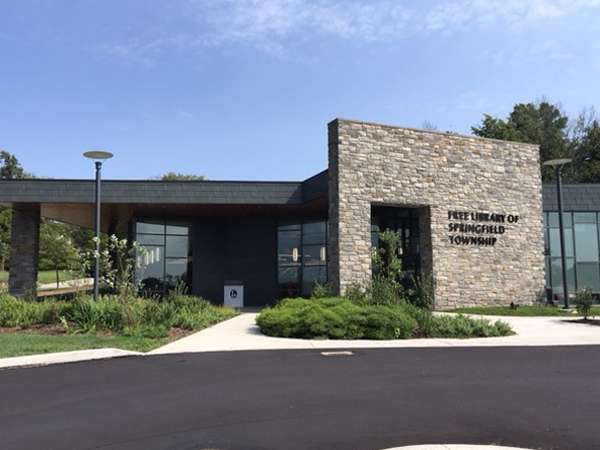
Case Study: Energy Benchmarking and HVAC Controls Analysis
Our Energy and Sustainability Team completed an assessment of BAS settings and algorithms, and a subsequent fine-tuning by the controls contractor, providing a significant and progressive reduction in energy use, resulting in utility bill and environmental savings.

Overview
Practical Energy Solutions, the Energy team at SSM, provided both energy benchmarking services and an HVAC building automation system (BAS) controls analysis and modification plan to Springfield Township, in Montgomery County. The project was championed by the Township’s Environmental Advisory Council.
The initial energy benchmark of 3 township buildings identified that two of the buildings, the Free Library and Police/Administration building, were under-performing. This suggested substantial opportunities to improve energy efficiency, leading to full HVAC Controls Analyses of both buildings.
Initial Controls Assessment

The energy team conducted a full assessment of the HVAC operations of both facilities during heating season. The team focused on the BAS controls, since the lighting systems are highly efficient and the building envelope is in good condition due to the relatively young age of the buildings.
The team identified ample opportunities to refine the controls and reduce energy consumption in both buildings. One or two measures required minor programming by the controls contractor, but most of the changes were simple and cost-free to the Township.
Administration/Police Building: Identified seven measures that will conservatively reduce whole-building energy use by one-third, saving nearly $10,000 in annual utility costs and reducing the CO2 pollution by approximately 130,000 pounds every year.

Free Library Building: Similar opportunities that will conservatively produce a 28% energy reduction, annual utility bill savings of approximately $6,200 and CO2 pollution reductions of more than 76,000 pounds annually.
These changes are expected to be highly cost effective and have the same environmental impact as planting nearly 4,800 mature trees or removing 21 passenger cars from the road.
Follow-up Assessment
After two years, a second benchmark of whole-building energy performance of both facilities showed a clear and positive trend to reduced energy use. After partial implementation of recommendations, whole-building energy use in the Administration/Police and Library buildings dropped 25% and 17% respectively, after normalizing for variations in weather climate. A second phase of BAS modifications is expected to show further, substantial energy and utility bill savings.
Here to Help | Paul Spiegel | Director, Energy and Sustainability Services | paul.spiegel@ssmgroup.com

Enhancing Piping System Longevity: The Role of Nitrogen in Fire Sprinkler Systems
Fire sprinkler systems play a crucial role in safeguarding facilities from the devastating effects of fires. For building owners who rely on dry pipe or pre-action sprinkler systems, a strategic switch from compressed air to nitrogen proves to be a functional solution for maximizing the lifespan of their piping systems.
Fire sprinkler systems play a crucial role in safeguarding facilities from the devastating effects of fires. For building owners who rely on dry pipe or pre-action sprinkler systems, a strategic switch from compressed air to nitrogen proves to be a functional solution for maximizing the lifespan of their piping systems. This article delves into the benefits of this transition, highlighting the vulnerabilities to corrosion, and the positive impact nitrogen generators can have on extending system life.
Understanding your Fire Protection
Sprinkler systems are a critical part of your fire protection system. The CDC states that between 2015-2019 sprinkler systems were 97% effective in preventing fires. According to the National Fire Protection Association (NFPA), compared to reported fires in properties with no automatic extinguishing systems, when sprinklers were present, the civilian fire death and injury rates per fire were 89 percent and 27 percent lower, respectively. The rate of firefighter injuries per fire was 60 percent lower. Additionally, the average loss to a building with sprinklers is 34-68 percent lower than buildings without AES.
The most common systems are wet systems which are connected to high-pressure water distributed by a steel piping system. These systems use a heat sensor to detect extreme heat (above 165 degrees Fahrenheit), triggering the glass bulb to break and release water and extinguish a fire in its early stages. However, the wet system, while often the least costly, is not conducive to all environments. There are in fact four different types of sprinkler systems that the NFPA permits: wet, dry, pre-action and deluge.
Dry Pipe and Pre-Action Sprinkler Systems
Dry pipe systems are often deployed in spaces susceptible to freezing temperatures, such as unheated warehouses, commercial freezers, and outside loading docks. A dry system functions similarly to a wet system, however, the water is not filled in the pipes. Here, the water is held away from the sprinkler behind a dry pipe valve. When the glass bulb is broken, air is released and pressure in the pipes drops which ultimately breaks the valve, releasing the water.
Pre-action systems, on the other hand, find application in data centers, museums, and archive spaces where an added layer or supervision is necessary to prevent unwarranted water discharge. Here, the system is interlocked with a fire detection system so that two events are needed before water is discharged. The heat detection will send an alarm or alert first. Then, as temperature increases, the glass bulb will break, and water will be released in a similar manner as in the dry system. This added step allows for extra protection from unwanted water flow.
Corrosion Challenges
Corrosion occurs when there is water, oxygen, and metal present. In a sprinkler system, corrosion is a serious concern as it can lead to pipe leaks, reduced water flow, or even render the system completely unusable.
While most think that wet systems are the only ones at risk for corrosion, in fact dry and pre-action systems that lean on compressed air also hold the same risk. Both dry pipe and pre-action systems have historically relied on compressed air for operation. However, using small air compressors without additional treatment results in wet air inside of the piping. This water vapor will condense in freezing temperatures, leaving water in the metal piping and subjecting pipes to corrosion.
The absence of or limited exposure to any of the three elements of corrosion (water, oxygen, metal) will slow down or prevent the process from occurring.
Nitrogen as a Corrosion Mitigator
To combat corrosion in dry and pre-action systems, the fire protection industry has turned to nitrogen generators to fill the system with a dry inert gas. Nitrogen, typically dry with a dew point below zero-degree Fahrenheit, eliminates water vapor condensation within the piping. Additionally, nitrogen has minimal oxygen content, further reducing corrosion-promoting elements. This dual action significantly lowers the potential for corrosion, ultimately extending the life of the piping system.
Switching from compressed air to nitrogen in dry pipe and pre-action sprinkler systems provides several advantages. The absence of water vapor and reduced oxygen content substantially mitigates corrosion, enhances the overall longevity, and increases the lifespan of this lifesaving piping system. The decision not only addresses corrosion concerns but also aligns with industry best practices for fire protection. As the fire protection landscape evolves, this strategic shift ensures that building occupants can rely on the systems for extended period, fostering a safer and more secure environment.
For additional information contact us:
Andrew Wengerd, PE, CFPS, LEED AP | andrew.wengerd@ssmgroup.com
Tips for Oil Water Separators (OWS)
Oil water separators (OWS) are a vital part of protecting the environment from hydrocarbon releases. Although typically out of sight and mind, they quietly do their part when properly maintained. The coalescing media is the essential element for attaining acceptable oil discharge limits. However, the coalescing media is also most susceptible to solids obstructing proper oil separation. When solids and hydrocarbons are not removed regularly, they can cause unwanted sludge buildup in the system and poor effluent characteristics.
Oil water separators (OWS) are a vital part of protecting the environment from hydrocarbon releases. Although typically out of sight and mind, they quietly do their part when properly maintained. The coalescing media is the essential element for attaining acceptable oil discharge limits. However, the coalescing media is also most susceptible to solids obstructing proper oil separation. When solids and hydrocarbons are not removed regularly, they can cause unwanted sludge buildup in the system and poor effluent characteristics.
In reviewing a number of OWS manufacturer designs and maintenance procedures, it’s recommended to perform yearly maintenance to recover released oils, dispose of fluids according to environmentally complaint methods, and clean the coalescing media. Grit and debris accumulations should not exceed the maximum allowable depth specific to the OWS design. Excessive solid build up should be monitored particularly after heavy rainfall events. Upon removing the oil and solids, clean the coalescing media with water. After maintenance is completed, the OWS should be filled with fresh water. As a final step, mark your calendar for checkup in another year.
Recommended annual OWS maintenance procedures:
Stop influent flow into the OWS.
Dispose of separated oils per regulatory procedures.
Drain the water from the OWS.
Measure and record the depth of solids, confirm depth is acceptable according to OWS literature, and remove the solids.
Clean the coalescing media with water spray according to manufacturer recommendations.
If cleaning in place, remove debris from the tank using a vacuum.
If cleaning outside of tank, ensure contaminated water is properly contained without disposing to ground.
Inspect tank interior and repair coating as needed.
Once debris is removed and the coalescing media has been cleaned, refill OWS with clean water.
For additional information contact us:
Andrew Wengerd, PE, CFPS, LEED AP | andrew.wengerd@ssmgroup.com

Farm to Table: Supporting the Food Industry
Farmers, processors, distributors, and even restauranteurs all turn to SSM. November is all about bringing food to the table. Here’s a little taste at some projects we’ve worked on.
It takes a lot to bring a product to market. Experts in the food industry should focus on just that- food. Because after all, addressing needs such as: regulatory compliance, increased capacity, routine maintenance, and facility expansion shouldn’t take away from doing what they know best. That’s why farmers, processors, distributors, and even restauranteurs all turn to SSM. We help secure prime locations, plan more efficient warehouses and distribution centers, conduct feasibility studies, upgrade utilities and building systems, improve traffic flow, and expand operations. By taking the lead on the engineering side, we enable the food industry to focus more on their core business.
Tyson Foods, Inc. | New Pottsville Truck Repair Facility | Spotts, Stevens and McCoy is providing comprehensive planning, engineering, and design services for the development of a Truck Repair Facility in Schuylkill County for Tyson Foods, Inc. Our scope of work encompasses a wide range of services and a multi-disciplinary team. These services include boundary and topographic surveys, preliminary and final land development plans, stormwater management system design, water and sanitary sewer design, mechanical, plumbing, and fire protection system design, electrical specifications and design, as well as structural retaining wall designs. Additionally, SSM is facilitating coordination of various municipal and regulatory approvals to ensure successful and timely completion of this project.
Joe Jurgielwicz & Son, Ltd. | Farm Electrical Upgrade | Spotts, Stevens and McCoy provided electrical engineering services to Joe Jurgielwicz & Son, Ltd., focusing on Electrical Permit Set of Plans for the Electrical Service Upgrade of a Hamburg, PA facility. The scope of our services included review and verification of existing electrical distribution system, identification of electrical equipment for new power feeds, and determination of locations of additional power feeds from the new system. As part of the electrical upgrade project, SSM provided the Circuit Breaker Settings and Time Current Coordination (TCC) Curves for the new switchboard and in preparation for the NFPA 70E Arc Flash Risk Assessment and Hazard Analysis. SSM’s delivered Electrical Permit Set included a site plan, floor plans, specifications, schedules, and diagrams.
Pepperidge Farm | Trailer Parking Lot Land Development | Spotts, Stevens and McCoy partnered with Pepperidge Farm for the planning and design of a new trailer storage parking lot in Lancaster County, PA. Our comprehensive land development services on this project included property survey services to update existing boundary and topographical data and coordination of a bedrock depth investigation with oversight by a licensed professional geologist. SSM also provided preliminary and final site development plans, as well as a complete stormwater management system design including components needed for receipt of an NPDES permit. And, our electrical engineering team provided design services including design of general lighting, concrete bases, lighting control and installation of underground space conduits.
Liberty Coca-Cola | The energy team at Spotts, Stevens and McCoy provided Liberty Coca-Cola with building tune-up services for several of the company’s buildings located in the Philadelphia region. Our team conducted an evaluation of the building systems, identified opportunities for operational, maintenance, and management improvements, and coordinated implementation of corrective actions. Building tune-up services ensure the building systems are in a state of good repair and improvements generate both energy and water savings all while maintaining occupant comfort. In support of these efforts, a qualified tune-up specialist from the SSM team performed the required evaluations, identified necessary improvements, and produced a final report for the City of Philadelphia’s Office of Sustainability for compliance with the City’s Building Energy Performance Program.
The Hershey Company | Spotts, Stevens and McCoy provided The Hershey Company with review and recommendations to the company-wide Asbestos Operations Plan (Management Plan). Previously, SSM provided The Hershey Company with additional environmental services as well as site engineering and infrastructure specification services.
Godiva Chocolatier, Inc. | Spotts, Stevens and McCoy provided Godiva Chocolatier assistance with revising and updating their Spill Prevention Control and Countermeasure (SPCC) Plan. SSM’s scope of work included a site inspection, as-built drawings for storm and sanitary lines, and review, update, and recertification of the SPCC plan. Previously, SSM provided Godiva Chocolatier with environmental safety services including an air permit application for installation of a new coating process.
Redner’s Markets, Inc. | Spotts, Stevens and McCoy provided Redner’s Markets, Inc. with baseline environmental assessments and reporting. Additionally, SSM previously worked with Redner’s Markets as the primary underground storage tank consultant to manage the removal and closure of USTs at four facilities.
Sunsweet Growers, Inc. | Spotts, Stevens and McCoy provided Sunsweet Growers, Inc. with environmental services to optimize the performance of the facility aerobic digester.
Who else we’ve worked for:
Maier’s Bakery | Site Engineering and Infrastructure
Herr Foods | Water and Wastewater Permit Assistance
Quaker Oats Company | Environmental Health and Safety
Samuel Adams Pennsylvania Beer | Environmental Health and Safety
The Bachman Company | Flood Plain Study
Adelphia Seafood | Environmental Health and Safety
Coca-Cola U.S.A. | Water and Wastewater Services
Dairy Queen | Site Development
Dunkin Donuts | Site Engineering and Infrastructure
Pabst Brewing Company | Environmental Health and Safety
Latrobe Brewing Company | Environmental Health and Safety
Stoudt’s Brewing Company | Water and Wastewater Services
Berks Packing Co., Inc. | Environmental Health and Safety
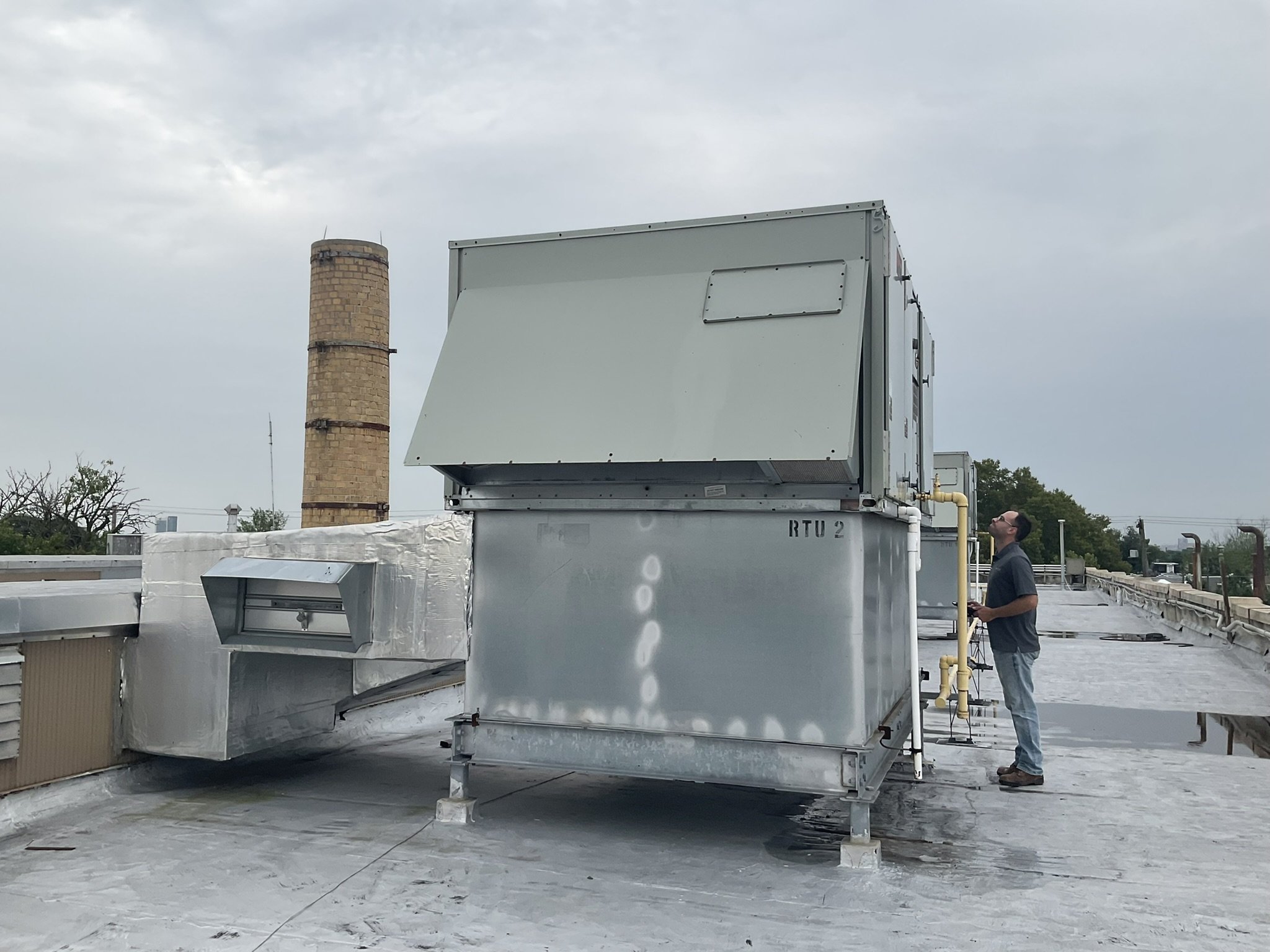










Lead and Copper Rule Revisions: GIS for Service Line Inventory
EPA recently revised the Lead and Copper Rule, establishing compliance deadlines of October 2024. To jumpstart the road to compliance, water systems should consider deploying a GIS team to establish their service line inventory. Likewise, water systems should ensure they have an engineering team on board that is well-versed in providing engineering design and consulting services.
Understanding the Lead and Copper Rule Revisions
In 2021, the U.S. Environmental Protection Agency (EPA) issued revisions to the Lead and Copper Rule that was first enacted in 1991. The new revisions intend to better protect children and communities from the risks of lead exposure in water. The revisions focus on taking more robust steps to get lead out of drinking water, as well as better informing communities and protecting children at schools and childcare facilities.
Required lead testing in schools and childcare facilities
Establishment of a “trigger level” to enable earlier mitigation
Use of science-based testing protocols to identify more sources of lead
Driving more full replacements of lead service lines
Development and maintenance of a public inventory of water service lines
The revisions to the Lead and Copper rule establish one of the largest updates to water regulation in 30 years. The rule is also accompanied by significant federal dollars available to assist community water systems (CWSs) with their plans for ridding the risk of lead in drinking water. The regulatory compliance deadline for water systems to meet the rule revisions is October of 2024.
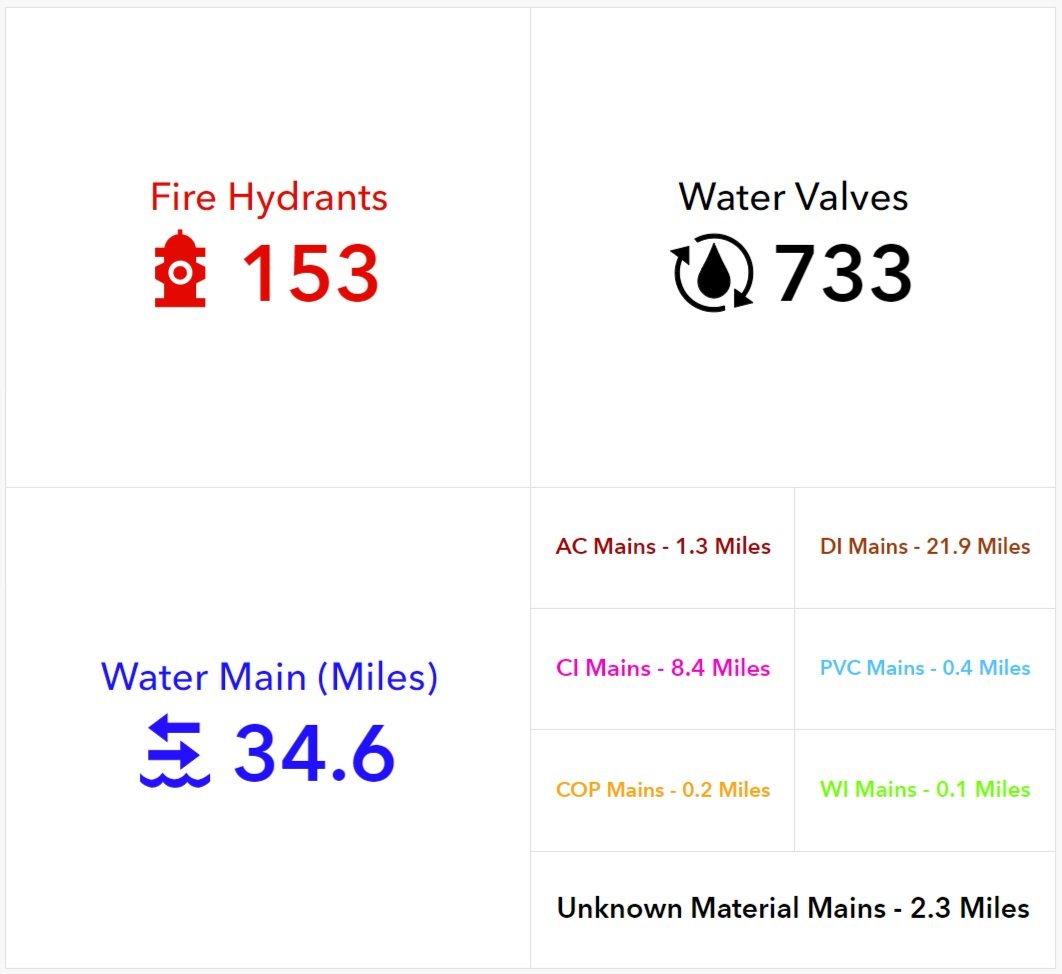
Sample of GIS data dashboard
Managing the Public Service Line Inventory with GIS
Among the revisions, EPA is requiring every water system provider to complete an inventory of their water service lines and report it. If done appropriately, this resource could aid in long-term planning and compliance including laying the groundwork for service line replacement plans as well as managing and tracking improvements and testing records.
A GIS dashboard, built around your water system means your data is always up to date and always accessible. In lieu of paper collection, management of assets can now be done through smart devices, in the field, with next to real-time updates. And accessing that information is easier than ever before. Your data can be built exactly the way that you need it - accompanying the location, analyzed alongside your capital planning, or summative looking at the whole picture.
Whether you're building your inventory from scratch or modifying your existing database - having a GIS team on board means that you data will start to work for you.
Our GIS team is well-versed in aiding our clients with the collection, documentation, and delivery of both private and public-facing dashboards as well as data analysis that ensures your data turns into an interactive, visual asset. This means all of that information becomes meaningful - saving you time and resources. The goal is not just to build a compliant service line industry. It’s to build one that is also valuable to you. To build an inventory that provides direction, meaning, and protection for you and your community.

The Right Time to Start your Service Line Inventory
The short answer to this common question is: now. While the deadline for compliance with the Lead and Copper Rule revisions isn’t until October 2024, it’s important to get your plan into action as soon as possible. A full inventory collection can be a time intensive process, particularly without deploying modern collection methods. It is recommended that the development of your inventory is as thorough as possible including the required historical records and assessment for replacement. Considering all of this, jumpstarting your inventory collection and database building now is crucial to compliance by 2024.
A great first step is to identify where you currently stand in the road to compliance. Then, assess the opportunities that a GIS team presents for preparing and managing your inventory moving forward.
SSM’s GIS Experience
For more than 20 years, we’ve provided professional GIS services to our clients; from mapping support for infrastructure projects, to focused GIS and data capture projects. We utilize GIS to analyze, visualize, and interpret data to understand patterns, relationships, and trends. Through SSM’s extensive geographic data our clients benefit from faster project startups and the economies of readily available data. SSM’s GIS Asset Management approach helps municipalities to transform water, sewer, storm water, or transportation infrastructure data into an easy-to-use operations asset management system capturing vital infrastructure data points with survey-grade accuracy. The data is verified and compiled into a geo-spatial database. Most of our water/wastewater clients have reaped the benefits of GIS in both their everyday use and long-term planning.
Compliance with Testing Protocols and Service Line Replacement
In addition to our GIS expertise, we have dedicated engineers with water system expertise. Our team of Process and Design Engineers have deep and long-standing experience providing water and wastewater engineering services. A significant number of our staff have more than 20 years of experience serving water and wastewater authorities. We combine professional engineers, professional land surveyors, environmental scientists, designers and drafters into teams to complete each assignment.
When it comes to managing and protecting water resources, SSM is the authority that everyone turns to. SSM offers extraordinary experience in the planning, design, and construction management of wastewater and water systems, piping systems, pumping stations, and treatment plants.
As you continue your planning for compliance with the Lead and Copper Rule Revisions, ensure your engineering team is ready and available to get you there not only with expertise, but with experience.


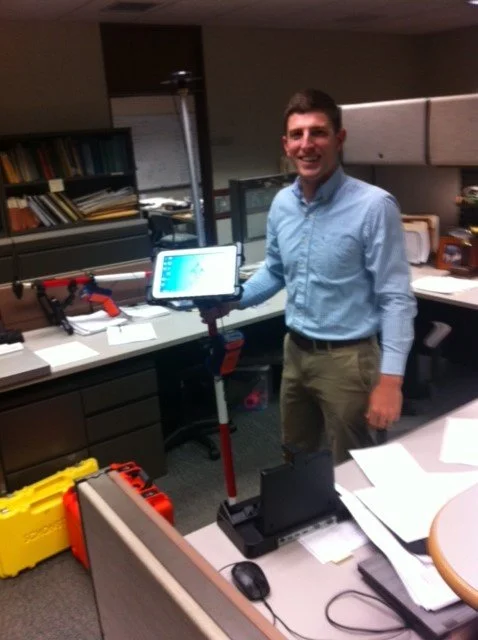


Zane Britton Certified as a FAA Certified Remote Pilot

Zane Britton, Survey Crew Chief has received his certification as a FAA Certified Remote Pilot. Britton is one of three certified pilots at SSM.
He is a graduate of Pennsylvania College of Technology, Associate of Applied Science, Civil Engineering Technology and Associate of Applied Science, Surveying Technology. Mr. Britton has 3 years of surveying experience. He is responsible for performing all aspects of site and boundary reconnaissance, construction stakeout, and boundary, topographic, roadway and as-built surveys, as well as ultimately turning that field data into AutoCAD drawings.

Patty Burke earned the Certified Plan Sponsor Professional credential.
Patty Burke, CPSP has earned her Certified Plan Sponsor Professional credential through Plan Sponsor Council of America.

Patty Burke | Certified Plan Sponsor Professional
Patty Burke, CPSP has earned her Certified Plan Sponsor Professional credential through Plan Sponsor Council of America.
The Certified Plan Sponsor Professional (CPSP)TM demonstrates a level of expertise in the duties of a retirement plan sponsor, and attests that the holder possesses the knowledge and skills to evaluate, design, implement and manage an employer-sponsored retirement plan. Leveraging the most current online education technology, the rigorous curriculum ensures plan sponsors have the knowledge they need to protect their organization from fiduciary risk and help secure their plan participants' retirement success. The program was developed by the nation’s leading retirement experts at the American Retirement Association (ARA), Plan Sponsor Council of America (PSCA), and select education partners.
A part of the SSM team since 2005, Patty serves as Senior Administrative and Executive Assistant in the Human Resources Department at SSM. She is responsible for administrating the employee benefit and retirement programs, including medical, dental, vision, life insurance, short- and long-term disability, and 401(k) plan. In addition, she administers the payroll process, facilitates recruiting and on-boarding initiatives and other employee safety and benefit programs.

Jamie Lorah, PE Named Technical Director, Environmental Engineering
Jamie Lorah, PE has been promoted to the role of Technical Director, Environmental Engineering in this role she will be responsible for managing the technical aspects of the Environmental Division’s business and ensuring the technical proficiency and adherence to technical standards.

JAMIE LORAH, PE | TECHNICAL DIRECTOR, ENVIRONMENTAL ENGINEERING
Jamie Lorah, PE has been promoted to the role of Technical Director, Environmental Engineering. Jamie has been a part of the SSM team since 2003, most recently serving as the Manager of Process and Design Engineering. As the Technical Director, Jamie will be responsible for managing the technical aspects of the Environmental Division’s business and ensuring the technical proficiency and adherence to technical standards as well as performing quality control checks on projects and deliverables. She will continue to manage the everyday operations of the Process and Design Department.
Jamie has over 20 years of experience in environmental and municipal engineering. Her responsibilities include client management, project management, water and wastewater design, design specifications, engineering cost opinions, population and flow projections, Act 537 Planning, hydraulic modeling, cost-effectiveness analysis, sewer system evaluations, Industrial Pretreatment Program development and support, data analysis, and report preparation. Jamie specializes in hydraulic modeling related to the identification of sewage collection system surcharging, particularly on older combined systems. She is also involved in the development of master rehabilitation plans and determination of cost effectiveness for various repair options. She has extensive experience in permitting, planning, and dealing with regulatory agencies such as the US Environmental Protection Agency (US EPA), the Department of Environmental Protection (DEP), and the Delaware River Basin Commission (DRBC).
Jamie is a graduate of Bucknell University, B.S. Civil Engineering. She is a licensed Professional Engineer in Pennsylvania. And, she is professionally affiliated with Pennsylvania Water Environment Association (PWEA) as well as Eastern Pennsylvania Water Pollution Control Operators Association (EPWPCOA).
Beyond Storefronts: Supporting the Retail Space
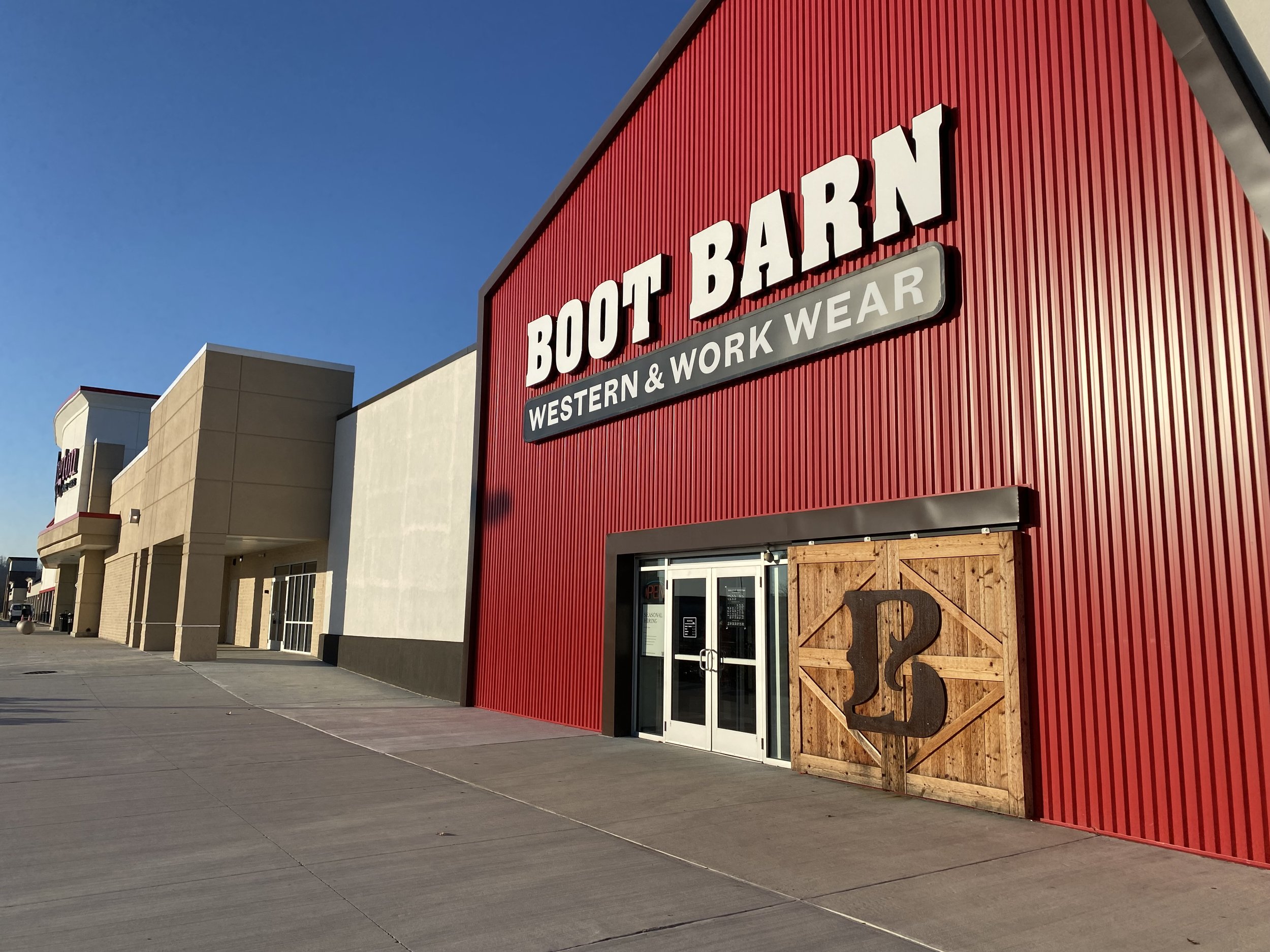

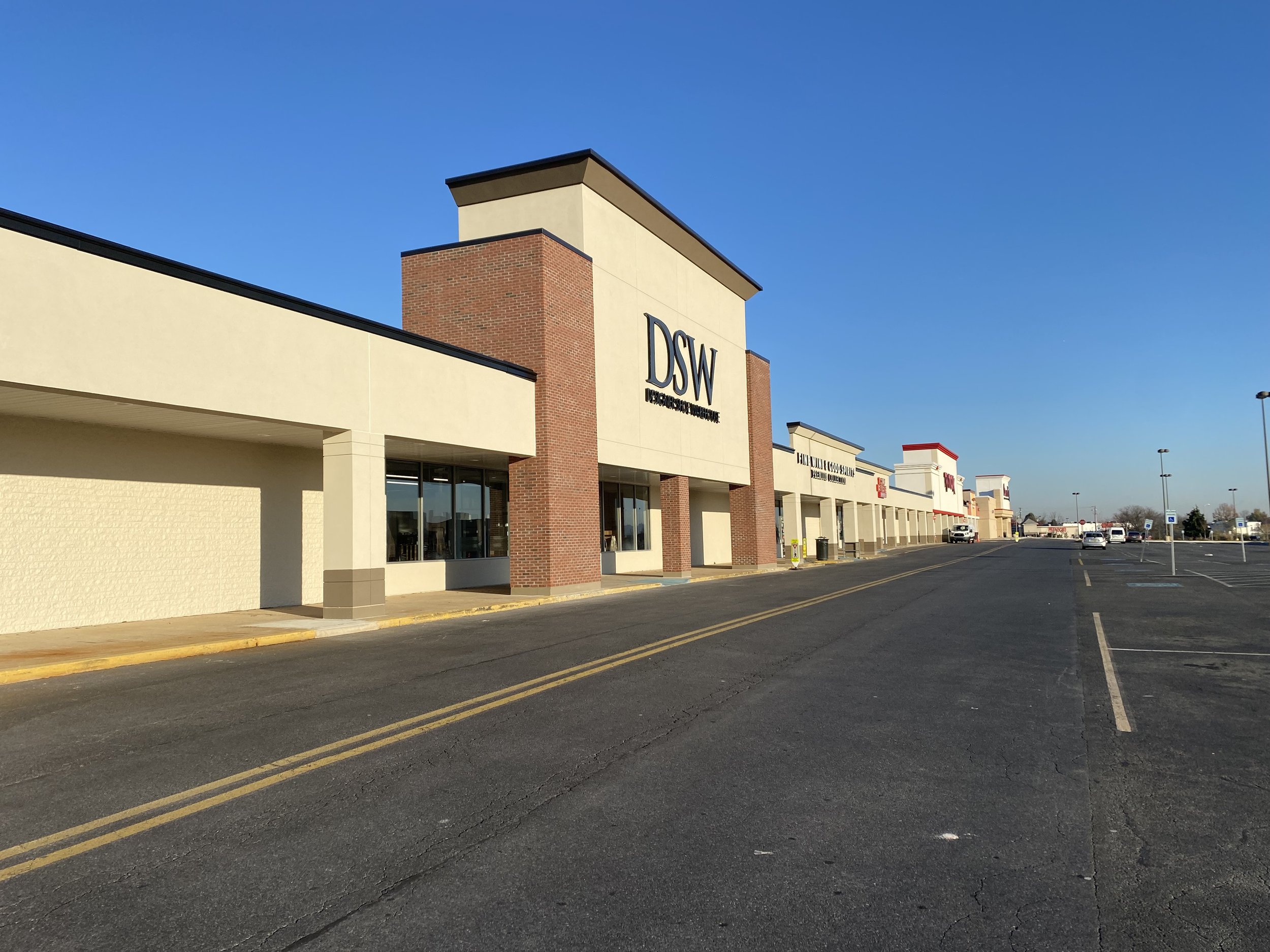
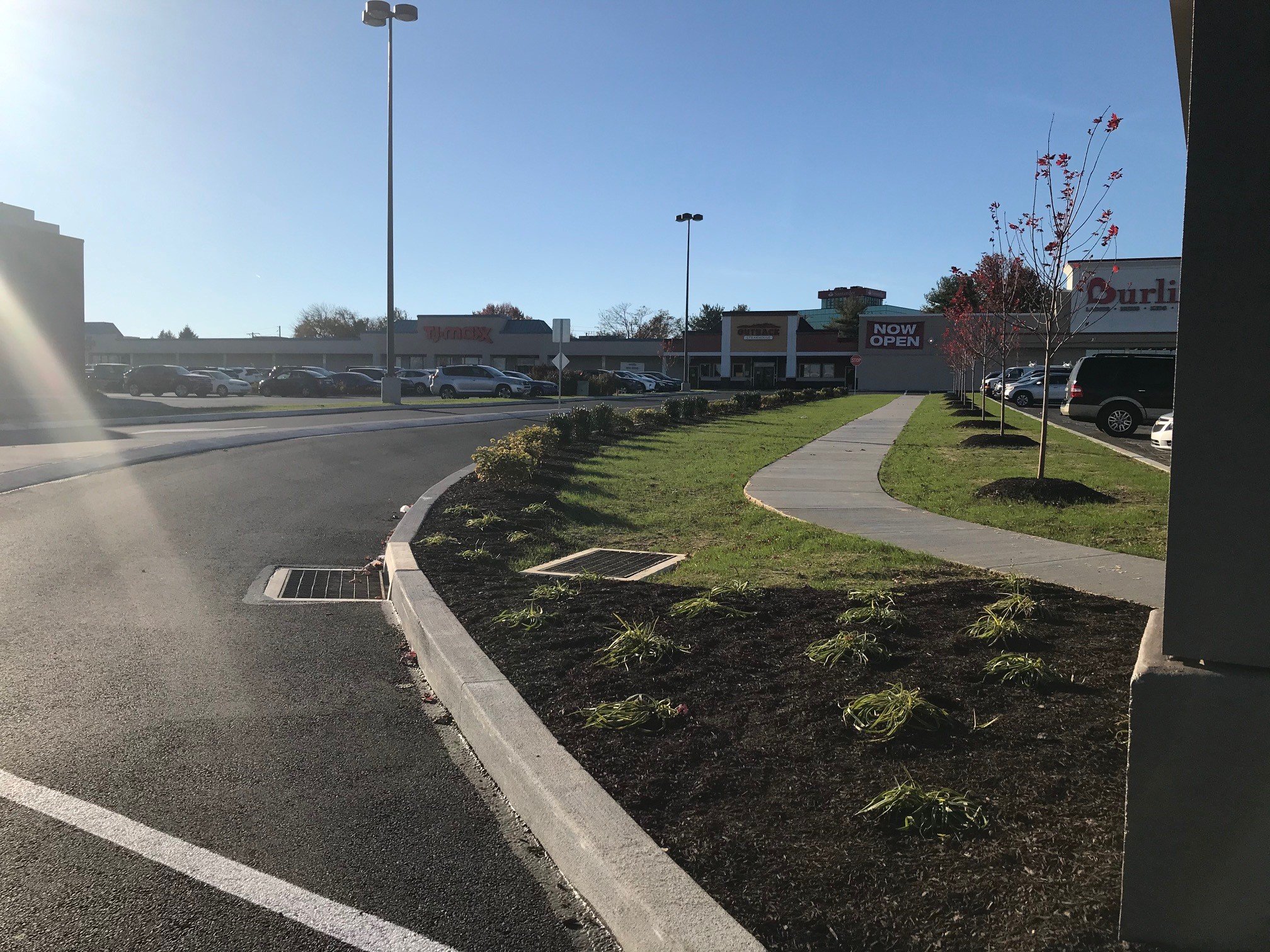
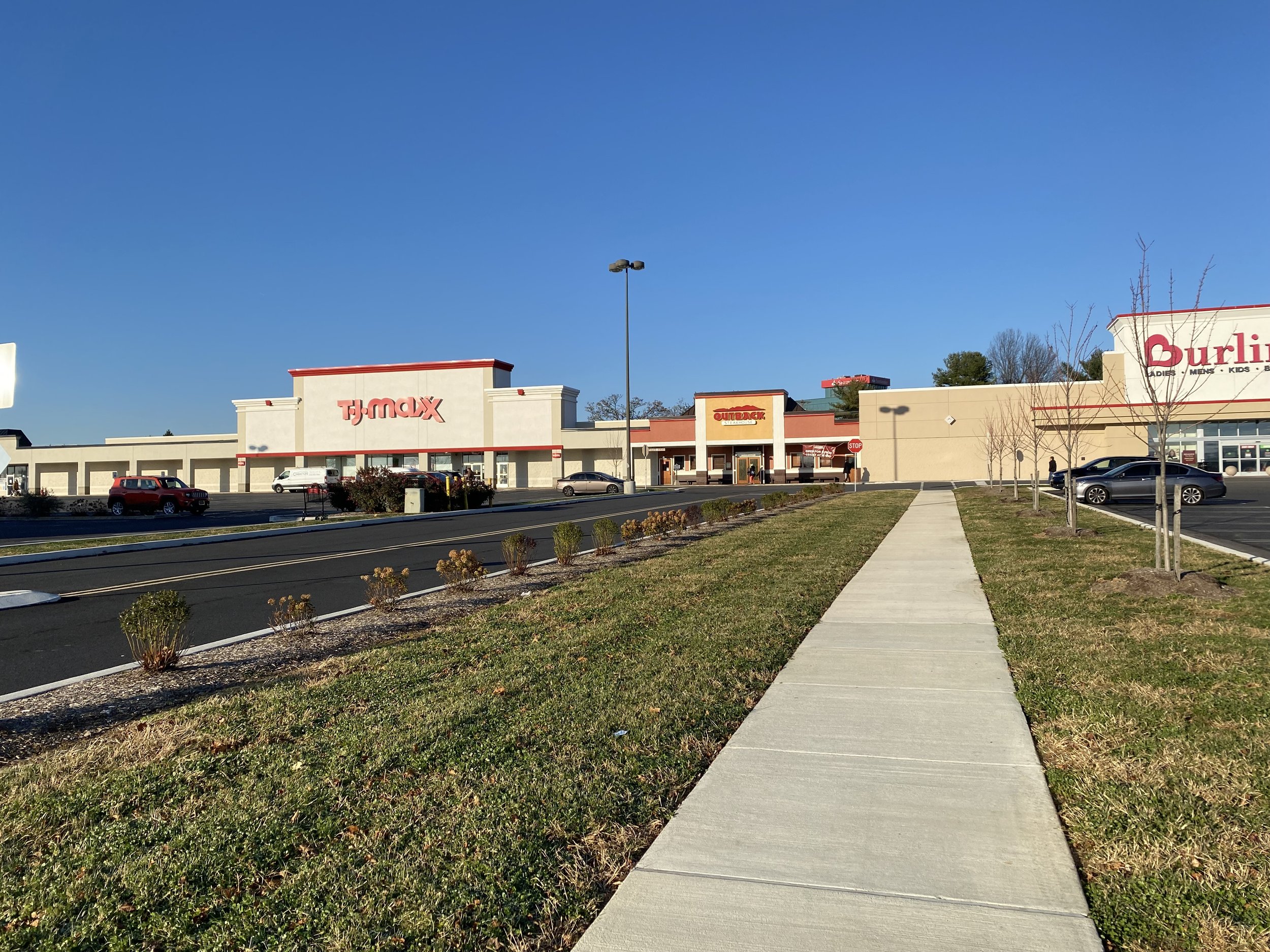
The landscape of retail is ever evolving with success lying in the seamless orchestration of many elements. At SSM, we’re proud to support our retail clients so that they get to focus on what they do best - curating exceptional shopping experiences. We recognize that the complexities of retail extend far beyond storefronts. From optimizing parking lots to ensuring safe spaces to shop - we specialize in providing comprehensive and multi-faceted solutions to even the most complex challenges. So that when holiday shopping is on the mind, our retail clients get to focus on just that.
Check out a few of the recent retail projects we’ve worked on:
Boscov’s | Solar Array | SSM has provided structural evaluations of existing framing for new solar array loading for retail outlets in various locations, including determining the existing structure capacity and providing guidance on load limitation for the proposed array. Existing steel-framed and concrete-framed structures have been evaluated.
TJ Maxx | Facade | SSM provided structural design for the renovation of a 4-foot-tall facade to a 20-foot-tall replacement. Structural scope included evaluating existing framing and capacity of existing steel joists. Engineering drawings included foundation plans, framing plans, wall sections, reinforcing details, and details of the light-gage metal framework. Construction administration services were also provided throughout renovation.
Berkshire Mall West | Site Improvements | Engineering and permitting services for a new driveway entrance and pedestrian circulation. SSM’s survey team provided a property survey, and our engineering team provided a land development plan as well as necessary Borough documents. Land development plans included existing conditions, site layout, grading and landscape, as well as construction details for the driveway and pedestrian facilities. SSM also provided construction administration and coordination.
Berkshire Mall West | ADA Ramp Evaluations | Survey, evaluation, and design services for existing ADA sidewalk ramps. SSM provided a detailed evaluation of existing ramps and developed design drawings for proposed ramps and related site improvements. Evaluation and design included compliance with ADA standards, construction specifications, project administration, and associated field meetings.
Berkshire Mall West | Land Development Plan | SSM has been contracted to provide land development services for a 40,000SF building addition. SSM’s services include land development plans and documentation for municipal approvals. Also included is an updated survey, conceptual layouts, and preliminary/final land development plans and construction details. SSM will also prepare a storm water management design and provide construction coordination.
Burlington | Building Addition | SSM provided survey services to support construction of an addition to an existing Burlington store. Our Survey team provided an existing conditions survey accompanied by construction stakeout - integrating the addition’s new design with existing structural steel and building walls. Construction stakeout included steel layout of the addition. Upon construction completion, SSM will prepare a final as-constructed survey plan.
Burlington | Construction Documentation | SSM provided structural design and documentation for the fit out of an existing retail space. SSM provided drawings from development of conceptual design into final construction documents. The structural scope of work also included providing foundation plans determining load capacity for existing roof framing.
Boot Barn | Square Foot Verification | SSM was contracted to verify the square footage of a building formerly used as a restaurant for the leasing operations of the Boot Barn retail location. Our team visited the site and performed field measurements throughout the interior of the building and around the exterior perimeter to verify the rentable area for leasing purposes.
For additional information contact us:
Scott Miller, ASLA | scott.miller@ssmgroup.com
Discussion Topics:
What is Source Water Protection?
Where to find protection zone information
Concerns with potential contamination issues and follow-up information
Managing Risks
Resources for education of customers and residents