

Spottlight on Engineering | Our work touches everyday life.
Founded by NSPE in 1951, Engineers Week is dedicated to ensuring a diverse and well-educated future engineering workforce by increasing understanding of and interest in engineering and technology careers. This week is a time for everyone to celebrate and recognize the people who create today’s awe-inspiring wonders like cloud-busting skyscrapers and human travel to Mars. And a great opportunity to reflect on how very different our lives would be without daily marvels like clean drinking water, computers and cars.

Engineers Week | February 18-24
Celebrate the Difference Engineers Make in Our World
Founded by NSPE in 1951, Engineers Week is dedicated to ensuring a diverse and well-educated future engineering workforce by increasing understanding of and interest in engineering and technology careers. This week is a time for everyone to celebrate and recognize the people who create today’s awe-inspiring wonders like cloud-busting skyscrapers and human travel to Mars. And a great opportunity to reflect on how very different our lives would be without daily marvels like clean drinking water, computers and cars.









Spottlight on a New Year

Staff News

JoSH JAMES, EIT

KEVIN HOFFMAN, SIT
SSM welcomes Joshua James, EIT as a Graduate Engineer in the Water and Wastewater Engineering Department. Josh is a 2016 graduate of The Pennsylvania State University with a BS in Environmental Systems Engineering.
We congratulate Kevin Hoffman, SIT on earning his Surveyor-In-Training Certification. Kevin is a 2016 graduate of Pennsylvania College of Technology with an A.A.S. in Surveying Technologies. He is responsible for conducting field topographical and property surveys, engineering surveys, records research, preparing plots, calculations and legal descriptions for properties; establishing field control; construction stakeout; and monumentation. He is trained in using Trimble GPS equipment, Trimble robotic instruments, Leica ScanStation, AutoCAD and Cyclone.


Spottlight on SSM
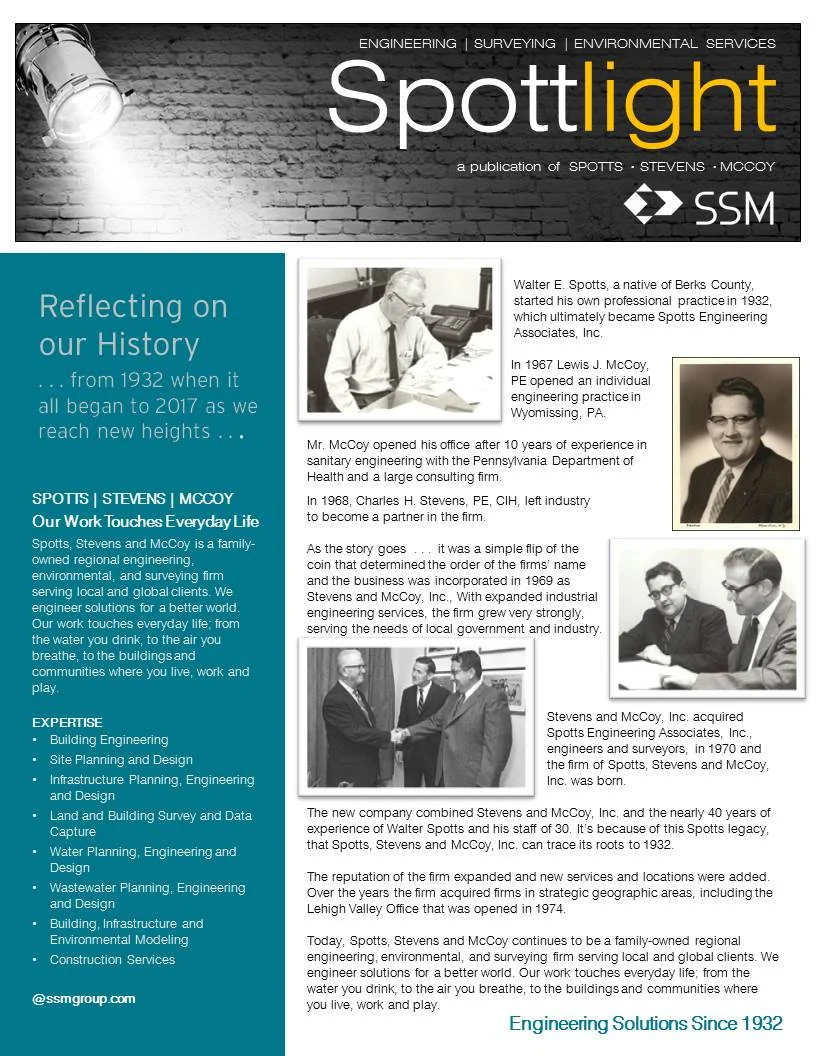
Reflecting on our History . . . from 1932 when it all began to 2017 as we reach new heights . . .

Reflecting on our History
. . . from 1932 when it all began to 2017 as we reach new heights . . .




Spottlight on Winter Preparations
Every day brings a heightened sense that there is a crispness in the air reminding us that another messy, wet, and sometimes brutal winter is just around the corner. Without much warning, temperatures, wind and heavy snow can bring about catastrophic damage in the form of collapsed roofs, ruptured pipes and even flooding.

Are you Ready for Snow?
According to The Old Farmer’s Almanac . . .winter will be warmer than normal, with above-normal precipitation and below-normal snowfall. The snowiest periods will be in mid- to late November, early and mid- to late January, and mid-March.
Every day brings a heightened sense that there is a crispness in the air reminding us that another messy, wet, and sometimes brutal winter is just around the corner. Without much warning, temperatures, wind and heavy snow can bring about catastrophic damage in the form of collapsed roofs, ruptured pipes and even flooding.


Spottlight on Fire and Water
Fire protection systems are essential to the safety of your employees and protection of your property. But more than that, these systems are essential in helping you to manage the risks associated with business continuity. Imagine the impact on your business or organization if a key production line were to go off-line for an extended period of time, if the runoff from a fire event were to cause an environmental impact, or if the assets in your building (from equipment to historical artefacts) were to be destroyed.


Spottlight on School Days
Even if you’re not heading back into the classroom this month, the back-to-school season is a great time to refresh and get back to the fundamentals.

Even if you’re not heading back into the classroom this month, the back-to-school season is a great time to refresh and get back to the fundamentals.
It takes a lot to make and market a product. It also takes a lot to assure regulatory compliance as well as address needs such as increased capacity, routine maintenance and facility expansion. That's why developers, educators, healthcare providers and manufacturers of everything from chocolate to steel turn to SSM when it comes time to secure prime locations, plan more efficient warehouses and distribution centers, conduct feasibility studies, upgrade utilities and building systems, improve traffic flow and expand operations. By taking the lead on the engineering side, we let you focus on your core business.
In this Issue


Spottlight on Water Quality
We use water everyday in a variety of ways: drinking, washing, swimming, fishing, eating from it, and traveling.
Clean and sustainable drinking water is an essential element of the quality of life for any community.
National Water Quality Month reminds us to take a long, hard look at what our household and community are doing to protect sources of fresh water. We use water everyday in a variety of ways: drinking, washing, swimming, fishing, eating from it, and traveling. Water quality refers to the chemical, physical, biological, and radiological characteristics of water. It is a measure of the condition of water. Water quality standards have been established to protect human health and aquatic life. The standards form a legal basis for controlling pollution entering the waters of the United States from a variety of sources (e.g., industrial facilities, wastewater treatment plants, and storm sewers) and describe the condition of a waterbody or level of protection necessary.

DOWNLOAD ISSUE


Spottlight on Parks and Recreation
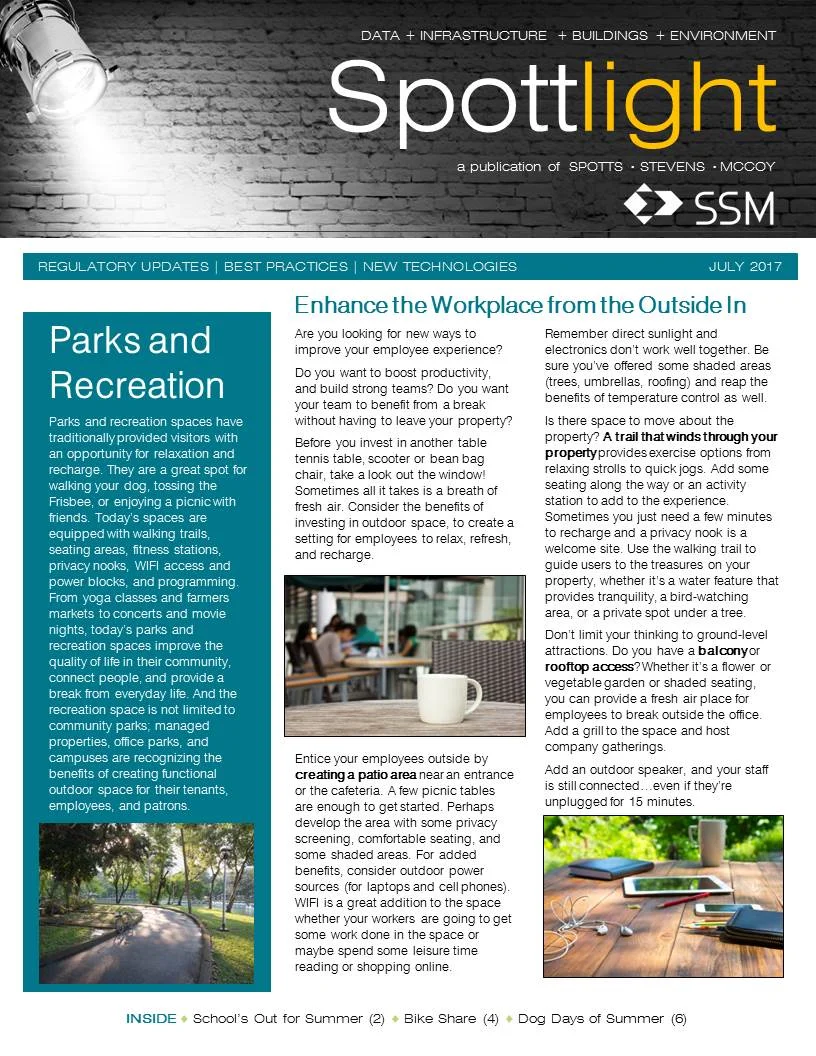
Parks and recreation spaces have traditionally provided visitors with an opportunity for relaxation and recharge. They are a great spot for walking your dog, tossing the Frisbee, or enjoying a picnic with friends. Today’s spaces are equipped with walking trails, seating areas, fitness stations, privacy nooks, WIFI access and power blocks, and programming.
Parks and recreation spaces have traditionally provided visitors with an opportunity for relaxation and recharge. They are a great spot for walking your dog, tossing the Frisbee, or enjoying a picnic with friends. Today’s spaces are equipped with walking trails, seating areas, fitness stations, privacy nooks, WIFI access and power blocks, and programming. From yoga classes and farmers markets to concerts and movie nights, today’s parks and recreation spaces improve the quality of life in their community, connect people, and provide a break from everyday life. And the recreation space is not limited to community parks; managed properties, office parks, and campuses are recognizing the benefits of creating functional outdoor space for their tenants, employees, and patrons.





Spottlight on Health and Safety
At SSM we provide a variety of industrial hygiene and indoor air quality services that will identify and allow corrective efforts for industrial air quality problems to assure the highest level of air quality in your working environment.

At SSM we provide a variety of industrial hygiene and indoor air quality services that will identify and allow corrective efforts for industrial air quality problems to assure the highest level of air quality in your working environment.
- Heat Stress Evaluations
- Particulate Sampling - Personal and Area
- Mold Investigations
- HVAC System Reviews and Analysis
- Noise Monitoring - Personal and Area
- Direct Read Instrument Analysis - VOCs, Carbon Monoxide, Relative Humidity, Ozone, Formaldehyde, and many others
- Various Chemical Analysis - dependent on the work environment
- Project-specific Health and Safety Plans
SSM has performed these services at a variety of local facilities including power plants, factories, foundries, shipyards, food processing facilities, vocational schools and many others.
We’re here to help you protect your workers’ health and safety.
Protecting Your Workers
Workers exposed to hot indoor environments and/or hot and humid conditions outdoors are at risk of heat- related illness and injuries. Individuals performing heavy work tasks and/or using bulky or non-breathable protective clothing and other personal protective equipment (PPE) are at greatest risk to heat exposure.
Quality Air is Fundamental
Maintaining the highest levels of air quality is most important in healthcare facilities where occupants are most susceptible to irritants in the air. It is vital to maintain a sterile environment in health care facilities to prevent the spread of infection as well as the threat of exacerbating pre-existing conditions. Burn patients and patients with compromised immune systems are at the greatest risk for infection and demand the most stringent infection control measures combined with high indoor air quality.
It’s not too Early to Begin Preparing Your Buildings for the Fall
Now is the time to plan ahead to avoid typical last-minute problems like mold and legionella. Although the students are vacationing and the classrooms are empty, school buildings and grounds continue to be a busy place during the summer months. In addition to finalizing budgets and overseeing summer construction and renovations, it’s important to take proactive steps to avoid problems in the fall.
Indoor Environmental Management Programs
At SSM, we consider all environmental factors in our IAQ/IEQ management programs to include building structure, materials, construction activities, and heating, ventilation, air conditioning (HVAC) systems, as well as the building occupants activities, the cleaning and maintenance of the building and sources originating outside the building that have the potential to impact indoor air quality. Our program is designed to recognize how systems work together within the built environment to improve indoor air quality and create a Satisfactory Work and Learning Environment (better than Satisfactory is our goal!).
More than the Air You Breathe
It has become apparent over the years, that more problems negatively affect building occupants than just poor Indoor Air Quality (IAQ). These additional problems can include but are not limited to structural issues, design and layout issues, mechanical issues, noise issues and even lighting issues. The inclusion of these additional factors in building occupant satisfaction has led to the use of the term Indoor Environmental Quality (IEQ), which can either simply include IAQ issues or be referred to in addition to IAQ issues.
NFPA 70E Arc Flash Risk Assessment
Although the duty to provide electrical safety in the workplace can be traced to the 1970 Occupational Safety and Health Act, updates and continual revisions to OSHA, National Electrical Safety Code (NESC) and the 2015 Edition of the National Fire Protection Institute (NFPA) 70E represent the basis for requirement for Arc Flash Risk Assessment (formerly a Hazard Analysis) and protective clothing and equipment. Updated Incident Energy Levels should be determined based on any system revisions and 2015 NFPA 70E requirements.

Spottlight on Facility Management
Integrating place, people, systems, technology and process is no small task.
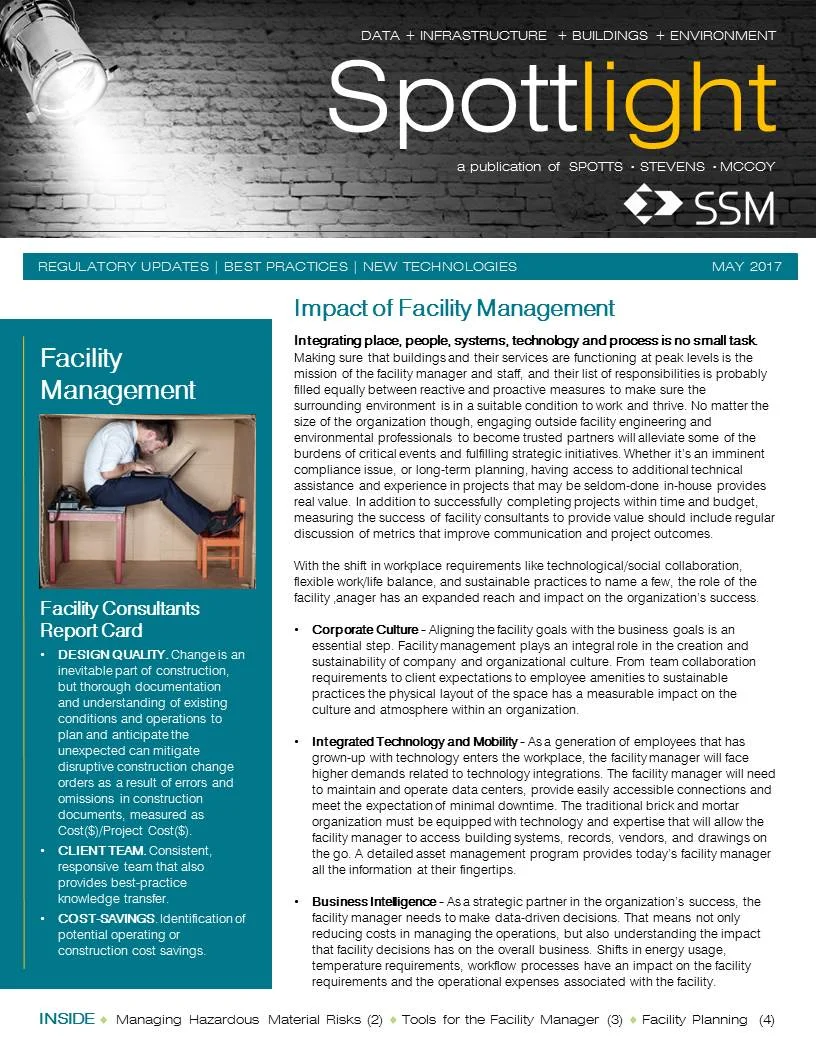
Integrating place, people, systems, technology and process is no small task.
Making sure that buildings and their services are functioning at peak levels is the mission of the facility manager and staff, and their list of responsibilities is probably filled equally between reactive and proactive measures to make sure the surrounding environment is in a suitable condition to work and thrive. No matter the size of the organization though, engaging outside facility engineering and environmental professionals to become trusted partners will alleviate some of the burdens of critical events and fulfilling strategic initiatives. Whether it’s an imminent compliance issue, or long-term planning, having access to additional technical assistance and experience in projects that may be seldom-done in-house provides real value. In addition to successfully completing projects within time and budget, measuring the success of facility consultants to provide value should include regular discussion of metrics that improve communication and project outcomes.




Spottlight on April Showers
“Thy fate is the common fate of all; into each life some rain must fall.”
-- Henry Wadsworth Longfellow

“Thy fate is the common fate of all; into each life some rain must fall.”
INSIDE THIS ISSUE


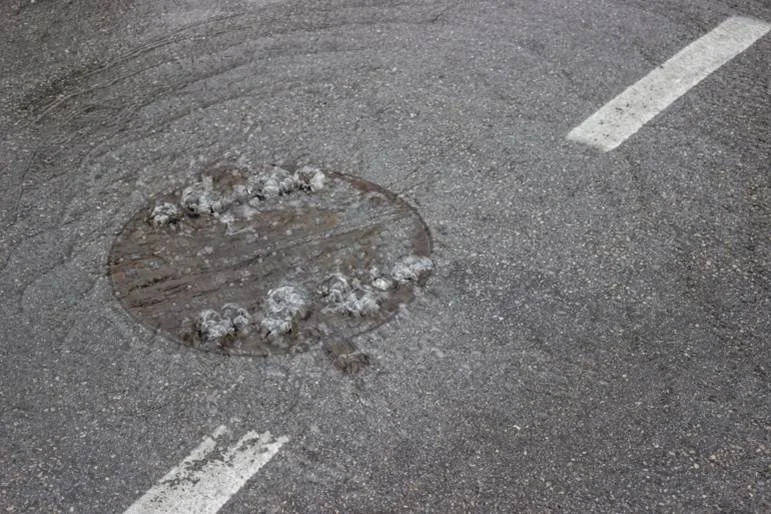


Spottlight on Asset Management
Whether your organization owns, leases, or manufactures space shuttles, IT equipment, fleet vehicles, biological samples, or spare parts, good asset management practices not only provide value but are essential to running a successful business.
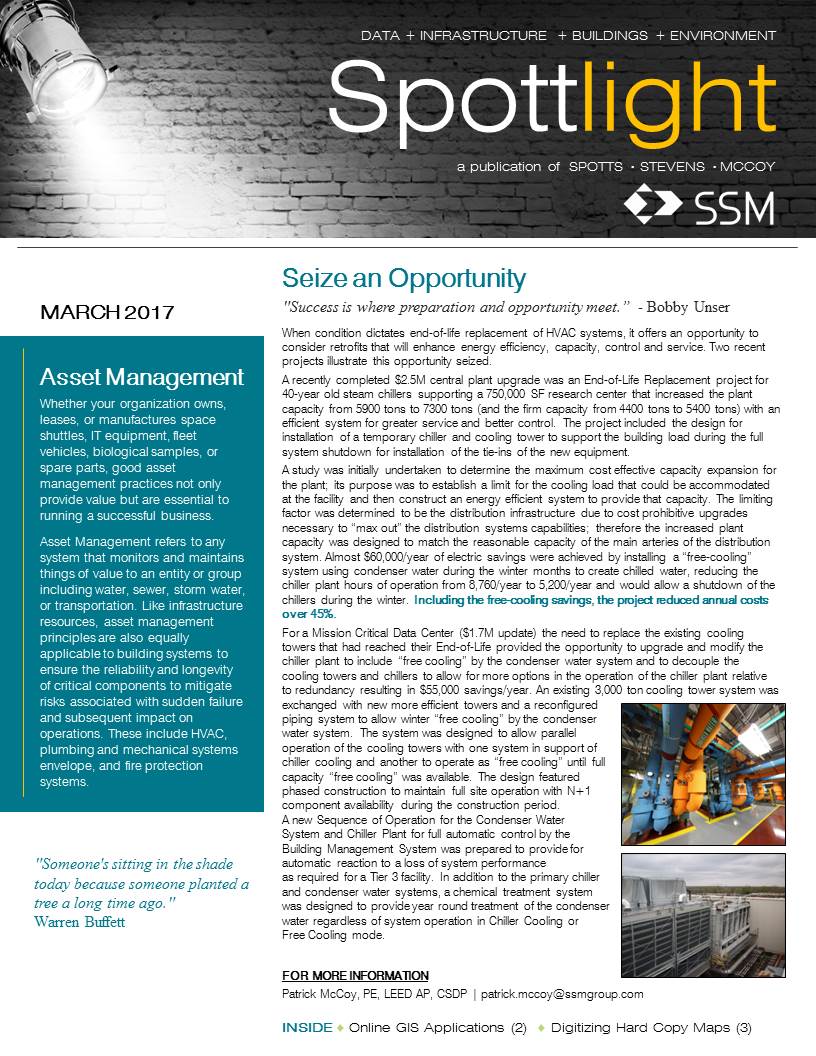
Whether your organization owns, leases, or manufactures space shuttles, IT equipment, fleet vehicles, biological samples, or spare parts, good asset management practices not only provide value but are essential to running a successful business. Asset Management refers to any system that monitors and maintains things of value to an entity or group including water, sewer, storm water, or transportation. Like infrastructure resources, asset management principles are also equally applicable to building systems to ensure the reliability and longevity of critical components to mitigate risks associated with sudden failure and subsequent impact on operations. These include HVAC, plumbing and mechanical systems envelope, and fire protection systems.
INSIDE THIS ISSUE


When condition dictates end-of-life replacement of HVAC systems, it offers an opportunity to consider retrofits that will enhance energy efficiency, capacity, control and service. Two recent projects illustrate this opportunity seized.
Low-Cost Asset Management Approach
Recent advancements in web-based GIS applications, similar to Google Earth, have provided new means to create, store, and access GIS data. Many water/wastewater systems use online GIS applications to transform their infrastructure data into an easy-to-use operations asset management system. This low-cost approach captures vital data within a secure geo-spatial database. By creating customized mobile web applications, field-critical data (material description, installation date, inspection reports and service history) is available when needed most and accessible to operators in the office or in the field.
Digitizing Hard Copy Maps
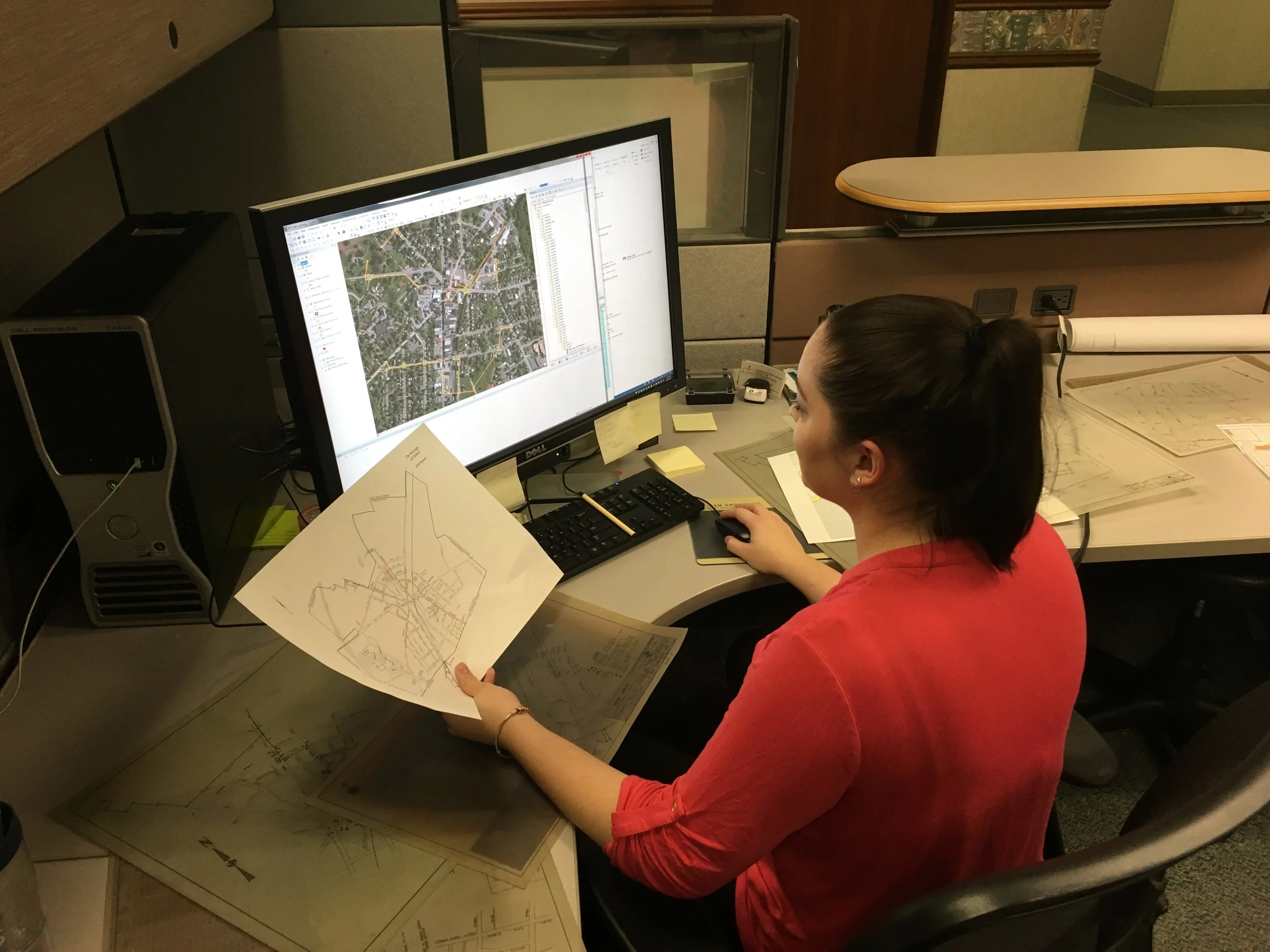
Advancements in GIS software and mobile applications have recently provided the ability to access maps and data on the go. This allows managers and operators to access asset locations, specifications, photos, and customized maps and applications wherever they take their mobile device. For many, digitizing old maps is well worth the process.
Spottlight on Little Things
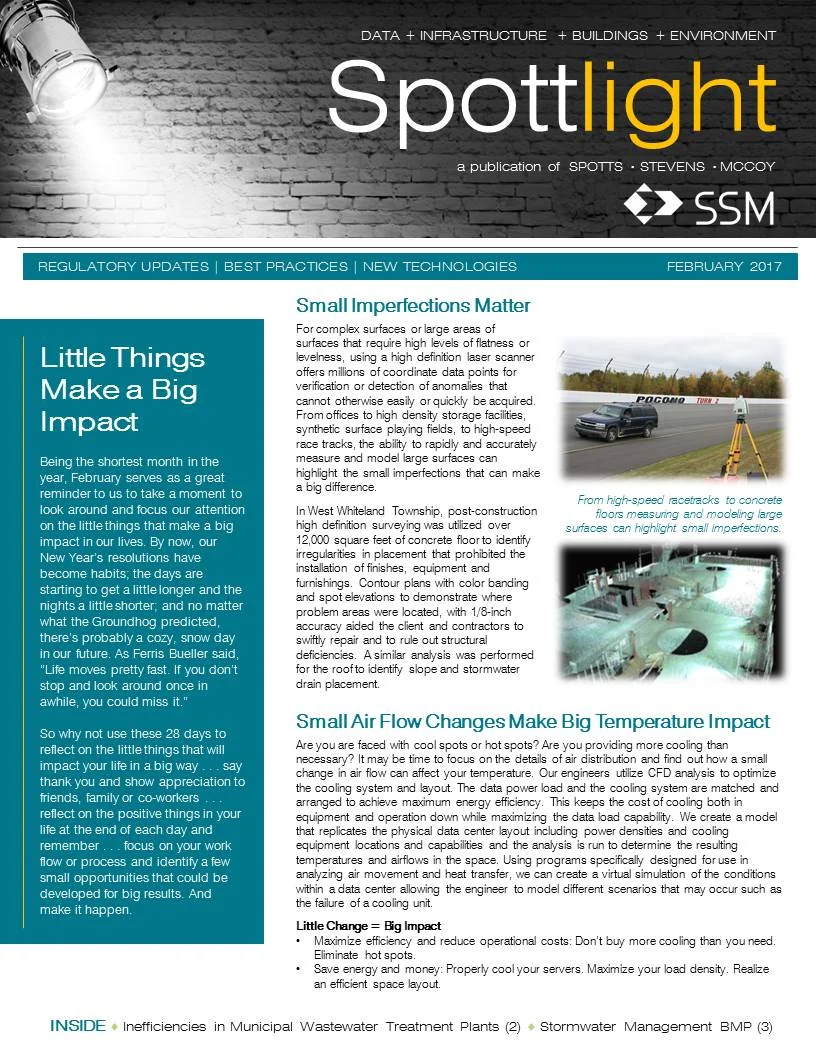
Being the shortest month in the year, February serves as a great reminder to us to take a moment to look around and focus our attention on the little things that make a big impact in our lives.

SSM NEWS
- Sam Zook, SIT| Surveyor, Survey and Data Capture has received his certification as a Drone Pilot. On June 21st, 2016 the FAA finalized a new regulatory framework for small, unmanned aerial systems. Titled Part 107, these new regulations created a new drone certification process that covers the majority of low-risk, commercial UAS flight operations for all commercially operated drones. Commercial refers to any kind of flight operation that can be tied to economic benefit. These new regulations were implemented on August 29, 2016. Zook is one of three certified pilots at SSM. He is a 2009 graduate of Pennsylvania College of Technology.
- SSM welcomes Christopher Colvin, EIT as Graduate Engineer in our Electrical Engineering Department. Chris is responsible for electrical design and preparation of scope, plans and specifications for industrial, commercial and institutional building projects. He received his BS in Engineering from James Madison University.
Little Things Make a Big Impact
Being the shortest month in the year, February serves as a great reminder to us to take a moment to look around and focus our attention on the little things that make a big impact in our lives. By now, our New Year’s resolutions have become habits; the days are starting to get a little longer and the nights a little shorter; and no matter what the Groundhog predicted, there’s probably a cozy, snow day in our future. As Ferris Bueller said, “Life moves pretty fast. If you don’t stop and look around once in awhile, you could miss it.”
So why not use these 28 days to reflect on the little things that will impact your life in a big way . . . say thank you and show appreciation to friends, family or co-workers . . . reflect on the positive things in your life at the end of each day and remember . . . focus on your work flow or process and identify a few small opportunities that could be developed for big results. And make it happen.
Inside this Issue
Small Imperfections Matter: For complex surfaces or large areas of surfaces that require high levels of flatness or levelness, using a high definition laser scanner offers millions of coordinate data points for verification or detection of anomalies that cannot otherwise easily or quickly be acquired. From offices to high density storage facilities, synthetic surface playing fields, to high-speed race tracks, the ability to rapidly and accurately measure and model large surfaces can highlight the small imperfections that can make a big difference.
Inefficiencies Often Abound in Municipal Wastewater Treatment Plants: Many Wastewater Treatment Plants (WWTP) were built at a time when budgets were not so tight and engineers erred on the side of caution to ensure that the plant met the design criteria. There are three areas that can provide big savings: energy usage, chemical addition, and sludge generation and disposal.
The Little Things in Stormwater Management: With the Chesapeake Bay Reboot and new MS4 permit requirements hitting municipalities, many are left asking, “How can we possibly accomplish this?” There are many ways to attack a stormwater management issue, and in a large watershed, the task can seem daunting. But when you stop and think about it, it really comes down to identifying, prioritizing, and properly managing small areas of land within the larger watershed. The combined impact of small BMP projects on a watershed can be astounding, and are only amplified as one moves downstream.

Spottlight on Resolutions for the New Year
New Year’s is the perfect time of year to reflect on areas where you’d like to see a change in your organization and to take steps to achieve those improvements.

The Tradition of Resolutions
From losing weight to saving more money, from learning to knit to running a marathon, from spending more time with family to quitting smoking . . . the practice of making New Year’s resolutions is a worldwide tradition that’s steeped in history. Four thousand years ago in ancient Babylonia the people held celebrations in honor of the new year. They affirmed their loyalty to their king and made promises to the gods to pay their debts and returned borrowed objects. In return for keeping these promises, the gods would bestow favor on them for the coming year. In ancient Rome, the new year was a symbolic time to look at the previous year and ahead to the future. Friends settled differences and people exchanged gifts like pears or sweets as wishes for a sweet new year. We’d like to wish you a Sweet New Year and invite you to take advantage of our business relationships and enjoy an assortment of treats representing some of our clients.
Click here to request a free Taste of SSM.
Business Resolutions
New Year’s is the perfect time of year to reflect on areas where you’d like to see a change in your organization and to take steps to achieve those improvements. Let’s face it – a resolution looks a lot like a goal. You set an objective, outline a plan, and take action. So why not resolve to make some changes in your organization?
- Think about what you want to achieve.
- Say it out loud.
- Ask for help.
Resolution: Focus on the Core
It takes a lot to make and market a product. It also takes a lot to assure regulatory compliance as well as address needs such as increased capacity, routine maintenance and facility expansion. That's why manufacturers of everything from chocolate to steel turn to SSM when it comes time to secure prime locations, plan more efficient warehouses and distribution centers, conduct feasibility studies, upgrade utilities and building systems, improve traffic flow and expand operations. By taking the lead on the facilities engineering side, we enable manufacturers to focus more on their core business.
Resolution: Stop Wasting Energy
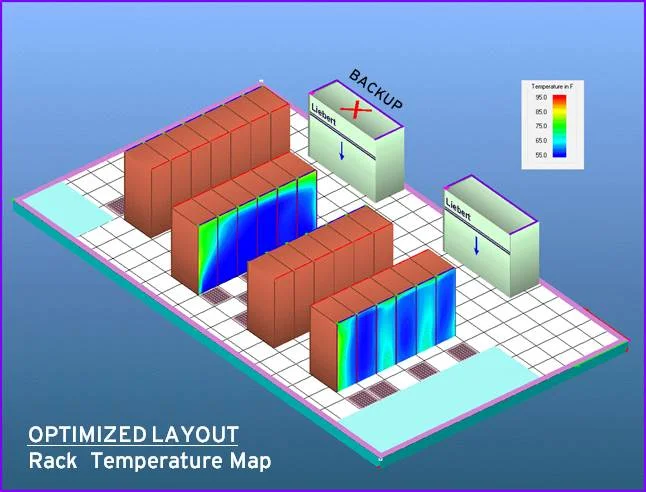
Are you faced with hot spots, cold spots, and a basic mismatch of providing more nominal cooling than necessary? Whether you use underfloor air distribution or “in the space” cooling, getting the air to the load has been a trial and error undertaking usually resulting in oversized cooling capacity and less floor space. The overlooked fundamental issue is air distribution.
We utilize CFD analysis to optimize the cooling system and layout. The data power load and the cooling system are matched and arranged to achieve maximum energy efficiency. This keeps the cost of cooling both in equipment and operation down while maximizing the data load capability. We create a model that replicates the physical data center layout including power densities and cooling equipment locations and capabilities and the analysis is run to determine the resulting temperatures and airflows in the space. Using programs specifically designed for use in analyzing air movement and heat transfer, we can create a virtual simulation of the conditions within the data center. The CFD analysis is a valuable tool for data center design that can save time and money by taking the guess work out of rack layout and cooling airflow design.

Spottlight - September 2016
Spottlight on Building Safety
Building Safety
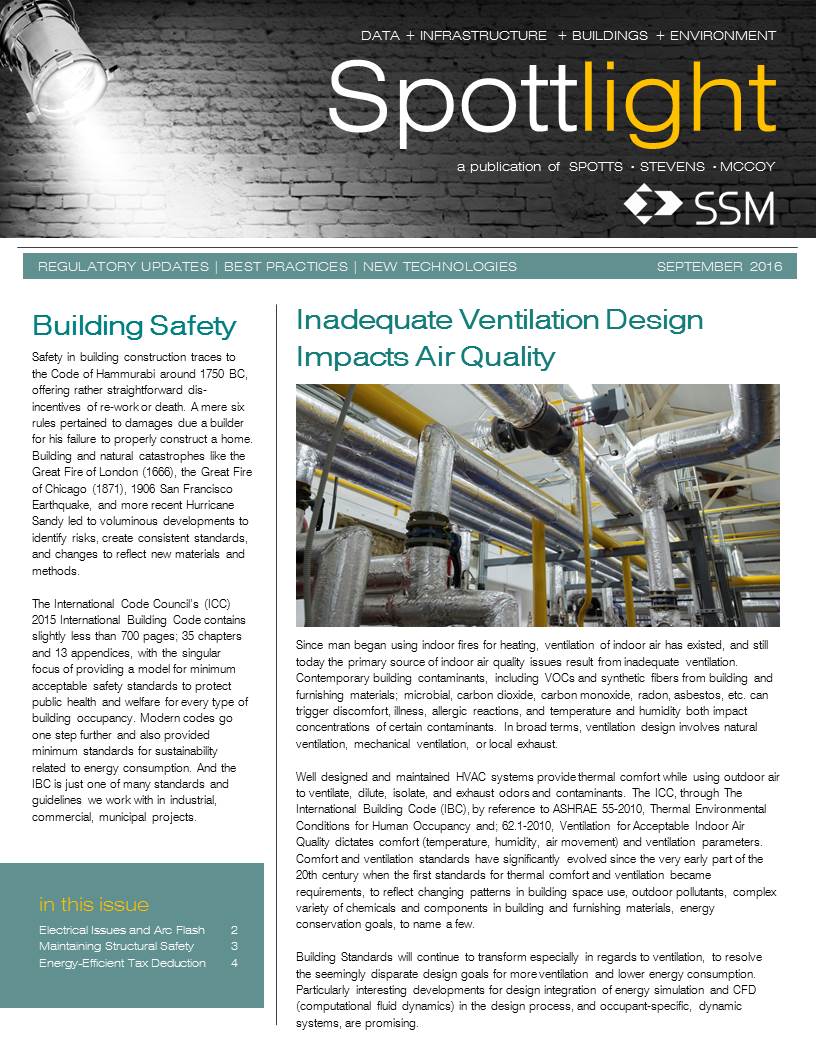
Safety in building construction traces to the Code of Hammurabi around 1750 BC, offering rather straightforward dis-incentives of re-work or death. A mere six rules pertained to damages due a builder for his failure to properly construct a home. Building and natural catastrophes like the Great Fire of London (1666), the Great Fire of Chicago (1871), 1906 San Francisco Earthquake, and more recent Hurricane Sandy led to voluminous developments to identify risks, create consistent standards, and changes to reflect new materials and methods.
The International Code Council’s (ICC) 2015 International Building Code contains slightly less than 700 pages; 35 chapters and 13 appendices, with the singular focus of providing a model for minimum acceptable safety standards to protect public health and welfare for every type of building occupancy. Modern codes go one step further and also provided minimum standards for sustainability related to energy consumption. And the IBC is just one of many standards and guidelines we work with in industrial, commercial, municipal projects.
Inadequate Ventilation Design Impacts Air Quality
Since man began using indoor fires for heating, ventilation of indoor air has existed, and still today the primary source of indoor air quality issues result from inadequate ventilation. Contemporary building contaminants, including VOCs and synthetic fibers from building and furnishing materials; microbial, carbon dioxide, carbon monoxide, radon, asbestos, etc. can trigger discomfort, illness, allergic reactions, and temperature and humidity both impact concentrations of certain contaminants. In broad terms, ventilation design involves natural ventilation, mechanical ventilation, or local exhaust.
Electrical Engineering Issues Supporting Building Safety
Opportunities for electrical faults and associated health risks to workers exist throughout industrial, municipal, and institutional facilities, with electrical distribution equipment and large equipment associated with manufacturing, process systems, research, HVAC, and central utility plants. The IBC by reference to the NEC (National Electrical Code) and NFPA (National Fire Protection Association) dictates that an electrical system be evaluated for Arc Flash hazards and that equipment be appropriately labeled according to the protection required.
Hazards associated with electricity is a serious workplace hazard; The Electric Power Research Institute (EPRI) and National Institute for Occupational Safety and Health (NIOSH) have very good videos describing research into arc flash and stories by those affected by incidents.
Maintaining Building Safety While Modifying Footprint and Function
The average building life cycle of non-residential structures extends many, many years. In fact, according to the US Energy Information Administration’s (EIA) 2012 report, Commercial Buildings Energy Consumption Survey, “commercial buildings remain in use for many decades. Although about 12% of commercial buildings (comprising 14% of commercial floor space) were built since 2003, the commercial building stock is still fairly old, with about half of all buildings constructed before 1980; the median age of buildings in 2012 was 32 years.” It’s also true that within a short period of time, buildings become functionally unsuitable, or that facilities constructed for one product or purpose evolves to serve another.
Regulatory Updates:
Tax Code: Section 179-D - Energy-Efficient Commercial Building Deduction
National BIM Guide for Owners Now Available for Public Review

Spottlight - August 2016
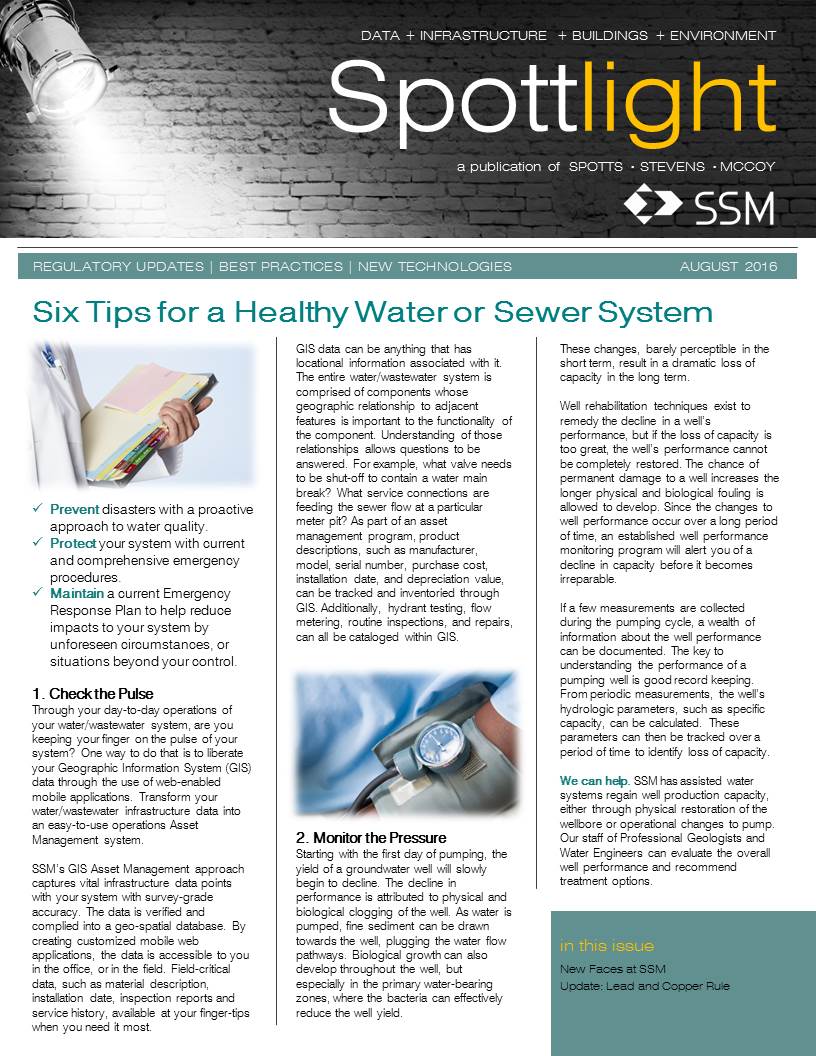
Prevent disasters with a proactive approach to water quality. Protect your system with current and comprehensive emergency procedures.Maintain a current Emergency Response Plan to help reduce impacts to your system by unforeseen circumstances, or situations beyond your control.
Six Tips for a Healthy Water or Sewer System
1. Check the Pulse - Through your day-to-day operations of your water/wastewater system, are you keeping your finger on the pulse of your system? One way to do that is to liberate your Geographic Information System (GIS) data through the use of web-enabled mobile applications. Transform your water/wastewater infrastructure data into an easy-to-use operations Asset Management system.
2. Monitor the Pressure - Starting with the first day of pumping, the yield of a groundwater well will slowly begin to decline. The decline in performance is attributed to physical and biological clogging of the well. As water is pumped, fine sediment can be drawn towards the well, plugging the water flow pathways. Biological growth can also develop throughout the well, but especially in the primary water-bearing zones, where the bacteria can effectively reduce the well yield.
3. Protect your Immune System - In the event of an emergency that could impact treatment plant operations, immediate action is often critical in preventing or minimizing the incident. Boost your immunity from disaster by developing a comprehensive emergency response plan (ERP) as required by DEP. Possible emergency situations include a distribution system line break, power outages, drought conditions, disinfection system failure, contamination of supply, pump failure, and prolonged outage.
4. Prevention is the Best Protection - The first step towards prevention is to develop a Source Water Protection Plan. To maintain its usefulness, a Source Water Protection Plan should be updated every five years.
5. Check your Footing - In certain parts of Berks County, the ground can fall out from beneath your feet. What would you do if your utility lines were threatened by a sinkhole? SSM personnel have assisted municipalities, insurance companies, and legal defense teams in settlement instances involving sinkhole and non-sinkhole related damage claims. By observing, evaluating and documenting site specific details, we have often been successful at determining the causes leading to ground failures. Determining these details and causes have often been beneficial to our clientele whereby at times limiting their liability or determining their involvement with remediating sites and damaged infrastructures.
6. Have a Vision - Accurate knowledge of your system asset and infrastructural component locations in your water/wastewater system plays a vital role in healthy operations. Key operational decisions require precise geographic information. Relying on an outdated or incomplete system map will lead to wasted time and potentially costly mistakes. A comprehensive system map will provide the means to effective management. Just as our eyes are the window to the world, your system map is your view to the system as a whole. 20/20 vision of your system requires accurate locational data. Armed with up-to-date and comprehensive infrastructure data, the system can be run with greater efficiency and operational awareness.
The Source - November 2015

Regulatory and legislative updates, best practices, and new technologies.
WHAT’S INSIDE
- Unassessed Waters Project Successful in Berks County
- Strategies for Successful Implementation
- Consider the Source Campaign
- New Faces in Sourcewater Protection
- Good Water = Good Life
The Source - July 2015
July 2015 Inside this Issue:
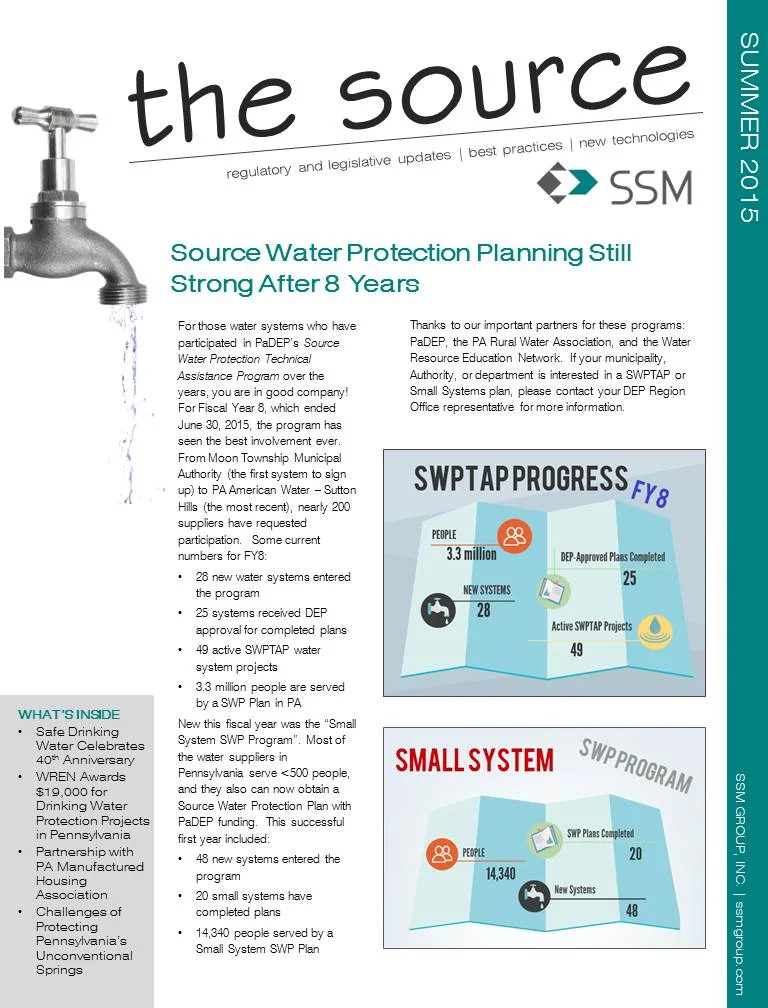
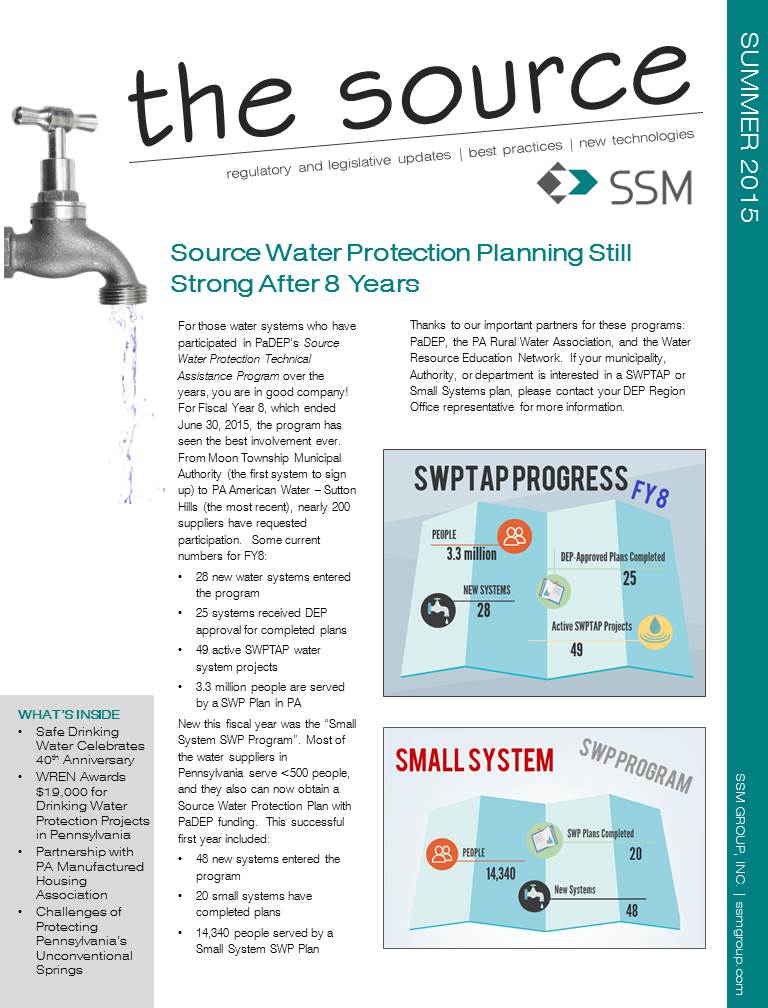
- Safe Drinking Water Celebrates 40th Anniversary
- WREN Awards $19,000 for Drinking Water Protection Projects in Pennsylvania
- Partnership with PA Manufactured Housing Association
- Challenges of Protecting Pennsylvania’s Unconventional Springs
JULY 2015 | The Source
Regulatory and legislative updates, best practices, and new technologies.
the Source - January 2015
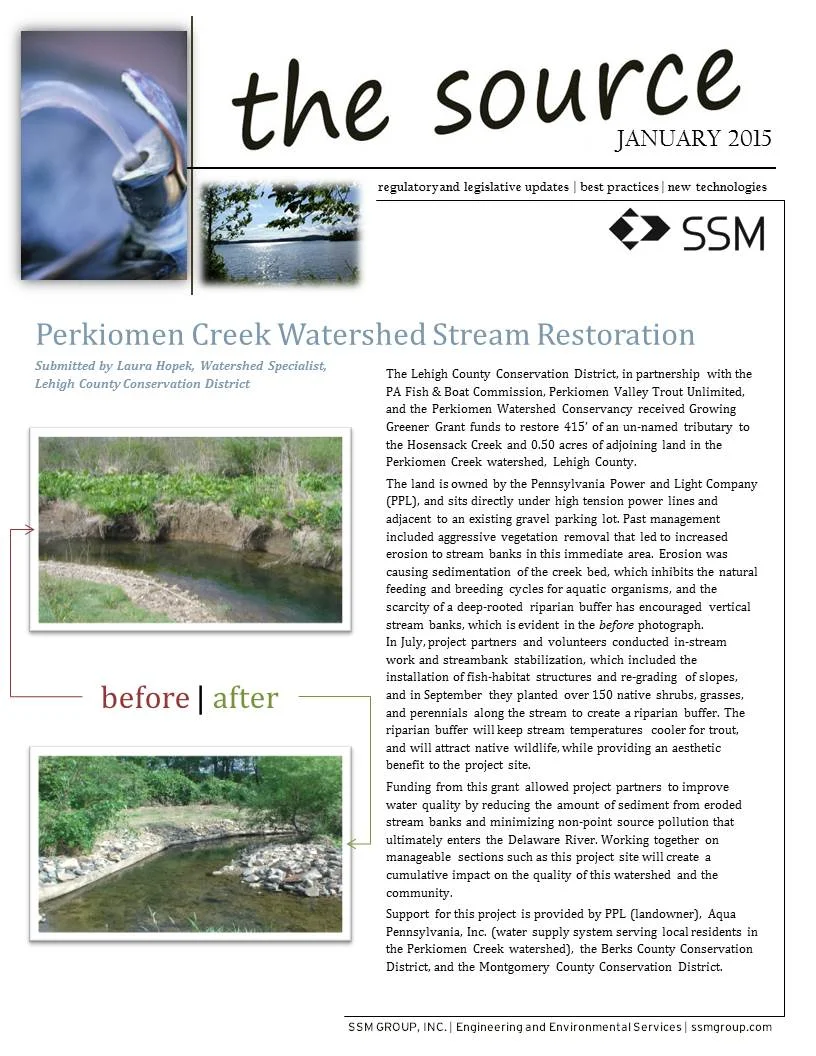
Source Water Protection News: regulatory and legislative updates, best practices, new technologies
Source Water Protection News
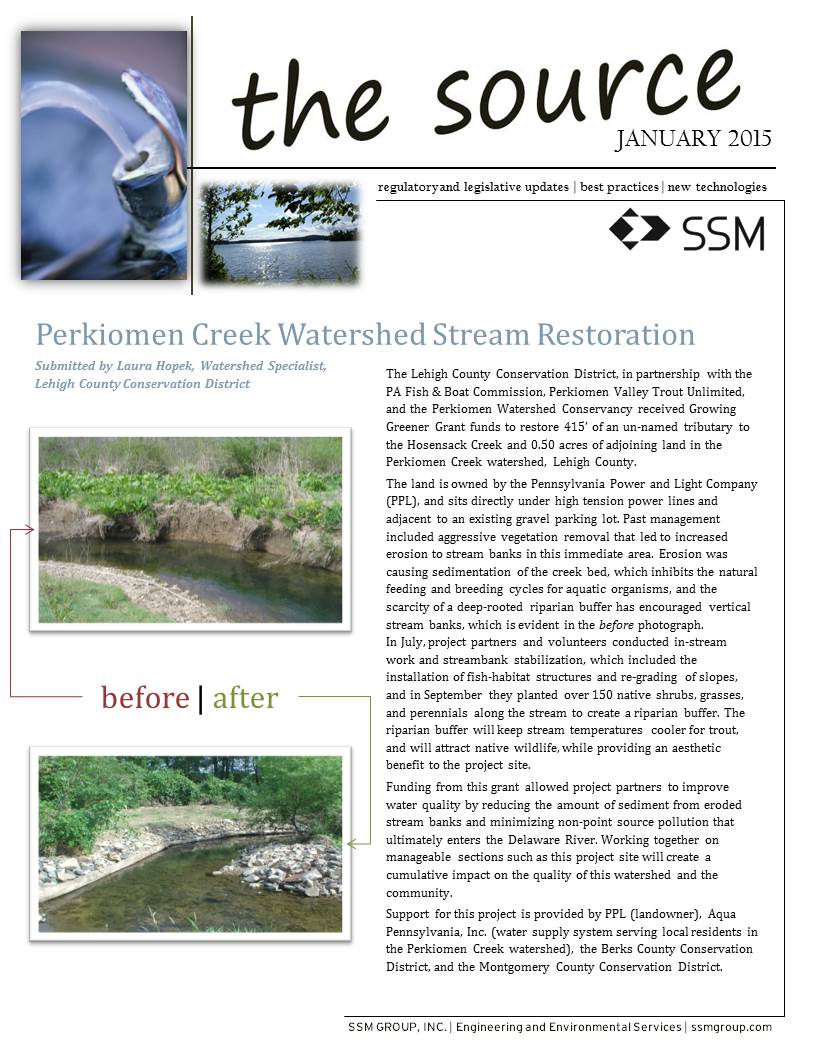
Regulatory and legislative updates, best practices, and new technologies.
the Source - September 2014
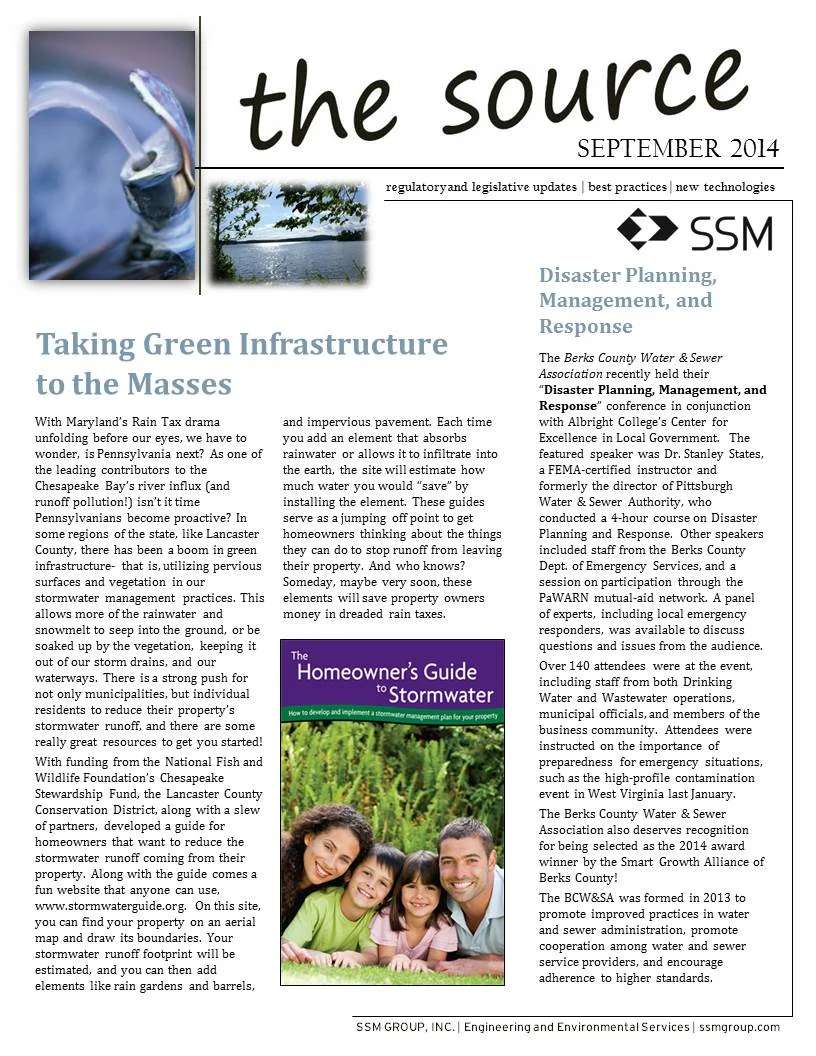
Regulatory and legislative updates, best practices, and new technologies.

Source Water Protection News
Regulatory and legislative updates, best practices, and new technologies.
Design the 480/277 Volt power distribution interconnection to an existing 2000 Amp Switchboard including 2 New 400AT/600AF Breakers for the Switchboard, Inverter Combiner Panels, PPL Disconnect Requirements Outside Near PPL Transformer, and overall coordination with PPL.