

Public Meeting: Climate Action Plan for Public Input
The Chester County Planning Commission, in partnership with the Chester County Environmental and Energy Advisory Board, is holding a virtual public meeting to present the county’s proposed Climate Action Plan.
Chester County Releases Draft Climate Action Plan for Public Input
March 4th, 6:30 pm
The Chester County Planning Commission, in partnership with the Chester County Environmental and Energy Advisory Board, is holding a virtual public meeting to present the county’s proposed Climate Action Plan. The updated Climate Action Plan will provide a current greenhouse gas emissions inventory, as well as action plans for reducing emissions and improving energy efficiency throughout the county.
This meeting is open to the public
FOR MORE INFORMATION:
Paul Spiegel, PE, LEED AP | Director, Energy and Sustainability Services
paul.spiegel@ssmgroup.com
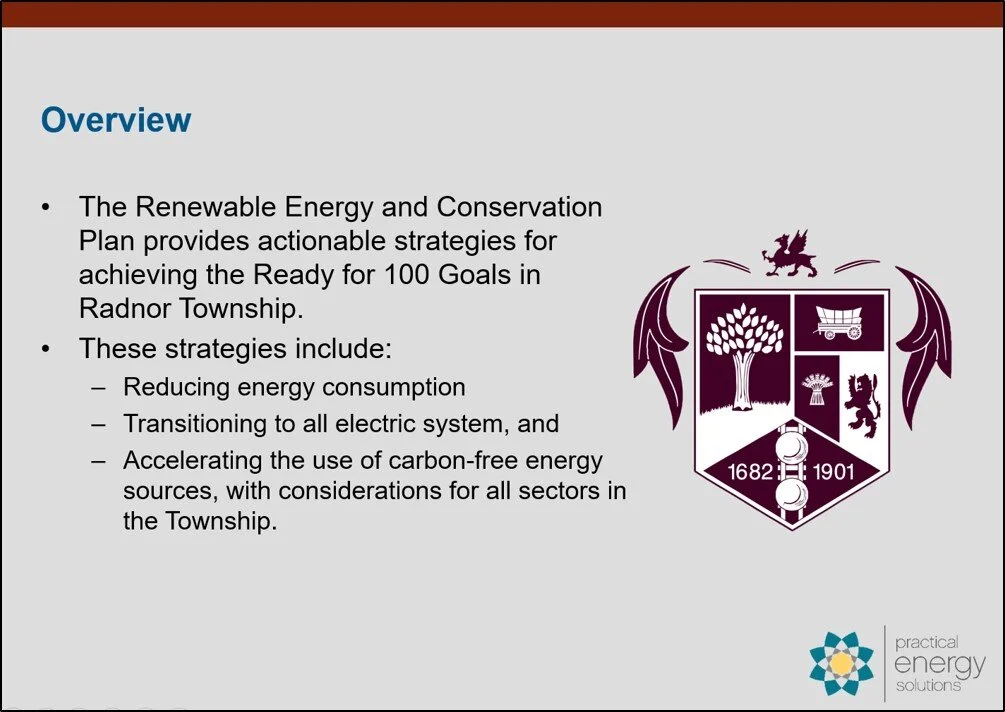
Webinar: How Radnor Township is reaching its goal for 100% Clean Energy
Learn how one Pennsylvania community — Radnor Township — can reach its goals for transitioning to 100% clean energy?How Radnor Township is reaching its goal for 100% Clean Energy March 2nd, 6-7 pm
Want to learn how one Pennsylvania community — Radnor Township — can reach its goals for transitioning to 100% clean energy?
Join the webinar presentation by Radnor’s energy consultants, Practical Energy Solutions (PES), on the energy transition plan they have prepared for the community. PES will lay out their combination of recommended strategies for meeting the township’s commitment to transition to 100% clean renewable electricity by 2035 and 100% renewable energy for heating and transportation by 2050. The plan is a mix of multi-faceted strategies for energy conservation, efficiency, and renewable alternatives.
The webinar is open to the public.
FOR MORE INFORMATION
Paul Spiegel, PE, LEED AP | Director Energy and Environmental Services
paul.spiegel@ssmgroup.com

DCED Accepting Applications for Act 13 Grants
The state Department of Community and Economic Development (DCED) is now accepting applications for Act 13 programs. Eligibility includes municipalities, authorized organizations, higher education institutions, watershed organizations, and for-profit businesses.
Act 13 of 2012 established the Marcellus Legacy Fund and allocates funds to the Commonwealth Financing Authority for statewide initiatives that include abandoned mine drainage abatement; abandoned well plugging; sewage treatment; greenways, trails and recreation; baseline water quality data; watershed restoration; and flood control.
The state Department of Community and Economic Development (DCED) is now accepting applications for Act 13 programs.
Application deadline: May 31, 2021
Eligibility:
Municipalities
Councils of Governments
Authorized Organizations
Institutions of Higher Education
Watershed Organization
For-Profit Businesses
Current Act 13 Grant Opportunities:
Abandoned Mine Drainage (AMD) Abatement & Treatment Program
Eligibility: Abandoned mine drainage, abatement, and treatment with the Abandoned Mine Drainage Abatement and Treatment Program (AMDATP).
Opportunity: Projects which involve the reclamation of Abandoned Mine Well(s), construction of a new AMD site, remediation and repair of existing AMD project sites, operation and maintenance maintaining current AMD remediation sites, establishment of trust fund to ensure ongoing maintenance is achieved, and monitoring of water quality to track or continue to trace non-point source load reductions resulting from AMD remediation projects.
Funding: Grants shall be awarded to eligible applicants for projects that do not exceed $1,000,000. The grant requires a least a 15% match of the total project cost.
Baseline Water Quality Data Program
Eligibility: Initiatives to establish baseline water quality data on private water supplies using the Baseline Water Quality Data Program (BWQDP).
Opportunity: Projects which involve practices for water sample collection and analysis to document existing groundwater quality conditions on private water supplies.
Funding: Grants shall be awarded to eligible applicants for projects that do not exceed $250,000. The grant requires at least 15% match of the total project cost.
Flood Mitigation Program
Eligibility: Projects authorized by a flood protection authority, the Department of Environmental Protection (PaDEP), the U.S. Army Corps of Engineers (USACOE) or the U.S. Department of Agriculture’s Natural Resources Conservation Service (NRCS) or identified by a local government, for flood mitigation.
Opportunity: This could be a good funding source to address localized stream flooding due to siltation and debris deposits over time, for which few funding sources exist.
Funding: Grants shall not exceed $500,000 for any project. A 15% match of the total project cost is required.
Greenways, Trails, and Recreation Program
Eligibility: Programs for planning, acquisition, development, rehabilitation and repair of greenways, recreational trails, open space, parks and beautification projects using the Greenways, Trails and Recreation Program (GTRP). Projects which involve development, rehabilitation and improvements to public parks, recreation areas, greenways, trails and river conservation.
Opportunity: This could be a good way to leverage recreation funds that already exist within municipal budgets.
Funding: Grants shall not exceed $250,000 for any project. A 15% match of the total project cost is required.
Orphan or Abandoned Well Plugging Program
Eligibility: Funding orphan or abandoned well plugging projects using the Orphan or Abandoned Well Plugging Program (OAWP).
Uses: Projects which involve the cleaning out and plugging of abandoned and orphan oil and gas wells; stray gas mitigation systems; and well venting projects.
Funding: There is a maximum of $1,000,000 for any project.
Sewage Facilities Program
Eligibility: Initiatives for complying with the Act of January 24, 1966 (1965 P. L. 1535, No. 537), known as the Pennsylvania Sewage Facilities Act.
Opportunity: Costs associated with the planning work required under Act 537.
Funding: Grants shall be awarded to eligible applicants up to $100,000. A 50% match of the total project cost is required.
Watershed Restoration and Protection Program
Eligibility: Projects which involve the construction, improvement, expansion, repair, maintenance or rehabilitation of new or existing watershed protection Best Management Practices (BMPs).
Opportunity: The overall goal of this program is to restore and/or maintain reaches of streams impaired by non-point source pollution. As such this grant could be used to implement NPDES MS4 Pollution Reduction Plans.
Funding: There is a maximum of $300,000 for any project. A 15% match of the total project cost is required.
Here to Help: Did you know that our teams can help you to acquire grant funding? Contact Andrew at andrew.shambach@ssmgroup.com

Project Highlight: Crane Support Analysis
SSM has conducted thorough inspections of Pier 5, both outside, underneath and dive inspection oversight.
An Interview with Jeff Thoms, PE
Project: Crane Support Analysis for Pier 5 at the Philadelphia Naval Business Center
Client: Rhoads Marine Industries

Describe the project:
A Chiquita Cargo Ship required its on-board crane to be serviced. To do so, several cranes were required to be positioned on the pier to achieve the pick. One of these cranes, a 600T mobile crane, is the largest of its kind on the east coast. SSM was tasked with mapping the exact locations of the crane outriggers to ensure there were no impacts to the pier.

Next to Pier 5 is Drydock #2 for which SSM performs biennial inspections for the City of Philadelphia. In this photo is the caisson that keeps the Delaware River out of the drydock. This location happens to be the approach flight path for Philadelphia Int’l Airport.
What was the service SSM provided?
SSM has conducted thorough inspections of Pier 5, both outside, underneath and dive inspection oversight. We know this pier and what it’s capable of doing. SSM was provided with the crane loading information for the pick and marked the locations for cribbing on the peer.
What makes this project one of your favorites?
What inspired me about this project is depicted in the top photo. This is the kind of activity that this pier is meant for and to see it in action was awe-inspiring.
SSM continues design and engineering work for the pier through inspections and design of repairs.

Jeff Thoms, PE is a Senior Structural Engineer in SSM’s Facilities Division. He has been a part of the SSM team for 7 years. He’s a girl dad, a dog dad, and a winter-time fun connoisseur.
#ProblemSolved: Our Facilities Team is here to help. Send an email to Patrick McCoy, PE, LEED AP, CSDP at patrick.mccoy@ssmgroup.com or give a call to 610-898-3008

Are you Ready?
This year, resolve to create lasting change in the world by adopting a resolution focused on reducing energy usage. From your home or workplace, to your community- we challenge you to get ready to deal with your energy consumption. For the sake of the year, but also for the sake of all the years to come.

Make it a better year by making it a better world. For many, we begin a new year with resolutions to create change, to reach new goals, and to establish new ways of life.
This year, resolve to create lasting change in the world by adopting a resolution focused on reducing energy usage. From your home or workplace, to your community- we challenge you to get ready to deal with your energy consumption. For the sake of the year, but also for the sake of all the years to come.
Quick & Easy Tips for the Home
Use energy-efficient LED light bulbs in your fixtures to use 75% less energy than with regular incandescent bulbs.
Clean or replace air filters as recommended, typically every 3-6 months. Already the biggest energy users in the home, your air conditioner and heater have to work harder with dirty air filters.
Run full loads in both the dishwasher and the washing machine to realize the most energy savings from the cycle.
Set your thermostats back when you leave your home so your heating equipment is not unnecessarily used. This will keep your energy costs low, and reduce the operating time for your equipment.
Turn off and unplug your devices when not used. Devices like TVs, computers, and printers all use electricity even when they turned off and are plugged into the wall.
Energy Conservation in the Community
In communities across the country, The Sierra Club is building local grassroots power to achieve 100% clean energy for all. Ready For 100 is a national movement with a vision of resilient and healthy communities powered by 100% clean, renewable energy. The Ready for 100 program works with cities and towns to achieve an equitable and just transition to 100% clean, renewable energy for all. Learn More at www.sierraclub.org/take-action.
Get Ready
Energy benchmarking is a great way to establish your starting point. Benchmarking established a metric for measuring performance. It compares the performance of your building to a standard or comparable building. Benchmarking identifies your opportunities for improvement and provides a baseline for comparison in the future.
Energy audits are a more detailed evaluation of your building that identify specific projects to improve the building’s energy performance. Energy audits study the operations, inventories the primary energy-using equipment, evaluates existing equipment, and assesses potential savings and financial returns.
Implementing Energy Savings in the Workplace through Building Tune-Up
The City of Philadelphia recently implemented regulations pertaining to the Building Energy Performance Policy. The goal of the policy is to increase tenant comfort while decreasing energy costs and carbon emissions. The City anticipates implementation of the policy will reduce annual carbon pollution by nearly 200,000 metric tons.
The policy focuses on improving building performance by identifying non-capital improvements to the operations and maintenance of existing systems. This approach can be used by any building owner to decrease energy costs while maintaining comfort. The tool is a Building Tune-Up. An assessment of existing base building systems and corrective actions to bring the systems up to a state of good repair.
Elements of the Tune-Up
Billing analysis
Assessment of elements: HVAC operations and controls, lighting system assessment, building system maintenance and repairs, domestic hot water and water usage, building envelope
Determination and implementation of corrective actions
Post-implementation assessment
Final tune-up report
Team Members named Tune-Up Specialists
The City’s newly implemented Building Energy Performance Policy (BEEP) requires a “tune-up specialist” lead all tune-up assessments and sign-off on all tune-up reports submitted to the City’s Office of Sustainability (OOS). Tune-up Specialists must meet certain requirements as set forth by the OOS.
Our team of approved tune-up specialists:
Paul Spiegel, PE, LEED AP, Director, Energy and Sustainability Services
Benjamin Pressman, PE BESM, Project Mechanical Engineer
Lindsey Walaski, LEED AP, CEM, Project Mechanical Engineer

Spottlight on Getting Ready
Make it a better year by making it a better world. For many, we begin a new year with resolutions to create change, to reach new goals, and to establish new ways of life.
Are you Ready?
Make it a better year by making it a better world. For many, we begin a new year with resolutions to create change, to reach new goals, and to establish new ways of life.
This year, resolve to create lasting change in the world by adopting a resolution focused on reducing energy usage. From your home or workplace, to your community- we challenge you to get ready to deal with your energy consumption. For the sake of the year, but also for the sake of all the years to come.

C-PACE Financing Tool: What makes a good energy audit?
Paul Spiegel, Practical Energy Solutions,- A Division of Spotts, Stevens and McCoy talked about what makes a good energy survey

FOR MORE INFORMATION:
Paul Spiegel, PE, LEED AP
Director Energy and Sustainability Services
Practical Energy Solutions
a division of Spotts, Stevens and McCoy
paul.spiegel@ssmgroup.com
The Philadelphia Energy Authority provided an update on programs relevant to GPAEE members with a focus on C-PACE, a financing tool now available in Pennsylvania, for clean energy projects. Maryrose Myrtetus, PEA Program Manager will discuss how C-PACE works and why it matters to energy engineers and consultants. She will be joined by Paul Spiegel, Practical Energy Solutions,- A Division of Spotts, Stevens and McCoy talked about what makes a good energy survey which is required for C-PACE financing and Liz McCormick, Director of Business Development, Energy Division, Pennoni, will discuss how to integrate C-PACE into your business development.
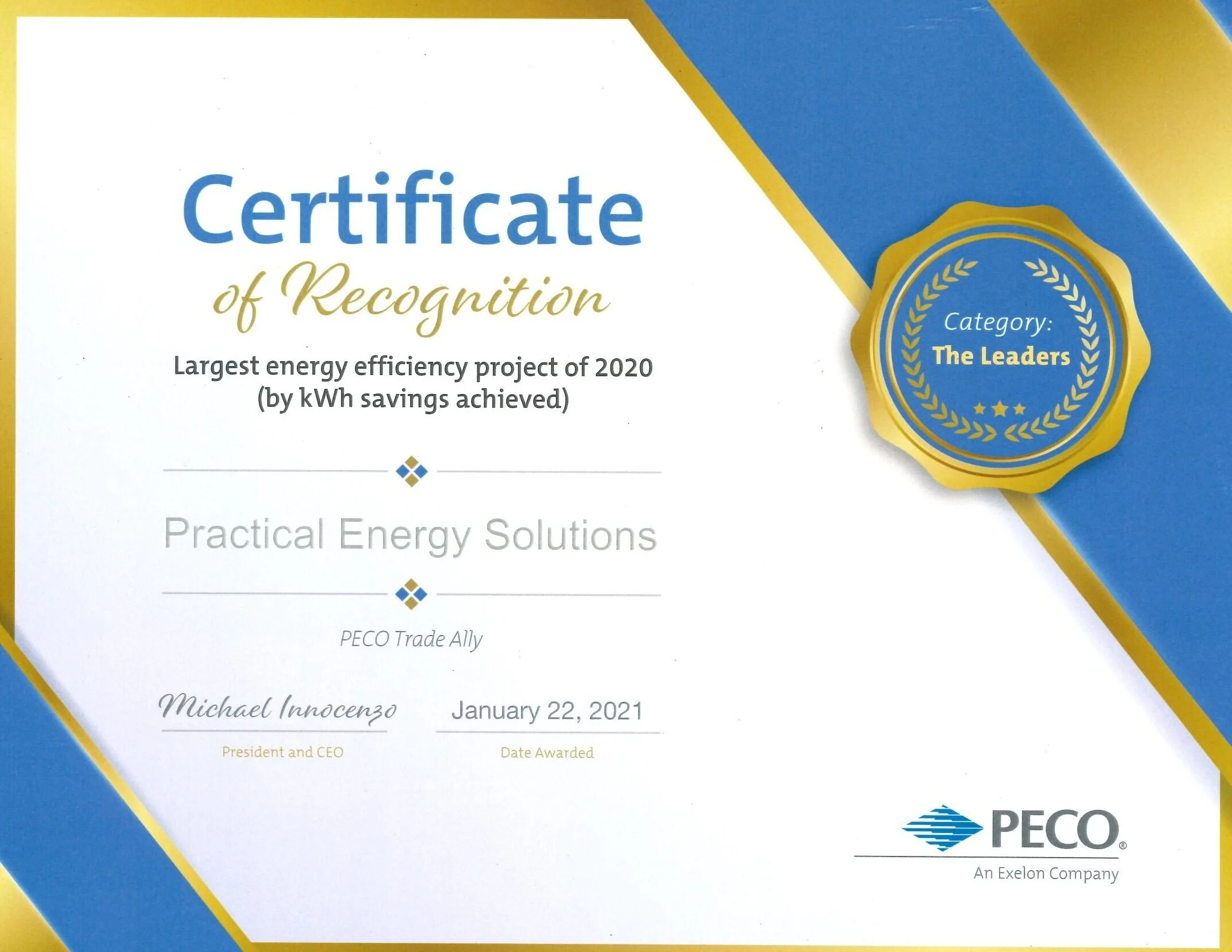
PECO recognizes Firm for Largest Energy Efficiency Project by kWh savings
Practical Energy Solutions, a Division of Spotts, Stevens and McCoy was recognized this week at the PECO Trade Ally meeting for their work on the largest energy efficiency project of 2020 by kWh savings achieved.

Practical Energy Solutions, a Division of Spotts, Stevens and McCoy was recognized this week at the PECO Trade Ally meeting for their work on the largest energy efficiency project of 2020 by kWh savings achieved.
The project was conducted at the Philadelphia 201 Hotel, with the rebate paid by PECO. The rebate was earned for modifications made to the exhaust fans/hood in the kitchen (variable speed drives) and additions of CO sensors for the exhaust fans in the parking garage that resulted in the fans running only when carbon monoxide was sensed, rather than 24/7.
The Trade Ally project is part of the PECO Smart Ideas program that helps businesses reduce energy use by providing incentives and rebates to customers to improve energy efficiency. The PES team became a Trade Ally to help clients better understand the energy incentives that are available that can help offset the costs of energy-efficient building system upgrades. These solutions can include HVAC and controls upgrades, high efficiency lighting projects or customized energy strategy implementations. In an every-changing marketplace, PES acts as an energy advocate for clients, developing the appropriate energy solution, and navigating the process to obtain rebates and incentives for those energy saving solutions.
About the Firm
Practical Energy Solutions, a division of Spotts, Stevens and McCoy, is an energy and sustainability engineering firm with a focus on municipal, institutional, educational, and commercial energy efficiency and renewable energy planning and project management. Our goal - to help building owners reduce energy consumption without capital upgrades. We design with energy efficiency and sustainability in mind; but never at the expense of occupant comfort, ease of maintenance, and optimal use of the facility. Our Philadelphia area-based, independent energy consulting group combines creativity and deep technical expertise to transform your buildings into comfortable, efficient, healthy spaces to live and work.

Team Members named Tune-Up Specialists for City of Philadelphia
Practical Energy Solutions, a division of Spotts, Stevens and McCoy, is pleased to announce that three members of the team have been approved as Tune-Up Specialists by the City of Philadelphia’s Office of Sustainability.
Practical Energy Solutions, a division of Spotts, Stevens and McCoy, is pleased to announce that three members of the team have been approved as Tune-Up Specialists by the City of Philadelphia’s Office of Sustainability.
The City’s newly implemented Building Energy Performance Policy (BEEP) requires a “tune‐up specialist” lead all tune‐up assessments and sign‐off on all tune‐up reports submitted to the City’s Office of Sustainability (OOS). Tune-up Specialists must meet certain requirements as set forth by the OOS. Individuals must be a Professional Engineer (PE) license or Certified Energy Manager (CEM) certification and have at least seven (7) years of combined educational and professional experience with commercial building operations and/or building energy management.
Tune-Up Specialists
Paul Spiegel, PE, LEED AP, Director, Energy and Sustainability Services - Paul has over 29 years of experience in building design, construction, and evaluation in the Philadelphia metropolitan region. His experience includes development and implementation of energy strategic master plans and comprehensive energy assessments for more than 150 educational, municipal, and commercial facilities. he is an adjunct professor of Engineering at Temple University.
Benjamin Pressman, PE BESM, Project Mechanical Engineer - Ben is a Certified Building Energy Simulation Analyst and has a deep understanding of building modeling software and methodology, energy auditing techniques, and HVAC systems operation. Ben holds an MSE in mechanical engineering from Johns Hopkins University.
Lindsey Walaski, LEED AP, CEM, Project Mechanical Engineer - With a Bachelor's Degree in Mechanical Engineering and a Master's Degree in Sustainable Engineering, and a year working in the Sustainability Coordinator's Office at Villanova, Lindsey brings a broad range of experience to the team. She provides services from energy audits and modeling to curricular presentations in the classroom.
About the Firm
Practical Energy Solutions, a division of Spotts, Stevens and McCoy, is an energy and sustainability engineering firm with a focus on municipal, institutional, educational, and commercial energy efficiency and renewable energy planning and project management. Our goal - to help building owners reduce energy consumption without capital upgrades. We design with energy efficiency and sustainability in mind; but never at the expense of occupant comfort, ease of maintenance, and optimal use of the facility. Our Philadelphia area-based, independent energy consulting group combines creativity and deep technical expertise to transform your buildings into comfortable, efficient, healthy spaces to live and work.

Lindsey Walaski, LEED AP Earns Certified Energy Manager Designation
Spotts, Stevens and McCoy (SSM) a family-owned, regional engineering, environmental and surveying firm announces Lindsey Walaski, LEED AP has earned the Certified Energy Manager (CEM) designation through the Association of Energy Engineers (AEE).

LINDSEY WALASKI, LEED AP, CEM
Spotts, Stevens and McCoy (SSM) a family-owned, regional engineering, environmental and surveying firm announces Lindsey Walaski, LEED AP has earned the Certified Energy Manager (CEM) designation through the Association of Energy Engineers (AEE). With a Bachelor's Degree in Mechanical Engineering and a Master's Degree in Sustainable Engineering, and a year working in the Sustainability Coordinator's Office at Villanova, Lindsey brings a broad range of experience to the team. She provides services from energy audits and modeling to curricular presentations in the classroom. Lindsey is a member of the Energy and Sustainability Services Team at SSM.
About the Certification: The CEM program helps educate and qualify individuals involved in optimizing the use of energy in buildings and systems. By obtaining the CEM certification, candidates gain industry and peer recognition by demonstrating their understanding of energy-efficiency principles, practices, and technologies. The program also helps the energy industry by raising the professional standards, both technical and ethical, of those engaged in energy efficiency and energy management. The CEM accreditation is one of the most globally respected in the field of energy management. To qualify for CEM designation — the internationally accepted symbol of professional competence within the energy management field — candidates must meet strict educational and professional criteria, attend an AEE-sponsored CEM training seminar, and pass a rigorous 17-part exam administered by AEE.
About the Firm: Spotts, Stevens and McCoy, Inc. is a family-owned regional engineering, environmental and surveying firm headquartered in Wyomissing PA with satellite offices in Lancaster, West Chester and Lehigh Valley. SSM provides services to various types of local, regional and national businesses that include commercial, industrial, manufacturing and telecommunications as well as healthcare and higher education institutions.

Spottlight on Education
This month, schools across the country participated in American Education Week.
The week promotes collaboration between parents and educators. This tradition began in 1921 when members of the American Legion, the U.S. Office of Education, and the National Education Association joined efforts to improve literacy and physical education across the country. This month we celebrate the educators and administrators that are inspiring the next generation of engineers, artists, innovators, and creators.
From helping students to understand how their school is heated and cooled to developing educational materials for outreach activities, to reaching out to the community to facilitate success we are engaged in providing educational opportunities.
We’re here to help. We understand what institutions of learning need, and we deliver cost-effective, sustainable services. The specifics vary, but one course is always part of the program: ensuring a safe and healthy environment for students and staff to learn, live, and work.


This month, schools across the country participated in American Education Week.
The week promotes collaboration between parents and educators. This tradition began in 1921 when members of the American Legion, the U.S. Office of Education, and the National Education Association joined efforts to improve literacy and physical education across the country. This month we celebrate the educators and administrators that are inspiring the next generation of engineers, artists, innovators, and creators.
From helping students to understand how their school is heated and cooled to developing educational materials for outreach activities, to reaching out to the community to facilitate success we are engaged in providing educational opportunities.
We’re here to help. We understand what institutions of learning need, and we deliver cost-effective, sustainable services. The specifics vary, but one course is always part of the program: ensuring a safe and healthy environment for students and staff to learn, live, and work.
IN THIS ISSUE:


City of Philadelphia Building Energy Performance Regulation
The City of Philadelphia recently implemented regulations pertaining to the Building Energy Performance Policy. The goal of the Policy is to increase tenant comfort while decreasing energy costs and carbon emissions. The City anticipates implementation of the Policy will reduce carbon pollution by nearly 200,000 metric tons. The policy does not require specific levels of efficiency or energy usage, but rather focuses on improving building performance by identifying non-capital improvements to the operations and maintenance of existing systems. Industrial processes or specialized equipment are excluded.
The City of Philadelphia recently implemented regulations pertaining to the Building Energy Performance Policy. The goal of the Policy is to increase tenant comfort while decreasing energy costs and carbon emissions. The City anticipates implementation of the Policy will reduce carbon pollution by nearly 200,000 metric tons. The policy does not require specific levels of efficiency or energy usage, but rather focuses on improving building performance by identifying non-capital improvements to the operations and maintenance of existing systems. Industrial processes or specialized equipment are excluded.
Who is impacted?
Owners of any non-residential building with indoor floor space of at least 50,000 square feet of floor space.
Mixed-use buildings in any mixed-use zoning classification with non-residential use greater than 50,000 square feet.
Industrial and manufacturing facilities.
Temporary lodgings, including hotels, motels, and short-term rental.
Large portfolios include 20 or more covered buildings or cumulative floor area in covered buildings of 5,000,000 SF or more.
Who is not included?
Residence halls, dormitories and other non-transient large lodging places.
Parking lots and parking garages, or the portions of otherwise covered buildings used for parking.
What is the Timeline?
Building Size Square Footage - Compliance Date
>200,000 SF - September 30, 2021 (COVID-19 extension application available)
100,000 - 200,000 SF - September 30, 2022
70,000 - 100,000 SF - September 30, 2023
50,000 - 70,000 SF - September 30, 2024
Large Portfolios - January 24, 2021
20 or more covered buildings or cumulative floor area in covered buildings of 5,000,000 SF or more qualify as large portfolios and have options to submit a compliance plan that details when buildings will comply across the cycle.
How do I comply?
Buildings must comply every 5 years from their compliance date.
Conduct a tune-up
Apply for an exemption
Demonstrate your building meets a high-performance option
Received initial certificate of occupancy within 3 years of the scheduled tune-up.
Building is scheduled to be demolished within one year of the Scheduled tune-up.
What is a building tune-up?
The Building Tune-Up is an assessment of existing base building systems and corrective actions to bring the systems up to a state of good repair.
The assessment includes all systems of the building that use energy or impact energy consumption.
HVAC Operations and Controls
Lighting System Assessment
Building System Maintenance and Repairs
Domestic Hot Water and Water Usage
Building Envelope
What will the tune-up include?
Billing analysis.
Assessment of Elements: HVAC Operations and Controls, Lighting System Assessment, Building System Maintenance and Repairs, Domestic Hot Water and Water Usage, and Building Envelope
Determination and Implementation of Corrective Actions
Post implementation assessment
Final Tune-up Report
Who can perform the inspection?
A qualified tune-up specialist is a licensed Professional Engineer or Certified Energy Manager with at least 7 years of experience. This specialist must be a third-party to the building (unless a large portfolio).
In-house or contracted service providers may complete the corrective actions, however, the final tune-up report must be verified and signed by the qualified tune-up specialist.
Large Portfolios have the option to use in-house staff as their tune-up specialists, but are required to hire a third-party
Resources:
Final Legislation
City of Philadelphia Resource Page
Where Here to Help:
Practical Energy Solutions
a Division of Spotts, Stevens and McCoy
Paul Spiegel, PE, LEED AP
paul.spiegel@ssmgroup.com

Engaging Students in Conservation Program Proves Successful
Our Energy and Sustainability Services group introduced its first Energy + Resource Conservation Program over a decade ago to the West Chester Area School District. The program focused on conserving energy through behavior changes and it consisted of 3 primary elements.
Our Energy and Sustainability Services group introduced its first Energy + Resource Conservation Program over a decade ago to the West Chester Area School District. The program focused on conserving energy through behavior changes and it consisted of 3 primary elements:
Motivational presentations to all faculty, outlining the reasons to save energy and concrete ideas for saving energy in the school.
Monitoring & Validating (M+V) Tracking, including posters delivered to all schools each month, with savings tracked by kWh, cost and CO2 emissions
Teacher/student club support for any teacher and/or student group expressing interest in working on the conservation program.
The result– in West Chester’s 16 schools, we achieved a 13% district-wide reduction in electricity consumption and greenhouse gas emission and a 7.3% reduction in utility costs during the first 6 months of the program. At Henderson High School where students supplemented the program with their own “Power Down Friday” campaign, we achieved a 21% reduction in electricity us eand Greenhouse Gas emissions and a 9/.4% reduction in utility costs.
The lesson - student engagement contributed greatly to program success.
The overall success of the program laid the foundation to secure a $150,000 EPA Climate Showcase Communities grant, which enabled the creation of the West Chester Student Conservation Corps with the District’s facilities Department. Our team continued to work for 4 years, thanks to a second, follow-on Environmental Education grant from the PA Department of Education written and secured by our firm. Overall, the program reduced electricity consumption 17%, eliminated 21 million pounds of CO2 emissions, and saved $1.3 million in electricity costs.
The Educational Program
Structuring an Educational Program specifically to your school community is critical to the program’s success.
Key Elements for Success
Research-based motivational techniques. Human behavior can be challenging to influence, since behaviors derive from ingrained habits, subcortical processes, and basic biological make-up-all subconscious activities. Fortunately, there is a vast library of scientific research exposing how the brain works on this subconscious level, and many researches have applie dthis understanding to behavior change techniques. To masximize the effectives of the educational program, we integrate specific, scientifically grounded motivational techniques.
M+V Tracking. A core component of a successful behavior change program is continual feedback to building occupants so that they can realize the results of their efforts. Developing a normalization methodology to accurately account for changes in weather and building use is especially important to educational-based programs.
Identifying impactful opportunities upfront. Over the past decade many schools have undergone various forms of energy efficiency improvements. As a result, opportunities for student and teacher behaviors to impact energy consumption may be less apparent. In schools that have undergone upgrades, its important to focus efforts on meaningful behavioral changes that remaining like additional plug loads or operational refinements. For those schools that have not undergone upgrades, the opportunities are readily apparent and can begin with simple efforts like turning out lights and shutting down computers.
Inter-Departmental Participation. We have found that participation from various departments helps create a cultural shift and helps the school community affect real and lasting change.
Structured curricular component. An increasing number of districts recognize that energy and sustainability is a key challenge for our future citizens. As a result, we have added a more structured curricular component to our program that aligns with the Pennsylvania Academic Standards—namely, Environment and Ecology and S.T.E.M. The alignment with these standards not only supports many districts’ desire to better educate students about sustainability, it also aligns with the programming teachers are already utilizing in their classrooms.
Add a resource component. Many school districts want to expand their sustainability initiatives beyond energy. Therefore expanding focus to such areas as recycling or paper conservation increases opportunities for programming and savings.
Incentives. It’s important to remember that an incentive is all it takes to increase participation. When appropriate, we facilitate incentives for top-performing schools. Sometimes it’s the ice cream party at the end of the school year that fosters energy savings.

Kent Morey, PE, CBLP Achieves Chesapeake Bay Landscape Professional Status
Spotts, Stevens and McCoy is pleased to announce that Kent Morey, PE has earned the Chesapeake Bay Landscape Professional (CBLP) designation. The achievement of the CBLP Level 1 designation demonstrates an advanced level of professionalism and knowledge of sustainable landscaping practices for a healthier Chesapeake Bay.

KENT MOREY, PE
Spotts, Stevens and McCoy is pleased to announce that Kent Morey, PE has earned the Chesapeake Bay Landscape Professional (CBLP) designation. The achievement of the CBLP Level 1 designation demonstrates an advanced level of professionalism and knowledge of sustainable landscaping practices for a healthier Chesapeake Bay.
Certification is voluntary and candidates must pass a comprehensive exam that assesses an individual’s command of sustainable practices in the design, installation, and maintenance of landscapes. CBLP-certified professionals have in-depth knowledge of sustainable landscape best practices and a focus on maintenance of stormwater best management practices. Advanced, Level 2 credentials are also available for highly experienced design (CBLP-D) and installation (CBLP-I) professionals.
Morey is a Senior Engineer in the Municipal Engineering and Planning department at Spotts, Stevens and McCoy. With more than 30 years of experience in the industry, Kent regularly performs engineering studies and designs for the construction, improvement, or installation of stormwater management facilities. He prepares contract documents and provides bidding assistance; performs site evaluation and detailed engineering design of storm drainage, erosion and sedimentation control, in addition to preparing PaDEP permit applications for public and private clients. In addition, Kent serves as a municipal client representative, stormwater management engineer, and provides assistance to MS4 communities. Morey is a 1985 graduate of The Pennsylvania State University with a BS in Civil Engineering. He is a registered Professional Engineer in Pennsylvania.
Spotts, Stevens and McCoy, Inc. is a family-owned regional engineering, environmental and surveying firm headquartered in Wyomissing PA with satellite offices in Lancaster, West Chester and Lehigh Valley. SSM provides services to various types of local, regional and national businesses that include commercial, industrial, manufacturing and telecommunications as well as healthcare and higher education institutions.

SSM Welcomes Senior Engineer, Craig Momose, PE

Spotts, Stevens and McCoy, a family-owned and managed, regional engineering firm based in Reading PA welcomes Craig Momose, PE to the team as a Senior Engineer in the Municipal Engineering and Planning Department.
Mr. Momose has thirty-six years of professional consulting engineering experience serving both the private and public sector. He is responsible for designs of all types of private and public land development projects and review of subdivision and land development plans for local municipalities. His experience includes stormwater management, site grading and earthwork, erosion and sediment control, floodplain and floodway modeling, FEMA Letter of Map Amendment and Letter of Map Revision applications, DEP Joint Permits, General Permits and NPDES Permit applications. Mr. Momose also served numerous municipalities throughout his career. Tasks include design of storm drainage and road improvement projects, waterway permitting, preparation of annual paving specifications, contract management and construction inspection. Services for planning commissions include review of subdivision and land development project stormwater management plans, preparation of improvements agreement cost estimates and review of escrow release applications. Craig is a 1981 graduate of The Pennsylvania State University with a BS in Mining Engineering.
City of Philadelphia Releases Building Energy Performance Regulations
The City of Philadelphia recently implemented regulations pertaining to the Building Energy Performance Policy signed into law by Mayor Kenney in December 2019. The Building Tune-Up policy requires all non-residential buildings 50,000 square feet and larger to either conduct a “tune-up” to bring existing building systems up to a state of good repair, or to get an exemption through a high-performance pathway. The newly released regulations better define the requirements of a tune-up and types of exemptions available to buildings.
The City of Philadelphia recently implemented regulations pertaining to the Building Energy Performance Policy signed into law by Mayor Kenney in December 2019. The Building Tune-Up policy requires all non-residential buildings 50,000 square feet and larger to either conduct a “tune-up” to bring existing building systems up to a state of good repair, or to get an exemption through a high-performance pathway. The newly released regulations better define the requirements of a tune-up and types of exemptions available to buildings.
The City of Philadelphia anticipates implementation of the Policy will reduce carbon pollution by nearly 200,000 metric tons, the equivalent of taking 40,000 automobiles off the roads.
The City recently conducted a pilot tune-up with Practical Energy Solutions on the Juvenile Justice Center in West Philadelphia to quantify potential savings and found that an initial $12,000 investment will result in $24,000 in annual energy savings.
Paul Spiegel, PE, Director Energy and Environmental Services at Practical Energy Solutions also participated in the Advisory Group for the Philadelphia Building Energy Performance Policy, providing technical guidance during the development of the regulations. Paul remarked, “We have been providing retuning services to our clients since 2006. The process allows owners to get a good pulse on the energy consumption and performance of their building.”
Practical Energy Solutions, a division of Spotts, Stevens and McCoy, is an energy and sustainability engineering firm with a focus on municipal, institutional, educational, and commercial energy efficiency and renewable energy planning and project management. Our goal - to help building owners reduce energy consumption without capital upgrades. We design with energy efficiency and sustainability in mind; but never at the expense of occupant comfort, ease of maintenance, and optimal use of the facility. Our Philadelphia area-based, independent energy consulting group combines creativity and deep technical expertise to transform your buildings into comfortable, efficient, healthy spaces to live and work.

Spottlight on Fire Safety
This month, we’re talking about the ways that you can continue to keep the facilities, the communities, and most importantly the people that you love safe. We’ve provided some reminders and maintenance tips to keep on your to do list.

Stop, Drop, Read, and React.
Did you know that in 1922, the National Fire Protection Association (NFPA) named the second week of October Fire Prevention Week in commemoration of the Great Chicago Fire in 1871? From fire prevention activities, to safety reminders, to acknowledgement of our fire and other first responders - October is a time to remember to stay fire safe.
This month, we’re talking about the ways that you can continue to keep the facilities, the communities, and most importantly the people that you love safe. We’ve provided some reminders and maintenance tips to keep on your to do list. Because even though October is about fire safety- emergencies happen year-round. Read our tips. Read our reminders. Read them, think about them, and then act on them. We’ll be here- because when it comes to safety- it’s not enough to just be aware, you also have to do.
We’re here to help.
IN THIS ISSUE:

Preventing an Arc-tastrophe
Arc flash. It’s just two words and it can happen in a only few rapid moments. But it can cause extensive harm, painful consequences, and irreplaceable damage. An arc flash is the result of an arcing fault between electrical conductor(s) and another electrical conductor(s) or ground with enough electrical energy.
Arc flash. It’s just two words and it can happen in a only few rapid moments. But it can cause extensive harm, painful consequences, and irreplaceable damage.
An arc flash is the result of an arcing fault between electrical conductor(s) and another electrical conductor(s) or ground with enough electrical energy. The fault gives off a rapid release of energy (light and heat). Air becomes the conductor. A massive amount of energy discharges during the arc flash or blast. This energy burns the conductors, vaporizing the copper and thus causing an explosive volumetric increase, the arc blast. This explosion propels deadly shrapnel and molten metal as it dissipates. This rapid release of energy can cause debilitating burns, other injuries and even death. But, It’s preventable. Spontaneous arc faults can stem from malfunctioning electrical equipment, improper precautions, negligent maintenance, or even unfitting electrical design.
Prevention: Hazard Analysis & Study
Employers and facility owners know that investing in the safety of their people, and their property is always worth it. A Hazard Analysis can identify areas in which preventative measures should be taken, where modifications should be made, and where risk factors become serious dangers.
Among the hazard analysis and study include: Short Circuity Study, Protective Device Evaluation, and Protective Device Time Current Coordination Study.
· Short Circuit Study - The study calculates the maximum short circuit current the electrical power system may be subjected to at each equipment location through out the distribution network from the sources such as utilities, generators, and motors. The equipment includes substations, switchgear, motor control centers, and panels with their respective over current protective devices; generators; transforms; motors; and UPS equipment. The short circuit results determine the required ratings for electrical equipment to adequately sustain the fault current capacity of the system. If a short circuit occurs, the electrical power system’s available energy is directed to the point of the fault in amounts that greatly exceed the normal operating currents, and the equipment must have the ability to withstand and interrupt these large currents until the protective device opens to clear the faulted portion of the circuit.
· Protective Device Evaluation - This evaluation determines if the equipment ratings needed to sustain the fault currents calculated by the Short Circuit Study are adequate. Each circuit breaker, bus, etc., is reviewed in regards to the available short circuit to determine that the equipment can adequately withstand the fault current.
· Protective Device Time Current Coordination Study - The study reviews the relay and circuit breaker trip settings, fuses, and their operating time and current characteristics in order to properly coordinate these settings with upstream and downstream devices so that any faults are isolated to the location of the fault; hence, limiting the impact to the remaining portions of the system. The coordination study is used in an Arc Flash study to determine the length of time an arc would occur which is directly related to the incident energy associated with an arc flash event.
The Hazard Analysis will identify the locations which require PPE greater than Category 0. The review determines if there are possible arc flash mitigation recommendations that can be implemented to reduce the incident energy levels. Such recommendations might include device setting changes, replacement of molded case type circuit breakers with static trip type circuit breakers, changing fuse types, or installation of additional fused disconnects or circuit breakers. As a result of reducing the incident energy levels, the corresponding Category of PPE required to work on the equipment while energized is reduced.
Prevention: Take Action
In addition to addressing your hazard analysis, you should continue to make proper maintenance, training, and care a priority. Always complete regular maintenance on your equipment. Use proper signage and labeling where necessary. Provide your teams with proper safety equipment– like appropriate arc flash suits and fire resistant attire as well as PPE gear. And lastly, don’t forget to make arc flash training a part of your facility safety plan. It’s not enough just to have the information- make sure you do something with it too.
#ProblemSolved: Our Electrical Engineering team is here to help. Send an email to Emerick Martin, PE, Senior Engineer at emerick.martin@ssmgroup.com or Seth Nace, PE, LC, LEED AP, Senior Engineer at seth.nace@ssmgroup.com

Emergency Vehicles and Road Design
How do we combine street design to accommodate economic growth, pedestrian and bike paths, and emergency vehicles? The expertise is in the engineers. Because when you need an emergency vehicle, it has to be able to get there.
When you are in need of an emergency vehicle, you expect it to be able to get there. Plain and simple.
It is expert civil and municipal engineers that make sure roads are made the way they should be, streets are designed the way we need them to be, curbs are structured the way they have to be, and emergency vehicles are able to get to you when you are relying on them to.
While most of us equate roadways with driving, recent trends have shown an uptick in structuring roadways to engage and include a variety of goals that include a whole lot more. Some of these enhancements include designated spaces for bicyclists and pedestrians as well as traffic calming elements that impact traffic speeds. Typically these decisions stem from an interest in encouraging public space, economic activity, physical activity, and enhancing the safety of all road users.
The street designs that meet these ends often involve narrower travel lanes.
At the same time, emergency responders are focusing their efforts on reducing the time it takes to arrive at the scene of an emergency. And they are requiring physical space to utilize equipment.
These two priorities- well-rounded street design and first responder vehicular and equipment needs provide a tug that expert civil engineers balance in design phases.
Effective street design considers not only the efforts of complete streets that accommodate a variety of activity, but also the adequate width and turning radii for emergency vehicles.
In addition to considering lane widths, providing an adequate number of lanes to accommodate traffic is critical to reducing delays for emergency vehicles, as is providing emergency vehicle pre-emption devices on traffic signals so that emergency vehicles can gain the right of way quickly and safely through intersections.
Lastly, keeping the road pavement in good condition is another way municipal governments can help emergency vehicle response time.
All of these, combined together ensure that when you need an emergency vehicle- they get there.
#ProblemSolved: Our Civil Engineering team is here to help. Send an email to Mark Stabolepszy, PE, Director of Municipal Engineering and Planning at mark.stabolepszy@ssmgroup.com or give a call to 610-898-3023

Corrosion: The Hidden Risk in Your Sprinkler System
It’s important to invest in and maintain your sprinkler system regularly to ensure that if an emergency ever occurs, your system has the capacity and the ability to do the job you need it to. One major area of concern is minimizing corrosion.
Often times sprinkler systems are installed and all but forgotten. We rely on our systems to exist with next to no keep, but be ready to work in an emergency. But the truth is, you should be investing and maintaining your sprinkler system regularly to ensure that if an emergency ever occurs, your system has the capacity and the ability to do the job you need it to.
A major concern to consider in your sprinkler system’s functioning is corrosion among the piping.
Many automatic sprinkler systems have been installed using steel piping. Steel piping is susceptible to corrosion over time which may cause leaks or failures in these piping systems. Corrosion in the piping system involves the reaction between ferrous metal piping and its environment. In this case, water and oxygen in the steel piping system will cause corrosion inside the pipe over time. Corrosion in fire sprinkler systems can obstruct the flow of water to your sprinkler heads. That means the water isn’t there when you need it to be.
By minimizing one of the variables, the rate of corrosion will be slowed. Slowing the rate of corrosion means extending the life of your system.
A great way to minimize one of these variables is by decreasing the oxygen supply that contributes to the corrosion. Most sprinkler systems do not have high point air vents, which allows trapped air to remain in the piping system. The trapped air supplies the oxygen needed for corrosion to occur. The 2016 Edition of NFPA 13 has recommended the use of air vents to purge air from the piping system, minimizing this corrosion-causing variable. Although the 2016 Edition of NFPA 13 is not yet enforced in Pennsylvania, it can be beneficial to implement this recommendation to your system. After all, the costs of corrosion related repairs later would likely be more expensive than installing high point air vents into your sprinkler piping systems now.
In addition to considering air vents, we recommend monitoring stations and regular condition inspections.
There are corrosion monitoring stations that can be installed into new systems or that can be retrofit into existing systems. These, as well as air vents, should be UL listed for fire protection systems and FM compliant.
Similarly, NFPA 25 recommends that an internal pipe condition inspection be performed on a regular basis. While the frequency of inspection can vary between buildings and locations, the recommended inspection frequency is 5 years. This is unless there is further risk analysis and/or a recommendation for increased or extended frequency.
After 25 years of a sprinkler system being in operation, there is concern that roughly 1/3rd of sprinkler systems will have corrosion issues. Neglect of your sprinkler system can lead not only to damages, but expensive repairs in the future.
If you are a facility owner or manager and you’re unsure of the impact of installing air vents, or the best approach to maintaining your system’s life- we encourage you to follow up with the building insurer, or reach out to us as your consulting engineer. We’re always here to help!
#ProblemSolved: Our Mechanical Engineering team is here to help. Send an email to Andrew Wengerd, PE, CFPS, LEED AP, Senior Engineer at andrew.wengerd@ssmgroup.com or give a call to 610-898-3074
The City of Philadelphia recently implemented regulations pertaining to the Building Energy Performance Policy. The goal of the Policy is to increase tenant comfort while decreasing energy costs and carbon emissions. The City anticipates implementation of the Policy will reduce carbon pollution by nearly 200,000 metric tons. The policy does not require specific levels of efficiency or energy usage, but rather focuses on improving building performance by identifying non-capital improvements to the operations and maintenance of existing systems. Industrial processes or specialized equipment are excluded.