
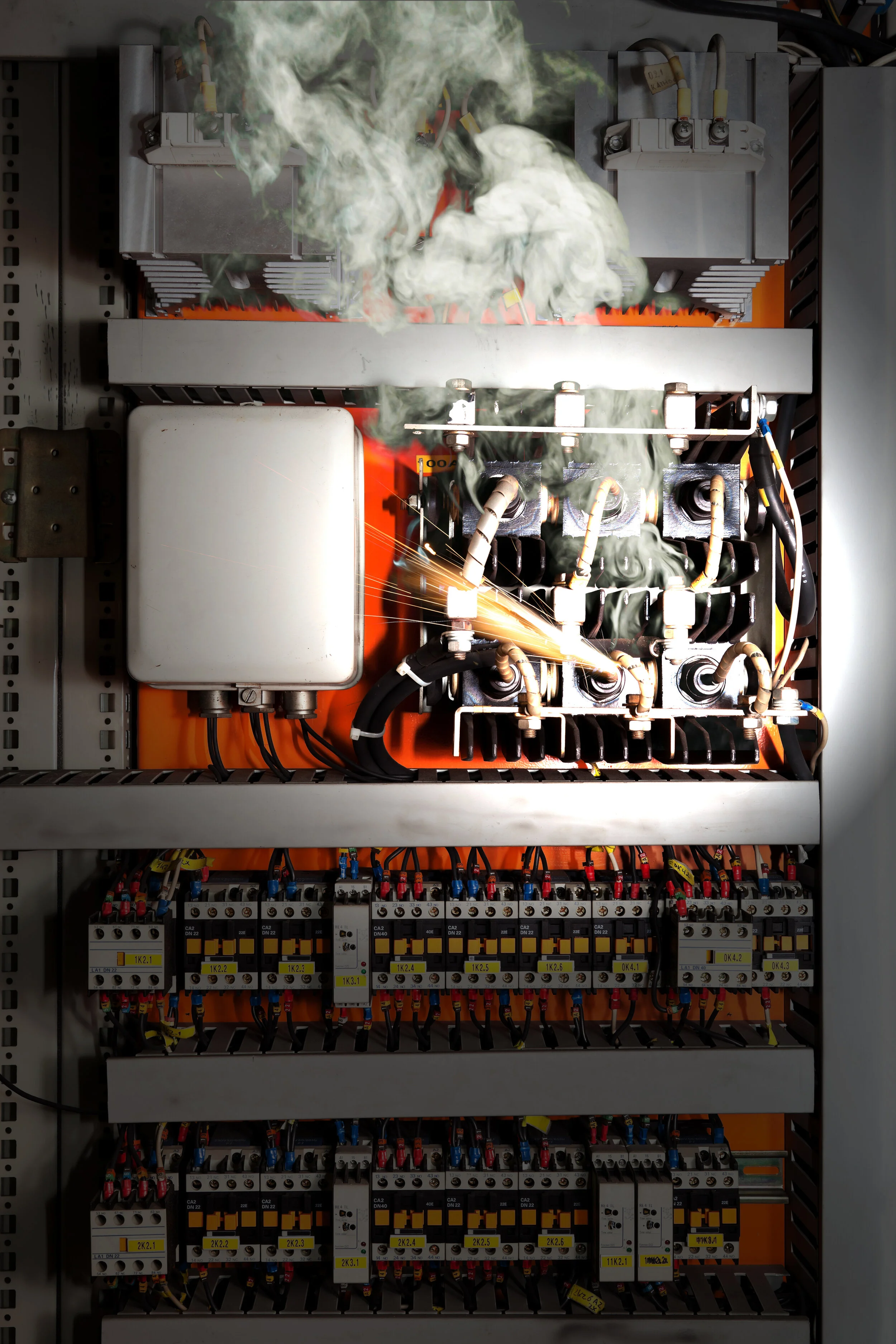
Preventing an Arc-tastrophe
Arc flash. It’s just two words and it can happen in a only few rapid moments. But it can cause extensive harm, painful consequences, and irreplaceable damage. An arc flash is the result of an arcing fault between electrical conductor(s) and another electrical conductor(s) or ground with enough electrical energy.
Arc flash. It’s just two words and it can happen in a only few rapid moments. But it can cause extensive harm, painful consequences, and irreplaceable damage.
An arc flash is the result of an arcing fault between electrical conductor(s) and another electrical conductor(s) or ground with enough electrical energy. The fault gives off a rapid release of energy (light and heat). Air becomes the conductor. A massive amount of energy discharges during the arc flash or blast. This energy burns the conductors, vaporizing the copper and thus causing an explosive volumetric increase, the arc blast. This explosion propels deadly shrapnel and molten metal as it dissipates. This rapid release of energy can cause debilitating burns, other injuries and even death. But, It’s preventable. Spontaneous arc faults can stem from malfunctioning electrical equipment, improper precautions, negligent maintenance, or even unfitting electrical design.
Prevention: Hazard Analysis & Study
Employers and facility owners know that investing in the safety of their people, and their property is always worth it. A Hazard Analysis can identify areas in which preventative measures should be taken, where modifications should be made, and where risk factors become serious dangers.
Among the hazard analysis and study include: Short Circuity Study, Protective Device Evaluation, and Protective Device Time Current Coordination Study.
· Short Circuit Study - The study calculates the maximum short circuit current the electrical power system may be subjected to at each equipment location through out the distribution network from the sources such as utilities, generators, and motors. The equipment includes substations, switchgear, motor control centers, and panels with their respective over current protective devices; generators; transforms; motors; and UPS equipment. The short circuit results determine the required ratings for electrical equipment to adequately sustain the fault current capacity of the system. If a short circuit occurs, the electrical power system’s available energy is directed to the point of the fault in amounts that greatly exceed the normal operating currents, and the equipment must have the ability to withstand and interrupt these large currents until the protective device opens to clear the faulted portion of the circuit.
· Protective Device Evaluation - This evaluation determines if the equipment ratings needed to sustain the fault currents calculated by the Short Circuit Study are adequate. Each circuit breaker, bus, etc., is reviewed in regards to the available short circuit to determine that the equipment can adequately withstand the fault current.
· Protective Device Time Current Coordination Study - The study reviews the relay and circuit breaker trip settings, fuses, and their operating time and current characteristics in order to properly coordinate these settings with upstream and downstream devices so that any faults are isolated to the location of the fault; hence, limiting the impact to the remaining portions of the system. The coordination study is used in an Arc Flash study to determine the length of time an arc would occur which is directly related to the incident energy associated with an arc flash event.
The Hazard Analysis will identify the locations which require PPE greater than Category 0. The review determines if there are possible arc flash mitigation recommendations that can be implemented to reduce the incident energy levels. Such recommendations might include device setting changes, replacement of molded case type circuit breakers with static trip type circuit breakers, changing fuse types, or installation of additional fused disconnects or circuit breakers. As a result of reducing the incident energy levels, the corresponding Category of PPE required to work on the equipment while energized is reduced.
Prevention: Take Action
In addition to addressing your hazard analysis, you should continue to make proper maintenance, training, and care a priority. Always complete regular maintenance on your equipment. Use proper signage and labeling where necessary. Provide your teams with proper safety equipment– like appropriate arc flash suits and fire resistant attire as well as PPE gear. And lastly, don’t forget to make arc flash training a part of your facility safety plan. It’s not enough just to have the information- make sure you do something with it too.
#ProblemSolved: Our Electrical Engineering team is here to help. Send an email to Emerick Martin, PE, Senior Engineer at emerick.martin@ssmgroup.com or Seth Nace, PE, LC, LEED AP, Senior Engineer at seth.nace@ssmgroup.com

Emergency Vehicles and Road Design
How do we combine street design to accommodate economic growth, pedestrian and bike paths, and emergency vehicles? The expertise is in the engineers. Because when you need an emergency vehicle, it has to be able to get there.
When you are in need of an emergency vehicle, you expect it to be able to get there. Plain and simple.
It is expert civil and municipal engineers that make sure roads are made the way they should be, streets are designed the way we need them to be, curbs are structured the way they have to be, and emergency vehicles are able to get to you when you are relying on them to.
While most of us equate roadways with driving, recent trends have shown an uptick in structuring roadways to engage and include a variety of goals that include a whole lot more. Some of these enhancements include designated spaces for bicyclists and pedestrians as well as traffic calming elements that impact traffic speeds. Typically these decisions stem from an interest in encouraging public space, economic activity, physical activity, and enhancing the safety of all road users.
The street designs that meet these ends often involve narrower travel lanes.
At the same time, emergency responders are focusing their efforts on reducing the time it takes to arrive at the scene of an emergency. And they are requiring physical space to utilize equipment.
These two priorities- well-rounded street design and first responder vehicular and equipment needs provide a tug that expert civil engineers balance in design phases.
Effective street design considers not only the efforts of complete streets that accommodate a variety of activity, but also the adequate width and turning radii for emergency vehicles.
In addition to considering lane widths, providing an adequate number of lanes to accommodate traffic is critical to reducing delays for emergency vehicles, as is providing emergency vehicle pre-emption devices on traffic signals so that emergency vehicles can gain the right of way quickly and safely through intersections.
Lastly, keeping the road pavement in good condition is another way municipal governments can help emergency vehicle response time.
All of these, combined together ensure that when you need an emergency vehicle- they get there.
#ProblemSolved: Our Civil Engineering team is here to help. Send an email to Mark Stabolepszy, PE, Director of Municipal Engineering and Planning at mark.stabolepszy@ssmgroup.com or give a call to 610-898-3023

Corrosion: The Hidden Risk in Your Sprinkler System
It’s important to invest in and maintain your sprinkler system regularly to ensure that if an emergency ever occurs, your system has the capacity and the ability to do the job you need it to. One major area of concern is minimizing corrosion.
Often times sprinkler systems are installed and all but forgotten. We rely on our systems to exist with next to no keep, but be ready to work in an emergency. But the truth is, you should be investing and maintaining your sprinkler system regularly to ensure that if an emergency ever occurs, your system has the capacity and the ability to do the job you need it to.
A major concern to consider in your sprinkler system’s functioning is corrosion among the piping.
Many automatic sprinkler systems have been installed using steel piping. Steel piping is susceptible to corrosion over time which may cause leaks or failures in these piping systems. Corrosion in the piping system involves the reaction between ferrous metal piping and its environment. In this case, water and oxygen in the steel piping system will cause corrosion inside the pipe over time. Corrosion in fire sprinkler systems can obstruct the flow of water to your sprinkler heads. That means the water isn’t there when you need it to be.
By minimizing one of the variables, the rate of corrosion will be slowed. Slowing the rate of corrosion means extending the life of your system.
A great way to minimize one of these variables is by decreasing the oxygen supply that contributes to the corrosion. Most sprinkler systems do not have high point air vents, which allows trapped air to remain in the piping system. The trapped air supplies the oxygen needed for corrosion to occur. The 2016 Edition of NFPA 13 has recommended the use of air vents to purge air from the piping system, minimizing this corrosion-causing variable. Although the 2016 Edition of NFPA 13 is not yet enforced in Pennsylvania, it can be beneficial to implement this recommendation to your system. After all, the costs of corrosion related repairs later would likely be more expensive than installing high point air vents into your sprinkler piping systems now.
In addition to considering air vents, we recommend monitoring stations and regular condition inspections.
There are corrosion monitoring stations that can be installed into new systems or that can be retrofit into existing systems. These, as well as air vents, should be UL listed for fire protection systems and FM compliant.
Similarly, NFPA 25 recommends that an internal pipe condition inspection be performed on a regular basis. While the frequency of inspection can vary between buildings and locations, the recommended inspection frequency is 5 years. This is unless there is further risk analysis and/or a recommendation for increased or extended frequency.
After 25 years of a sprinkler system being in operation, there is concern that roughly 1/3rd of sprinkler systems will have corrosion issues. Neglect of your sprinkler system can lead not only to damages, but expensive repairs in the future.
If you are a facility owner or manager and you’re unsure of the impact of installing air vents, or the best approach to maintaining your system’s life- we encourage you to follow up with the building insurer, or reach out to us as your consulting engineer. We’re always here to help!
#ProblemSolved: Our Mechanical Engineering team is here to help. Send an email to Andrew Wengerd, PE, CFPS, LEED AP, Senior Engineer at andrew.wengerd@ssmgroup.com or give a call to 610-898-3074