

The Longest Day of the Year - and the Brightest Opportunity for Solar Power
The longest day of the year means more sunlight—and more power!
Find out how the summer solstice supercharges solar energy, why it’s the future of clean power, and how you can benefit today. Don’t miss the bright side of solar!
The sun is the most abundant energy source on the planet — and it isn’t going away!
The sun produces 173,000 terawatts of solar energy per second, which is 10,000 more than the electricity produced worldwide. With the summer solstice finally here, there’s even more chances to catch some rays.
The June solstice, which typically takes place on June 20, 21, or 22 every year, occurs when the sun is directly over the Tropic of Cancer in the Northern Hemisphere. On this day, the northern regions experience longer daylight hours, while the southern regions see shorter days. This is due to the tilt of the Earth’s axis and its orbital cycle around the sun.
The farther north of the equator one is, the more sunlight they will see on this day. In our area, the sun is expected to be out for 15 hours and 6 minutes. However, in more north regions like New York City, the daylight can last for more than 16 hours!

While the sunlight and long summer days offer many enjoyable opportunities for all, it also offers benefits when it comes to solar energy. With more sun available for solar panels to soak up, comes more solar energy that can be produced.
By the end of 2023, nearly 7% of global electricity generation was produced by solar PV, a major leap from 3% in 2020. Along with solar panels’ growing use, they are growing in efficiency, with more than 20% of the sunlight that gets absorbed by them being converted to energy in good-functioning, modern panels.
With their increased efficiency and their ability to last for 40+ years, solar power is becoming more and more widespread. Furthermore, their safer environmental impact — as opposed to the burning of fossil fuels — is also driving people to use them.
At SSM, we take solar power seriously! We provide surveying, civil engineering, electrical and structural engineering, and landscape architecture for the installation of solar PV arrays. We prepare site plans and supporting documents needed for land development approval, as well as create single- and three-line drawings required for utility company interconnection applications. Our team performs technical reviews of roof mounted solar PV systems and roof surveys to draft plans for rooftop installations.
Our work is focused around interconnecting the solar PV array design into the existing power distribution systems.
While solar energy offers a more reliable, environmentally friendly, and efficient source of energy, that’s not all they’re good for. There are so many more benefits that solar power has to offer! Here are more reasons to go solar this summer solstice:
Solar slows climate change- With no toxic gases being produced, solar electricity production doesn’t cause a greenhouse effect.
No pollution- With no byproducts being released into the atmosphere, there’s no waste accumulating.
Reduced carbon footprint- Solar energy is clean, efficient, and sustainable, and has no emissions, causing it to leave no footprint behind.
Saves water- Regular electricity production requires lots of water in the production process, but not in solar conversion.
Less energy lost in transmission- Regular electricity is supplied to substations, then the consumer, allowing for energy to be lost in transmission. Solar energy, however, goes directly to the consumer.
FOR MORE INFORMATION
Seth Nace, PE | Manager, Eleectrical Engineering | seth.nace@ssmgroup.com

Arc Flash Incidents Don't Give Second Chances
With arc flashes being one of the most dangerous events in electrical systems, it’s important to know what you can do to prevent them from happening. The workplace is meant to be a safe environment. Arc flash assessments, which identify hazards and calculate risks, are the key to this safety. An arc flash assessment is conducted to determine the arc flash boundary. In turn, this boundary determines the PPE category needed to keep a worker safe when dealing with electrical hazards to reduce the risk of injury in case of an arc flash or shock. There are four categories of PPE. The farther from the electrical hazard you can be to sustain second-degree burns, the higher PPE category must be selected. The selected PPE must meet or exceed the potential incident energy level determined by the assessment.
With arc flashes being one of the most dangerous events in electrical systems, it’s important to know what you can do to prevent them from happening.
The workplace is meant to be a safe environment. Arc flash assessments, which identify hazards and calculate risks, are the key to this safety.
An arc flash assessment is conducted to determine the arc flash boundary. In turn, this boundary determines the PPE category needed to keep a worker safe when dealing with electrical hazards to reduce the risk of injury in case of an arc flash or shock. There are four categories of PPE. The farther from the electrical hazard you can be to sustain second-degree burns, the higher PPE category must be selected. The selected PPE must meet or exceed the potential incident energy level determined by the assessment.
The PPE categories follow the NFPA 70E guidelines, which are a set of guidelines put in place to ensure workers wear the appropriate attire when working with electrical hazards.
At SSM, we perform site surveys, model and analyze updates to new and existing electrical systems, and submit official reports stating conclusions and recommendations to clients in accordance with NFPA 70E standards. We perform Short Circuit Analysis and Device Coordination Review to identify locations with high incident energy and notify clients of areas that require a PPE category 1 or higher.
SSM updates incident energy levels in existing models to reflect system revisions and prepares labels for installation on equipment. We design and implement safety systems to eliminate hazards—so you can focus on your work, worry-free. We don’t just design systems, we design infrastructure for a safer tomorrow.
This electrical safety month, we want to remind you not only of arc flash safety, but of the overall importance of electrical safety. While arch flash is a big electrical safety risk, it’s not the only one. Faulty wiring, overloaded circuits, and neglected maintenance can all lead to risks such as fires, power outages, and costly repairs.
To help you maintain an all-around electrically safe workplace, here’s a list of things you can do to make sure your space is less at risk of accidents!
Schedule regular electrical inspections.
Ensure proper grounding of electrical systems.
Comply with electrical codes and regulations.
Prevent overloaded circuits.
Invest in surge protection.
Work with a trusted electrician.
Make a checklist of updates and maintenance that needs to be done.
Don’t be shocked when an incident happens, be informed and prepared!
FOR MORE INFORMATION
Seth Nace, PE | Manager, Electrical Engineering | seth.nace@ssmgroup.com

Preventing an Arc-tastrophe
Arc flash. It’s just two words and it can happen in a only few rapid moments. But it can cause extensive harm, painful consequences, and irreplaceable damage. An arc flash is the result of an arcing fault between electrical conductor(s) and another electrical conductor(s) or ground with enough electrical energy.
Arc flash. It’s just two words and it can happen in a only few rapid moments. But it can cause extensive harm, painful consequences, and irreplaceable damage.
An arc flash is the result of an arcing fault between electrical conductor(s) and another electrical conductor(s) or ground with enough electrical energy. The fault gives off a rapid release of energy (light and heat). Air becomes the conductor. A massive amount of energy discharges during the arc flash or blast. This energy burns the conductors, vaporizing the copper and thus causing an explosive volumetric increase, the arc blast. This explosion propels deadly shrapnel and molten metal as it dissipates. This rapid release of energy can cause debilitating burns, other injuries and even death. But, It’s preventable. Spontaneous arc faults can stem from malfunctioning electrical equipment, improper precautions, negligent maintenance, or even unfitting electrical design.
Prevention: Hazard Analysis & Study

Employers and facility owners know that investing in the safety of their people, and their property is always worth it. A Hazard Analysis can identify areas in which preventative measures should be taken, where modifications should be made, and where risk factors become serious dangers. Among the hazard analysis and study include: Short Circuity Study, Protective Device Evaluation, and Protective Device Time Current Coordination Study.
Short Circuit Study:
The study calculates the maximum short circuit current the electrical power system may be subjected to at each equipment location through out the distribution network from the sources such as utilities, generators, and motors. The equipment includes substations, switchgear, motor control centers, and panels with their respective over current protective devices; generators; transforms; motors; and UPS equipment. The short circuit results determine the required ratings for electrical equipment to adequately sustain the fault current capacity of the system. If a short circuit occurs, the electrical power system’s available energy is directed to the point of the fault in amounts that greatly exceed the normal operating currents, and the equipment must have the ability to withstand and interrupt these large currents until the protective device opens to clear the faulted portion of the circuit.
Protective Device Evaluation:
This evaluation determines if the equipment ratings needed to sustain the fault currents calculated by the Short Circuit Study are adequate. Each circuit breaker, bus, etc., is reviewed in regards to the available short circuit to determine that the equipment can adequately withstand the fault current.
Protective Device Time Current Coordination Study:
The study reviews the relay and circuit breaker trip settings, fuses, and their operating time and current characteristics in order to properly coordinate these settings with upstream and downstream devices so that any faults are isolated to the location of the fault; hence, limiting the impact to the remaining portions of the system. The coordination study is used in an Arc Flash study to determine the length of time an arc would occur which is directly related to the incident energy associated with an arc flash event.
The Hazard Analysis will identify the locations which require PPE greater than Category 0. The review determines if there are possible arc flash mitigation recommendations that can be implemented to reduce the incident energy levels. Such recommendations might include device setting changes, replacement of molded case type circuit breakers with static trip type circuit breakers, changing fuse types, or installation of additional fused disconnects or circuit breakers. As a result of reducing the incident energy levels, the corresponding Category of PPE required to work on the equipment while energized is reduced.
Prevention: Take Action

In addition to addressing your hazard analysis, you should continue to make proper maintenance, training, and care a priority. Always complete regular maintenance on your equipment. Use proper signage and labeling where necessary. Provide your teams with proper safety equipment– like appropriate arc flash suits and fire resistant attire as well as PPE gear. And lastly, don’t forget to make arc flash training a part of your facility safety plan. It’s not enough just to have the information- make sure you do something with it too.
Know your codes:
The National Fire Protection Association Guidelines (NFPA 70E - Standard for Electrical Safety in the Workplace) provides direction to require facility owners to perform an arc flash risk assessment prior to allowing a worker or contractor to perform a task on energized equipment. The arc flash risk assessment identifies the presence and location of potential hazards and provides recommendations for PPE, boundaries for limited and restricted approaches, recommendations for flash protection, and safe work practices. NFPA 70E, ARTICLE 130.5 says an arc flash assessment must be completed to determine if an arc flash hazard exists, taking into consideration the design of the overcurrent protective device, its opening time, and its condition of maintenance. The assessment must be updated if a major modification or renovation takes place, and it must be reviewed periodically, at intervals not to exceed 5 years.
#ProblemSolved: Our Electrical Engineering team is here to help. Send an email to Seth Nace, PE, LC, LEED AP, Manager of Electrical Engineering at seth.nace@ssmgroup.com, or Emerick Martin, PE, Technical Manager of Electrical Engineering at emerick.martin@ssmgroup.com
Preventing an Arc-tastrophe
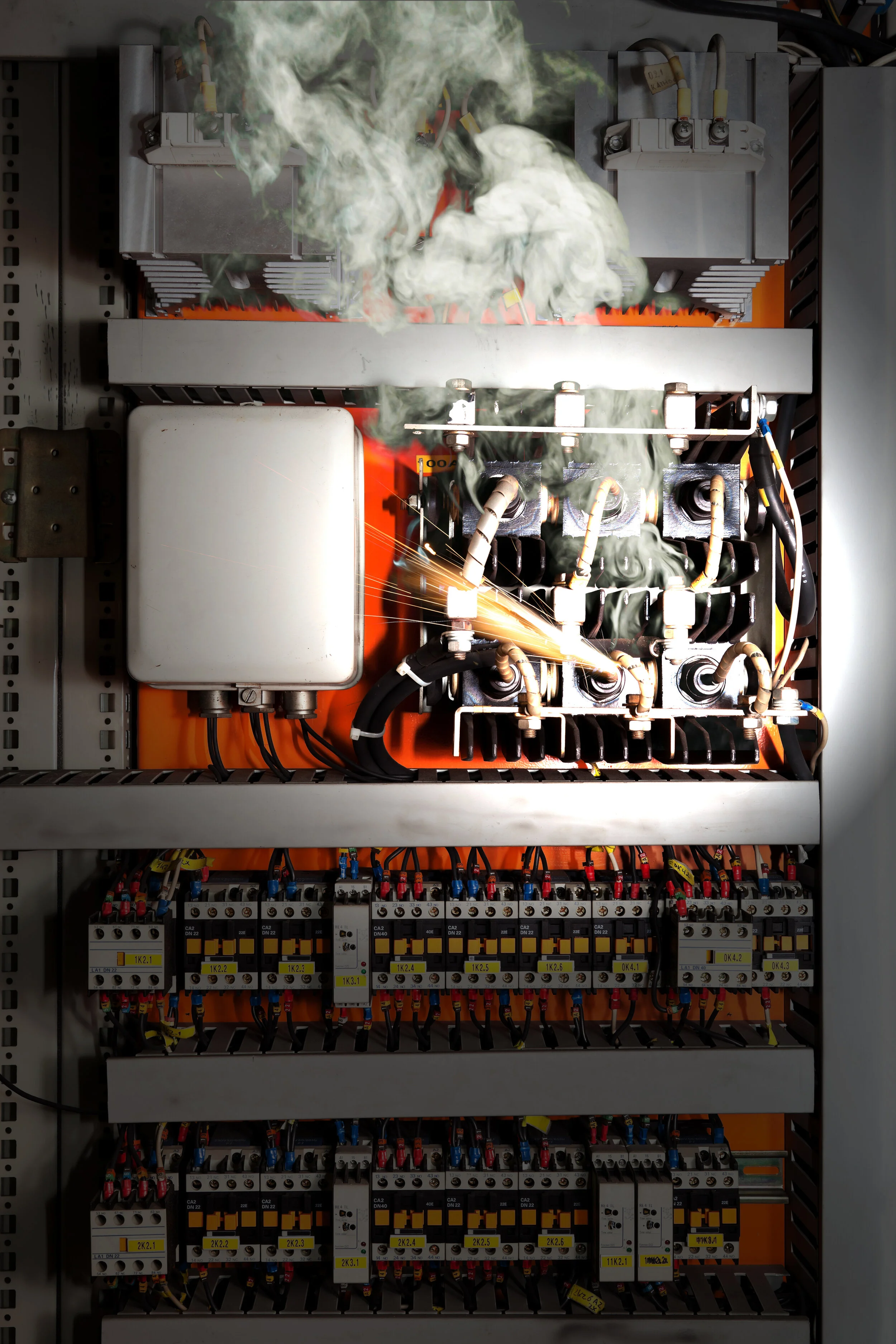
Arc flash. It’s just two words and it can happen in a only few rapid moments. But it can cause extensive harm, painful consequences, and irreplaceable damage. An arc flash is the result of an arcing fault between electrical conductor(s) and another electrical conductor(s) or ground with enough electrical energy.
Arc flash. It’s just two words and it can happen in a only few rapid moments. But it can cause extensive harm, painful consequences, and irreplaceable damage.
An arc flash is the result of an arcing fault between electrical conductor(s) and another electrical conductor(s) or ground with enough electrical energy. The fault gives off a rapid release of energy (light and heat). Air becomes the conductor. A massive amount of energy discharges during the arc flash or blast. This energy burns the conductors, vaporizing the copper and thus causing an explosive volumetric increase, the arc blast. This explosion propels deadly shrapnel and molten metal as it dissipates. This rapid release of energy can cause debilitating burns, other injuries and even death. But, It’s preventable. Spontaneous arc faults can stem from malfunctioning electrical equipment, improper precautions, negligent maintenance, or even unfitting electrical design.
Prevention: Hazard Analysis & Study
Employers and facility owners know that investing in the safety of their people, and their property is always worth it. A Hazard Analysis can identify areas in which preventative measures should be taken, where modifications should be made, and where risk factors become serious dangers.
Among the hazard analysis and study include: Short Circuity Study, Protective Device Evaluation, and Protective Device Time Current Coordination Study.
· Short Circuit Study - The study calculates the maximum short circuit current the electrical power system may be subjected to at each equipment location through out the distribution network from the sources such as utilities, generators, and motors. The equipment includes substations, switchgear, motor control centers, and panels with their respective over current protective devices; generators; transforms; motors; and UPS equipment. The short circuit results determine the required ratings for electrical equipment to adequately sustain the fault current capacity of the system. If a short circuit occurs, the electrical power system’s available energy is directed to the point of the fault in amounts that greatly exceed the normal operating currents, and the equipment must have the ability to withstand and interrupt these large currents until the protective device opens to clear the faulted portion of the circuit.
· Protective Device Evaluation - This evaluation determines if the equipment ratings needed to sustain the fault currents calculated by the Short Circuit Study are adequate. Each circuit breaker, bus, etc., is reviewed in regards to the available short circuit to determine that the equipment can adequately withstand the fault current.
· Protective Device Time Current Coordination Study - The study reviews the relay and circuit breaker trip settings, fuses, and their operating time and current characteristics in order to properly coordinate these settings with upstream and downstream devices so that any faults are isolated to the location of the fault; hence, limiting the impact to the remaining portions of the system. The coordination study is used in an Arc Flash study to determine the length of time an arc would occur which is directly related to the incident energy associated with an arc flash event.
The Hazard Analysis will identify the locations which require PPE greater than Category 0. The review determines if there are possible arc flash mitigation recommendations that can be implemented to reduce the incident energy levels. Such recommendations might include device setting changes, replacement of molded case type circuit breakers with static trip type circuit breakers, changing fuse types, or installation of additional fused disconnects or circuit breakers. As a result of reducing the incident energy levels, the corresponding Category of PPE required to work on the equipment while energized is reduced.
Prevention: Take Action
In addition to addressing your hazard analysis, you should continue to make proper maintenance, training, and care a priority. Always complete regular maintenance on your equipment. Use proper signage and labeling where necessary. Provide your teams with proper safety equipment– like appropriate arc flash suits and fire resistant attire as well as PPE gear. And lastly, don’t forget to make arc flash training a part of your facility safety plan. It’s not enough just to have the information- make sure you do something with it too.
#ProblemSolved: Our Electrical Engineering team is here to help. Send an email to Emerick Martin, PE, Senior Engineer at emerick.martin@ssmgroup.com or Seth Nace, PE, LC, LEED AP, Senior Engineer at seth.nace@ssmgroup.com