

PennTec 2022
SSM Presentations
Implementing Emergency Response Programs
Optimize Asset Management with GIS
Utility Management and Operations for the Future
PennTec 2022 - PWEA Annual Technical Conference & Exhibition
June 5-8 | Penn Stater Conference Center
Utilities Management and Operations for the Future
Presented by: Darryl Jenkins, PE
Overview
In the next 10 years, there may not be enough operators to properly monitor and control every public water/wastewater treatment system adequately
Interest is low because public understanding of the job is poor
Local wastewater and drinking water facilities are feeling the stress of their eroding workforces
Officials should recognize the need to entice a younger generation to fill the need
There will also be fewer experienced professional engineers and technicians to design and maintain treatment and collection system facilities
Implementing Emergency Response Plans
Presented by: Carolyn Rodino, PMP and Sydney Jernigan, EIT
Why is an ERP important?

In an emergency situation, people aren’t thinking clearly!
Need specific procedures to ensure that response doesn’t cause further harm.
Should be reviewed and updated on annual basis at minimum.
Training and practice for routine situations and “what if” situations.

Utilize GIS workflows for asset management, including maintenance and inspections. Featuring a Township’s case study for outfall inspection process using GIS tools.
GIS Workflow for MS4 – making data accessible to operations staff.
Collaborative data exchange – connecting those who know with those who manage.
Mobile database population – capturing institutional knowledge and performing inspections and tracking maintenance.
Features a Township case study for outfall inspection processing using GIS tools.

Funding Opportunity:
Funding Opportunity - No Match Required
National Water Quality Initiative Watershed and Source Water Protection Area Selection and Criteria for Planning and Implementation Phases of NWQI - Fiscal Year 2023
Funding Opportunity - No Match Required

the Natural Resources Conservation Service (NRCS) and United States Department of Agriculture (USDA) recently announced the latest round for the National Water Quality Initiative. This is a great source water protection funding opportunity - and it does NOT require a match.
FOR MORE INFORMATION contact Serena DiMagno
Download the Bulletin

Legislative and Regulatory Update -- Water/Wastewater
Discussion Topics
Clean Streams Law - Spill Reporting
Delaware River Basin Compact - Voting Power
Water and Wastewater Asset Management Plans
Bipartisan Legislation - Legionnaires’ Disease
New/Revised Federal Drinking Water Regulations
Technical Guidance - Notification Requirements for Spills, Discharges and Other Incidents
Legislative and Regulatory Update for the PA Section AWWA Northeast District and WWOAP Eastern Section
presented by Serena DiMagno - serena.dimagno@ssmgroup.com
Discussion Topics
Clean Streams Law - Spill Reporting
Delaware River Basin Compact - Voting Power
Water and Wastewater Asset Management Plans
Bipartisan Legislation - Legionnaires’ Disease
New/Revised Federal Drinking Water Regulations
Technical Guidance - Notification Requirements for Spills, Discharges and Other Incidents
Celebrating Fifteen Years of SWPTAP
May 1-7, 2022 is the annual recognition of Drinking Water Week. In celebration, SSM is proud to be participating in our fifteenth year as a technical partner in the Source Water Protection Technical Assistance Program (SWPTAP). The program offers a no cost opportunity for water suppliers to develop a source water protection plan with the goal of protecting their water sources utilized for drinking water.
May 1-7, 2022 is the annual recognition of Drinking Water Week. In celebration, SSM is proud to be participating in our fifteenth year as a technical partner in the Source Water Protection Technical Assistance Program (SWPTAP).
About SWPTAP
SWPTAP is a voluntary technical assistance program funded by the U.S. Environmental Protection Agency (EPA) and Pennsylvania Department of Environmental Protection (Pa DEP). The SWPTAP program offers public drinking water suppliers the no-cost opportunity to develop a source water protection plan with the goal of protecting their water sources utilized for drinking water.
Over the last fifteen years, the program has been incredibly successful, with more than 500 public water suppliers requesting participation in the program.

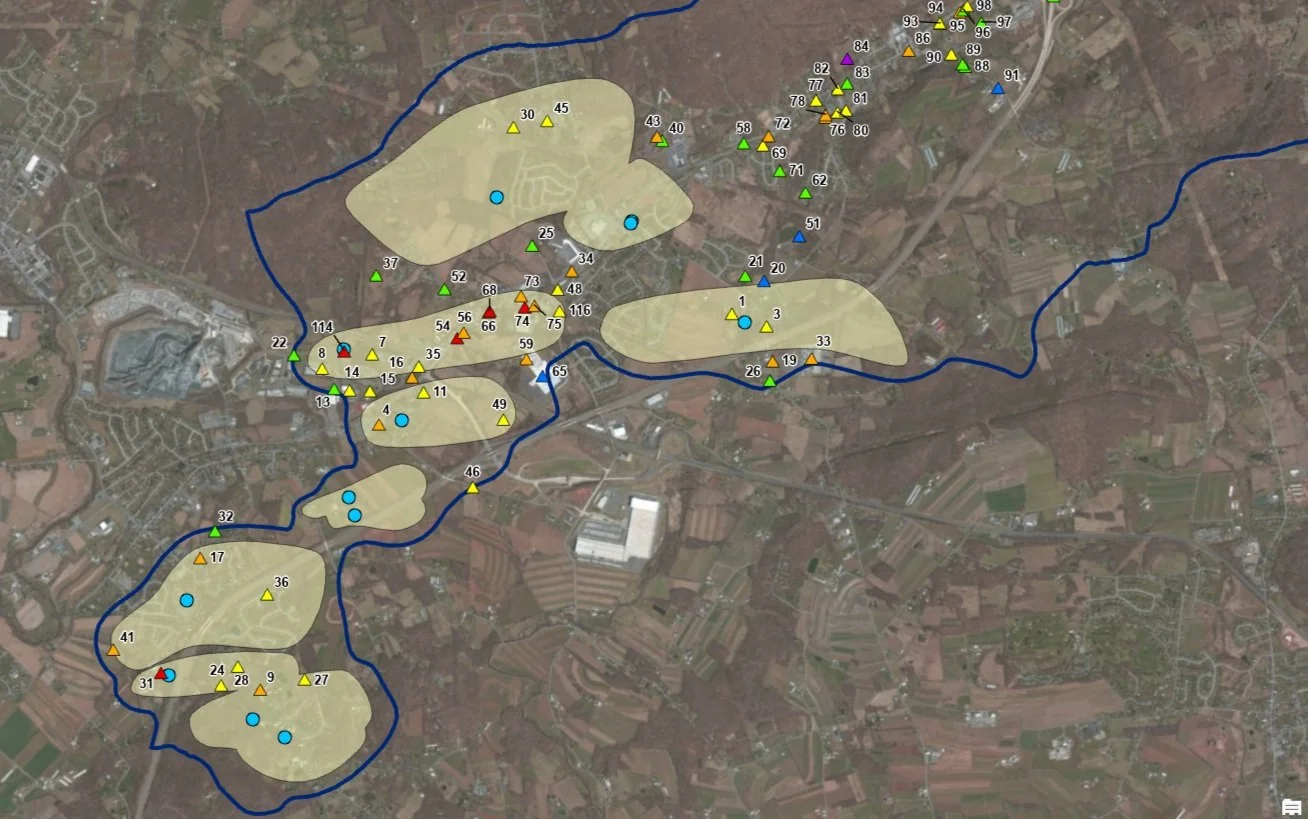
potential sources of contamination in a system's protection areas. Sites are assessed and given a rating from A to F, based on how severe a contamination event from the site could potentially be to the drinking water supply.
Developing a Source Water Protection Plan

Identifying the protection area.
The first step in creating a source water protection plan is delineating protection areas for each drinking water source. Sources may consist of groundwater wells, springs, surface water intakes, or a combination of these. The SSM team uses a variety of inputs in geographic information system (GIS) database and hydrogeologic modeling software to determine how and from where water flows to a source - whether on the surface or through the ground. The result of that modeling determines the boundaries of the protection area which serves as the basis for the protection plan.
Analyzing potential threats.
Once the protection areas are determined, the team analyzes potential sources of contamination (PSOCs) within the area. Identifying these potential threats is key to creating a viable protection plan for the protection area. This phase of the plan provides the water system with an inventory and maps of the PSOCs.
Developing management strategies.
The SSM team then works with the system and steering committee to develop a list of attainable management strategies which will help the system protect their sources from these PSOCs. As a final phase, our team develops a report describing the water system and technical aspects of the project.
Implementation
The water system can choose to implement their source water protection plan in whichever way makes sense for the size, resources, and goals of the system. Implementation can range in complexity and may involve simple good housekeeping practices such as house training, or developing a spill cleanup program. Or, the implementation may involve public education and outreach with cleanups or tree planting. Implementation may also be as involved as working with local and county officials to implement ordinances or other regulatory protections for the water system. At SSM, we’re honored to assist several SWPTAP graduate, now our valued clients, in their implementation efforts.
Moving Forward
Over the years, SSM has seen the SWPTAP program evolve with the introduction of new technologies, data, and program goals. Eight years ago, the small system program was added as a sub-set of SWPTAP. This program aims to provide much smaller water supplies - such as mobile home parks, assisted living facilities, or small municipalities - the same benefits as SWPTAP, but on a smaller, more appropriate scale.
While any size public water supplier may always apply to the program, in recent years we have seen a shift from mostly larger, urban and suburban water to suppliers to more rural water suppliers are participating in the program. This proves that source water protection truly is for everyone.
Of the 500 total systems who have participated in SWPTAP over the years, more than 200 of those have entered through the small system program, almost all of those systems serving a population of less than 500 customers, with many serving less than 100 customers.
As the program continues to evolve, we continue to be proud of being a part of it. We have had the opportunity to assist our clients in protecting drinking water for millions of Pennsylvanians over the last 15 years. The future of source water protection continues to grow, and we look forward to being right there with it.

Spottlight on Engineering for Buildings
It takes a lot to make and market a product. It also takes a lot to assure regulatory compliance as well as address needs such as increased capacity, routine maintenance and facility expansion. That's why manufacturers of everything from chocolate to steel turn to SSM when it comes time to secure prime locations, plan more efficient warehouses and distribution centers, conduct feasibility studies, upgrade utilities and building systems, improve traffic flow and expand operations.

Marika Selzler, named Tune-Up Specialist for City of Philadelphia
Marika Selzler, EIT, ENV SP, CEM has been approved as a Tune-Up Specialist by the City of Philadelphia’s Office of Sustainability.
Marika Selzler, EIT, ENV SP, CEM has been approved as a Tune-Up Specialist by the City of Philadelphia’s Office of Sustainability.
The City of Philadelphia’s newly implemented Building Energy Performance Policy (BEEP) requires a “tune-up specialist” lead all tune-up assessments and sign-off on all tune-up reports submitted to the City’s Office of Sustainability (OOS). Individuals must be a Professional Engineer (PE) license or Certified Energy Manager (CEM) certification and have at least 7 years of combined educational and professional experience with commercial building operations and/or building energy management.
Marika is a member of the Energy and Sustainability Services Team. With a Bachelor's Degree in Chemical Engineering, she brings a broad range of experience to the team including energy benchmarking, load profiling, and long-term trend analysis of commercial facilities, industrial plants, and vehicle fleets; BAS-based continuous commissioning and Analytics-as-a-Service of commercial buildings; calculating and evaluating emissions of existing systems, buildings, campuses, and fleets, and improvements from conservation, efficiency, and fuel-switching projects; supervising preparation of energy audits and reports.
TUNE-UP SPECIALISTS:
Paul Spiegel, PE, LEED AP Director, Energy and Sustainability Services
Benjamin Pressman, PE BESM Project Mechanical Engineer
Marika Selzler, EIT, ENV AP, CEM Energy Analyst

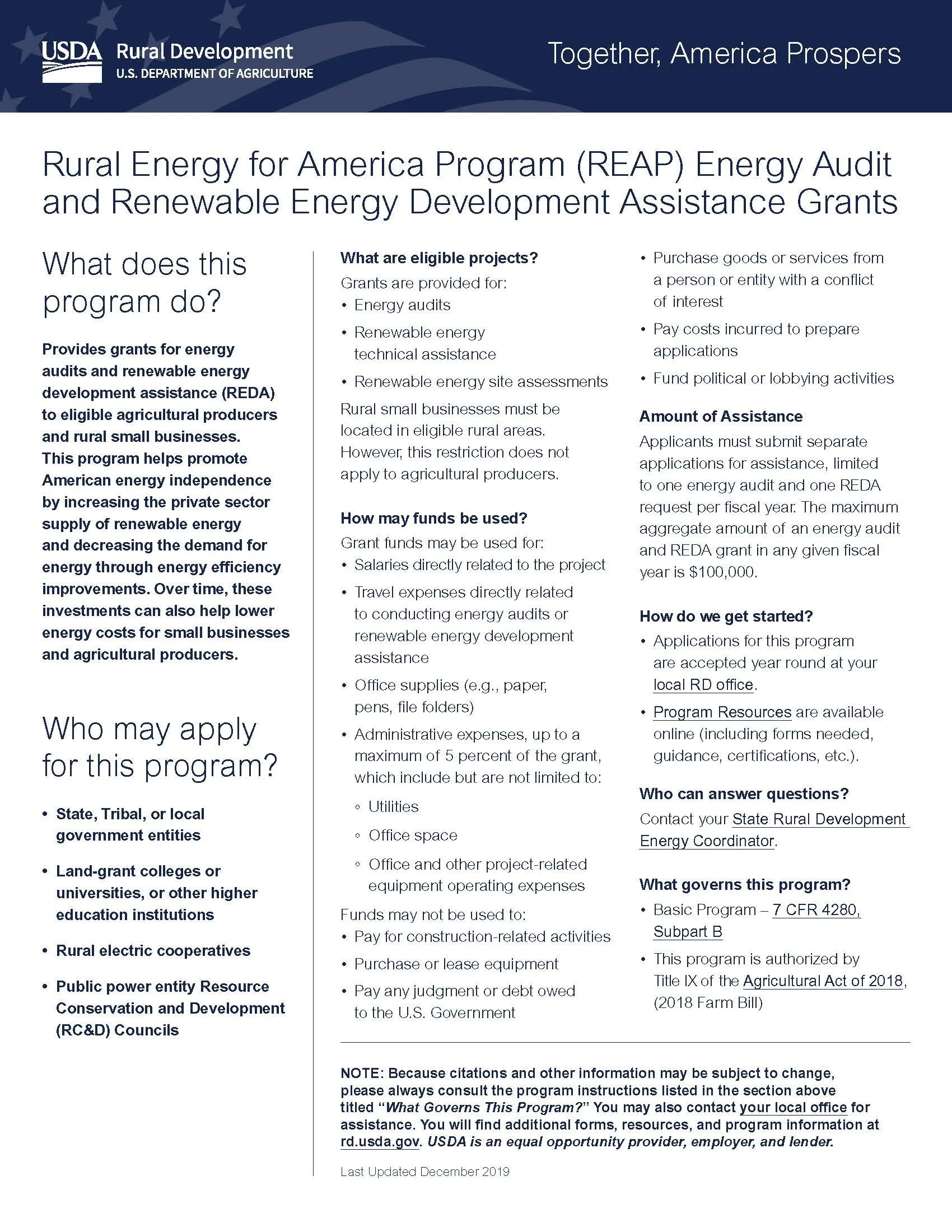
Funding Opportunity: Energy Audit & Renewable Energy Development Assistance Grants
What does this program do?
Provides grants for energy audits and renewable energy development assistance (REDA) to eligible agricultural producers and rural small businesses. This program helps promote American energy independence by increasing the private sector supply of renewable energy and decreasing the demand for energy through energy efficiency improvements. Over time, these investments can also help lower energy
FUNDING OPPORTUNITY
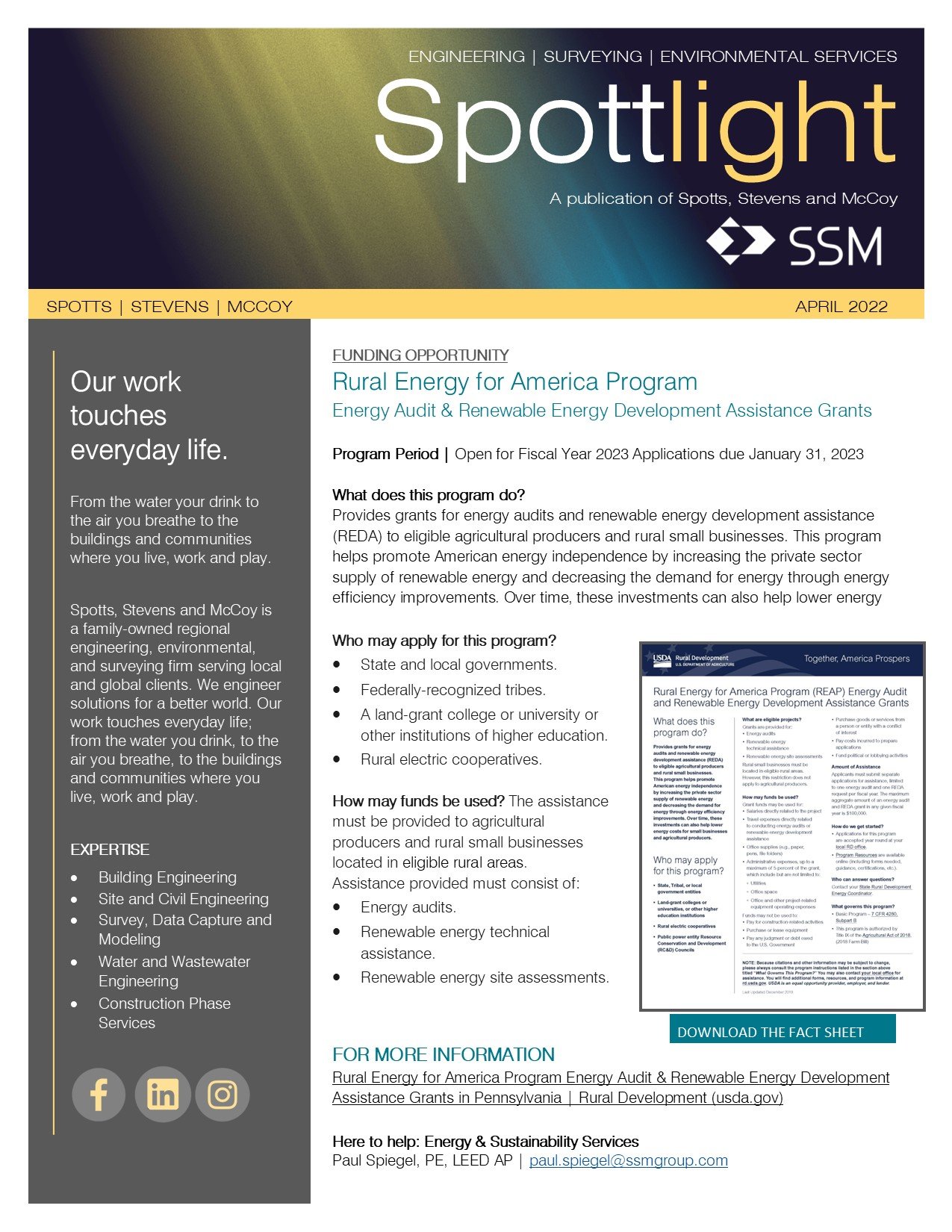
Rural Energy for America Program Energy Audit & Renewable Energy Development Assistance Grants
Program Period | Open for Fiscal Year 2023 Applications due January 31, 2023
What does this program do?
Provides grants for energy audits and renewable energy development assistance (REDA) to eligible agricultural producers and rural small businesses. This program helps promote American energy independence by increasing the private sector supply of renewable energy and decreasing the demand for energy through energy efficiency improvements. Over time, these investments can also help lower energy costs for small businesses and agricultural producers.
Who may apply for this program?
State and local governments.
Federally-recognized tribes.
A land-grant college or university or other institutions of higher education.
Rural electric cooperatives.
How may funds be used?
The assistance must be provided to agricultural producers and rural small businesses located in eligible rural areas.
Assistance provided must consist of:
Energy audits.
Renewable energy technical assistance.
Renewable energy site assessments.
FOR MORE INFORMATION
Rural Energy for America Program Energy Audit & Renewable Energy Development Assistance Grants in Pennsylvania | Rural Development (usda.gov)
Here to help: Energy & Sustainability Services
Paul Spiegel, PE, LEED AP | paul.spiegel@ssmgroup.com


Spring 2022 Joint Technical Conference - April 6, 2022
Legislative and Regulatory Update

Presented by: Serena DiMagno, Senior Environmental Consultant
serena.dimagno@ssmgroup.com
Legislative and Regulatory Update
AWWA PA Section - Southeast District & Eastern Section - Water Works Operators Association of PA
Wednesday - April 6 | Exton Hotel & Conference Center

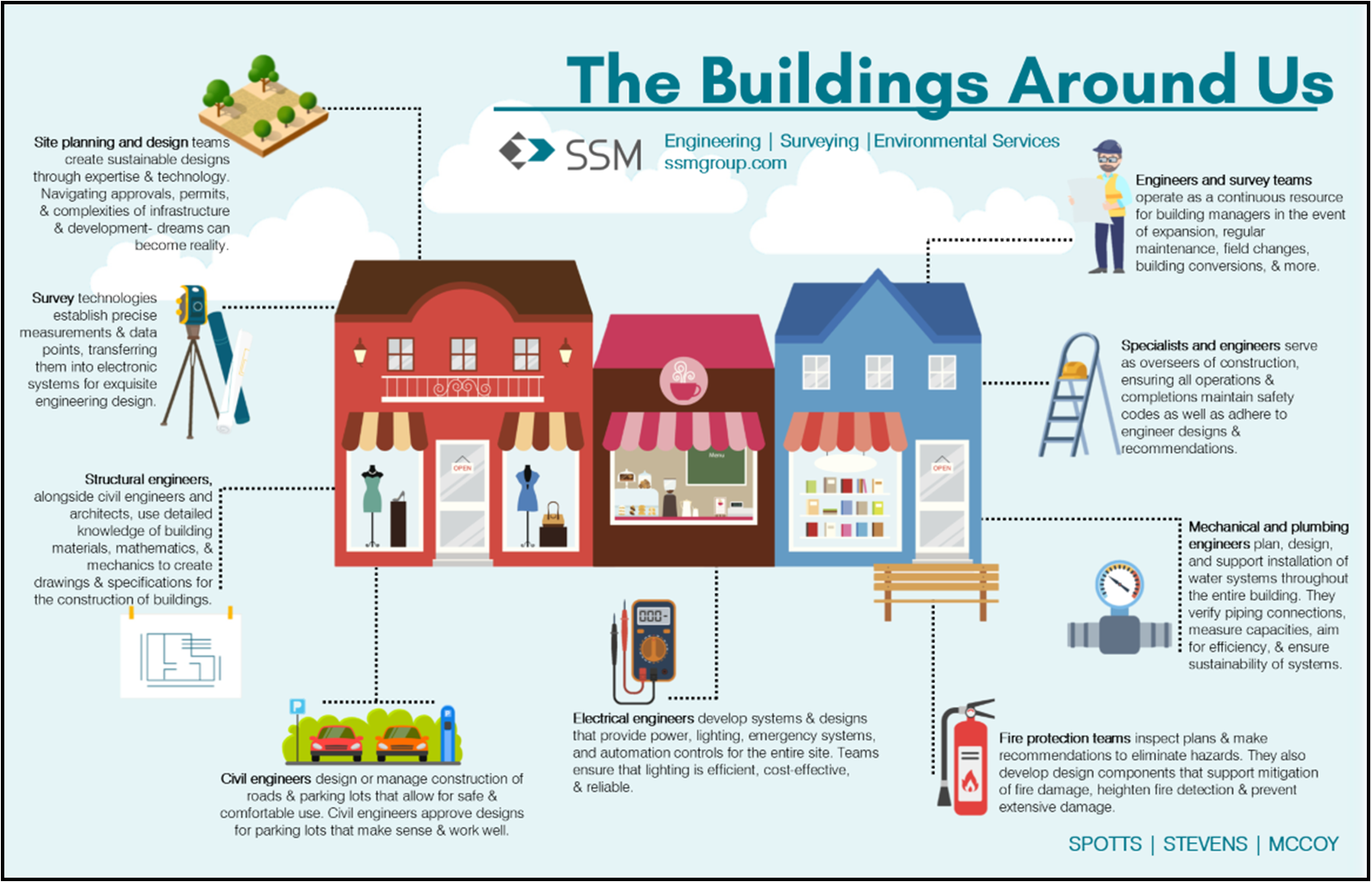
Engineering for Buildings
It takes a lot to make and market a product. It also takes a lot to assure regulatory compliance as well as address needs such as increased capacity, routine maintenance and facility expansion. That's why manufacturers of everything from chocolate to steel turn to SSM when it comes time to secure prime locations, plan more efficient warehouses and distribution centers, conduct feasibility studies, upgrade utilities and building systems, improve traffic flow and expand operations.

It takes a lot to make and market a product. It also takes a lot to assure regulatory compliance as well as address needs such as increased capacity, routine maintenance and facility expansion. That's why manufacturers of everything from chocolate to steel turn to SSM when it comes time to secure prime locations, plan more efficient warehouses and distribution centers, conduct feasibility studies, upgrade utilities and building systems, improve traffic flow and expand operations. By taking the lead on the facilities engineering side, we enable manufacturers to focus more on their core business.
Whether it's a specific mechanical or electrical project or a vision for a new building, we start by knowing the challenge inside out. We understand the intricacies of each task, and how multiple disciplines ultimately need to work together to achieve the best possible results. The breadth and depth of SSM's facilities engineering resources guarantee an integrated approach. We do a lot of listening, too. Working with owners, architects, agents, and process engineers to understand the goals, needs, budgets, and unique considerations. Add our penchant for innovative thinking to the picture, and you'll find SSM to be the best single-source solution for any facilities engineering challenge. No matter how many facets.
From ground up solutions to retrofit and reuse, we bring the team and technology to ensure the result you envision. We are leaders in the use of High Definition Scanning (HDS) and Building Information Modeling (BIM) technology to streamline the process end-to-end, from planning and design through construction. And we do it with a passion for a sustainable built environment and economic operational performance. Workflow planning for occupied spaces is also an SSM strong suit. So if being “down” during renovation isn't an option, you have definitely found your solution here.
If there’s one thing you should know about SSM - it’s that we never shy away from a challenge. In fact, it’s what we do best. We take pride in the success of our clients. We do a lot of listening to appreciate the needs, the goals, and the vision. We take responsibility for making those dreams a reality. For structures big and small, to organizations large and growing - we want you to know that we’ve got you covered.
Project Profile: Indoor Growing Facility
SSM provided innovative and energy-efficient solutions for an indoor cultivation and processing facility. The project involved working closely with the Process Engineer, Owner Team and Contractor to maximize cultivation density, provide precise temperature, humidity and lighting controls while maximizing energy-saving opportunities. Core and shell by others; SSM provided design engineering and construction phase assistance for the $7M fit-out of the pre-engineered secure facility.
The details of the facility: 40,000 SF growing facility with provisions for expansion of systems to serve 80,000 SF.
Energy Modeling for Cost-Benefit Analysis | Quantified the anticipated energy savings to be realized by designing and installing a central chiller plant and custom-designed air handling equipment, and lighting, versus conventional rooftop equipment. In response to the Energy Modeling results, the client elected to proceed with an SSM custom design.
Mechanical Design | Design of HVAC system including custom design of fan coil units for heat/cooling recovery to minimize load on the central plant. Design of 1,000 ton central chiller plant using heat recovery chillers and fluid coolers. Design of 1,400 MBH Boiler Plant
Electrical Design | Design of two 2,500 KVA power distribution systems including 750 KW emergency generator
Energy Incentive Documentation | Reviewed custom energy rebates and incentives available through Power Company, and prepared support documentation to seek and apply for energy incentives.
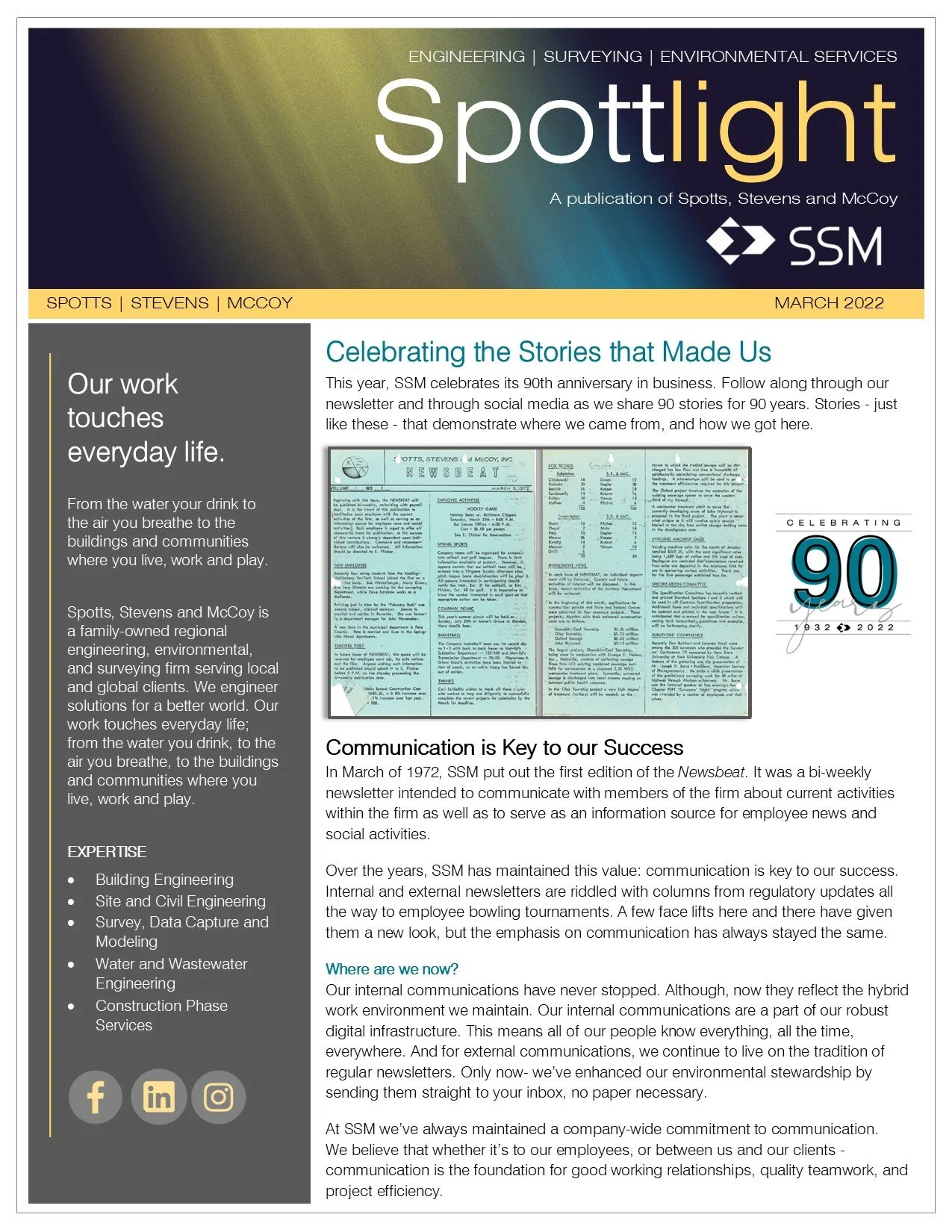
Spottlight on Groundwater
Did you know: National Groundwater Awareness Week is an annual observance sponsored by the National Groundwater Association (NGWA). This year, it was celebrated March 6-12, 2022.
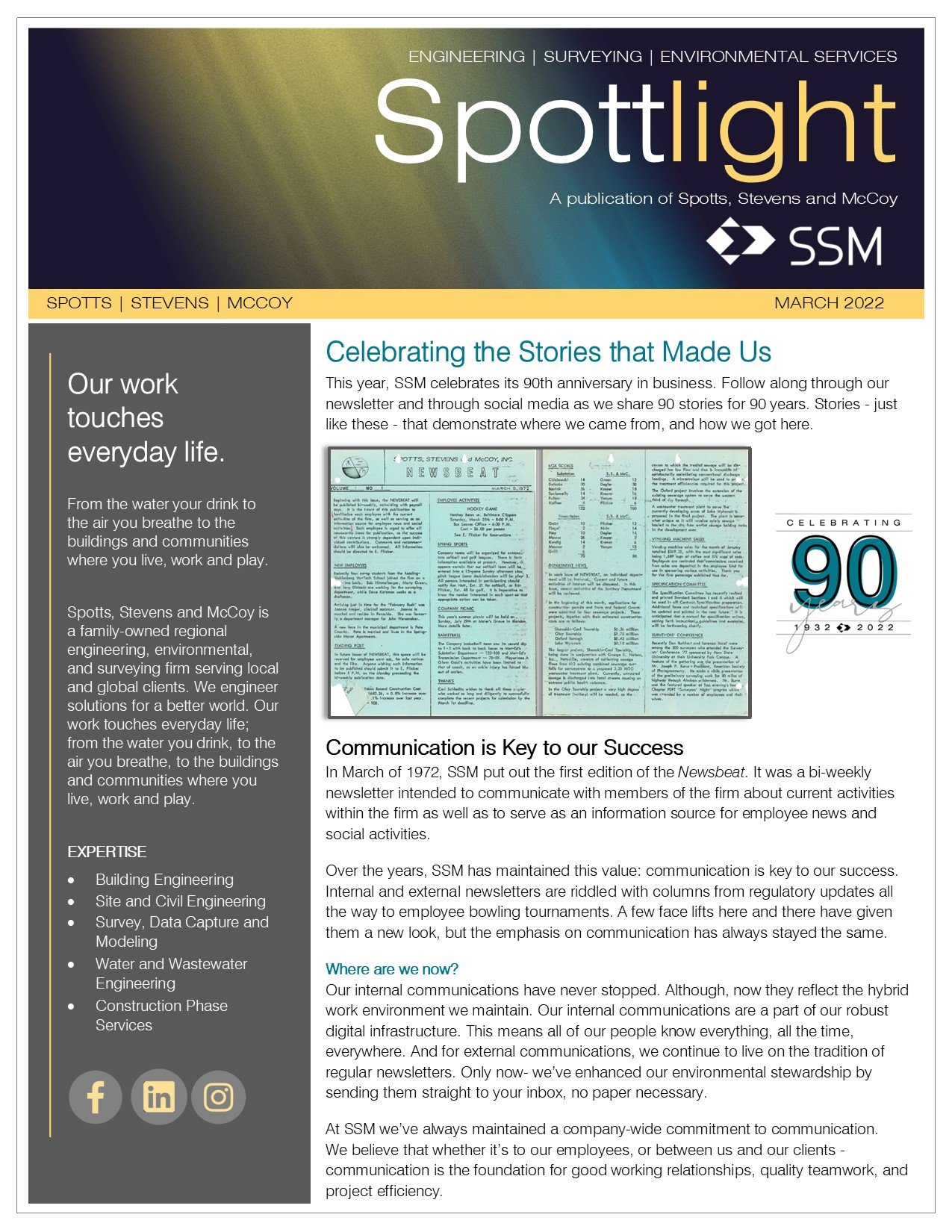
Did you know: National Groundwater Awareness Week is an annual observance sponsored by the National Groundwater Association (NGWA). This year, it was celebrated March 6-12, 2022.
IN THIS ISSUE


Celebrating National Surveyor's Week
The SSM survey and data capture team collects and manages data that allows for the best designs, the most comprehensive solutions, and highly effective, efficient results.


Accuracy. Expertise. Care.
This month we celebrated National Surveyors Week and it goes without saying that our survey team does work that touches everyday life. They're at local parks, establishing property boundary lines. They're at lakes, finding spots for public water drains. They're at community organizations, hospitals, landfills, shopping centers, parking lots, and the list goes on. And sometimes they're at their desk, turning valuable data into functional deliverables.
The SSM survey and data capture team collects and manages data that allows for the best designs, the most comprehensive solutions, and highly effective, efficient results.
Since 1932, we have consistently refined our practice while maintaining our values: to provide surveying services with accuracy, expertise, and care. Our expertise defies standard surveying boundaries thanks to our extensive experience. From expansion to preservation, land to buildings, residential properties to multi-faceted commercial spaces, and relocation all the way to revitalization- SSM surveyors solve problems.
At Spotts, Stevens and McCoy we’re here to help. Because what we do best, is what you don’t. Our surveyors see the world differently: through the vision of making the world a better place, through the lens of advanced technology, and through the eyes of precision and accuracy.
We like to say there are four things that make our surveyors unique:
At the forefront. We’ve been at the forefront of surveying expertise since 1932.
Pioneers. We’ve consistently pioneered new, cutting-edge technology in the field. From drone technology to automatic levels and high-definition scanners. We take pride in upping our technology game to decrease equipment error and increase results.
Know what it takes. We use the right equipment and the right skills for the job. Because when it comes to your projects, they shouldn’t just get done. They should get done correctly. And precision matters. Attention to detail matters. Expertise matters. You know the data you need, we know what it takes to get it.
Shared values. We provide quality work, with teamwork as our foundation and pride and integrity as our guides.
We thank our surveyors, for the skill in which they look at things, for the eyes through which they see the world, and for the points of view with which they bring to the table.

Case Study: National Water Quality Initiative Readiness Assessment Plan
In celebration of Agriculture, we highlight the collective efforts of the local farmers and the Schuylkill Action Network (SAN) to improve water quality in Berks County.
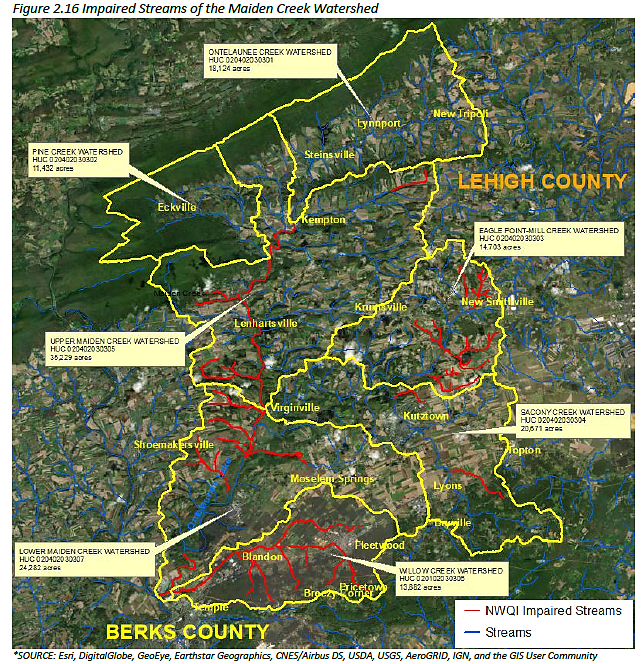
Collective efforts of the local farmers and the Schuylkill Action Network (SAN) to improve water quality in Berks County.
Write-up courtesy of Kent Himelright, Watershed Coordinator, Berks County Conservation District
This case study highlights the collective efforts of local farmers and the Schuylkill Action Network (SAN) to improve water quality in Berks County. Through collaboration with the Natural Resource Conservation Resource (NRCS), the many partners of the Schuylkill Action Network, including Spotts, Stevens and McCoy, were able to engage the Reading Area Water Authority, and begin the process of developing a National Water Quality Initiative (NWQI) Readiness Assessment Plan for the Maiden Creek Watershed. The goal of the Plan was to evaluate the water quality needs of the watershed’s Source Water Protection Areas and Public Water Systems.
As a result, the completion of Readiness Plan in 2019 yielded the allocation of $5 million over 5 years to implement agricultural conservation practices in the Maiden Creek Watershed.
Now, in it’s third year of implementation the NWQI and the many great farmers of the Maiden Creek watershed have allocated over $2 million and implemented dozens of conservation practices like manure storages, animal heavy use area protection, pasture management, and fencing to restrict livestock from waterways.
The implementation of these conservation practices helps improve water quality and keep our drinking water sources healthy. It has been the strong relations and cooperation between both conservation partners and agricultural operators that have made these worthwhile efforts possible.
Spottlight on Walter E. Spotts
“Engineers are plotters of direction and measurements – on land, sea, in the air and of all physical things. And in a sense, navigators to set a course to solve earthly problems. We are concerned with the direction from which the wind blows and advise our clients so that they might avoid the dangers of unexpected storms.”
Walter Spotts is the namesake for Spotts in Spotts, Stevens and McCoy.

Walter E. Spotts received technical training in the field of engineering at the Keystone Institute in Reading, having completed study in 1922. From this time until 1932, he was employed by William H. Dechant and Sons, Reading. A highlight of his employment was the layout of the Susquehanna Pipe Line from Chester PA to Syracuse, New York.
From 1932 to 1961, Mr. Spotts served as Owner and President of Walter E. Spotts and Associates. During these years, the firm provided consulting engineering services for nearly 40 municipalities. In 1961, the company was incorporated into the firm of Spotts Engineering Associates, Inc. and later merged with Stevens and McCoy, Inc. in 1970.
Through the years, Mr. Spotts received many awards and honors, including the PSPE - Reading Chapter "Engineer of the Year" award in 1963 and the Crostwaite Award (1961) and Outstanding Service Award (1971) from the Pennsylvania Association of Boroughs. Mr. Spotts was a member of the Pennsylvania Water Pollution Control Association and the American Society of Civil Engineers.
In addition to his engineering accomplishments, Mr. Spotts was also noted in the community for his activities as a bandleader and for his work in the Rajah Temple.

Wally Spotts (middle) with survey crew on Main Street in Kutztown PA.

Spottlight on Mobile GIS Applications
SSM provides professional GIS services to municipalities; from mapping support for infrastructure projects, to focused GIS and data capture projects. SSM’s GIS Asset Management approach helps municipalities to transform sewer infrastructure data into an easy-to-use operations asset management system capturing vital infrastructure data points with survey-grade accuracy. The data is verified and compiled into a geo-spatial database.

SSM provides professional GIS services to municipalities; from mapping support for infrastructure projects, to focused GIS and data capture projects. SSM’s GIS Asset Management approach helps municipalities to transform sewer infrastructure data into an easy-to-use operations asset management system capturing vital infrastructure data points with survey-grade accuracy. The data is verified and compiled into a geo-spatial database.
GIS Database Development
GIS Training
ArcGIS Online Implementation
Mobile Application Design
Field Data Collection
Survey Grade GPS Collection
Customizable Inspection Forms
Field Inspection Reports
Document Management
IN THIS ISSUE



Marika Selzler, EIT, ENV SP Earns Certified Energy Manager Designation
Marika Selzler, EIT, ENV SP has earned the Certified Energy Manager (CEM) designation through the Association of Energy Engineers (AEE). Marika is a member of the Energy and Sustainability Services Team at SSM.

MARIKA SELZLER, EIT, ENV SP, CEM
Marika Selzler, EIT, ENV SP has earned the Certified Energy Manager (CEM) designation through the Association of Energy Engineers (AEE). Marika is a member of the Energy and Sustainability Services Team at SSM. With a Bachelor's Degree in Chemical Engineering, she brings a broad range of experience to the team including energy benchmarking, load profiling, and long-term trend analysis of commercial facilities, industrial plants, and vehicle fleets; BAS-based continuous commissioning and Analytics-as-a-Service of commercial buildings; calculating and evaluating emissions of existing systems, buildings, campuses, and fleets, and improvements from conservation, efficiency, and fuel-switching projects; supervising preparation of energy audits and reports.
About the Certification: The CEM program helps educate and qualify individuals involved in optimizing the use of energy in buildings and systems. By obtaining the CEM certification, candidates gain industry and peer recognition by demonstrating their understanding of energy-efficiency principles, practices, and technologies. The program also helps the energy industry by raising the professional standards, both technical and ethical, of those engaged in energy efficiency and energy management. The CEM accreditation is one of the most globally respected in the field of energy management. To qualify for CEM designation — the internationally accepted symbol of professional competence within the energy management field — candidates must meet strict educational and professional criteria, attend an AEE-sponsored CEM training seminar, and pass a rigorous 17-part exam administered by AEE.
Case Study: Field Inspection Applications Using Mobile GIS Technology
SSM is working with South Heidelberg Township on the development and deployment of field inspection applications using mobile Geographic Information Systems (GIS) technology.
SSM is working with South Heidelberg Township on the development and deployment of field inspection applications using mobile Geographic Information Systems (GIS) technology. This technology will modernize the Township’s operations and maintenance as well as contribute to a more efficient workflow. SSM is providing multiple inspection applications, all of which include training to Township staff on how to use the GIS applications.
Stormwater Facilities Inspection Applications
Populated the existing GIS database with current information, such as outfall descriptions and existing land use within outfall drainage areas.
Deployed mobile GIS-based field inspection applications for the routine inspection of stormwater outfalls within the Township. Data collected using the outfall inspection applications will be used to generate PaDEP MS4 Outfall Field Screening Report.
Development and deployment of field inspection applications to gather information and assess the condition of stormwater infrastructure assets throughout the Township.
Transportation Inspection Applications
Development and deployment of mobile GIS-based field inspection applications for the routine inspection of street signs and road conditions within the Township.
Sanitary Sewer Manhole Inspection Application
Development and deployment of GIS-based field inspection application for the routine inspection of sanitary sewer manholes within the Authority’s system.

In Action: Field Inspection Applications Using Mobile GIS Technology
This month, Katie Baltzley, Senior GIS Analyst, accompanied the South Heidelberg Public Works crew in deploying the second round of this project: the Street Sign Inspection Application.

This month, Katie Baltzley, Senior GIS Analyst, accompanied the South Heidelberg Public Works crew in deploying the second round of this project: the Street Sign Inspection Application.
The GIS team at SSM created the GIS workflow and mobile application that allows the Township staff to log road sign inspections with mobile devices as well as attach photos of every road sign. All of the inspections and data are saved in ArcGIS online and accessible to Township staff through a Sign Management Dashboard designed by our team.
This electronic ability to map out all of the Township infrastructure and assets (stormwater facilities, street signs, sewer lines, manholes, etc.) is increasing the modernization and efficiency of the Township staff and workflows.
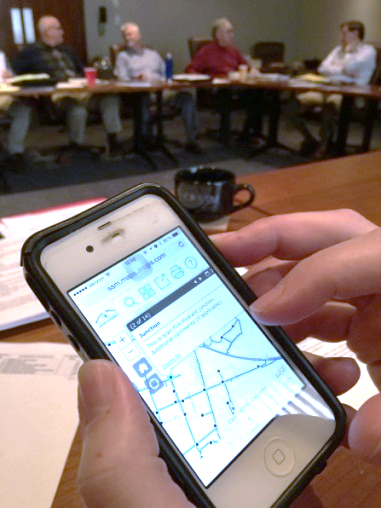
In action the workflow is as follows: The Public Works members inspect signs to determine the condition of those signs and what signs are in need of replacement. All of the data collected (including photos) is stored in an online database with access through a management dashboard (photo above) which then assists the Township in ensuring proper timelines and maintenance of signs. The data also assists in proper planning of budgets for sign replacements and repairs in future years.
Deployment of this application is the second phase of the Township’s GIS program - initiated with stormwater inspection and being followed by sewer/sewer manholes.

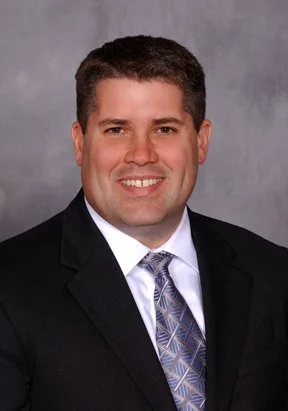
Andrew J. Wengerd, PE, CFPS, LEED AP Named Manager, Mechanical Engineering
Andrew Wengerd has transitioned into the role of Department Manager.

ANDREW WENGERD, PE, CFPS< LEED AP
Andrew Wengerd has transitioned into the role of Department Manager. In this role he will be responsible for daily operations of the Mechanical Engineering department and execution of the department’s strategic assignments. His experience includes design of heating, ventilating and air conditioning systems for industrial, commercial, educational, and semiconductor facilities. He has experience in design and project management for a variety of projects as well as experience in system start up and testing services. He has prepared reports analyzing existing systems and evaluating new systems and products. These reports contain calculations, analysis, recommendations, cost estimates, and energy estimates. In addition to HVAC design, Mr. Wengerd also has several years’ experience in the fire protection field. He has performed several sprinkler system layouts, hydraulic calculations, and fire pump selections. He has also experience evaluating city water supplies for capabilities in supplying new and existing buildings.
Geographic Information Systems and Asset Management
SSM provides professional GIS services to municipalities; from mapping support for infrastructure projects, to focused GIS and data capture projects. SSM’s GIS Asset Management approach helps municipalities to transform sewer infrastructure data into an easy-to-use operations asset management system capturing vital infrastructure data points with survey-grade accuracy. The data is verified and compiled into a geo-spatial database.
SSM provides professional GIS services to municipalities; from mapping support for infrastructure projects, to focused GIS and data capture projects. SSM’s GIS Asset Management approach helps municipalities to transform sewer infrastructure data into an easy-to-use operations asset management system capturing vital infrastructure data points with survey-grade accuracy. The data is verified and compiled into a geo-spatial database.
GIS Database Development
GIS Training
ArcGIS Online Implementation
Mobile Application Design
Field Data Collection
Survey Grade GPS Collection
Customizable Inspection Forms
Field Inspection Reports
Document Management
Sewer Manhole Inspections through Integrated Mobile GIS Technology
Traditionally sanitary sewer manhole inspections are conducted by field inspectors, filling out a blank inspection report form, using pen and paper. Utilizing mobile GIS technology, the process can be streamlined, eliminating the need for paper forms and clipboards. A customized manhole inspection app guides the inspector through a series of questions where answers range from yes/no or multiple choice to free-form responses. Working directly with the collection system’s existing GIS data, the inspection app pulls manhole information (such as manhole ID#) into the form, and when complete, pushes the collected information back into the GIS. If the system does not have GIS already in place, the manhole inspection app can be used to initiate system-wide GIS implementation.

Case Study: GIS Mapping for Sanitary Sewer Rehabilitation and Investigation
SSM provided assistance to the Norristown Municipal Waste Authority (NMWA) for over 15 years for compliance with a PA Department of Environmental Protection Consent Order and Agreement to eliminate combined sewer overflows (CSOs) and excessive Inflow/Infiltration from the sewage collection system. SSM performed extensive Inflow/Infiltration (I/I) investigations and program management, including manhole inspections, building and outside property inspections, and some smoke and dye testing of roof leaders, foundation drains and parking lot storm drains.
SSM prepared and calibrated the hydraulic model of the Authority’s 60-mile sanitary sewer collection system and performed Sewer System Evaluations and cost-benefits analysis for various projects, including alternatives analyses for several sewer rehabilitation projects. SSM also prepared an extensive conceptual design and analysis of alternatives for the WWTP.
SSM provided extensive GIS Mapping of the NMWA’s sanitary sewer collection system to include 60 miles of sanitary sewer. The GIS database was used to prepare and calibrate a hydraulic model of the sewer system and to provide maps for use in Inflow/Infiltration (I/I) investigations and program management, including flow metering locations (pre- and post-rehabilitation), manhole inspections, building and outside property inspections, some smoke and dye testing of roof leaders, foundation drains and parking lot storm drains. GIS database management was utilized in order to map the results of televising investigations and flow metering, as well as to provide recommendations for non-invasive inflow reduction methods for property owners. SSM provided guidance to NMWA staff for collecting data from property surveys which was then incorporated into the GIS database. This mapping was later incorporated into the NMWA’s Combined Sewer Overflow - Long Term Control Plan for submission to the PA DEP, including the Nine Minimum Controls update for CSO 003.

Spottlight on Winter Tips
From simple tips like the most environmentally-friendly way to clean up a snowstorm, to the most energy-efficient way to heat your home - we’ve collected several resources for you for this month’s Spottlight.

Welcoming Winter
Shovels: out, hibernation mode: on. Sweater weather: here. As we embark on another annual winter season, we recommend you make time for a few proactive steps that could save you a lot this season. From simple tips like the most environmentally-friendly way to clean up a snowstorm, to the most energy-efficient way to heat your home - we’ve collected several resources for you for this month’s Spottlight. Because after all, less time you have to worry about keeping your family safe and warm means more time to enjoy making snowmen and snowballs. (Or cozying up with a blanket and a book).


In celebration of Agriculture, we highlight the collective efforts of the local farmers and the Schuylkill Action Network (SAN) to improve water quality in Berks County.