Implementing UV Filtration & Reconfiguring Your Space
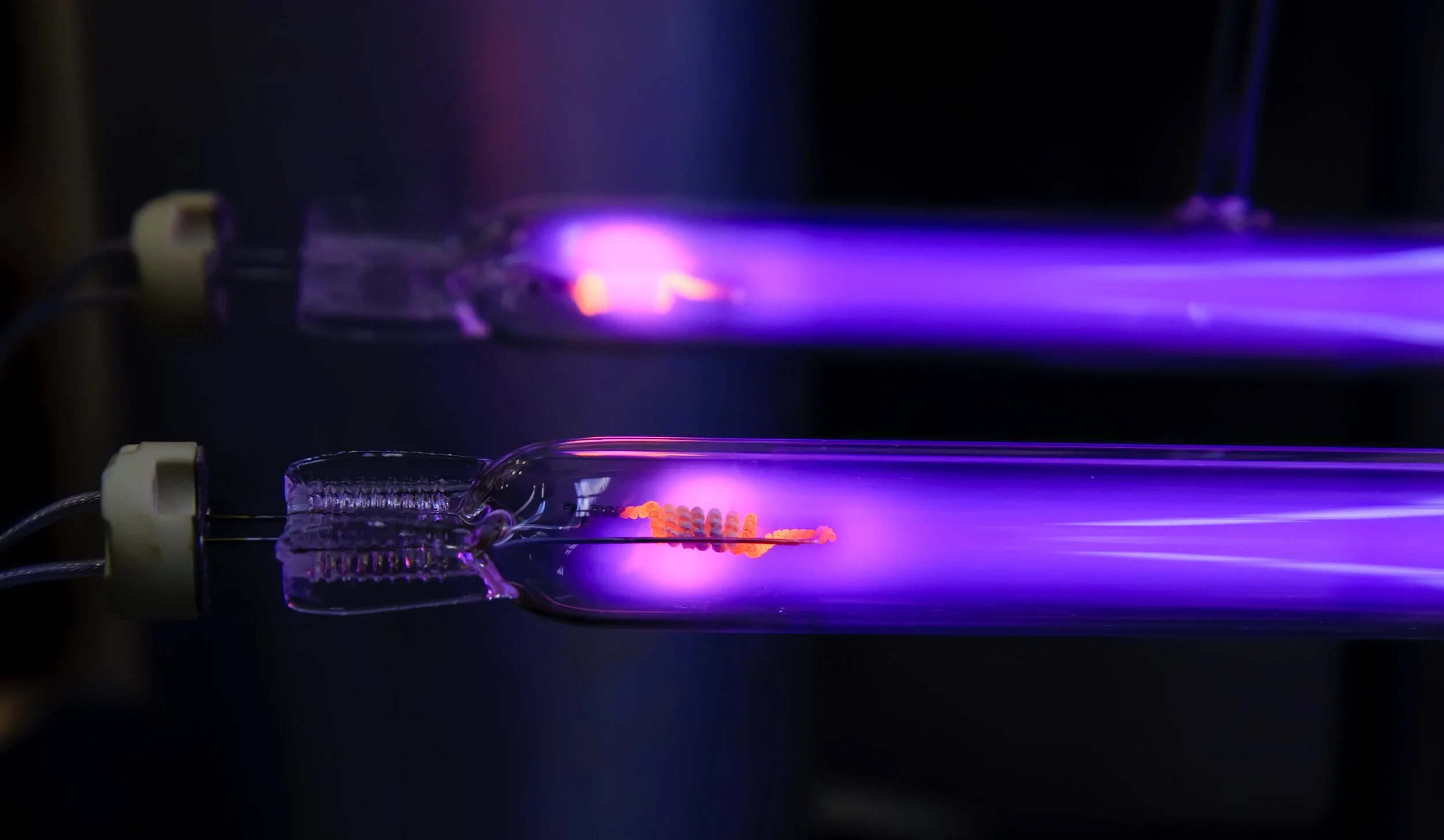
When bringing operations and employees back to the facility, air quality is of the highest priority. Ultra-Violet (UV) filtration is an additional area in which we see options for facility managers to use their HVAC system to improve air quality and decrease contaminants and toxins.
Implementing UV Filtration
When bringing operations and employees back to the facility, air quality is of the highest priority.
Ultra-Violet (UV) filtration is an additional area in which we see options for facility managers to use their HVAC system to improve air quality and decrease contaminants and toxins. While UV has become a popular conversation for facility and operations managers, make sure that you are working with a team that can implement it appropriately and effectively for the needs of your specific organization.
UV filtrations are a common offering and can be added to almost any air handler. Adding UV filtration is also an easy adjustment to your system in the sense that it does not require much reconfiguration to implement. While the addition of UV treatment does require some additional electric power, typically a few amps at 120 V, it is a very low pressure drop add to the fan system meaning a change to the air handler fan motor is highly unlikely and the additional cost of operation miniscule.
We know that UV is very effective for eliminating mold and viruses. We’ve actually helped get some of these systems up and running in water treatment plants.
But an important factor is making sure your employees are not exposed to the UV light. This can cause many issues and risks. Our suggestions are to first and foremost, run UV filtration through duct work.
If you are using a recirculating UV system located within the occupied space, we recommend using it when space is unoccupied. An easy tip is to create a “cleaning” schedule for spaces so that UV can work while other parts of the building are being used, or when the building is closed.
A great decision is walking through your options and finding the best fit for your facilities, employees, and budget. Moving forward with mindful and meaningful changes means creating a healthy place for people to work. This isn’t one size fits all- it’s about you, your people, your place- and doing what works for you.
Reconfiguring the Workplace
Don’t forget: reconfiguring your workspace may have a significant impact on your HVAC system.
You may be planning to reconfigure your partitioned office space, or any workspace within your facility. Keep in mind that this will change the airflow of the workspace which not only has an impact on your HVAC system and comfortability, but also the health of your employees. Consider this a priority when re-evaluating how your space will function. We’d be happy to talk through what the reimaged airflow looks like, and how you can best utilize your space.
New ventilation requirements for HVAC systems might also impact the current equipment you have, as for many the current equipment won’t be able to handle the load. Designing a more sophisticated system that uses a higher level of design and more outdoor air, might be a good option. While this is not always as energy efficient as we’ve seen in the past, we can still design the new standards to be as efficient as possible and healthy for employees.
The priority is to remember HVAC’s role in the health and functioning of your facility. Too often, HVAC becomes an invisible thing that we forget needs to be cared for, upgraded, and utilized to the best of its capacity. Think forward to what you can do to best take care of your people, and your building.
#ProblemSolved: Our Mechanical Engineering Team is here to help. If you have questions, send an email to Bruce Bell, Director at bruce.bell@ssmgroup.com or give a call to 610-898-3079

HVAC’s Role in Mitigating Virus Contaminants
In light of the COID-19 pandemic, The American Society of Heating, Refrigerating, and Air-Conditioning Engineers (ASHRAE) has assessed the role HVAC systems have in the propagation and mitigation of airborne contaminants. ASHRAE, and other similar organizations, have recently released papers discussing the subject. As an engineering company that delivers HVAC design services, SSM is providing a summary of the findings for consideration.

By Bruce Bell, PE- Director, Mechanical, Electrical and Plumbing Engineering
Summary of ASHRAE findings on HVAC’s role in propagation and mitigation of airborne contaminants.
In light of the COVID-19 pandemic, The American Society of Heating, Refrigerating, and Air-Conditioning Engineers (ASHRAE) has assessed the role HVAC systems have in the propagation and mitigation of airborne contaminants. ASHRAE, and other similar organizations, have recently released papers discussing the subject. As an engineering company that delivers HVAC design services, SSM is providing a summary of the findings for consideration.
In discussing the potential for airborne spread of viruses, the ASHRAE position document states, “HVAC systems may contribute far more both to transmission of disease and, potentially, to reduction of transmission risk.”
The role of HVAC systems in transmission of disease is obvious. The system circulates all of the air that we breathe. This includes the contents of the air that we exhale.
HVAC Design
Typical HVAC design (for all but medical, R&D facilities, and manufacturing with environmental requirements) meets the code-mandated fresh air requirements and provides standard air filtration which captures some airborne contaminants.
This typical design is intended to meet the minimum requirements. Exceeding those requirements adds cost to construction and operation of the system. Similarly, we usually design systems to provide an occupied space with temperature and humidity that complies with the ASHRAE 55 guidelines.
Fresh Air Ventilation
In specific regard to reducing transmission of disease, the first and most obvious approach is to increase the amount of fresh air introduce for occupants.
Historically, guidelines and codes have varied necessary quantities from lows of 5 cubic feet per minutes (cfm) per person, to 20 cfm per person. It is anticipated that reviewing these guidelines will again be a primary consideration of governing bodies moving forward, in light of the COVID-19 pandemic.
The ASHRAE position document states,
“Ventilation represents a primary infectious disease control strategy through dilution of room air around a source and removal of infectious agents (CDC 2005) [(…) However, it remains unclear by how much infectious particle loads must be reduced to achieve a measurable reduction in disease transmissions and whether the efficiencies warrant the cost of using these controls. Energy-conserving strategies that reduce annualized ventilation rates, such as demand-controlled
ventilation, should be used with caution, especially during mild outdoor conditions when the additional ventilation has low cost. Greater use of air economizers has a positive impact both on energy conservation and annualized dilution ventilation.”
It is evident that ventilation is a primary focus in reducing transmission of disease. Increasing ventilation should be reviewed with consideration for effectiveness as well as energy conservation and cost.
Air Filtration
A second area with the potential for great impact is filtration. Use of HEPA filters and those with even higher filtration capabilities can be employed as well as Enzymic Bactericidal filters and Ultra-Violet treatment of the airstream.
Utilizing enhanced filtration with efficient filters presents itself to be a viable, and energy-conscious option, as well as UV disinfection systems. As noted with ventilation, consideration should be given to effectiveness, capacity, energy consumption, and costs.
Temperature and Humidity
Recent studies are also focusing on the effect of temperature and humidity and their impacts on disease.
On April 2, 2020 FacilitiesNet reported,
“Yale researchers have been able to pinpoint the three ways relative humidity levels between 40 and 60 percent helps to improve resistance to respiratory infection. First of all, the dryer the air the clearer the path is for airborne viral particles, say researchers. Secondly, the function of cilia, which sweep out viral particles from the lining of the airway, improves with a higher relative humidity. And the immune system response is also boosted with higher humidity.”
ASHRAE’s position report also references one study that found influenza infectivity to be higher (71% to 77%) among low relative humidity (23%). Similarly, the reference points to inactivation (infectivity of 16% to 22%) at higher relative humidity (43%) rapidly after coughing.
Forbes magazine featured an article in 2019 noting a study by Harvard Medical School lecturer, Pediatric Oncologist and molecular biologist Dr. Stephanie Taylor. Dr. Taylor and her colleagues studied close to 400 hospital patients, trying to narrow down the root cause of their hospital infections. They looked at everything from the number of visitors to hand hygiene.
After a second analysis, one factor stood out: when indoor air was dry, as it tends to be in the winter, infection rates went up. Dr. Taylor's research found the ideal humidity levels for indoor air range between 40 and 60 percent relative humidity. Dr. Taylor also points to a study at the Mayo Clinic involving a preschool where half of the school was given humidifiers in the winter, and half were not. They specifically were tracking flu rates and found that in the humidified half of the school, the absenteeism rate dropped by about 66 percent.
Note that ASHRAE “does not make a broad recommendation on indoor temperature and humidity for the purpose of controlling infectious disease.”
It is our recommendation for building owners to utilize existing systems with humidification capacities, or to add humidification to existing systems. This is an upgrade that can be done that does not require an increase to the unit capacity for cooling/heating.
Overall Conclusions
The ASHRAE position document makes several recommendations of which we present one below:
Building designers, owners, and operators should give high priority to enhancing well-designed, installed, commissioned, and maintained HVAC systems with supplemental filtration, UVGI, and, in some cases, additional or more effective ventilation to the breathing zone. Filtration and UVGI can be applied in new buildings at moderate additional cost and can be applied quickly in existing building systems to decrease the severity of acute disease outbreaks. Indoor Air Quality Guide (ASHRAE 2009) contains information about the benefits of and techniques for accomplishing these enhancements.
We understand that each of these approaches has an associated construction cost. Additionally, the cost of operation of the HVAC equipment will increase as improved filtration with higher pressure drops necessitates more fan horsepower, treatment of larger amounts of fresh air increases the load on HVAC equipment, on top of addition of humidification systems. SSM can assist in the evaluation of your existing HVAC systems, including their capability for employing air treatment strategies and providing the design for implementation of those strategies.