
Infrastructure: the underlying foundation or basic framework (as of a system or organization)
There will never be a replacement for face-to-face human connection. Here lies the power of developing social infrastructure.
Where did you meet your last friend? Really, stop and think about it. Where exactly did you meet? What did you connect on? Think about the friends you spend Saturday nights with or the ones you invite to your Memorial Day picnic. Where did they come from? Your answer might be “she’s a mom friend - our kids go to daycare together”. Or maybe you met at church. Maybe it was a soccer game- or was it a yoga session in the park?
Think about it and then pause. How did you end up chatting with that other mom at daycare? What brought you to yoga in the park? How about the soccer game - did those bleachers encourage you to start talking to the guy next to you? We want to take a second to consider the infrastructures that allow these person-to-person connections to form.
Yes, we said infrastructures. No, we aren’t going to try to convince you that roads and rivers are the reason you have friends. What we’re actually talking about is social infrastructure. These are spaces intentionally designed to support the formation of human connections and interactions. Social infrastructures are the places where human bonds are formed. They are the spots where relationships begin and where human interaction is created.
Social infrastructure is the public library where you and another dad bond over ponytails and braids with your daughters. This space was designed to give you access - access to resources and access to relationships. Social infrastructure is the dog park where you and another dog mom compare notes on indestructible toys. This space was designed to help you relax and it was designed to help you relate. It is the amphitheater where you enjoy a summer concert, the coffee shop where you spend your day off, and the park where your kids finally run out of energy.
We’re living in a world where technology has challenged what we know about social connections. In some ways we fear our constant connection. In other ways, we fear our disconnect.
There will never be a replacement for face-to-face human connection. Here lies the power of developing social infrastructure.
Public libraries, athletic fields, dog parks, playgrounds, and even schools- these are where we make our friends. Community gardens and green spaces- they bring people into the public space. Sidewalks, courtyards, walking trails- they all invite people to come together. These are the places where we gather. These are the places where we form social bonds.
It’s about more than just donating to the local library. It’s also about being innovative. It’s about finding ways that we can create accessible opportunities for humans to interact. Plus, standard infrastructure systems no longer need to be just standard. Instead, we can build social infrastructure into these systems. Our bridges can incorporate walking trails. Our waterwalls can be built into exploration classrooms. Even planned open spaces- let’s create a community garden.
Social infrastructure is diverse in its nature. It varies to meet the needs of many populations. There are opportunities that offer brief social interactions- like chatting at a dog park or sitting next to someone on a subway. There are also deep connection opportunities- like programs at a public library or parent events at a daycare center. Regardless, what all of these offer is a sense of involvement, an opportunity for relationship, and a door open for human connection.
Enhancing and protecting social infrastructures allows us to no longer fear losing person-to-person interaction- but relish in the opportunities we have to build new, long-lasting relationships.
Technology
The Scott Outdoor Amphitheater is a free outdoor structure, offering a space for human connections to occur year-round. Like many amphitheaters, it is a space for people to come together, communicate, and connect. Events held in amphitheaters invite social interactions and establish personal relationships. Every year, rain or shine, the Swarthmore commencement is held in this very space.
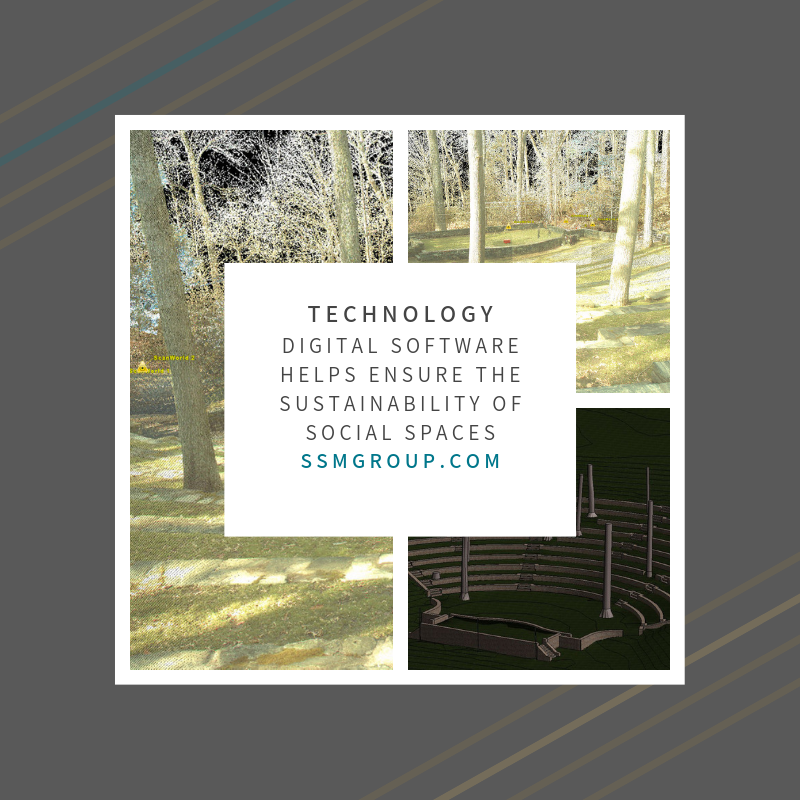
Digital software helps ensure the sustainability of social spaces.
The Scott Outdoor Amphitheater of Swarthmore College
Technology is not a competitor of social infrastructure, but a partner. SSM used surveying technology to help Swarthmore College pursue improvements to their 50-year-old outdoor amphitheater. Using high-definition laser scanning software, SSM was able to capture the existing structure and landscape in a digital, 3-D version. This capture was then available for the project team to design potential renovations to the amphitheater and view the effects of their design on the existing landscapes.
The Scott Outdoor Amphitheater is a free outdoor structure, offering a space for human connections to occur year-round. Like many amphitheaters, it is a space for people to come together, communicate, and connect. Events held in amphitheaters invite social interactions and establish personal relationships. Every year, rain or shine, the Swarthmore commencement is held in this very space.


Intent
Spaces such as courtyards are free; they are accessible; they nurture human-to-human relationships. Use of inviting scenery and purposeful design enhance and promote the social opportunities that courtyards provide.
Being purposeful in decision making ensures all social spaces meet the need of the community.
Courtyard Marriott
There is intention integrated into all of our social spaces. Consider the Marriott Courtyard within Wyomissing Square. SSM assisted with construction document preparation for site design. SSM also assisted with the planting plan, construction details, locating utilities, as well as grading and drainage. The design decisions within even these small spaces matter.
This intentional design within Wyomissing Square invites guests to come together. Spaces such as courtyards are free; they are accessible; they nurture human-to-human relationships. Use of inviting scenery and purposeful design enhance and promote the social opportunities that courtyards provide.


Simplicity
Welcoming sidewalks and street spaces foster a sense of community and engagement within a public space. By enhancing their streetscapes, Oxford Borough invested in the social engagement of their residents and their visitors.

Design of simple spaces can hugely influence the relationships that are born there.
Oxford Borough
Simple spaces- such as the sidewalk outside of your home, or the grass knoll in the center of town- transcend the basic thought. SSM worked with Oxford Borough, in Chester County, to prepare preliminary and final design plans/specifications for streetscape enhancements. Enhancements included crosswalks, curb designs, pedestrian bump-outs, and design of sidewalks. Enhancements also included planters, benches, and street lights.
Welcoming sidewalks and street spaces foster a sense of community and engagement within a public space. By enhancing their streetscapes, Oxford Borough invested in the social engagement of their residents and their visitors. Making streetscapes accessible, safe, and welcoming invites positive social interactions to occur.

Attention
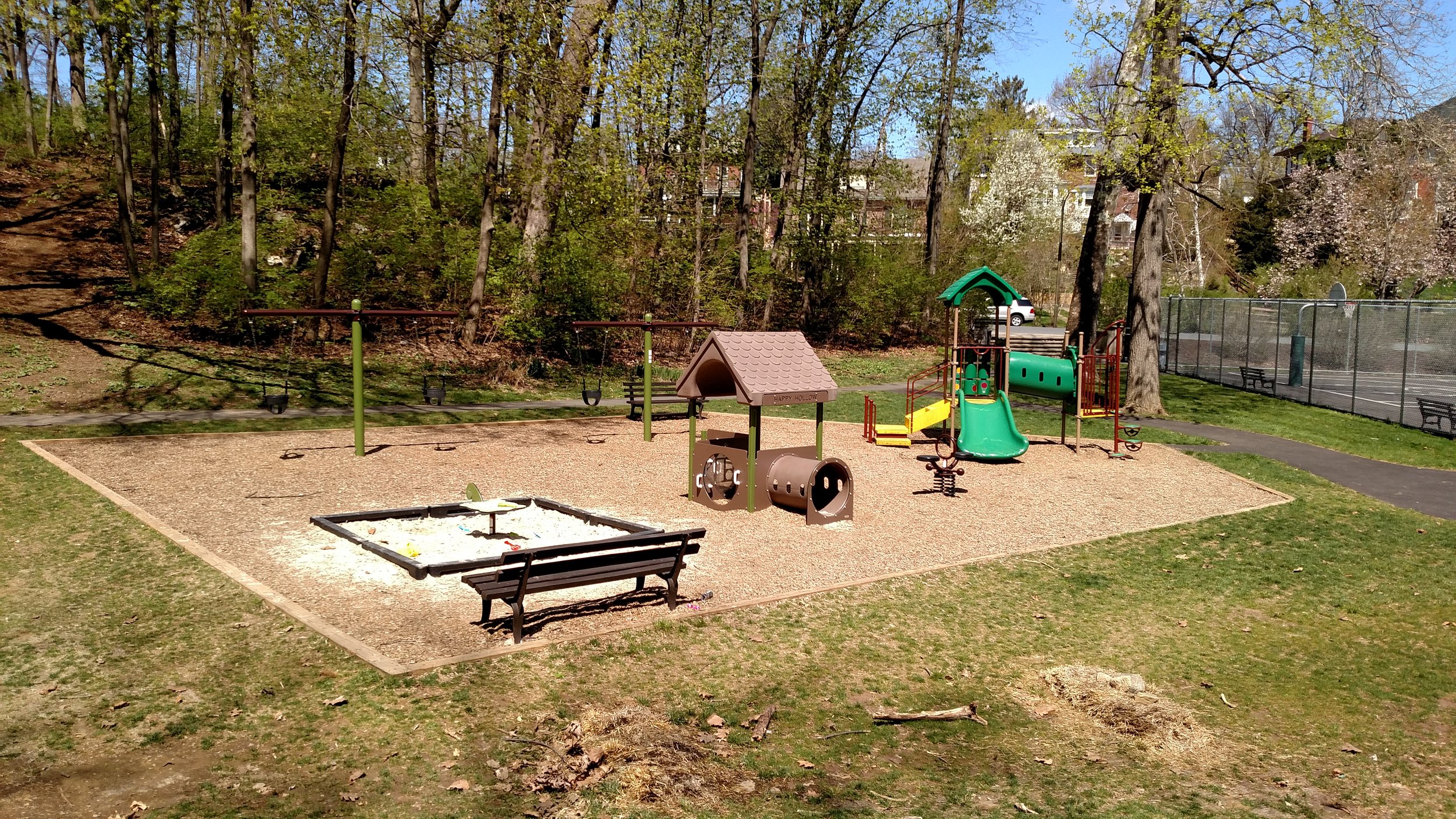
Community parks that offer many social spaces to enjoy create opportunities for many social relationships to form. Wyomissing Borough’s care and attention to all of the needs makes for a comforting and welcoming place for all to enjoy.
Providing care and commitment to the needs of many people opens the door for diverse human connections.
Wyomissing Borough
Attention to the needs and wants of communities is the crucial component of social infrastructure. SSM worked closely with the Wyomissing Borough to develop and implement Conceptual Master Plans for 4 public parks. With each plan, SSM worked to ensure the objectives of the borough met the results of each park. Whether it be the goal of maintaining an old time feel, or the need to update the most used playground spaces- the finished products contain modern facilities for a wide variety of users.
Community parks that offer many social spaces to enjoy create opportunities for many social relationships to form. Wyomissing Borough’s care and attention to all of the needs makes for a comforting and welcoming place for all to enjoy.

Beautiful Spaces - making us healthier and happier
Research demonstrates that beauty, more specifically beautiful spaces, produce a positive emotional experience in the observer, enhancing feelings of joy and well-being.
“When successful, architecture allows for participation in meaningful action, conveying to the participant an understanding of his or her place in the world…it opens up a clearing for the individual’s experience of purpose.”
- Alberto Perez-Gomez, Director of History and Theory of Architecture at McGill University
Research demonstrates that beauty, more specifically beautiful spaces, produce a positive emotional experience in the observer, enhancing feelings of joy and well-being. Taking the role of beauty into account when considering design and architecture is crucial to its success as an experienced space. Beautifully designed spaces open up the way for people to feel engaged, included, and in a space that’s conducive to their feelings of health and positive sense of community.
What exactly does beauty contribute to health? Research also shows that there is a relationship between the perception of beauty and the impact of design on human health, well-being, and even behavior. This is the study of neuroaesthetics, which examines the psychological effects of beauty and aesthetics from the perspective of neuroscience. The research demonstrates that design with deliberate intention to incorporate beauty is actually imperative to human psychological well-being and has positive effects on learning, social behavior and emotional wellness. This proves that beauty plays a significant role in the mental health of building occupants. It grounds us in our environments, which perpetuates a shared sense of community, and in turn, heightens our feelings of calmness and emotional well-being.
Creating spaces that incorporate beauty in the design are integral to perpetuating a work/play-place culture that enhances human health and wellness.
Because beauty is rather subjective, it is vital to define what beauty means in a design context.
“Beauty is not aesthetics alone. Instead, beauty is the melding of functionality and aesthetics in just the right proportions to achieve the desired result.”
This must involve being fluid and constantly adapting design to incorporate and reflect different populations or communities and their specific cultural values and contexts. For example, using design elements that represent regional perspectives helps honor the history of the local community.
The goal for architects/designers is to create beautiful environments that adapt to local contexts, meet user needs and positively impact occupants. A well-designed space is not just something that individuals move through, but rather a key influence on occupant health, happiness and overall sensory experience.