

The Power of the Checklist
Utilizing checklists from other experts allows you to focus on what you know best and feel relief from battling the unknown. What’s your expertise? You should be spending most of your time doing just that.
Think about your days at work. What would you describe as the “best feeling in the world”? What is it that gives you that giddy feeling of joy and calmness all in one?
Maybe for you it is the feeling of relief, knowing one more thing is off of your plate. There is one less thing to worry about, to stress over, to contemplate. Maybe instead of relief, that best feeling in the world is accomplishment, it’s completing the job, or the task, or the assignment, or even the challenge. Maybe the best feeling in the world to you is consistency, knowing everything is under control, everything’s all done the same, every time, you never have to worry about it.
Maybe you’re sitting here thinking, like many of us, the best feeling in the world, isn’t just one. It’s when all of those things: relief, accomplishment, and consistency all happen at once.
Checklists. The incredibly simple, incredibly powerful tool that can do just that.
Relief that it will get done. Studies have shown that retention rates are 10% better if we write something down. By writing it down, you’re significantly increasing the chance of it happening. Feel relief that as long as it’s there, on your checklist, it will get done. Have trust in yourself again; write it down.
But checklists also offer a second opportunity for relief. Utilizing checklists from other experts allows you to focus on what you know best and feel relief from battling the unknown. What’s your expertise? You should be spending most of your time doing just that. Don’t reinvent the wheel. By locating and utilizing checklists related to your area of work, you’re giving yourself relief of the constant fear that you aren’t doing the steps correctly - that you’re missing something. Stop wasting time worrying. Start spending your time doing what you do best.

Accomplishment that feeds your brain. There are neuroscience studies that have concluded that when we cross out tasks as completed, our brain actually releases dopamine. Have you ever caught yourself in your office doing a little celebration dance when you get a job done? There’s something magical about being on a roll, that feeling helps you to keep going and get what feels like a million more things done. That’s your dopamine working. Crossing tasks off of our list provides a sense of accomplishment that feeds the pleasure senses and neurotransmitters in your brain, making you feel happy. Although, this may not be news to you. We all already know the happy feeling of a really great, productive day at work. Did you know having a checklist could help you feel that way more often?
Consistently good results. Many businesses develop checklists for essential processes like onboarding new hires, processing payroll, or checking compliance to prevent errors. In this case, checklists make sure that things get done the way they should, every single time. A good checklist provides your team with guidance, ensuring the same results, no matter who is using it, or what the morning looked like.
It’s time to take the pressure off of you. Stop worrying about when things will get done, who will do them, and whether or not they will be done correctly. Feel relief knowing it’s all taken care of. Feel accomplishment in being on the right path and crossing it off your list. And feel the power of consistency, knowing it will always be done correctly.
It’s time for you to spend more of your time being creative, productive, and efficient. You’re the expert in your field. Do what you do best.
FOR MORE INFORMATION:
Want to read more about the power of a checklist? Check out two of our favorites:
https://podcasts.apple.com/us/podcast/the-checklist-manifesto/id433442266?i=1000093292503

Checklist: Mold Prevention - Winter Preparations
Mold is a growing problem in buildings – no matter the season. Now is the time to plan ahead to avoid problems like mold and legionella.

Mold is a growing problem in buildings – no matter the season. Now is the time to plan ahead to avoid problems like mold and legionella.
Leaks and Drainage.
Address roof leaks and poor drainage areas around the building.
Clean and repair roof gutters to avoid ice dams.
Make sure the ground around your building slopes away from the foundation so that water doesn’t pond.
Housekeeping Training.
Avoid environmental quality problems with indoor air and watery systems by training on effective and appropriate means and methods of maintenance and cleaning procedures.
Establish Routine Flushing Cycle.
If portions of your plumbing system are used infrequently, establish a routine flushing program to prevent bacterial growth in your water system.
Check the Seals.
Make sure all the seals on the windows and doors are not compromised and are in good working condition. Act quickly if condensation appears on windows, pipes or walls inside the building. Dry out the area and determine if the source of the condensation is from a leak or the result of high humidity.

Checklist: Preparing your Wastewater Treatment Plant for Winter
Preventative Maintenance is a priority as the weather starts to turn cold.
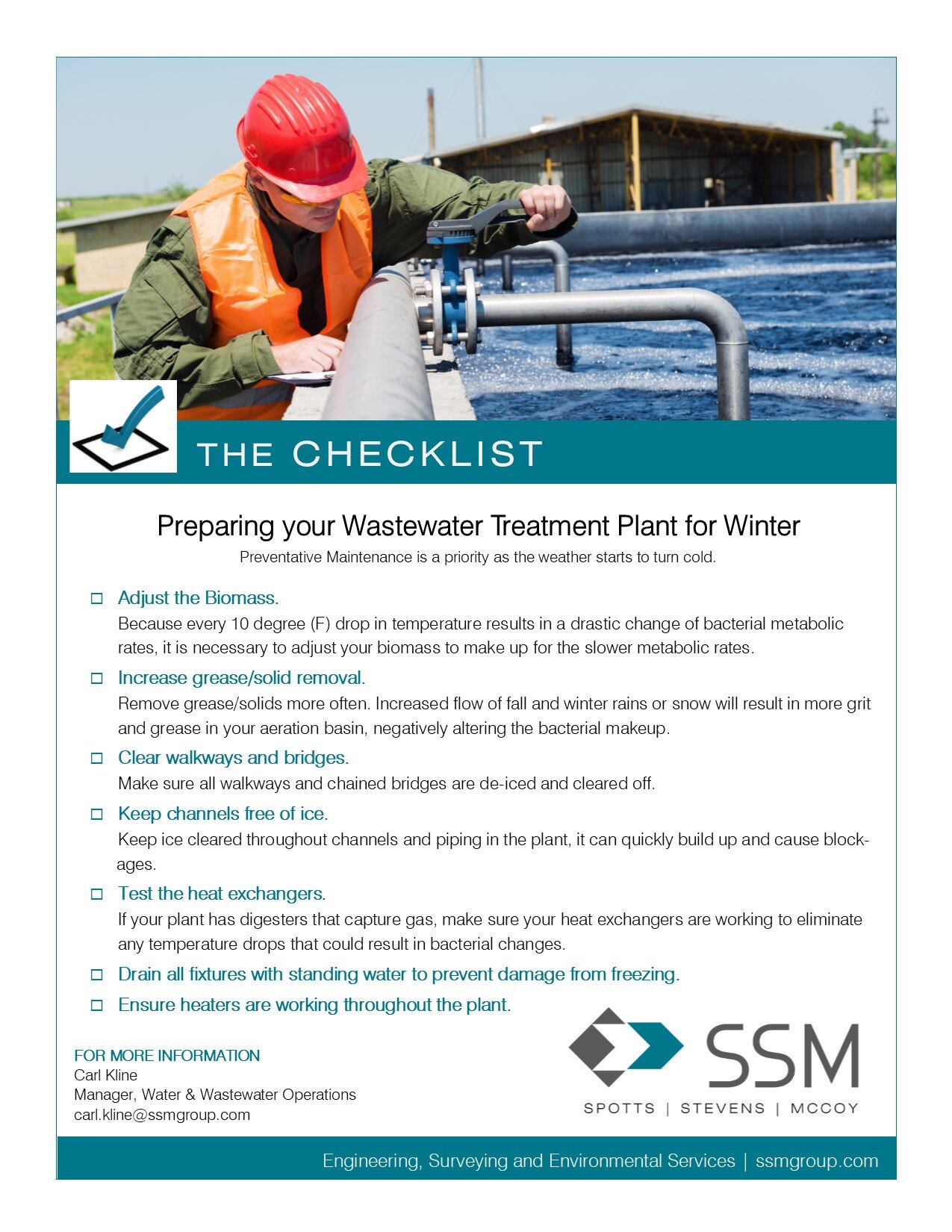
Preventative Maintenance is a priority as the weather starts to turn cold.
Adjust the Biomass. Because every 10 degree (F) drop in temperature results in a drastic change of bacterial metabolic rates, it is necessary to adjust your biomass to make up for the slower metabolic rates.
Increase grease/solid removal. Remove grease/solids more often. Increased flow of fall and winter rains or snow will result in more grit and grease in your aeration basin, negatively altering the bacterial makeup.
Clear walkways and bridges. Make sure all walkways and chained bridges are de-iced and cleared off.
Keep channels free of ice. Keep ice cleared throughout channels and piping in the plant, it can quickly build up and cause blockages.
Test the heat exchangers. If your plant has digesters that capture gas, make sure your heat exchangers are working to eliminate any temperature drops that could result in bacterial changes.
Drain all fixtures with standing water to prevent damage from freezing.
Ensure heaters are working throughout the plant.

Checklist: Mold Prevention - Summer Preparations
Minimize the potential for indoor air quality problems. As school lets out for summer — it’s the perfect time to begin preparing your buildings for the fall.

Minimize the potential for indoor air quality problems. As school lets out for summer — it’s the perfect time to begin preparing your buildings for the fall.
Work with teachers and staff to prepare classrooms for summer cleaning and maintenance.
Avoid environmental quality problems with indoor air and water systems by training staff on effective and appropriate means and methods for maintenance and cleaning procedures.
Maintain grounds and landscaping to avoid the introduction of contaminants to the indoor air environment.
Minimize conditions that lead to mold growth by operating building ventilation systems to maintain a constant temperature and humidity.
Eliminate the potential for growth of bacteria by maintaining appropriate procedures for your buildings water systems.
Check unoccupied areas frequently to avoid the propagation of mold.
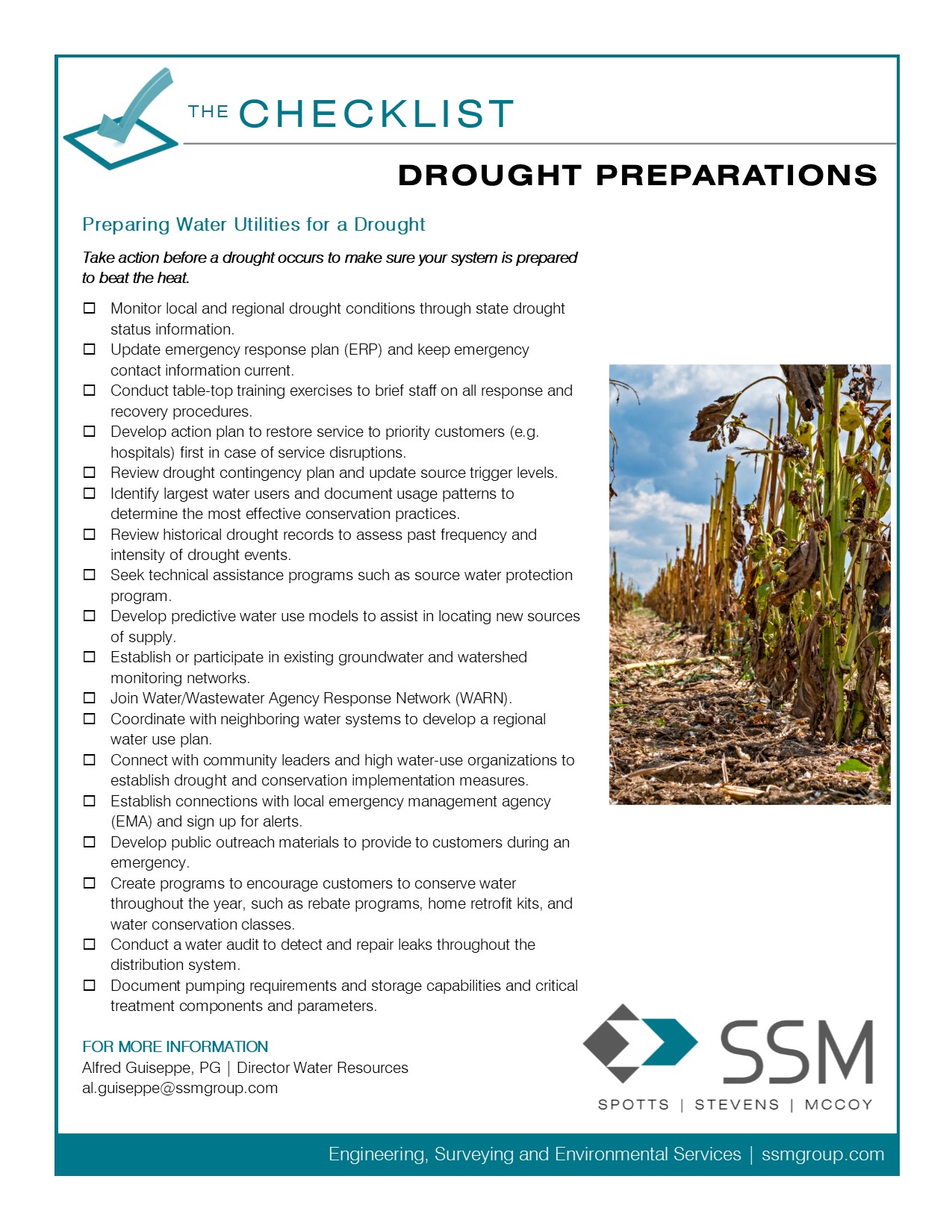
Checklist: Preparing Water Utilities for a Drought
Take action before a drought occurs to make sure your system is prepared to beat the heat.

DOWNLOAD THE CHECKLIST
Take action before a drought occurs to make sure your system is prepared to beat the heat.
Monitor local and regional drought conditions through state drought status information.
Update emergency response plan (ERP) and keep emergency contact information current.
Conduct table-top training exercises to brief staff on all response and recovery procedures.
Develop action plan to restore service to priority customers (e.g. hospitals) first in case of service disruptions.
Review drought contingency plan and update source trigger levels.
Identify largest water users and document usage patterns to determine the most effective conservation practices.
Review historical drought records to assess past frequency and intensity of drought events.
Seek technical assistance programs such as source water protection program.
Develop predictive water use models to assist in locating new sources of supply.
Establish or participate in existing groundwater and watershed monitoring networks.
Join Water/Wastewater Agency Response Network (WARN).
Coordinate with neighboring water systems to develop a regional water use plan.
Connect with community leaders and high water-use organizations to establish drought and conservation implementation measures.
Establish connections with local emergency management agency (EMA) and sign up for alerts.
Develop public outreach materials to provide to customers during an emergency.
Create programs to encourage customers to conserve water throughout the year, such as rebate programs, home retrofit kits, and water conservation classes.
Conduct a water audit to detect and repair leaks throughout the distribution system.
Document pumping requirements and storage capabilities and critical treatment components and parameters.

Checklist: Preparing Water and Wastewater Utilities for a Flood Event
Take action before flooding incident occurs to make sure your water or wastewater system is prepared to weather the storm.
Flooding is common throughout much of the United States and can be caused by heavy precipitation events, storm surge, levee or dam failures or inadequate drainage. These events often occur with little or no notice, and can cause extensive damage to drinking water and wastewater infrastructure.
Flooding impacts to utilities often include, but are not limited to:
Infrastructure damage, possibly resulting in service interruptions.
Pipe breaks due to washouts, which could result in sewage spills or low water pressure throughout the service area.
Debris blockage at an intake or unearthed water and wastewater lines due to falling trees.
Loss of power and communication lines.
Combined sewer overflows (CSOs).
Water quality changes to source waters and treated effluents, including increased turbidity, increased nutrients and other potential contaminants.
Restricted access to the facility due to debris, flood waters and damage to roadways from washouts and sinkholes.
Loss of water quality testing capability due to restricted facility and laboratory access and damage to utility equipment.

Take action before a flooding incident occurs to make sure your system is prepared to weather the storm.

Checklist: Fire Protection System Evaluation
Imagine the impact on your business or organization if a key production line were to go off-line for an extended period of time, if the runoff from a fire event were to cause an environmental impact, or if the assets in your building (from equipment to historical artefacts) were to be destroyed.
Fire Protection is Critical to Business Continuity
Fire protection systems are essential to the safety of your employees and protection of your property. But more than that, these systems are essential in helping you to manage the risks associated with business continuity. Imagine the impact on your business or organization if a key production line were to go off-line for an extended period of time, if the runoff from a fire event were to cause an environmental impact, or if the assets in your building (from equipment to historical artefacts) were to be destroyed.
An evaluation of your fire protection systems will identify potential risks within your facility or on your campus. The evaluation can address all potential threats from building and fire code compliance to safeguards like alarms, sprinklers, to inventorying the hazardous materials, to modeling the water flow to the hydrants.
Consider Your Facility/Campus
Are you in compliance with local fire codes? Is the fire suppression system in place aligned with the current function of your facility? We can help. Our team of mechanical, electrical and plumbing engineers are experienced in developing fire protection systems.
Emergency Water Supply is critical to Disaster Preparedness
Water supply interruption can be caused by several types of events such as natural disaster, a failure of the community water system, construction damage or even an act of terrorism. Because water supplies can and do fail, it is imperative to understand and address how your facility will be impacted.
PROJECT HIGHLIGHT: CARPENTER TECHNOLOGY CORPORATION
Emergency Water System Evaluation and Distribution System Mapping
SSM recently completed a Water System Analysis project that included preparation of drawings to depict the location of the various water supply mains, fire hydrants, and valves throughout the facility. As a follow-up to the Analysis, and using the data collected, SSM constructed a hydraulic model of the water supply system to simulate various demand and emergency supply scenarios.
