

New Water Quality Project Grant Program
The Department of Environmental Protection (DEP) announced the creation of a new water quality project grant program funded by the penalty assessed against the Mariner East 2 (MEII) Pipeline.
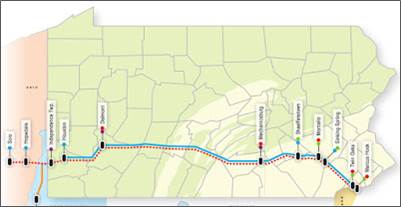
Grants will be awarded for projects that reduce or minimize pollution and protect clean water in the 85 municipalities along the length of the pipeline corridor.
The Department of Environmental Protection (DEP) announced the creation of a new water quality project grant program funded by the penalty assessed against the Mariner East 2 (MEII) Pipeline.
In February, DEP collected the $12.6 million penalty for permit violations related to the construction of the project. The penalty, one of the largest collected in a single settlement, was deposited into the Clean Water Fund and the Dams and Encroachments Fund, in accordance with the provisions of the Clean Streams Law and the Dam Safety and Encroachments Act.
Grants will be awarded for projects that reduce or minimize pollution and protect clean water in the 85 municipalities along the length of the pipeline corridor. These grants will be directed to the municipalities to eliminate pollution and protect the public from unsafe dams, water obstructions, and encroachments.
Eligible grant applicants include the 85 municipalities, county conservation districts, incorporated watershed associations, educational institutions, and non-profit organizations along the length of the MEII Pipeline. The 45-day grant application round will open May 7 and close June 21. DEP anticipates announcing the approved projects in the summer of 2018.
Examples of eligible projects include:
- Projects to improve water quality while enhancing community recreational opportunities, such as restoration and enhancement of natural water resource features at community parks and public properties, including lake restoration and wetland creation.
- Projects to educate future generations about water resource protection, such as demonstration projects that showcase pervious pavement, stormwater runoff management features and systems, bioretention systems, constructed wetland complexes, stormwater runoff collection and reuse projects, stormwater mitigation projects that reduce rate and volume and improve water quality on a school or other public property.
- Projects to improve and/or protect public drinking water sources and infrastructure, such as repairs to drinking water system source facilities that improve resiliency of the water supply, including water supply dam rehabilitation work and upgrades, and repairs to water treatment infrastructure and water intakes.
- Municipal Separate Storm Sewer System (MS4) projects to address rate, volume and/or sediment load, including flood-control project features and retrofits to existing stormwater runoff control infrastructure that reduce rate and volume of stormwater runoff.
- Projects that result in nitrogen, phosphorus, sediment load reductions within the Chesapeake Bay watershed and impaired waters, including stream buffers, stream restoration projects, wetland restoration or enhancement projects.
- Projects that result in water quality improvements in DEP Priority Watersheds and Impaired Watersheds within the 85 municipalities.
FOR MORE INFORMATION
Contact Spotts, Stevens and McCoy: Al Guiseppe, PG, Director, Water Resources
Visit DEP Informational Page:
Eligible applicants can apply via the Commonwealth of Pennsylvania Electronic Single Application website:
Visit Mariner East II Pipeline Webpage:
Contact DEP: R. Scott Carney, Chief Watershed Support Section - 717-783-2944


Governor's Award for Environmental Excellence
Governor’s Award for Environmental Excellence: Berks County Water and Sewer Association: Berks County Source Water Protection Program

Berks County Water and Sewer Association: Berks County Source Water Protection Program
Incorporating new and existing protection zones to maintain safe drinking water in Berks County, this program identifies possible sources of contamination for both surface water and groundwater. The program combines education and water quality improvements to the Chesapeake Bay and Schuylkill River watersheds and covers 266,000 people in Berks County.
The Governor’s Awards for Environmental Excellence are awarded each year by the Pennsylvania Department of Environmental Protection. Each year the Governor’s Awards for Environmental Excellence provide statewide recognition to businesses and organizations involved in a cross-section of environmental initiatives from cleaning up watersheds, saving energy, eliminating pollution, reducing waste and more. The awards highlight those projects that promote innovative technological advances, partnerships, public service and environmental outreach as well as encourage pollution prevention, demonstrate economic impact or employ innovative technology.

Berks County Source Water Protection Program
In 2017, the Berks County Water & Sewer Association and the Berks County Planning Commission completed a County-wide program to combine source water protection and stormwater management strategies that crossed both watershed and municipality boundaries. This program was selected to receive one of the 2018 Governor’s Award for Environmental Excellence by the Pennsylvania Environmental Council (PEC). These awards were presented at a banquet on April 26, with PA Department of Environmental Protection Secretary Patrick McDonnell as the keynote speaker.
Community water systems use a variety of surface waterways and groundwater wells and springs to provide safe, clean drinking water to about 70% of Berks County residents. To help protect the drinking water, these water systems and volunteers from other local agencies, organizations, and businesses worked with the Department of Environmental Protection and other partners to develop a source water protection program. Currently, 16 community water systems have a DEP-approved plan, 5 have plans-in-progress or have registered for the program. An additional 9 plans have also been developed for small systems like mobile home parks. Some of the program’s management strategies include public education, partnering with the Berks County Department of Emergency Services, and working with local businesses to reduce pollutants from entering the watershed.
Along with source water protection, the program will assist participants with some stormwater management solutions required by Municipal Separate Storm Sewer System (MS4) requirements. Staff from the Berks County Conservation District will provide ongoing leadership for the program, which will be funded through donations and fundraisers from the Berks County Water & Sewer Association, which plans to hold a golf tournament in September to support projects through the Berks Watershed Restoration Fund. A copy of the Executive Summary of the program is available on the Planning Commission website.
For more information on the Berks County Source Water Protection Program, please contact the program Coordinator, Kent Himelright.

NFPA 70E Arc Flash Risk Assessment
Although the duty to provide electrical safety in the workplace can be traced to the 1970 Occupational Safety and Health Act, updates and continual revisions to OSHA, National Electrical Safety Code (NESC) and the 2015 Edition of the National Fire Protection Institute (NFPA) 70E represent the basis for requirement for Arc Flash Risk Assessment (formerly a Hazard Analysis) and protective clothing and equipment. Updated Incident Energy Levels should be determined based on any system revisions and 2015 NFPA 70E requirements.

Although the duty to provide electrical safety in the workplace can be traced to the 1970 Occupational Safety and Health Act, updates and continual revisions to OSHA, National Electrical Safety Code (NESC) and the 2015 Edition of the National Fire Protection Institute (NFPA) 70E represent the basis for requirement for Arc Flash Risk Assessment (formerly a Hazard Analysis) and protective clothing and equipment. Updated Incident Energy Levels should be determined based on any system revisions and 2015 NFPA 70E requirements.
Implementing this in a facility generally consists of the following tasks:
- Arc Flash Risk Assessment Data Collection - Review existing data on the electrical distribution system, and survey existing electrical system to collect additional data required to perform a short circuit analysis and a device coordination review for the facility. Both are required to perform the Arc Flash Risk Assessment with the Incident Energy Analysis Method.
- Arc Flash System Modeling - Utilize field-collected data to develop electrical system software models of the electrical distribution. Examine various operating scenarios of the electrical system to determine the worst case personal protective equipment (PPE) requirements.
- Arc Flash System Analysis - Perform system analyses utilizing the Incident Energy Analysis Method, based on Institute of Electrical and Electronic Engineers (IEEE) 1584 “Guide for Performing Arc Flash Calculations” and NFPA 70E “Standard for Electrical Safety in the Workplace®”. Results will identify locations with high levels of incident energy. These are the areas which require PPE Category 1 and higher.
- Arc Flash Hazard Labels - Provide appropriate labels based on the as-surveyed conditions for the switchboard, distribution panels, motor control centers, subpanels, disconnect switches, control panels and transformers.
- Design for the installation of Arc Flash Mitigation Modifications recommended by the Arc Flash Analysis.
- Training of personnel in arc flash awareness or personal protection equipment (PPE) necessary at each location accessed by the technicians or other qualified personnel as determined by the analysis.