

Impact of Facility Management
Integrating place, people, systems, technology and process is no small task.


Integrating place, people, systems, technology and process is no small task.
Making sure that buildings and their services are functioning at peak levels is the mission of the facility manager and staff, and their list of responsibilities is probably filled equally between reactive and proactive measures to make sure the surrounding environment is in a suitable condition to work and thrive. No matter the size of the organization though, engaging outside facility engineering and environmental professionals to become trusted partners will alleviate some of the burdens of critical events and fulfilling strategic initiatives. Whether it’s an imminent compliance issue, or long-term planning, having access to additional technical assistance and experience in projects that may be seldom-done in-house provides real value. In addition to successfully completing projects within time and budget, measuring the success of facility consultants to provide value should include regular discussion of metrics that improve communication and project outcomes.
With the shift in workplace requirements like technological/social collaboration, flexible work/life balance, and sustainable practices to name a few, the role of the facility manager has an expanded reach and impact on the organization’s success.
- Corporate Culture - Aligning the facility goals with the business goals is an essential step. Facility management plays an integral role in the creation and sustainability of company and organizational culture. From team collaboration requirements to client expectations to employee amenities to sustainable practices the physical layout of the space has a measurable impact on the culture and atmosphere within an organization.
- Integrated Technology and Mobility - As a generation of employees that has grown-up with technology enters the workplace, the facility manager will face higher demands related to technology integrations. The facility manager will need to maintain and operate data centers, provide easily accessible connections and meet the expectation of minimal downtime. The traditional brick and mortar organization must be equipped with technology and expertise that will allow the facility manager to access building systems, records, vendors, and drawings on the go. A detailed asset management program provides today’s facility manager all the information at their fingertips.
- Business Intelligence - As a strategic partner in the organization’s success, the facility manager needs to make data-driven decisions. That means not only reducing costs in managing the operations, but also understanding the impact that facility decisions has on the overall business. Shifts in energy usage, temperature requirements, workflow processes have an impact on the facility requirements and the operational expenses associated with the facility.

Facility Planning: Aligning short, mid-, and long-term business plans
For facility managers, long-term planning may be as long as 20 years in the institutional world or as far-sighted as 10 years in the commercial field depending on the next fiscal downturn, acquisition or merger. Regardless of the cycle, aligning the facility plan with the company business plan is critical to meet the demands of human resources, sales and marketing, research, manufacturing, and of course, finance.


For facility managers, long-term planning may be as long as 20 years in the institutional world or as far-sighted as 10 years in the commercial field depending on the next fiscal downturn, acquisition or merger. Regardless of the cycle, aligning the facility plan with the company business plan is critical to meet the demands of human resources, sales and marketing, research, manufacturing, and of course, finance. With the additional factors of aging equipment, finishes and envelope, a master plan can provide the roadmap for implementing replacement, modifications and upgrades to support the corporate mission, all while these facilities remain online.
SSM recently completed a Mission Critical Facility Master Plan Update outlining the steps and costs to bring a 300,000 sf office and level 3/3+ data center hotel from its present condition based on circa 2005 watt densities to newly established goals. Having performed the existing conditions assessment, the team evaluated and recommended approaches to achieve the company’s goals maintaining operation of the site and service to its tenants. The effort considered use of floor space, central utility capacities, infrastructure, equipment End of Life (EoL) replacement, and changes in requirements and guidelines for critical data centers. The deliverable provided a phased approach for upgrading the facility’s power distribution, emergency standby power, UPS power distribution, and expansion and upgrading of the central chilled water plant and distribution system. A timeline was established inter-relating the EoL replacement of equipment, increase in power source capacity and distribution, and central cooling capacity and distribution so that growth and modifications were undertaken in steps that were coordinated and manageable. A timeline was established inter-relating the EoL replacement of equipment, increase in power source capacity and distribution, and central cooling capacity and distribution so that growth and modifications were undertaken in steps that were coordinated and manageable.
Goals were established that reflected immediate (plans on the books), short term (full fitout at probable densities) and long term (densities thought reasonably achievable within 20 years). The conditions assessment information was used to define the modifications that would be necessary to support those projects to be constructed in the immediate future and develop the timeline and phasing to support the increased watt density and increasing occupancy of the facility established with the client. A long range plan was also developed outlining the steps necessary to support the 20 year vision.
Making significant modifications to any facility is challenging. Making modifications to a facility that must remain on line with redundant capabilities and providing for growth at the same time extremely challenging. Further adding to the complexity of the development of the plan was the client’s commitment to EoL replacement of aging equipment to assure up time. The plan was developed overlaying the timelines for EoL replacement of equipment with the timeline for growth and timeline for system/infrastructure expansion to produce one master timeline to achieve the desired goals.

Tools for the Facility Manager
We are using drone technology, HDS and BIM on our projects to enhance our collaborative relationships for outstanding results.
Drones are a powerful solution for monitoring construction, capturing hard-to-reach details, and documenting infrastructure on expansive sites.
We are using drone technology, HDS and BIM on our projects to enhance our collaborative relationships for outstanding results. We can measure things that couldn't be measured before, capture images of existing conditions for future reference, bring information to your fingertips as well as create reference points for future site considerations.
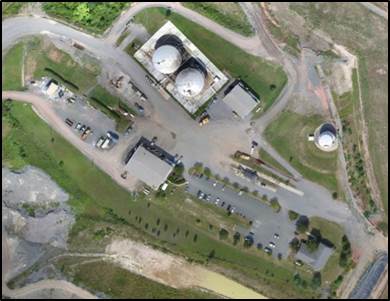
The view from above.
Identifying features on a project site slated for demolition and reconstruction at another location. The imagery from the software is clear at either 20 or 40 scale (1” = 40’).

Measuring design impact.
SSM utilized high definition laser scanning equipment and software to quickly and accurately capture the existing structure and landscape conditions for an Amphitheater Design at Swarthmore College. The Revit model and accompanying point cloud allows the team and owner to design and then view the effects their design will have on the multi-terraced levels, stone retaining walls and mature trees.

When access is limited.
The SSM civil and structural engineering team utilized high definition surveying to streamline a project with critical timelines for DeMet’s Candy Company. What started as a simple condition assessment of the exposed steel beams, led to in situ repairs of multiple beams, severely eroded foundations, casting new retaining walls and underpinning. The building literally spans over an active trout stream, which led to access issues for work and equipment. Potential stream impacts required proper documentation and permitting. All of the work was designed and carried out without the aid of heavy machinery. The largest piece of equipment that could gain access to the work area was a small skid loader.

Connect the Dots
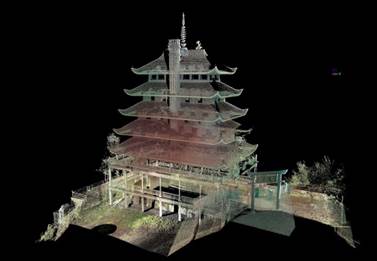
Despite the accuracy and speed, the widespread use of high definition scanning (HDS) for documentation of existing buildings has been hindered by the often asked question of “now what do I do with the point cloud?” Many HDS service providers can deliver a point cloud, but have limited experience in developing useful 2D or 3D models of all of the building systems, or the ability to create other useful visual tools for data analysis.
Connecting the dots, or technically speaking, the 3D coordinate data points, was a laborious, time-consuming exercise in the advent of the tool, but thanks to the integration of Point Cloud engines by major players like AutoDesk and Bentley, third-party software is quickly gaining maturity to allow more automated extraction of piping, structure and envelope. If the challenge of what to do with the Point Clouds was a deterrent to utilizing HDS, it’s worth a fresh look at the vastly improved work flows and deliverables.
Managing the Data Center
Are you faced with cool spots or hot spots? Are you providing more cooling than necessary? It may be time to focus on the details of air distribution and find out how a small change in air flow can affect your temperature.

Maximizing Efficiency and Reducing Operational Costs
Are you faced with cool spots or hot spots? Are you providing more cooling than necessary? It may be time to focus on the details of air distribution and find out how a small change in air flow can affect your temperature.
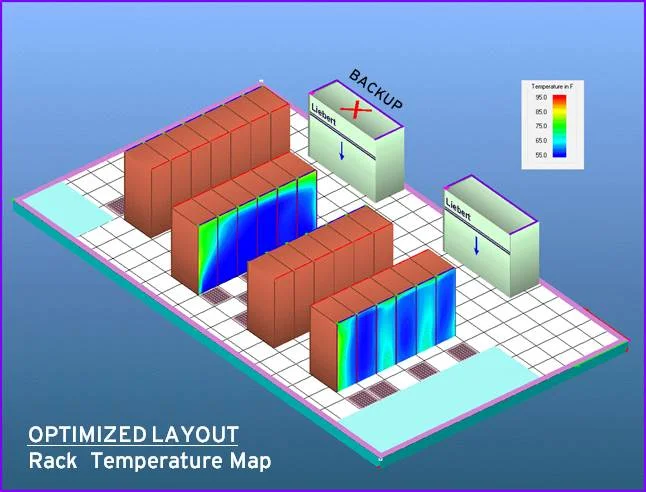
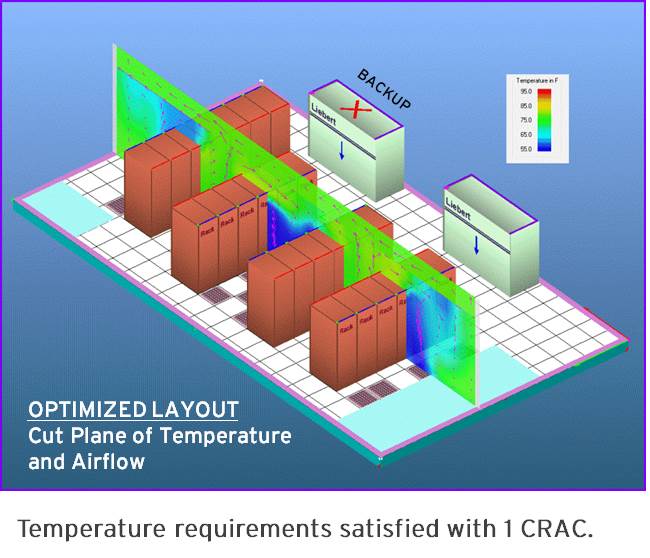
Our engineers utilize CFD analysis to optimize the cooling system and layout. The data power load and the cooling system are matched and arranged to achieve maximum energy efficiency. This keeps the cost of cooling both in equipment and operation down while maximizing the data load capability.
We create a model that replicates the physical data center layout including power densities and cooling equipment locations and capabilities and the analysis is run to determine the resulting temperatures and airflows in the space. Using programs specifically designed for use in analyzing air movement and heat transfer, we can create a virtual simulation of the conditions within a data center allowing the engineer to model different scenarios that may occur such as the failure of a cooling unit.
A Little Change can Make A Big Difference
- Maximize efficiency and reduce operational costs: Don’t buy more cooling than you need. Eliminate hot spots.
- Save energy and money: Properly cool your servers. Maximize your load density. Realize an efficient space layout.


Managing the Risk associated with Hazardous Materials
The storage, issue, use, and disposal of flammable and combustible materials falls under the rules and regulations promulgated under OSHA and the National Fire Protection Association.

The storage, issue, use, and disposal of flammable and combustible materials falls under the rules and regulations promulgated under OSHA and the National Fire Protection Association.
The Hazard Communication Standard
(29 CFR 1910.1200(g)) was revised in 2012 to require that the chemical manufacturer, distributor, or importer provided Safety Data Sheets (SDSs), formerly MSDSs or Material Safety Data Sheets, for each hazardous chemical to downstream users to communicate information on these hazards. The information contained in the SDS is largely the same as the MSDS, except now the SDSs are required to be presented in a consistent user-friendly, 16-section format.
The SDS includes information such as the properties of each chemical; the physical, health, and environmental health hazards; protective measures; and safety precautions for handling, storing, and transporting the chemical.
SDS Sections
- Identification. Identifies the chemical on the SDS as well as the recommended uses.
- Hazard(s) Identification. Identifies the hazards of the chemical presented on the SDS and the appropriate warning information associated with those hazards.
- Composition/Information on Ingredients. Identifies the ingredient(s) contained in the product indicated on the SDS, including impurities and stabilizing additives. This section includes information on substances, mixtures, and all chemicals where a trade secret is claimed.
- First-Aid Measures. Describes the initial care that should be given by untrained responders to an individual who has been exposed to the chemical.
- Fire-Fighting Measures. Provides recommendations for fighting a fire caused by the chemical.
- Accidental Release Measures. Recommendations on the appropriate response to spills, leaks, or releases, including containment.
- Handling and Storage. Guidance on the safe handling practices and conditions for safe storage of chemicals.
- Exposure Controls/Personal Protection. Indicates the exposure limits, engineering controls, and personal protective measures that can be used to minimize worker exposure.
- Physical and Chemical Properties. Identifies physical and chemical properties associated with the substance or mixture.
- Stability and Reactivity. Describes reactivity hazards of the chemical and the chemical stability information.
- Toxicological Information. Identifies toxicological and health effects information or indicates that such data are not available.
- Ecological Information. Provides information to evaluate the environmental impact of the chemical(s) if it were released to the environment.
- Disposal Considerations. Provides guidance on proper disposal practices, recycling or reclamation of the chemical(s) or its container, and safe handling practices.
- Transport Information. Provides guidance on classification information for shipping and transporting of hazardous chemical(s) by road, air, rail or sea.
- Regulatory Information. Identifies the safety, health, and environmental regulations specific for the product that is not indicated anywhere else on the SDS.
- Other Information. Indicates when the SDS was prepared or when the last known revision was made.
Employer Responsibilities
Employers must ensure that the SDSs are readily accessible to employees for all hazardous chemicals in their workplace. This may be done in many ways. For example, employers may keep the SDSs in a binder or on computers as long as the employees have immediate access to the information without leaving their work area when needed and a back-up is available for rapid access to the SDS in the case of a power outage or other emergency. Furthermore, employers may want to designate a person(s) responsible for obtaining and maintaining the SDSs. If the employer does not have an SDS, the employer or designated person(s) should contact the manufacturer to obtain one.
FOR MORE INFORMATION:
https://www.osha.gov/Publications/OSHA3514.html
