
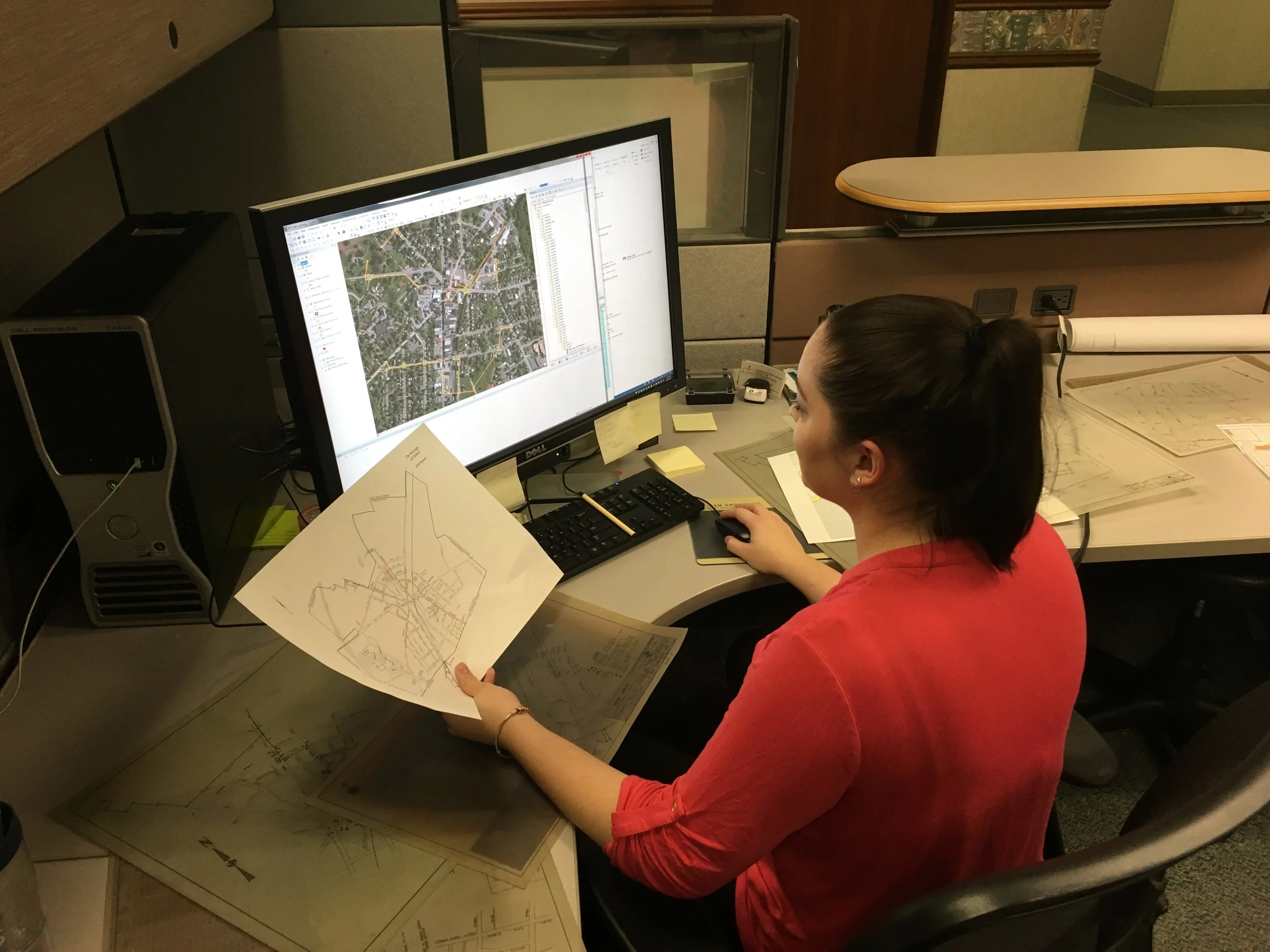
Digitizing Hard Copy Maps
Advancements in GIS software and mobile applications have recently provided the ability to access maps and data on the go.
For decades, public utility providers and municipalities have used paper maps to maintain and keep track of their assets. Too often, these bulky, hard copy maps are still being utilized today, but many of SSM’s clients are opting to digitize their utility maps. Advancements in GIS software and mobile applications have recently provided the ability to access maps and data on the go. This allows managers and operators to access asset locations, specifications, photos, and customized maps and applications wherever they take their mobile device. For many, digitizing old maps is well worth the process.
The process begins by scanning the paper maps. Once the maps are scanned as an image file, they are then georeferenced using GIS software. This assigns real world coordinates to the image, allowing the features to be traced as a shapefile. Depending on how old the map is, or how accurately it was originally created, some inferring may be required to correctly place the data. After the data is digitized, it’s best to verify the locations, as things may have changed since the maps were originally created. Now you can access the data whenever and wherever you need it via computer, smartphone and/or tablet.

Online GIS Applications: A low-cost Asset Management Approach
Many water/wastewater systems use online GIS applications to transform their infrastructure data into an easy-to-use operations asset management system.
Geographic Information Systems (GIS) emerged in the 1970s and became accessible enough for deployment within local government and utility companies in the 1990’s. For the past 20 years, municipal authorities were sold on the power of GIS in asset management. But after investment in the hardware, software, and data conversion, many small water and wastewater systems found themselves with a system that is not living up to their expectations. Cost-cutting measures may have relegated updating and maintaining the GIS data to in-house operators with whisper-down-the-lane training. Hesitant to invest in a poorly-understood system, but eager to capitalize on the benefits, small utilities are seeking a low-cost, effective asset management approach. Recent advancements in web-based GIS applications, similar to Google Earth, have provided new means to create, store, and access GIS data.
Many water/wastewater systems use online GIS applications to transform their infrastructure data into an easy-to-use operations asset management system. This low-cost approach captures vital data within a secure geo-spatial database. By creating customized mobile web applications, field-critical data (material description, installation date, inspection reports and service history) is available when needed most and accessible to operators in the office or in the field.
Large water utility companies have invested significant capital resources in data capture, mapping, and management of their system assets. The massive amount of the data is contained within a centralized enterprise GIS database and made accessible by credentialed users. Operation and maintenance of large GIS datasets are conducted by a full-time GIS department. Small water systems would benefit from the same access to a GIS database, but are unable to dedicate the resources necessary to collect and maintain the asset data. An online GIS approach uses a similar data model, but scaled down to the appropriate size to meet the financial structure of the system.
The process of building an online GIS data system begins with the conversion of as-built plans to geographic data. Old paper maps are scanned to an image file. Through a process of georeferencing, the map is given a map coordinate projection. The features of the map are digitized to populate the geodatabase with geometry and attribute features. The geometry features are the geographic locations of the features, such as the exact location a fire hydrant or the run of a pipe. The attribute features are the information that is associated with each individual asset. Everything from the manufacturer and serial number to maintenance and performance history can be associated with an individual piece of equipment. Notes and annotation from the paper maps, such as “turns right” on valves, can be added to the attribute features to preserve institutional information about the system. The resultant geodatabase can be completely customized to the needs of the individual system.
Once the geodatabase is built, the data is presented in the form of online map applications. The locational data is visualized on a variety of basemaps, be it parcel street maps (as example below) or areal imagery. Selecting a feature brings up the relevant information regarding that feature. The maps are accessible to any device with a connection to the internet. That means an operator in the field, using his smart phone or tablet, will have the same access to the system information as a manager, sitting in the office at his computer.

Seize an Opportunity
When condition dictates end-of-life replacement of HVAC systems, it offers an opportunity to consider retrofits that will enhance energy efficiency, capacity, control and service. Two recent projects illustrate this opportunity seized.
When condition dictates end-of-life replacement of HVAC systems, it offers an opportunity to consider retrofits that will enhance energy efficiency, capacity, control and service. Two recent projects illustrate this opportunity seized.
A recently completed $2.5M central plant upgrade was an End-of-Life Replacement project for 40-year old steam chillers supporting a 750,000 SF research center that increased the plant capacity from 5900 tons to 7300 tons (and the firm capacity from 4400 tons to 5400 tons) with an efficient system for greater service and better control. The project included the design for installation of a temporary chiller and cooling tower to support the building load during the full system shutdown for installation of the tie-ins of the new equipment.
A study was initially undertaken to determine the maximum cost effective capacity expansion for the plant; its purpose was to establish a limit for the cooling load that could be accommodated at the facility and then construct an energy efficient system to provide that capacity. The limiting factor was determined to be the distribution infrastructure due to cost prohibitive upgrades necessary to “max out” the distribution systems capabilities; therefore the increased plant capacity was designed to match the reasonable capacity of the main arteries of the distribution system. Almost $60,000/year of electric savings were achieved by installing a “free-cooling” system using condenser water during the winter months to create chilled water, reducing the chiller plant hours of operation from 8,760/year to 5,200/year and would allow a shutdown of the chillers during the winter. Including the free-cooling savings, the project reduced annual costs over 45%.
For a Mission Critical Data Center ($1.7M update) the need to replace the existing cooling towers that had reached their End-of-Life provided the opportunity to upgrade and modify the chiller plant to include “free cooling” by the condenser water system and to decouple the cooling towers and chillers to allow for more options in the operation of the chiller plant relative to redundancy resulting in $55,000 savings/year. An existing 3,000 ton cooling tower system was exchanged with new more efficient towers and a reconfigured
piping system to allow winter “free cooling” by the condenser water system. The system was designed to allow parallel operation of the cooling towers with one system in support of chiller cooling and another to operate as “free cooling” until full capacity “free cooling” was available. The design featured phased construction to maintain full site operation with N+1 component availability during the construction period. A new Sequence of Operation for the Condenser Water System and Chiller Plant for full automatic control by the Building Management System was prepared to provide for automatic reaction to a loss of system performance as required for a Tier 3 facility. In addition to the primary chiller and condenser water systems, a chemical treatment system was designed to provide year round treatment of the condenser water regardless of system operation in Chiller Cooling or Free Cooling mode.