
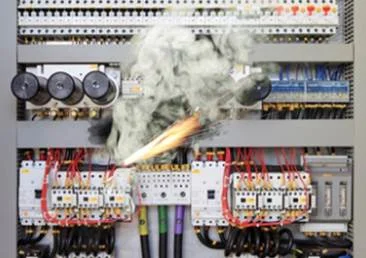
NFPA 70E Arc Flash Risk Assessment
Updated Incident Energy Levels should be determined based on any system revisions and 2015 NFPA 70E requirements.

Although the duty to provide electrical safety in the workplace can be traced to the 1970 Occupational Safety and Health Act, updates and continual revisions to OSHA, National Electrical Safety Code (NESC) and the 2015 Edition of the National Fire Protection Institute (NFPA) 70E represent the basis for requirement for Arc Flash Risk Assessment (formerly a Hazard Analysis) and protective clothing and equipment. Updated Incident Energy Levels should be determined based on any system revisions and 2015 NFPA 70E requirements.
Implementing this in a facility generally consists of the following tasks:
- Arc Flash Risk Assessment Data Collection - Review existing data on the electrical distribution system, and survey existing electrical system to collect additional data required to perform a short circuit analysis and a device coordination review for the facility. Both are required to perform the Arc Flash Risk Assessment with the Incident Energy Analysis Method.
- Arc Flash System Modeling - Utilize field-collected data to develop electrical system software models of the electrical distribution. Examine various operating scenarios of the electrical system to determine the worst case personal protective equipment (PPE) requirements.
- Arc Flash System Analysis - Perform system analyses utilizing the Incident Energy Analysis Method, based on Institute of Electrical and Electronic Engineers (IEEE) 1584 “Guide for Performing Arc Flash Calculations” and NFPA 70E “Standard for Electrical Safety in the Workplace®”. Results will identify locations with high levels of incident energy. These are the areas which require PPE Category 1 and higher.
- Arc Flash Hazard Labels - Provide appropriate labels based on the as-surveyed conditions for the switchboard, distribution panels, motor control centers, subpanels, disconnect switches, control panels and transformers.
- Design for the installation of Arc Flash Mitigation Modifications recommended by the Arc Flash Analysis.
- Training of personnel in arc flash awareness or personal protection equipment (PPE) necessary at each location accessed by the technicians or other qualified personnel as determined by the analysis.

More than the Air you Breathe
It has become apparent over the years, that more problems negatively affect building occupants than just poor Indoor Air Quality (IAQ).
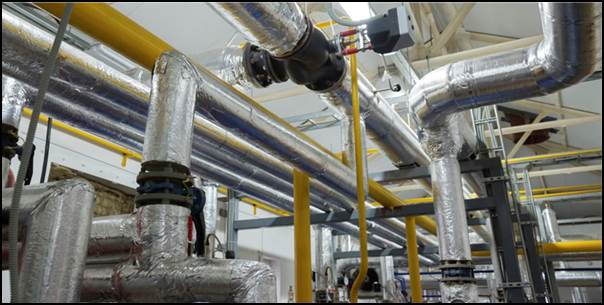
It has become apparent over the years, that more problems negatively affect building occupants than just poor Indoor Air Quality (IAQ).These additional problems can include but are not limited to structural issues, design and layout issues, mechanical issues, noise issues and even lighting issues. The inclusion of these additional factors in building occupant satisfaction has led to the use of the term Indoor Environmental Quality (IEQ), which can either simply include IAQ issues or be referred to in addition to IAQ issues.
Several of the factors mentioned above, specifically structural, design and mechanical issues, tend to directly affect air quality. Research has concluded that IAQ/IEQ factors not only affect the comfort and health of building occupants, but has also been shown to significantly impact student academic performance both directly and indirectly. Students are directly affected when their comfort and health levels are decreased, with their ability to learn and retain lessons also declining. Likewise, a teacher’s ability to teach and interact with their students decreases when their comfort and health levels are negatively impacted. Teachers and students spend a significant amount of time in their school buildings, in some cases more time than they spend at home; therefore, it is crucial that school administrators and facility managers recognize the importance of proactively addressing IAQ/IEQ issues in their school buildings.

Indoor Environmental Management Programs
We consider all environmental factors in our IAQ/IEQ management programs to include building structure, materials, construction activities, and heating, ventilation, air conditioning (HVAC) systems, as well as the building occupants activities, the cleaning and maintenance of the building and sources originating outside the building that have the potential to impact indoor air quality.

At SSM, we consider all environmental factors in our IAQ/IEQ management programs to include building structure, materials, construction activities, and heating, ventilation, air conditioning (HVAC) systems, as well as the building occupants activities, the cleaning and maintenance of the building and sources originating outside the building that have the potential to impact indoor air quality. Our program is designed to recognize how systems work together within the built environment to improve indoor air quality and create a Satisfactory Work and Learning Environment (better than Satisfactory is our goal!).
A customized IAQ/IEQ Management Program may be exactly what your school needs to ensure you’re providing a safe learning environment for your staff and students. SSM’s health & safety professionals and engineering staff have developed a comprehensive Indoor Environmental Management Program to address these issues. As no two schools are ever quite the same and even two similar schools may have very different issues, the program is intended to be customized and adapted for the individual needs or level of coverage required by the subject school(s).
This program is designed to assist school facility managers identify and eliminate Indoor Air Quality/ Environmental issues that impact the school’s learning environment. The program establishes an IEQ baseline that has proven to be instrumental in designing and implementing solutions to address any outstanding IEQ issues as well as prevent future issues from occurring. SSM combines decades of experience working with hundreds of school buildings and assisting facilities managers with every day indoor environmental quality problems.
Based on the school district’s site specific situation, SSM’s staff can develop a management plan customized to assure that the indoor air quality/indoor environmental quality is not compromised during ongoing construction activities and will work with the district to maintain the highest level of indoor air quality. SSM will assist the facility managers with determining what problems exist in the schools and how can they be addressed and prioritized in a cost effective logical fashion.

It’s not too Early to Begin Preparing Your Buildings for the Fall
Now is the time to plan ahead to avoid typical last-minute problems like mold and legionella.
“Before everything else, getting ready is the secret to success.”
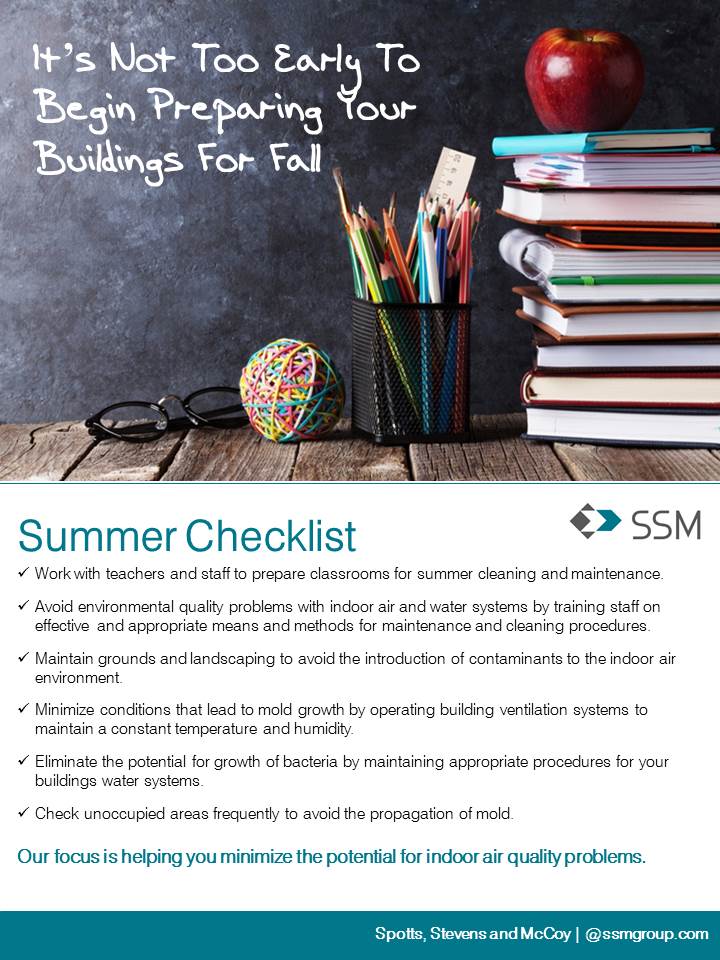
Now is the time to plan ahead to avoid typical last-minute problems like mold and legionella. Although the students are vacationing and the classrooms are empty, school buildings and grounds continue to be a busy place during the summer months. In addition to finalizing budgets and overseeing summer construction and renovations, it’s important to take proactive steps to avoid problems in the fall.
We recommend addressing the symptoms before they escalate into problems. Each year we are called to investigate various indoor environmental situations, many of which result in expensive clean-up costs. You can avoid many of those non-budgeted expenses by taking proactive steps during the summer months. A few suggested steps are included in our Summer Checklist.
Spotts, Stevens and McCoy has been providing services to schools for more than 70 years. Our focus is to help you minimize the potential for indoor air quality problems with a proactive approach for existing building and buildings under construction.
Summer Checklist
- Work with teachers and staff to prepare classrooms for summer cleaning and maintenance.
- Avoid environmental quality problems with indoor air and water systems by training staff on effective and appropriate means and methods for maintenance and cleaning procedures.
- Maintain grounds and landscaping to avoid the introduction of contaminants to the indoor air environment.
- Minimize conditions that lead to mold growth by operating building ventilation systems to maintain a constant temperature and humidity.
- Eliminate the potential for growth of bacteria by maintaining appropriate procedures for your buildings water systems.
- Check unoccupied areas frequently to avoid the propagation of mold.
Quality Air is Fundamental
Maintaining the highest levels of air quality is most important in healthcare facilities where occupants are most susceptible to irritants in the air. It is vital to maintain a sterile environment in health care facilities to prevent the spread of infection as well as the threat of exacerbating pre-existing conditions

The majority of an individual’s day is typically spent indoors which makes maintaining good indoor air quality essential to a person’s overall health. Fifty percent of all illnesses are either caused by, or aggravated by, polluted indoor air. Maintaining the highest levels of air quality is most important in healthcare facilities where occupants are most susceptible to irritants in the air. It is vital to maintain a sterile environment in health care facilities to prevent the spread of infection as well as the threat of exacerbating pre-existing conditions. Burn patients and patients with compromised immune systems are at the greatest risk for infection and demand the most stringent infection control measures combined with high indoor air quality.
Special precautions must be taken into account especially during construction projects to prevent infections from spreading as well as dust and other irritants contaminating adjacent areas. When undertaking a construction project in a healthcare facility, it is highly recommended to contract an indoor air quality specialist to provide indoor air quality (IAQ) oversight during construction activities. It is important to support construction projects with IAQ oversight in all applications within a healthcare facility due to air systems communicating with the entire building. If construction projects are needed in areas such as burn units, operating rooms, or any area where sterilization is vital, special precautions must be taken to assure the air quality is not compromised during the project. Infection control risk assessment (ICRA) measures must be taken and followed to varying degrees based on the sensitivity of the work area to maintain proper air quality and infection control. In areas of highest risk for infection, such as burn units and operating rooms, ICRA containments must be created and special work practices must be implemented.
ICRA Special Work Practices
- Isolate the HVAC system in the area where work is being done to prevent contamination of the duct system. Complete all critical barriers i.e. sheetrock, plywood, plastic, to seal area from non work areas or implement control a cube method (cart with plastic covering and sealed connection to work site with a HEPA vacuum for vacuuming prior to exit) before construction begins.
- Maintain negative air pressure within the work site utilizing HEPA equipped air filtration units. Seal holes, pipes, conduits, and punctures.
- Construct anteroom and require all personnel to pass through this room so they can be vacuumed using a HEPA vacuum cleaner before leaving work site or they can wear cloth or paper coveralls that are removed each time they leave work site.
- All personnel entering the work site are required to wear shoe covers. Shoe covers must be changed each time the worker exits the work area.
- A thorough sampling protocol must be created by an indoor air quality specialist to provide data that the work areas were properly contained and all construction generated particulates were being contained. Upon completion of the work in a contained area, an experienced industrial hygienist will perform a visual inspection and additional particulate sampling to confirm the area was suitable for re-occupancy. Through expert design of the sampling protocol and analysis of all data collected by the indoor air quality specialists, it can be definitively shown that the air quality was not compromised during the construction project. As always, the goal is to establish the highest level of indoor air quality to promote a healthy working environment as well as maintaining a sterile environment for patients to heal.

Protecting Your Workers’ Health and Safety
Workers exposed to hot indoor environments and/or hot and humid conditions outdoors are at risk of heat- related illness and injuries. Individuals performing heavy work tasks and/or using bulky or non-breathable protective clothing and other personal protective equipment (PPE) are at greatest risk to heat exposure.
Workers exposed to hot indoor environments and/or hot and humid conditions outdoors are at risk of heat- related illness and injuries. Individuals performing heavy work tasks and/or using bulky or non-breathable protective clothing and other personal protective equipment (PPE) are at greatest risk to heat exposure.
Even still, some workers may be at greater risk than others if they have not built up a tolerance to hot conditions, or if they have certain health conditions. It’s important to prepare workers for their duties in hot environments.
Workers who are suddenly exposed to working in a hot environment face additional and generally avoidable hazards to their safety and health. New workers and those returning back to work after a prolonged absence are especially vulnerable. All workers should be medically fit for the exposure as well as for the types of PPE they may need to use (such as respirators).
It’s vital to educate workers about the dangers of heat and the best ways to minimize its affects, to acclimatize workers to the hot environment and if possible, gradually increase the workload. One simple solution to help mitigate the risk of heat-related injuries is to allow employees to take more frequent breaks and encourage the consumption of water as good hydration is a critical part of their body’s ability to manage exposure to hot environments.
Many industries such as steel and iron foundries, shipyards, manufacturing facilities, power plants, and commercial kitchens generate substantial heat and/or require the wearing of PPE year round and it is important to make the working environment as safe as possible. In such environments it is most likely that heat is not the only work related hazard that workers are subjected to on a daily basis.
Hazards such as noise, mold, dust, and toxic welding fumes and organic solvents can multiply the risk for injury when combined with excessive heat. When air quality is compromised in a work environment, it is necessary for workers to protect themselves with proper PPE such as respirators, safety glasses, full body suits, hearing protection and gloves which will help shield them from the harmful aspects of the job. This protective equipment does not allow the worker to regulate their body temperature normally and can greatly increase the occurrence of heat related injuries. It is crucial to take preventative measures in an industrial environment to maintain proper indoor air quality so workers are not exposed to several hazards requiring “layers” of protection.
Due to certain industrial processes a hot working environment is unavoidable however controlling your indoor air quality is not. Combining hot working conditions with poor air quality and other hazards puts workers at a greater risk of heat related injuries as well greatly reducing productivity.