

Regulatory Update: America's Water Infrastructure Act of 2018
New Requirements for Drinking Water Utilities
On October 23, 2018, America’s Water Infrastructure Act (AWIA) was signed into law requiring community water systems serving more than 3,300 people to complete a risk assessment and develop an emergency response plan
Risk Assessments and Emergency Response Plans
New Requirements for Drinking Water Utilities
On October 23, 2018, America’s Water Infrastructure Act (AWIA) was signed into law requiring community water systems serving more than 3,300 people to complete a risk assessment and develop an emergency response plan
RISK AND RESILIENCE ASSESSMENT REQUIREMENTS
Applies to each community water system serving a population of greater than 3,300 persons.
Requires an assessment of the risks to, and resilience of, its system.
Elements of the Assessment:
The risk to the system from malevolent acts and natural hazards.
The resilience of the pipes and constructed conveyances, physical barriers, source water, water collection and intake, pretreatment, treatment, storage and distribution facilities.
The cyber security of electronic, computer and other automated systems which are used by the system.
The monitoring practices of the system.
The financial infrastructure of the system.
The use, storage, or handling of various chemicals by the system.
The operation and maintenance of the system.
The assessment includes an evaluation of capital and operational needs for risk and resilience management for the system.
EMERGENCY RESPONSE PLAN REQUIREMENTS
Applies to each community water system serving a population of greater than 3,300 persons.
Requires an emergency response plan that incorporates the findings of the assessment within 6 months of certifying completion of its risk and resilience assessment.
Elements of the Response Plan:
Strategies and resources to improve the resilience of the system.
Plans and procedures that can be implemented, and identification of equipment that can be utilized, in the event of a threat to the ability of the community water system to deliver safe drinking water.
Actions, procedures and equipment which can prevent or lessen the impact of a malevolent act or natural hazard on the public health and the safety and supply of drinking water.
Strategies that can be used to aid in the detection of malevolent acts or natural hazards that threaten the security or resilience of the system.

We can help.
Spotts, Stevens and McCoy has the experience to assist you in assessing your system and preparing your response plans.
FOR MORE INFORMATION
Dan Standish, Sr. Operations Specialist, Water and Wastewater Engineering

Baby It's Hot Outside!
This month we tip our hats to mechanical engineer Willis Haviland Carrier and celebrate the idea that helped make those long, hot days a little more comfortable: air conditioning.
Oh those lazy days of summer . . . The longer days filled with trips to the beach, cookouts with garden-fresh vegetables, and evenings in the park. This month we tip our hats to mechanical engineer Willis Haviland Carrier and celebrate the idea that helped make those long, hot days a little more comfortable: air conditioning.

Weightman Hall was originally constructed as a field house. It houses offices of the Penn Athletic Department and the Penn Sports Medicine Center.
Ventilation Study at the University of Pennsylvania
SSM completed a study to provide options to ventilate the “attic” space of Weightman Hall. The space contained two air conditioners discharging hot condenser air into the space. The existing ventilation of this space was not sufficient to remove the heat leading to an increased load on the air conditioners and decrease in performance of the units which are rated at ambient temperatures of 95 degrees F. Temperatures in the attic space were believed to exceed 120 degree F.
SSM explored options to ventilate the space housing the air conditioners to provide a satisfactory ambient condition or modify the installation to mitigate the impact of being installed in an interior space. SSM mechanical engineers surveyed the site and documented existing conditions including several existing and apparently abandoned duct systems in the vicinity of the air conditioners and the space in which the units are housed and the surrounding areas in sufficient detail to develop ventilation options. The final report included three options for creating a satisfactory environment for the operation of the air conditioning units and budgetary construction costs for each scenario.
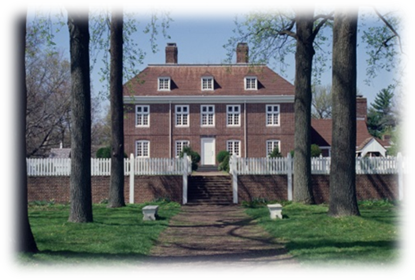
Pennsbury Manor is a historic recreation of William Penn’s 17th century estate, it is located along the Delaware River and open to the Public for tours. There are several other buildings located on the 43-acre property including a Visitor’s Center, and the Crozier House which is currently used as office space.
Exploring Alternative Technologies for Cooling Historical Structures at Pennsbury Manor
Known as “William Penn’s Country House”, Pennsbury Manor includes several buildings recently included in a design project to replace and upgrade existing HVAC systems on the campus with geothermal systems. Working closely with the Department of General Services and The Pennsylvania Historical and Museum Commission, the multi-discipline mechanical, electrical, and hydrogeology staff of Spotts, Stevens and McCoy, along with architectural and archaeological partners took on the challenges often presented by similar historic and sensitive structures. Outdated HVAC, plumbing and electrical systems are common limitations that can be resolved with innovative application of new technologies. SSM designed the HVAC systems within the buildings, electrical and plumbing systems in support of the HVAC system design, coordinated with Agency Fire and Security and Controls consultants, and developed a preliminary construction phasing plan for the project. In addition we analyzed the assessment reports and developed a preliminary abatement plan.
The Manor House – It was imperative for the mechanical system to integrate with the existing architecture. A whole house ventilation system was designed to attempt to improve the indoor environment during the cooling season. Geothermal water source heat pumps were located in the basement to draw outdoor air into the building and supply it through floor registers at existing chases. The air was then exhausted by fans located in the attic space. A geothermal boiler was also installed to replace two electric boilers. The geothermal boiler and geothermal heat pumps used an open loop ground system to transfer heat to and from the ground water.
The Visitor’s Center – The open loop system was also used at the Visitor’s Center. The existing system consisted of an air-cooled chiller, a gas boiler, fan coil units, and DX air handling units. The existing chiller was replaced with a geothermal heat recovery chiller. The chiller is capable of making heating water and chilled water simultaneously so there is no longer a need for the existing oil-fired boiler. The existing DX cooling coils and electric heating coils were replaced in the air handling units and fan coil units so the entire system can run off the new geothermal heat recovery chiller.
The Crozier House – The existing heating system at the Crozier House was an oiled-fired boiler with radiator units located throughout the space. There was no existing air conditioning system. The new mechanical system design is a VRF system that will be able to provide heating or cooling simultaneously to each space.

Let Your Nerd Flag Fly
Mr. Zip was introduced in 1963 as a way of acclimating Americans to the new Zip Code System.

Mr. Zip was introduced in 1963 as a way of acclimating Americans to the new Zip Code System.
Fifty years ago, on July 1, 1963, the United States Postal Service (USPS) introduced the Zone Improvement Plan Codes, more commonly known as ZIP Codes. Aimed at providing a more efficient way of sorting through billions of pieces of mail each year, ZIP Codes were created in order to divide the country into coded delivery zones. From 1943 to 1963, annual mail volume had doubled to 66.5 billion pieces. Today, On average, the Postal Service processes 20.2 million mailpieces each hour, 336,649 each minute and 5,611 each second.
With the fiftieth anniversary of the ZIP Code, the Office of the Inspector General at the USPS has released a paper exploring ways to improve the ZIP code, “both to save postal costs and to enhance the opportunity for third party innovators to discover new uses and applications.” Check out the “The Untold Story of the ZIP Code”, the executive summary recommends linking the USPS address database with GIS to create a more efficient ZIP Code system.