
PROFILE | Splitting Edge Axe Throwing
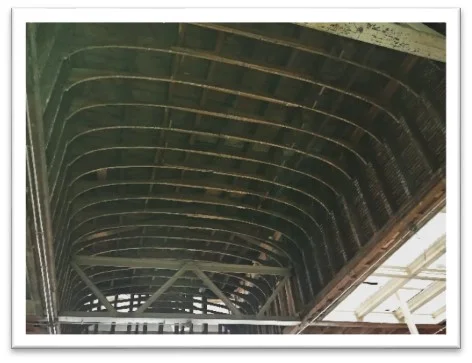
Axe Throwing - SSM was involved in a renovation project to structurally evaluate the existing roof structure for support of new units for heating and cooling the axe-throwing space.

The roof is original to the building and dates to the late 1800s, when steel was just becoming a common material for roof construction.
PROJECT PROFILE
Splitting Edge Axe Throwing
SSM was involved in a renovation project to structurally evaluate the existing roof structure for support of new units for heating and cooling the axe-throwing space. The roof structure is composed of wood framing supported on riveted steel trusses. The roof is original to the building and dates to the late 1800s, when steel was just becoming a common material for roof construction. When the building owner opted to support the units along the centerline of the building, SSM developed the structural design drawings for a new steel frame to be supported on the existing steel trusses. SSM then verified that the existing trusses were capable of supporting the added weight.

Check out the venue: https://www.splittingedgeaxethrowing.com/

Floodplain Restoration Can Reduce Stream Temperatures for Optimal Aquatic Health
Cold water streams provide excellent fish habitats. Unfortunately many streams in southeastern Pennsylvania run too warm to support fish hatcheries. Since most streams in agrarian areas lack sufficient vegetative buffer, tree planting programs are a common practice to stabilize stream banks and provide much needed shade to cool water temperatures.

Cold water streams provide excellent fish habitats. Unfortunately many streams in southeastern Pennsylvania run too warm to support fish hatcheries. Since most streams in agrarian areas lack sufficient vegetative buffer, tree planting programs are a common practice to stabilize stream banks and provide much needed shade to cool water temperatures. While tree planting is fairly easy and relatively inexpensive, the efficacy is limited. Great effort is required to protect the young saplings through the long time required to reach maturity. All too often a storm flood event washes away the saplings before the roots structure has had time to establish. The next season, a fresh round of tree planting starts anew.
But what if there’s a better way to return a stream to its natural state, resulting in consistently lower water temperatures, better vegetation and biological survival rates, and improved stormwater management? This is the question LandStudies, a Lancaster County firm dedicated to solving modern environmental issues with natural sustainable solutions, has been attempting to answer with their stream restoration projects.
A recent LandStudies project along Kurtz Run in Lancaster County serves as an example of the work they’ve been doing, which involves grading of the floodplain by removing legacy sediments which have been deposited in the original floodplain over decades, and many times, centuries. After grading, a new stream channel is established, natural in-stream structures for stabilization are installed, and wetlands are created. By comparing pre- and post-restoration daily maximum temperatures, LandStudies was able to determine that this method of floodplain restoration significantly reduced the effect of solar radiation on the temperature of the stream, much more-so than traditional tree planting “restorations.”
The reason this method of restoration is so successful in reducing stream temperature, is that by grading the floodplain and removing legacy sediments, the surface water of the stream is being reconnected to the cooler groundwater of the bedrock aquifer, below; whereas, in its pre-restoration state, the streambed was disconnected from the groundwater aquifer by sediments and debris. This enhanced surface-groundwater interaction is referred to as hyporheic exchange, and would have been how the stream operated naturally, before the land was settled and cleared for development and agriculture.
In addition to lowering water temperatures, this method broadens the floodplain, creating more gently-sloped surface area over which the stream can expand during heavy rain events, instead of rushing down a narrow channel. This reduces area flooding, erosion of the stream bank, and sedimentation in the stream, while increasing its capacity to take on rain and stormwater. The cooler, more stable stream characteristics are favorable to vegetation and other organisms, such as fish, allowing these ecosystems to better survive and thrive in the restored stream and floodplain.
Beyond its many ecological benefits, floodplain restoration projects provide communities with a way to address MS4 issues, protect drinking water supplies, recharge groundwater aquifers, and enhance green infrastructure.

Electric Vehicle Charging Rebate Program
The Pennsylvania Department of Environmental Protection (DEP) has introduced a program to make rebates available to businesses, governments, and other entities that install electric vehicle charging stations on their properties.

The Pennsylvania Department of Environmental Protection (DEP) has introduced a program to make rebates available to businesses, governments, and other entities that install electric vehicle charging stations on their properties. The Wolf Administration has developed the new rebate program under the Driving PA Forward initiative.
The program opened in September 2018 and is designed to improve air quality in Pennsylvania and drive transformation from older, polluting diesel engines to clean technologies. Through this program, Pennsylvania’s goal is to permanently reduce NOx emissions by as much as 27,000 tons.
The Level 2 EV Charging Rebate Program will accomplish this goal by spurring widespread investment in EV charging infrastructure across Pennsylvania. The program is funded through Pennsylvania’s allocation from the State Mitigation Trust, and will make $7.7 million available over a 5 year period.
Businesses, nonprofit organizations, and government at various levels can apply for rebates after they have installed the equipment. Rebates will be provided either as a maximum dollar amount or as a percentage of project costs, whichever is less.
Details on the program and grant application forms can be found at: www.depgis.state.pa.us/DrivingPAForward
Eligible Applicants
Those eligible for the program include:
businesses incorporated in Pennsylvania
incorporated nonprofits
state, local, or tribal government agencies
air quality or transportation organizations
metropolitan or rural/regional transportation planning organizations
federal government agencies
Ineligible Applicants
Those organizations that are not eligible for the program include:
businesses that are not incorporated in Pennsylvania
individuals
Eligible Locations
Publicly accessible government-owned property
Publicly accessible non-government owned property
Workplace property accessible to employees but not publicly accessible
Multi-unit dwelling property accessible to resident but not publicly accessible
