

Celebrating a Decade of Source Water Protection
SSM is celebrating 10 years of working in conjunction with DEP and Community Water Systems to protect drinking water through the SWPTAP.
Clean and sustainable drinking water is an essential element of the quality of life for any community.

The Source Water Protection Technical Assistance Program (SWPTAP) was created by the Pennsylvania Department of Environmental Protection (DEP) to help community water systems protect their drinking water.
SSM is celebrating 10 years of working in conjunction with DEP and Community Water Systems to protect drinking water through the SWPTAP. Recently the DEP renewed the program and awarded SSM a SWPTAP 5-year contract extension.
SWPTAP is a voluntary program designed to keep drinking water sources clean by eliminating harmful contaminants from the source water. For the community water provider, SWPTAP has economic benefits such as reducing water treatment costs, andreducing the burden of engineering controls to keep drinking water clean. The Program also provides environmental benefits such as clean water for sustaining native ecosystems.
The Source Water Protection Program was initiated in 1996 through federal law emanating from the Safe Drinking Water Act (SDWA). While the initial SDWA focused on water quality at the tap, protecting drinking water sources provides another important layer of protection. Source water protection plans are custom-tailored to accommodate water providers that serve large cities, and also to small systems that serve less than 50 people.
The Environmental Protection Agency (EPA), the main agency responsible for implementing the SDWA, views Pennsylvania’s SWP Program as a leading example for other states to follow.
SWPTAP Highlights
- 3.9 million Pennsylvanians are served by SWPTAP Plans
- SSM has worked with over 300 community water systems
- Protecting source water has direct ties to the helping regulated MS4 stormwater communities
- Grassroots efforts are developing by partners such as County Planning Commissions, County Conservation Districts and watershed organizations throughout the Commonwealth

One Region’s Approach to Water Quality
The River Alert Information Network (RAIN) is serious about water quality in Western Pennsylvania and Northern West Virginia! RAIN is a collaborative effort from dozens of public water supply systems in the Allegheny River Basin, Monongahela River Basin, Beaver River Basin, and the first 36 river miles of the Ohio River.

Adapted from the River Alert Information Network website
The River Alert Information Network (RAIN) is serious about water quality in Western Pennsylvania and Northern West Virginia! RAIN is a collaborative effort from dozens of public water supply systems in the Allegheny River Basin, Monongahela River Basin, Beaver River Basin, and the first 36 river miles of the Ohio River. These systems have banded together to develop regional Source Water Protection Plans in their watersheds, and are implementing shared management strategies to reduce pollution flowing to their water intakes.
RAIN's mission is to serve the public by creating an Early Warning (Spill Detection [EWSD]) System in the Ohio River Basin to address public health issues, watershed protection, and environmental accountability. One key strategy is the proactive water quality monitoring currently conducted by several of the member systems.
All of the RAIN monitoring sites monitor for specific conductance and pH. Conductivity measures how well water can conduct an electrical current (and provides an estimate to the amount of total dissolved solids (TDS) in the river); pH is an indication of the alkalinity or acidity in the river. Water acidity can be increased by acid mine discharges, industrial discharges, and acid rain. Some RAIN sites also monitor for additional water quality parameters, such as turbidity and/or dissolved oxygen, and RAIN plans to expand the parameter list to include organics, bromide, oil and diesel fuel.
Check out RAIN’s new interactive map that shows how and where RAIN monitors the rivers from which most of the region’s drinking water is taken. The map allows the user to see the water data collected in near real-time, and informs the user about general water quality data and the water resources used by public drinking water systems. Access the map on RAIN's website.


Ten Things that help Protect our Water Quality
National Water Quality Month reminds us to take a long, hard look at what our household and community are doing to protect sources of fresh water.
- Don’t use antibacterial soaps or cleaning products when regular soap and water will do the trick. Much of the antibacterial soaps contain a registered pesticide that is known to harm marine life.
- Don't overuse pesticides or fertilizers. Many fertilizers and pesticides contain hazardous chemicals. These can travel through the soil and contaminate ground water.
- Properly dispose of prescription medications. Don’t flush unwanted or out-of-date medications down the toilet or drain. Your local health department can provide information on proper disposal.
- Properly dispose of hazardous products. Don't dump hazardous waste on the ground; it can contaminate the soil, which could also contaminate the ground water or nearby surface water.
- Find a watershed or wellhead protection organization or a source water collaborative in your community and volunteer to help. Help pick up litter on the streets that could end up going down the storm drain or seeping into our waterways.
- Choose nontoxic household products when possible, and take old or unused household hazardous waste to a local collection event. Many counties and communities provide free disposal.
- Pick up after pets.
- Use a commercial car wash - cleaning your car at home flushes dangerous chemicals down the storm drain and directly into our lakes and streams.
- Fix leaks that drop from cars and put liners in driveways to collect oil and other materials.
- Use rain barrels to catch rain water from your roof. The water collected can be used to water garden plants.

Industrial Wastewater: Make the Problems Go Away
In industrial settings, the goal in addressing wastewater problems is precise and concise: make the problems go away.
In industrial settings, the goal in addressing wastewater problems is precise and concise: make the problems go away. Dealing with wastewater problems has little to do with the production of your product. And yet it has everything to do with it; because the smallest wastewater problem can disrupt production and cost you money. Our engineers and environmental scientists understand your industrial wastewater problems. We know you are seeking the right balance between cost-effective solutions and impacts on production. We have a proven track record for swift and cost-effective solutions. Chances are we’ve seen the problem before, and know what to do about it. We look at the entire system for process, pretreatment, and maintenance alternatives. We identify opportunities to eliminate or reduce the wastewater stream at its source, and deliver the solution that balances the needs of the system and the bottom line.
Expertise
- Planning and Engineering
- Treatment and Process Control
- Architectural Engineering
- Collection Systems
- Pump Stations
- Operations and Maintenance Manuals
- Permitting and Regulatory Assistance
- Financial and Grant Application Services
Inaugural Drinking Water Day
On September 27, 2017, the Eastern Lancaster County (ELANCO) Source Water Collaborative (SWC) will hold its Inaugural Drinking Water Day in Terre Hill, PA.

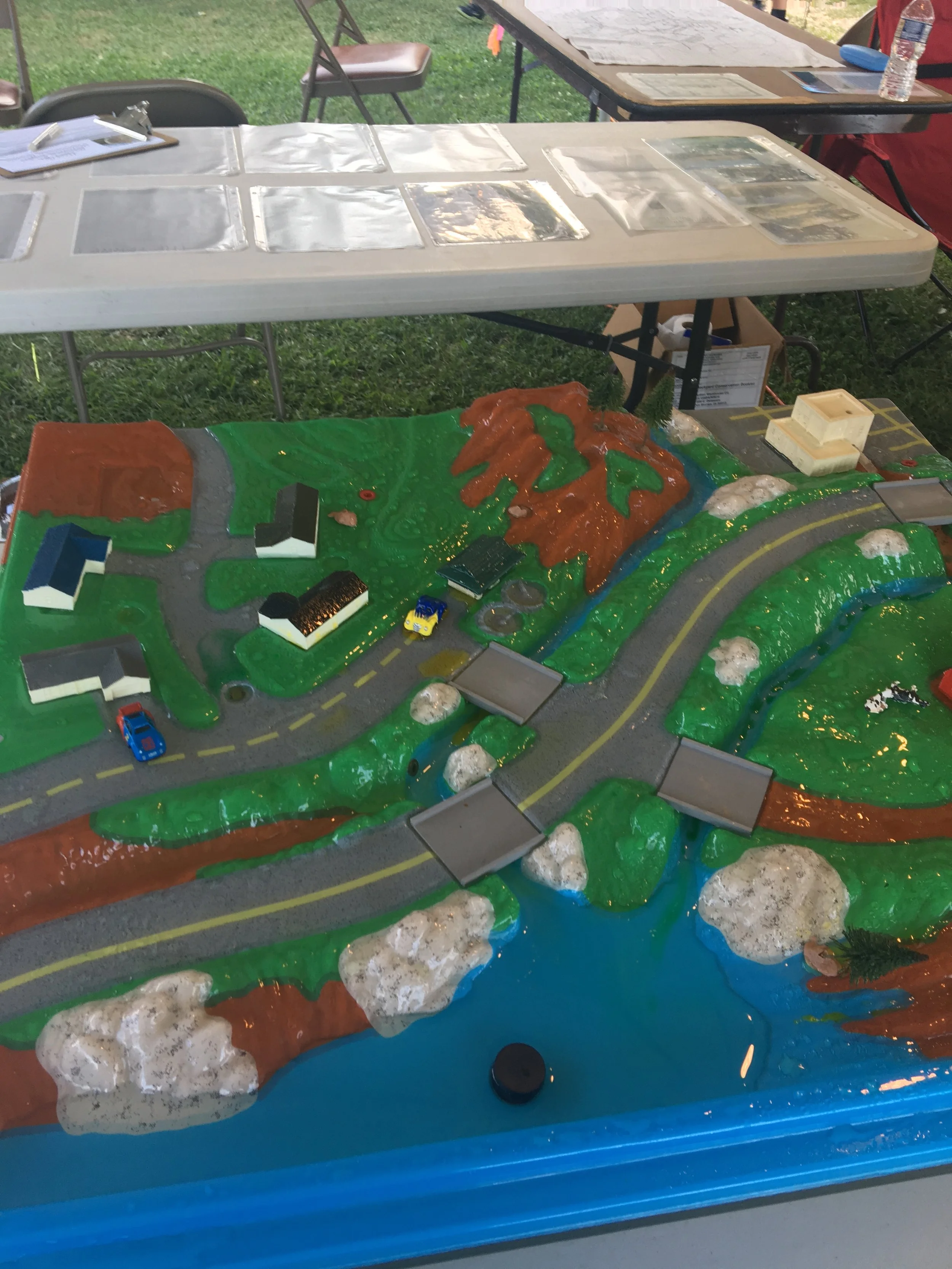
Darrell Belz demonstrates the groundwater model at Terre Hill Days
ELANCO Source Water Collaborative
On September 27, 2017, the Eastern Lancaster County (ELANCO) Source Water Collaborative (SWC) will hold its Inaugural Drinking Water Day in Terre Hill, PA. The event will be split into two sessions; a morning session geared towards school-aged children, and an evening session for adults in the community.
The morning session will feature several educational booths, where school children in the community can learn about where their drinking water comes from, and how it can be protected from contamination. Elementary school children in the public school system, and children who attend school in one-room school houses throughout the region are invited to attend.
The focus of the evening session of Drinking Water Day is a private well water testing opportunity, where members of the community can bring their well water to be tested by Penn State Extension.
The ELANCO region is mostly rural, heavily agricultural, and has a large Amish and Mennonite community. A large portion of residents rely on private wells for household and drinking water.
The ELANCO SWC is an effort consisting of local, state, federal, public, and private organizations, whose goal is to implement source water protection strategies in the ELANCO region. They focus on implementing strategies which reduce pollutants, especially nitrates, in local drinking water sources. SSM has been a collaborative partner since 2012.
The group has been hugely successful in reaching out to the community in their educational efforts, and adding a Drinking Water Day to these efforts will add an interactive element to their educational techniques.